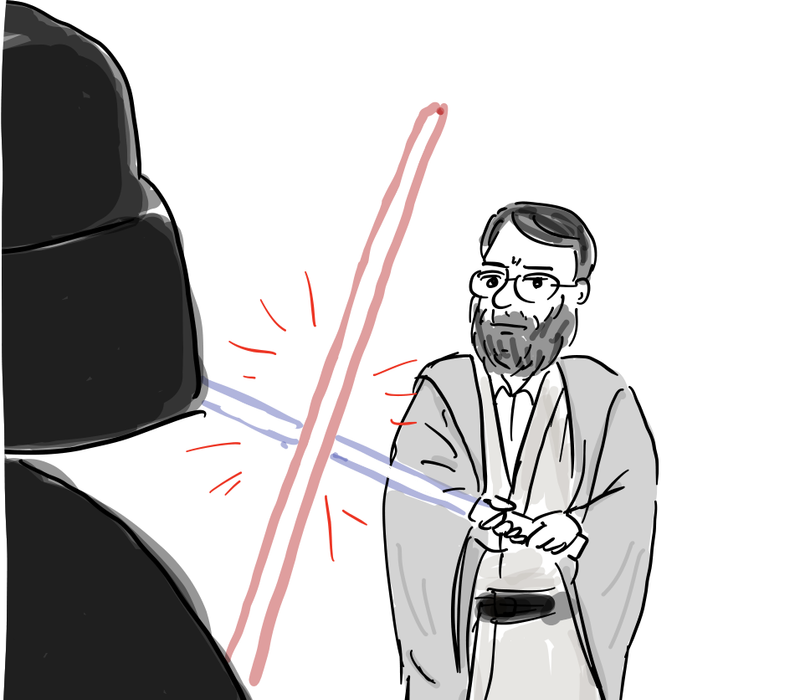
The struggle for freedom: How BSD escaped AT&T licensing
fosscomics.comIt's worth pointing out that BSD prevailed, despite working directly with a copy of AT&T's source code. A clean-room rewrite is a great way to reduce chances of a nuisance lawsuit, but in no way needed to comply with copyright law.
Yes and no. The case was settled; no legal precedent was set.
And the period of legal uncertainty did a great deal of damage to BSDs popularity.
Always wondered about that. Seems like BSD licensing would be more attractive today, yet Linux prevails.
Lingering legal uncertainties were almost certainly one issue.
Fragmentation and not always the most welcoming of communities was another.
BSD would probably have won out in the absence of Linux. (We'll leave Windows out of this discussion.) But the Linux community, early-on commercial distros, the endorsement by IBM, and various other factors help cement Linux's position.
Permissive licenses have increasingly won out over time but Linux had the momentum with respect to operating systems by then.
Honestly, thank god for it! I don't think that we would have had the technological strides we have had if companies were not forced to share alike to comply with the GPL.
If everyone would have switched to BSD for stability (?? not sure how it was compared to Linux circa 93 to 95) or whatever -then Windows would have eaten everyone's lunch.
I think it's as much a religious argument as it is a speculative historical one. The BSDs have not failed to innovate nor gain a userbase despite Linux's popularity and the permissive license.
The landscape would probably look very different if the preeminent FLOSS OS was BSD rather than GPL, but I'm confident it would be thriving in its own way, just as the BSDs are now.
But they did determine that only a few files were infringing.
Why is one of the characters so featureless compared to the others? The one with just some eyes and hair strands.
That character is a time traveler who narrates this story.
Any serious advantages nowadays running BSD over Linux (desktop or server)? I seem to remember once upon a time BSD networking being way ahead of the pack but it seems like Linux has caught up in a major way, and honestly running BSD-linux-ports to get up-to-date drivers and a desktop environment running is just f'ing ugly.
It is largely what you are used to. But I really like openbsd as a desktop system, I run it as a slim no-frills traditional unix desktop(lots of terminals, simple tiling WM) everything is simple(not user friendly, but simple) and I feel I understand and am ahead of the system at all times. Heavy desktop environments and linux are fine, they are still good guys compared to windows, but the complexity starts making me feel like I am loosing control of my system.
Aside from my weird fetish for how I like my desktop. I think where openbsd really excels is in the boring infrastructure department, minor low intensity services that keep stuff running in the background with no surprises, this is nothing that linux can't do, and if you are more familiar with linux go with that, but for stuff like a departmental or home level name servers, web servers, routers, mail servers, etc openbsd has close to zero fuss and drama and is fairly pleasant to sys-admin the old-fashioned way.
OpenBSD feels like a much more coherent operating system, and makes Linux feel like a Rube Goldberg machine in comparison.
Also the docs (man pages, mostly) are top notch.
Lower attack surface, lower CPU usage, lower RAM usage.
> Lower attack surface
Once you install all the crap you need, it doesn't matter.
> lower CPU usage, lower RAM usage
Irrelevant for actual working loads which dwarf whatever the kernel/OS require.
> Once you install all the crap you need, it doesn't matter
It does matter though. Have you not seen all the critical exploits in the Linux kernel these days?
> Irrelevant for actual working loads which dwarf whatever the kernel/OS require.
That depends on the workload. What if you're on an embedded system where CPU/RAM resources are scarce? Or what if your machine is a server host and you want to run hundreds or even thousands of lightweight VMs?
This is the final part of the BSD Unix story.
The series was a fun read. Thanks for making it!
What do you mean by 'final'?
This is the sixth episode of the BSD Unix story, and the final episode of the series.
What about 386BSD and all the other BSD variants that spawned in the early to mid 90s?
I'm working on a 386BSD episode, but that's a separate story because it was created by different people.
Wasn't OS X the final part of the BSD Unix story?
NeXT Step was derived from both BSD and Mach, which somewhat became OS X when Jobs came back to Apple.
There is also A/UX, an Apple UNIX derived from BSD.
However, isn't the BSD story still going? Or were you only regarding history?
A/UX was actually system V.2/3 with BSD networking bolted on
(at the time the US govt required that systems be able to run Sys V in order to be able to tender for govt contracts)
NeXTSTEP has no space (and STEP is in all caps)
And the start of the BSD Linux(-like) story.
https://fosscomics.com/posts/16.%20BSD%20Unix%20Part%206%20-... <-- Really bro? Wow, lol.