Raspberry Pi Zero 3W and Pi 4 Model A spotted in device trees
bret.dkI really hope they can keep the cost down, it needs to be in the "it's so cheap just hack on it" price range for not just engineers but kids too. I'm excited to see low-cost hardware put in the hands of kids with LLMs in their sails.
I've personally stopped believing we will ever return to a world where anything computer isn't at extortionist nosebleed prices as if they're made by Patek Philippe.
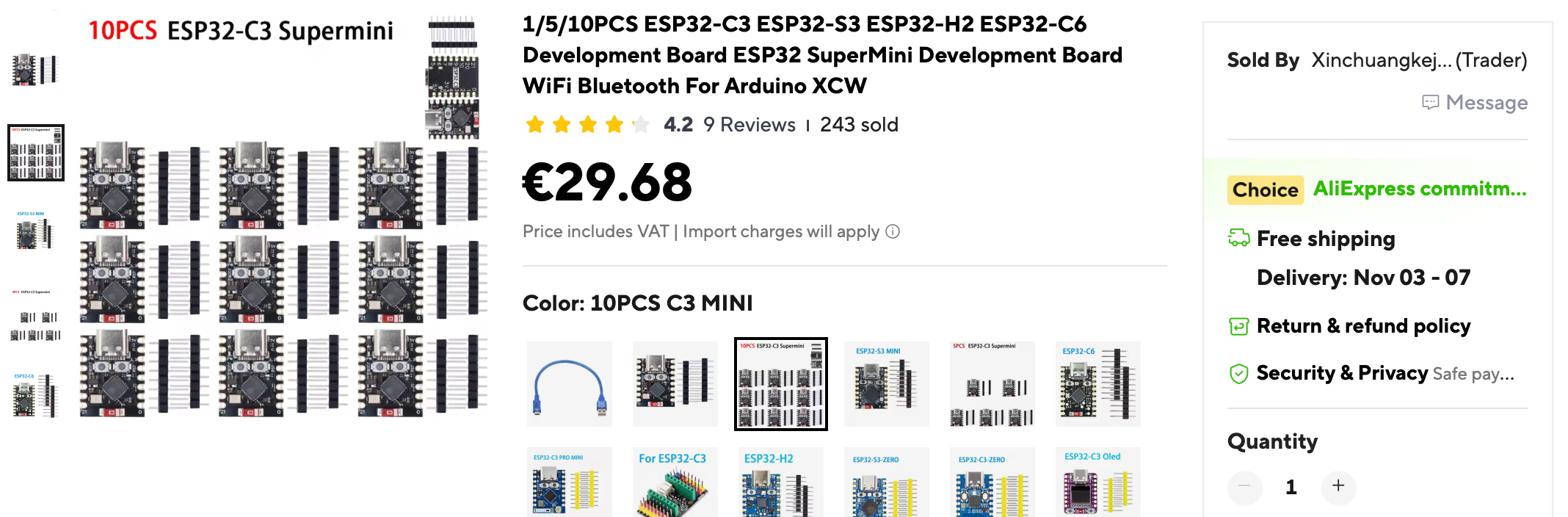
An ESP-C3 costs about £1.50 and runs my terrarium automation with web portal for data logging and scheduling
This is the way forward these days. In my opinion the situations in which a Raspberry Pi is the right answer are vanishingly small these days - for interacting with physical things like relays or LEDs use an ESP or similar, run Micropython on it if you're not into writing C and the like, or ESPHome if you want something dead simple.
If you need an actual computer there are so many options along those lines now, and almost all of them are better than a Raspberry Pi in various aspects. Finally, if you just want to put some stuff on a screen then most TVs already have an operating system and a web browser on them, target that and you can get rid of the computer dangling off the back entirely.
Where can you get a EPS-32 for 1,50, with shipping, taxes and duties included?
Because in the EU whether it's amazon or AliExpress, the cheapest I can get one now would be 4,50 Euros a piece, and that's only if you buy them in bundles of two or more.
Or is it that the UK lacks the lunacy parcel taxes and duties of the EU so things are much cheaper over there?
The bare SoC you can get for ~1.20€ in Germany:
https://www.reichelt.com/de/en/shop/product/esp32-c3_soc_wif...
But even paying 5-30€ for a devkit still seems insanely cheap to me; that's like several bars of chocolate at current prices, even kids can afford that (or make someone buy it for them).
There's no escaping the fact that EU fucked the hobbyists that previously were able to ship stuff not even made or available in EU at sane prices from china. I f I were to buy things I did in last 12 or so years based on current rules, I'd pay like 200% on customs/taxes and bullshit charges like 3+EUR per made up category on invoice or whatever it's now.
Hopefully, it will put a downwards price pressure on middlemen/resellers, now that buying directly is prohibitively expensive.
>There's no escaping the fact that EU fucked the hobbyists that previously were able to ship stuff not even made or available in EU at sane prices from china.
EU doesn't care about hobbyists, it cares about protecting the interests of the monopolies of the major retailers who lobby the politicians, who disliked that people could order the same Chinese shit they sell at 100x markups, directly from China, and cutting them off as middle-men.
But don't worry, in their heads, this way we'll get to on-shore our HW/electronics manufacturing industry back. Any day now. I can already see the factories pumping out ESP32s "Made in the EU", popping up everywhere across the EU, creating jobs and a competitive electronics industry. Alarm clock buzzes
>bullshit charges like 3+EUR per made up category
Add 2€ to that for the new handling fee from 1st November onward.
It would be cool if the EU would also find ways to add value to the economy, instead of just adding more taxes that extract value from it.
>The bare SoC you can get for ~1.20€ in Germany:
Obviously, in the context of hobbyists at home, we were talking about the ESP32 SBCs, and not the bare solderable chips themselves.
>But even paying 5-30€ for a devkit still seems insanely cheap to me
Yeah but I wanted to know if the 1,50 price is realistic since it's quite a big difference, 200%+, between those two price ranges.
If price differences didn't matter for hobbyists, then Arduino wouldn't have been killed, and ESP32 taken over the world.
Clearly both people and businesses are highly price sensitive, especially in the current economy.
>that's like several bars of chocolate at current prices, even kids can afford that (or make someone buy it for them).
Needless whataboutism straying from my point, as with such line of reasoning, you can justify anything that's bad: "Getting punched in the balls isn't so bad, because you could always get cancer which is much worse."
Not exactly £1.5, but you can get them just under €3.0 shipped (with duty etc) to EU when ordering a bundle of 10 on Ali.
In November last year I could still buy them for €1.57 each.
>In November last year
A lot of things have changed since then: EU taxes and duties, AI-induces HW shortages and price hikes. For example RPI prices today are untenable compared to a year ago.
That's why I asked about the prices of today. Whatever people paid in the past, is not necessarily applicable anymore.
Prices seem about the same here with delivery. I have not yet checked very extensively though.
OT but I would love to see your terrarium build!
Yeah! Let's see that!
The prices will come down eventually, even if not all the way down.
But I'd be more concerned about computing staying open in general - not only as open source but at least open and accessible standards, interfaces, open to individual development, open to tinkering.
I see a concentrated push from almost all sides to lock down any platform, lock the hardware and build black box devices, lock the software under layers of attestation and certifications, all in the name of "security". I use the quotes because I don't believe security is the top concern, or even a concern at all, it's about taking the control away from users.
For now the open-computing world is still bustling and accessible but the intention to curtail this is there, with technical or legal measures.
It is a cycle, and one may bet millions of annoyed nerds will invent something other than ddr dram... after all they always have in the past.
Blitz-scaling LLM for fictional future revenue assumes competing technology will remain immutable. It is a false premise with dire consequences for the credulous.
China is already filling the vacuum within the flash/ddr/cpu/gpu market, and quality/speed will rapidly improve with domestic use. We are already seeing blank label storage clones emerging in international markets. =3
Right now, I think the sweet spot is getting a Raspberry Pi 400 for USD$50 ( Microcenter).
A Pi400 is a very capable 4GB ram Linux machine, working out of the box. I have a few, each doing a different job. I just ssh to them with a beefier machine plugged on LLMs tools, and it's really fun and exciting.
Then Mini pcs, you can get a good deal here and there, for a more capable machine with a little bit more flexibility.
ESP32s are also awesome and I have been playing with them but not as a replacement of these light linux servers.
Was at Microcenter, yesterday.
Marietta's did not have any Pi400s for sale (I love mine, with its built in keyboard; it is my main Kali hackbox) but did have lots of Pi5 (4gb was ~$100 IIRC; 1gb was ~$40).
I've picked up two 7" touchscreens, which seemlessly integrate into any Pi project (mine are both now installed on Pi 3b+ PiHoles, to display realtime DNS traffic 24/7); if you buy the returned/open-box, each screen is less than $50 (no more fumbling for HDMI cables).
----
Unrelated: the RTX5070Ti (purchased May 2026 for $999) is now $1449! The 5060 (purchased July 2026 for $329) is now $459; no 5090 in stock (of course).
A few, that's 3 to me so what kind of jobs are they doing? I'm always interested in this stuff but never know what my use case would be. Can you explain what I'm missing?
The most amazing thing about the Zero was that it was 5€
Even at 10€ it was tantalizing. Please, give us something in that price range.
> Even at 10€ it was tantalizing. Please, give us something in that price range.
A few years ago we could get our hands on a Orange Pi Zero, with wifi, Ethernet, and 512MB of RAM, for less than $10. I think I bought mine for slightly over $5.
Now they sell for a tad over $30. What a shame.
We now have the ESP32 line of microcontrollers. That should scratch some of the itches.
Are they as well supported as the RPi? I heard software support was bad compared to the Raspberry Pis
Your best option is to look into Armbian (https://armbian.com/) for these, they do the Lord's work when it comes to making sure these alternatives aren't destined to be ewaste when vendors abandon them. I'd say Radxa are probably in 2nd place after Raspberry Pi when it comes to support, but Armbian still makes that a lot better.
They are two different things. You're not running a full blown Linux OS on the ESP32. But many of the simple projects people used the Pi for can be done with the ESP32.
Is that a change in the valuation of the pi or of the dollar?
Covid shortages and RAMageddon changed the valuation.
> Is that a change in the valuation of the pi or of the dollar?
I believe that revenue maximization plays a role. So it's inflation in a way, but not the kind where bom costs are forwarded to consumers.
The dollar had just over 30% inflation since the start of COVID. But not all prices increased equally, for anything with RAM or NAND they skyrocketed in the past year.
Got mine for circa $7 a few years back. Absolutely best tiny computer I ever had. It sips power, and is rock stable for me. Only one issue: it doesn’t reboot for some reason, it shutdowns. I can tolerate that for $7. Apart from that, I’m very happy with that tiny beast. Got three of them. And at that price, I’d buy 10 more and give them for free for friends, already setup with some services. I just hope they’d go really cheap at some point, once the bubble bursts or something.
raspberry pi has turned into a rich nerd “gotta collect them all” scheme, not a cheap entry level computer for young hackers.
That's what esp32's are for. $5 and uses fuck all power.
Those are entirely different operational models.
While people do often use pis to do things you could do with an esp32, an ESP32 cannot do the majority of things a Pi can do.
Over time the Raspberry Pi use case shifted more and more away from GPIO. They all still have it but probably most of them are used as a Linux computer without ever touching the GPIO now. The people who do use GPIO on a Raspberry Pi are often better off using an ESP32 because they have better control of GPIO, consume far less power, and are actually cheap.
Personally I use ESP32s for GPIO to control things around the house and have one Raspberry Pi acting as a hub.
I've been doing home electronics projects since around 2013, I used to use Raspberry Pi's for everything from lighting control to robots, camera projects and lots in between (I even had a mechanical keyboard with a Pi inside) and a massive collection of hats and addons. These days, I can do 99% of what I need with tiny little ESP32 variant boards for a fraction of the cost and significantly less complexity. Hell, you can even get esp32's with really nice touch screens attached for dashboards / animations. I built a whole cyberdeck using an ESP32 and no computer in-sight.
their RP1 IO chip is such a disappointment for high performance GPIO use cases as well, literally can’t trust any IO decision they make after having hacked on that chip
The full size Pi has less and less of a niche. GPIO / low power edge? ESP32s are great. Signage? The pi isn’t really all that great, and is expensive, get a cheap N100/150. Hacking on Linux? Literally anything else.
In many cases that’s an advantage. Tiny (or no) attack surface, less power, etc
The attack surface maybe smaller but less eyes on the firmware images for sure.
At least most my ESP32s are off any net, and pretty low stakes applications.
There is some overlap, see FUZIX for the RP2040 for example.
Most of the time it's some UART or BT proxy for me, maybe toggle a light, etc. Sometimes it's all of that in one. Plenty of power for it lol.
> Those are entirely different operational models.
In some of the tinkering applications, RPis are shoehorned into the very operarional model that is followed by ESP32s.
ESP32s may be harder to debug but they allow us to remove a big chunk of the complexity that lies between our code and what we want the device to do.
I think your criticism is more in line with "they are not exactly the same as RPis". And that is fine.
> I think your criticism is more in line with "they are not exactly the same as RPis". And that is fine.
I chose my wording very intentionally. My criticism is exactly what I said.
It’s like comparing a bicycle to a light duty farm truck.
The original Pi Zero was $5, although it probably uses more power than an esp32.
IIRC that was the MSRP but you could never find them at that price.
> you could never find them at that price.
Microcenter sold it for $5, limited to 1 per customer. Additional ones were $15 each.
And on Pi Day they were $3.14. I'd go every year, it's a neat little machine.
Yeah the price was always a bit of a con (even if it was a great product!)
it is also more capable than an esp32. Im dinking around with both. esp32 is very restrictive in its compute capacity. It isnt multifunctional at all either.
A pi zero is to play with, an esp32 is so tiny, that it is more of a build for a single thing, and then set it and forget it doing that single thing.
You cant really stack more and more cool stuff onto it and keep building on it.
The CM4 and Pi 4 use the Cypress CYW43455 for Wi-FI, which I found to be unreliable. Under load, it crashes, and it can't be fixed in the kernel.
Frustratingly, many other SoMs and SBCs use this chip. I don't understand why there is no recall on this - in my opinion - trash product. It's an odd feeling to be the only one experiencing this. I am 100% confident this is a design flaw in the CYW43455. I've seen this also on a Pine64 CM4 compatible SoM, which has a completely different SoC. This is on both the official and custom carrier. Cypress, fix your shit!
Qualcomm did it once. A SAW filter had hermetic seal issue or something and Wi-Fi modems lost voice in matters of months. Quite a lot of Android phones around 2010-2012 were affected. Virtually none of manufacturers took actions based on that information.
It'spossible it's thermal limits are being triggered. Many years ago I had a laptop that started dropping WiFi when it got too hot. Fixed it with some copper shims and thermal tape.
I believe that is actually a Broadcom chip, originally BCM43455.
It's the same chip, renamed (which is silly) after the Broadcom IoT division was bought by Cypress, which is bought by Infineon. So technically, it's the Infineon CYW43455 (formerly Broadcom BCM43455).
While the SoC maybe different, the FW on the Wireless SOC could be similar.
Yes, so different SoC, same WiFi, same issues, isolating the issues to the WiFi chip (common denominator). Carrier was also ruled out since I tried a custom and Raspberry offical one.
No, i mean the problem could be in the Wireless FW, not Wireless chip, which mean it can be patched.
I wonder how feasible decompilation is. The firmware is used in many boards. An open, cleanroom reimplementation (derriving hardware details from the firmware, then reimplementing cleanly in embedded C++ or rust) could fix the issues, that would be very interesting.
It's feasible, in fact i'm in process of decompiling a bluetooth blob from other vendor. But the thing is it's just Bluetooth, Wifi is vastly more complex than BT.
It always astounds me that we’re using hard-coded device trees descriptions _in the kernel_ for ARM based computers. One for each board!
Every other desktop platform has had self-describing hardware with loadable drivers for 30 years now.
Why is it like this?
I'm using the 2 W for a project and one thing I would love is for a better wifi antenna, the one that's on the 2 just isn't good enough. You can hack it though, there is a spot on the board where you can solder on a connector, cut a single trace and you're good to go. But it would be great if it would do better out of the box.
Amazingly powerful hardware for the price these little things.
I wouldn't hold out hope for an easier out of the box wifi antenna. If you want a U.FL antenna for the built-in wifi, there has to be a physical switch (cost, fragility) or a built-in antenna connected to U.FL you can replace (same issues) or the same cut and solder pattern for wifi antennas across chips like ESPs, nRFs, and others.
Just use a USB adapter with a decent antenna.
You can also have infernal multiplexers to route the antenna signal to another pin, like the esp32-S3 has: https://docs.espressif.com/projects/esp-idf/en/latest/esp32s...
The output trace needs to be impedance-controlled, but it could be a regular GPIO, or an external antenna connector/footprint.
The 'infernal' really threw me until I realized you must have meant 'internal'.
> there has to be a physical switch
Or literally any $1-3 SPDT RF switch? >80% of which are directly optimized and advertised for wifi and bluetooth?
For a Zero, that’s a big BoM item given this would be used by relatively few people.
Yeah, western parts are expensive.
https://www.lcsc.com/product-detail/C47117600.html
Here's a capable switch for $0.07.
There are RF connectors by Hirose which are bypassable due to a built-in switch, but I don't think pigtails with them are common.
Yeah I find the Pi's of that era have pretty poor wifi reception, has been a constant source of uncertainty when I run things on them sadly
I don't see the need for an even more powerful Pi Zero. I'd say just have a modernized version of the original $5 single core Pi Zero, or ok the wireless version was good too. Maybe even have a 128MB config (original one was 512MB before the DRAM shortage) to keep the price down. Model A same same, who needs it if it's not a lot cheaper than the B.
I do like the Pico series and it would be cool to have one of those with memory protection.
I agree. Give me a Pi Zero with 256MB RAM for $10. Or 128MB RAM for $5.
welcome change if so i suppose. however the better half of the past decade have been rough for sourcing for them, but they keep making decisions that often don't make sense in terms of consistency.
i'd understand using micro-usb on a $5 sbc, but now with themselves charging for accessories, especially on the rpi 5 with the $15 power supply, something's gotta give.
i appreciate the challenges with properly supporting a standard at a reasonable component cost. but in a sea of poorly designed usb-c, doing micro-usb otg for the new zero would be outright ridiculous if they go ahead with it.
the video out has similar grievances where a cheap usb-c dongle is better than adapting hdmi in niche, fragile ways. i hope the model a still allows using the bandwidth provided by the soc to still add ethernet and regular connectivity for those who would rather implement it themselves.
whether the focus is at commercial partners or still the foundation's core audience, i hope they stop nickel and diming on the simpler components going forward. tough times to make hardware as usual but i hope they keep on trucking with the releases.
I hope they'll finally bring usb-c to the zero. Badly needed
Totally. For my use cases, everything else is a nice-to-have. But I'm looking forward to ditching all my old micro USB cables. I have 6 Pi Zeros deployed and around twice that many ESP32s. I hate having to keep 2 sets of cables on hand.
I have several use cases for micro USB, and was slowly running out of cables as they broke or degraded over time. I was going to point out that Ikea has some very nice feeling Micro USB cables, which is a rare thing to find these days, but they don't appear to be on their website anymore. I bought 2 last time I was in-store a few months back, I'll have to swing by and see if they are still there and buy a bunch more, they're probably discontinued.
The ones I got are light blue colored (easy to identify in the cable drawer), very flexible, with solid smooth rubber connector housings.
Hmm yea but usb-c to micro cables are super rare and some modern chargers only have usb-c
If the Zero 3W has USB-C gadget mode support, a gigabyte of RAM and the Pi 4 chip, it’s going to sell very well indeed.
Mmmmm, tasty $75 pi zero
Thats if they can make enough to make them accessible to the masses.
Products like BananaPi M4 Zero or OrangePi Zero 2W/3W have offered much more competitive hardware in the same form factor for quite a while (if you didn't particularly care for the RaspberryPi "ecosystem"). Let's see if 3W can actually compete - on paper it should be a bit faster than Allwinner H618 and still far behind A733.
If only they'd keep the prices low and availability there. Things have been pretty bad since they've started moving out of the consumer market target.
I wonder if they need to do this because of the EU Cyber Resilience Act means older designs can't be sold any more there. Apparently that's causing a lot of design refreshes.
The Pi zero is dead to me. Price might be one thing but lack of availability makes it useless. I like running Merves on it but will move to AtomVM and Esp32 where I can.
The lack of availability is basically the only reason they are releasing this new version.
They stopped making the lpddr2 dram that the old SoCs used a few years back, and now most of the stock has dried up.
The Pi 4 SoC used lpddr4, and I’m pretty sure they are still making it.
Now is the time for the RPI to diversify into features adjacent to those adding cost based on the market usage.
They did this with the Pi400 (keyboard added), maybe now faster pcie and external device support, faster networking, indicator LEDs, built in UPS, maybe even a built in SDR (both media players and hacking tools would benefit).
I prefer all of the above to be aftermarket to keep costs down. The RPI should be as barebones as possible, with just enough core functionality to get the job done. I think they do a great job with the current offerings.
I still have no idea why Raspberry Pi is still supporting broadcom who is still very hostile to Linux and open source to this day. No more binary blobs!
Quite a few core people in Raspberry Pi are ex- (or even current) Broadcom engineers, that's what they're familiar with.
Because, to be honest, the number of people who care about binary blobs can probably fit in their headquarters.
there is radxa zero 3w, which on paper is nice looking board. bit dated maybe but still lot fresher than pi zero 2w. the rockchip soc should have decent mainline support and it has been around for a while
Decent support is not good enough. The Rasppi support is kind of an unsurmontable advantage.
Seems like a good use for AI. If people can use it to port video games from one system to another or jailbreak consoles, surely "get this library/program compiling on this device, then get all the tests passing, here's root ssh and an internet connection" could work pretty well in most cases. I wouldn't have bothered wasting my time in the past, but now, sure why not? It's not my time anymore and AI can turn the crank until it works.
Largely agreed but very different problems between "works for me" and "ready for upstream/mainline".
I myself am guilty as hell of this, of carrying my own remixed software, juggling patches atop upstream, and feeling like getting it upstream would be far more work and labor (and ultimately like I don't really have the confidence to assert to upstream). Meanwhile upstream is screaming their heads off everywhere that they can't take it anymore, that they are not ok. It sucks that we have such amazing power, such competency, but our scaling & social functions aren't scaling into the godlike powers that are now on tap! Alas.
Yeah, agreed. I do the same. I only contribute smaller patches that definitely fix bugs, and not big vibe coded sprawls of code that happen to work for me but who knows what it breaks. For example I started using opengym which is definitely someone’s vibe code project and then grafted SSO on top for my own needs, but there’s no way I’d submit that upstream. That’s fine. I got what I wanted out of it. Things will adjust but for now just enjoy the ride :)
Rpi is not always such a gold standard either.. is their boot chain still a mess? That was one of the problems with zero 2w
TBF, booting any Arm board is a mess. Rpi gets my kudos for frequently updating kernel sources, unlike any other SBC I have tracked. I know which gauntlet I'd rather run to enable secure boot on an Arm SBC., despite the weird architecture.
All of the boot chain is a mess because the Pi 1 used a bucket load of unused Broadcom set-top-box SoCs which were GPUs with a tiny ARM core along for the ride. Every Pi boots off the GPU first.
Yeah, it's not talked about too often but RPi 1 was basically Broadcom's "useless SoC recycling program".
If not for the success of Raspberry Pi, Broadcom would have zero SBC presence today. Like many companies chasing the high volumes and high margins, they don't see the market value in a segment like this. Thus things like poor docs and weird blobs. Raspberry Pi is open to the degree it is despite Broadcom, not because of it.
Ironically, that Broadcom tie could have caused RPi to eventually lose ground to other SBCs - because the likes of Rockchip just deliver more bang for buck in SoC dept. Broadcom doesn't seem to be investing in staying competitive in the segment. So RPi's edge is just the ecosystem being more important than raw price/performance.
For now though, that's pretty much on hold, because SBC price tags are increasingly DRAM dominated instead.
Rockchip has stellar mainline kernel support for most of their SOCs.
how close is the OS distribution for that to actual stock debian?
Stock enough that if I don't pay attention to which shell I'm looking at I can get confused.
Yeah, I have a bunch of Radxa zero 3W, with their Rockchip rk3566. 4x A55 is just barely better than the A53 era still plaguing us 15 flipping years latter! Unbelievable. Alas just a hair before modern era of Rockchip, so it's support is much less consistent! But still pretty competent all in all!
Pine's Quartz64 has different peripherals attached but still afaik one of the best ways to track upstream support. It hasn't changed much since Linux 6.1 and I don't know if that's because there's nothing new or the page is just out of date. https://pine64.org/documentation/Quartz64/Development/
I tested te Pine64 SQQuartz CM4 compatible SoM, but it uses the same Cypress CYW43455 WiFi as the CM4/Pi4, which crashes on me under load (not the kernel, the chip itself). There is no fix or easy mitigation, other than lowering the load which only reduces occurence. I't odd that not many are talking about this.
Original source article: https://www.phoronix.com/news/Raspberry-Pi-Zero-3-W-Pi-4-A
A Phoenix link is almonst never the "original article." It barely contains half the info OP's link does.
The article literally says "Phoronix spotted it first" in its first paragraph and provides that link, so the parent poster is quite mistaken.
Later I noticed other sources posted earlier, though Phoronix is the first link I saw on the subject. Regardless, it wasn’t a straight copy paste, there was an attempt to add detail beyond “it was seen, not much info yet”
The biggest thing I want to see in a zero 3 w is not better cpu or ram, but wifi that isn't the zero 2 w spec of "2.4GHz 802.11 b/g/n wireless LAN"
Having at least 1x1 802.11ac that's capable of working in the 5050 to 5900 MHz band will be a huge feature improvement. Such as to connect to a 'modern' AP running in an 80 MHz channel.
There's tons of environments where 2.4 GHz is a CSMA hell of noise and the performance in a single 20 MHz channel will always be crap, and ranges/real world distances between AP and pi will be very limited because of the extreme noise in the 2.4 band.
Can confirm. Unfortunately. Even so this form factor is really nice and it's cheaper than an Arduino and far more powerful.
Supporting WPA3 would be nice as well.
Bluetooth 5.3 with LE audio would also be very nice.
Better be $10-$15 to be of any use. There are MANY much better offerings now. Rockchip/Allwinner etc.
Yeah their software support is AMAZING!
Right. These days sdk or software doesn't matter much when I can easily vibe code stuff (which is what I have been doing). No matter the board, give me adb and watch me fully use it in an hour.
Software slop made hardware slop viable.
Why a Pi 4 Model A and not a Pi 5? Perhaps because LPDDR4 is cheaper/more available than LPDDR4x?
I still havent been able to buy a Pi zero 2w from anywhere that isnt scalper prices. Zero is DOA if they cant actually manufacture them enough to get them into peoples hands.
Would be hilarious if it still came with micro USB.
I'm guessing it will still be Micro USB lol.
I only have one wish for the Zero 3 W: 1GB RAM. I’m not even asking for more.
And please don't raise prices anymore. It would be great if the price stayed at $15.
2 GB RAM?
Could we get one that has Ethernet only and no wireless connectivity? I am so sick and tired of the entire concept of "IOT".
Better: a (lower cost) option without built-in network hardware.
For who 'needs' it, USB-Ethernet dongles exist.
can’t you disable it on the device? why would they make skus for this?
You clearly have no idea what IoT is if you think getting rid of wireless but keeping the ethernet port makes it not IoT.
It's hard to get too excited about anything coming from Raspberry Pi these days. Their anti consumer moves, weird accusatory social media positioning and obscene pricing just makes it all feel a bit like their relationship with B2C has gone very sour.
It's kind of insane how the higher end Raspberry PIs are almost as powerful as my PC tower. The price is quite low and developer friendly too. Really great products. The lower end products are awesome too.
It's one of the few products I look at with awe and which makes me feel good about the tech industry.
I managed to build a WiFi temperature sensor (which can be substituted with any analog sensor) which streams its data to a web platform (I also built), encrypted over HTTPS (with CA certificate verification), using a $10 Raspberry PI Pico W; built in a single weekend. I can connect it to my phone's WiFi hotspot from anywhere and stream data to my web platform where it displays a realtime chart. $10.
You have really awful PC.
The Pi5 is even slower than N100 cpu, which is low power mobile laptop cpu.
Actually my current machine is 5.5 GHZ with 28 cores but core count only really matters if you have a lot of parallel workloads. Most of my CPUs are idle the vast majority of the time. Raspberry Pi 5's 2.4GHz Quad core doesn't seem so far behind when you consider the physical size difference.
I remember programming ATMEL ATMEGA8s and being amazed as how much I could do with them, so to me, the fact that devices of that size can approach even half the clock speed of a cutting-edge computer, and have multiple cores, is mind-blowing.
Have you actually benchmarked it? If your current PCs boosting up to 5.5Ghz that means you have a pretty modern PC and quite a lot more powerful than a Pi 5. Also, you're completely missing out the IPC differences even given same clock speed.
If you're going after perf per watt, then sure the Pi will likely win. But not possible for raw performance if what you said is true about having a modern CPU with 5.5 Ghaz boost clock.
You would be even more amazed to know that some phone SOC can now boost to 5Ghz. It can fit into your hand and run from battery.