Worst-case glacial lake flood scenarios in a transboundary Himalayan basin 2022
nhess.copernicus.orgI can understand that this is not the exact location where the floods actually happened. But I am sad and I am frustrated and I am angry.
We had floods in Sikkim, which is practically a "stone throw" away from a world-level map point of view. I was there then. There was past research but everyone was so surprised. Activists talking about that event 10 years prior. Published reports.
Yet, we do nothing to move people away. To pause and think what the hell is going wrong. Just keep hustling and pretend shit is not going to go wrong. I am tired of our* culture.
our: all of us, I am not only talking about India, Nepal or China here.
I'm from Iran and sadly it is the same here as well. Our country is in a bad shape given the political/economic situation and there are so many warnings that are common knowledge, but given the economy of fixing them, nothing really happens to prevent them. We had a mall that was decades too old and very unstable. The fire department had issued many safety warnings and had tried to close the place for safety; it did not happen and the building went on fire and crashed to the ground, killing many civilians and firefighters. Its a shame things like this happen; made me incredibly sad to see this report. Hope nothing like this ever happens to anyone.
This happens nearly every year in Italy.
Someone said that it's because we humans are very good at reacting at immediate danger and very bad at reacting at risks building up slowly.
I don't know if it is true, but by today still voting for parties denying climate change all the way and that have done nothing in past years to prevent this type of risks is crazy.
People are good at reacting to a common danger. Look at the Boxing Day Tsunami - people standing and watching the sea as they just didn't know what it was as they had never seen it before.
This month a 'hunger stone' appeared in the Danube, indicating the levels for pre-20th century famine.
And various other markers in many countries for 'the water reached this level', ironically, on the side of existing buildings.
Yet we build closer and closer to rivers because (flash) flood events happen rarely, and typically not in our lifetime.
> Someone said that it's because we humans are very good at reacting at immediate danger and very bad at reacting at risks building up slowly.
I have a tiny lithium battery on a desk in my lab that started swelling about a week ago. I've been meaning to go to the recycle place every day since then to drop it off, but nothing exploded yet, so here I sit with a slightly swollen battery some meters away from me.
I'd say you're just about right :)
Fingers crossed it doesn't burn your house down when your out and about. At least put it somewhere outside.
I have plenty of fire alarms, both local and remote, and extinguishers of different types around, I'm not too worried :) But thanks for the concern kind stranger!
At least put it in a coffee cup or something like that!
How am I supposed to be able to observe it slowly swell more over time then? I think I might have overstated how big this battery is, or understated how small it is. It's fiiine :)
YES!!
The other thing to do is discharge it, so it has little energy stored to maintain/enlarge a fire
A drone engineer I worked with would immediately put any suspect battery into a barrel of water for several days, then get them disposed of properly.
The risk really seems trivial, probably because of our extensive experience with ordinary alkaline and NiCad batteries with a very benign degradation pattern, but the risk with Li-Ion is no joke.
All your fire extinguishers will do you no good if it goes off while you are out of the house. Also, the fire extinguishers will only suppress the surrounding fire, and do nothing about the core Li-Ion fire itself.
PSA: check drawer with old devices regularly. Found a swollen battery in my PSP, after not touching it 7-8 years. Same with an old motorola A920 (quite old). Who knows how many years both had swollen batteries but, then again, newer batteries have much more power to contain.
If you think about it though, there are billions of shoddily made lithium batteries sitting in drawers everywhere for years now, and yet there are only about 10 fire incidents a day.
So like many other boogeymen, driving to work is still far more dangerous. Back of the napkin shows about 100x more likely to die in a car crash than experience a battery incident in any given year.
It must be hard to discuss that in Italy, where millions of tourist (like me) queue to visit Pompei (or, better in my opinion, Herculanum), and then go back to their AirBnB in... Napoli, aka the backyard of an active volcano.
As a friend says, "Our collective cognitive dissonance is something I would not want to climb with a bike."
It’s very different to visit a risk area as a tourist. Your chances of being buried are slim for a particle week. But for the people living there every day, the statistics compound. For a long enough period it’s almost guaranteed you will suffer. In the case of the downhill villages in Nepal, everyone knew those lakes would eventually burst , and in a matter of a few years. To continue building and living in those areas was completely reckless and I want to believe that anywhere in Europe they would have evacuated such villages decades before disaster.
In Germany we just rebuild everything in an area (Ahrtal) devastated by one of the worst floods in local history...
By the amount of (some of it useless) tech we've come to build in the last 3 decades, we should have arrived at the stage where we can collectively control the CO2 levels in our atmosphere, by now. For ever.
We failed.
We can increase them, it's just really hard to decrease them which is why scientists have been telling us to stop increasing the CO2 levels for about a century.
It's not hard, it just takes a lot of energy.
Enough cheap energy (that doesn't produce CO2) and some incentive and you could have CO2 slowly removed.
Like in Critical Mass by Daniel Suarez.
Trees are that and they don't even need human intervention.
There’s some projects trying to figure out carbon capture that’s net negative for co2 emissions like Vesta[1], but yea, we haven’t done nearly enough.
Indeed.
Cutting down on annual emissions will not be accompanied by reduction in atmospheric CO2, unless the current rate of emission is lower than that of natural processes that take CO2 out of the atmosphere.
That's why atmospheric CO2 continues to rise, despite cuts, if the cuts at global scale are at all real.
>Someone said that it's because we humans are very good at reacting at immediate danger and very bad at reacting at risks building up slowly.
Humans are really good at stealing, lying, beating their wives and all sorts of other bad shit too but you don't see people going around saying "aw shucks, it's just nature, whatcha gonna do". One of the benefits of society is to tame human nature in such a way that we all benefit more than we lose and those benefits let us outcompete the adjacent society whether that's the cavemen or a nation state.
Whichever society figures out how to marginalize the voice of the unprincipled, the emotional, those who lie with plausible deniability for their own (often not even financial, just in their own damn head) self interest and overall detriment will mop the floor with the rest of them.
> I am tired of our* culture.
The way I justify it in my mind is that, by all accounts, there's never been a global civilization of any kind on this planet before. Especially not one with sentient primates connected by instant telecommunications and powered by capitalism. There is no existence proof that this can work. So when it seems like it is failing, I take solace in that maybe it's not even possible.
I'm really not sure if any combination of political and economic systems could have avoided the mess we find ourselves in. Capitalism and free enterprise powered by fossil fuels does seem like it strapped a booster rocket to our inherent greed and inability to live in balance with our surrounding ecosystems, and now we've got an unhealthy combination of massive momentum and no political will to redirect human development towards sustainability. It's going to be chaos because global civilization seems to be uncontrollable and voracious. So, buckle up?
Same approach that we are taking against climate change
Yes.
Aleksey Yurchak coined a term Hupernormalisation and it works here too.
We know the reality, yet leaders keep telling us via TV, social media... that everything is fine.
We know that they know that we know.
Fake world? Matrix? Escape from the freedom?
In a large part of the world, the people voted for those people.
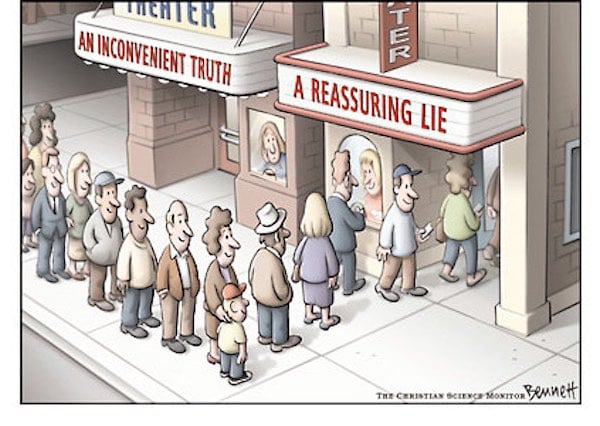
https://deming.org/wp-content/uploads/2020/06/inconvienent-t...
On the other hand, there's also a market for generating outrage and panic, sometimes justified, sometimes not.
Voting is in many parts manipulated or gerrymandered... feature and for it to work we'd need a lot of work.
So not the best metric for what majority of people want.
Also the wants are manufactured in many parts.
There’s a great doc by Adam Curtis about HyperNormalisation
From wiki:
It argues that following the global economic crises of the 1970s, governments, financiers and technological utopians gave up on trying to shape the complex "real world" and instead established a simpler "fake world" for the benefit of multi-national corporations that is kept stable by neoliberal governments
Reminds me of Plato's Allegory of the Cave
So I don't think it'a new thing, but maybe it's getting worse
Yes, it's awesome and exactly what I had in mind.
The century of the self must be recommended also.
Baudrillard restated, as a cause rather than an effect.
I can highly recommend "the agony of the real" if you haven't read it yet :)
> yet leaders keep telling us via TV, social media... that everything is fine.
How else will they make easy money from illegal and unsafe constructions.
There is always the "it was the will of god" excuse.
This will continue till we wisen up and elect the right people, select the right people.
> This will continue till we wisen up and elect the right people, select the right people.
This is part of the problem:
The problem is not necessarily democracy, but rather the insight the lack of bandwidth in voting ballots. A few bits every 4 years or whatever? Contrast this with the rate of modification in the law of a jurisdiction. Define the "democratic grade" as the ratio of binding democratic input in bits/per year to the changes in the binding law in bits/per year.
The problems aren't the concepts of democracy, but that humanity was sold a muzzle with a nameplate stating "democracy".
One may argue that it was necessary in the era where most democracies were initiated, until large enough fractions of the population become educated, but justified or not, its hard to defend today.
Every time you spread the message that we just need to "vote right" you too are in a novel way a part of the problem.
I agree with your broad point. As I said in another comment, perhaps it is time to lean towards sortition. We need a better and faster feedback loop.
Low probability but high impact hazards, those are the toughest to deal with at society scale.
There's no system that can compensate for what people think, want, and do.
We just need to be better. All anyone can do is be a bit better everyday. It's a monumental, hard task that we all just need to do.
This is how society gets better. We have come a long way. We have a long way to go. We can't "design" our way out of simply being better people.
I think you will find little support for your suggestion that when you huurtehoog give up on something, the whole world should also give up on it, without rigorous proof of the proclaimed hopelessness.
Are there "right people"? Or does power corrupt, and your cozy wish is just not realistic? Looking at local politics, I see misuse of power and on all sides. Left, right, middle. Nobody can be trusted.
That's a damn good question.
My hunch is there are honest and reasonably competent people but who don't desire such positions.
Perhaps it is time to try sortition at scale.
Valid point!
I was just a while ago writing elsewhere (sorry, not totally on topic):
"But now almost everyone has figured out what the signs of the corruption are so we can spot the ones getting ill from the power and remove them.
I was joking that we (Finland) could sacrifice a island f Åland to be a Matrix for the power corrupted elite. We can simulate plenty of virtual sycophants fro them to be perfectly happy narcissists while isolated from doing us harm.
And I'm happy to volunteer to train as a therapist, should someone want to get better!
The golden rule and its formulations is pretty damn good litmus test for checking the level of corruption. If you're deep enough this will create a rage reaction. Think of Trump when someone talks about empathy or standard deviation. He will get hostile as he doesn't understand what the aliens around him are talking about.
I referred to the moral development with the lollipop and the levels are:
Pre-conventional (narcissist level in childhood or later in life regression by trauma, addiction or ...) Conventional (the sheep level that understands moral based on what others do around - google banality of evil if you don't know this) Post-conventional is the level where we do the golden rule thinking.
Most of us are in the conventional in action, BUT can understand the golden rule and that's enough. Have the decision makers reflect on some, even mundane, issues on the basis of "what if all 8 billion of us did this" and you'll get a short sircuit or division by zero, if the capability has regressed or never developed. These are no evil people by no means, but in most cases ones that have not had a healthy people around them. Either as a child or later on. We just know where we're going to end up should we not remove them from the power. Whether the society is powered by communism, or capitalism, or whateverism the outcome is the same if we don't figure out a way for this.
We cannot allow replacement via "good great leaders" as the power itself also creates the regression, just like addiction or trauma. So if I'm seemingly moral now and you'll select me as the great spagetti leader that dictates over the world and other puny religions, eventually I will corrupt by the admiration. And so will you.
The predicament of the human race is IMO decided by the fact that do we dare to start talking about this human trait honestly :D Sorry a long rant, now I'll shut up!"
So thanks for a question I had an answer almost available!
> I was joking that we (Finland) could sacrifice a island f Åland to be a Matrix for the power corrupted elite.
"Take all your overgrown infants away somewhere And build them a home, a little place of their own The Fletcher Memorial Home For Incurable Tyrants and Kings" ... "They can polish their medals and sharpen their smiles, And abuse themselves playing games for a while Boom boom, bang bang, lie down you're dead"
-- "The Fletcher Memorial Home" by Pink Floyd
I feel bad for Roger Waters now. He seems to be a sad old solitary man shouting at the clouds, though I mostly agree with him.
My disagreements are about how he treated the band.
We do the opposite. The political class and the contractor class regularly flout safety norms and build where they shouldn't. They make the money from the safety of being out of range.
When the political class are questioned they utter inanities like people should be grateful that God Ganga maia waters have come to bless their lands and homes.
It is a racket. This will continue till we start electing people who respect the scientific methods and their conclusions.
Okay, but isn't it likely that the outcome of those scientific investigations will be that the Himalayan foothills should not be inhabited at all, except maybe a couple of places? What I mean is: Sure, politicians and contractors could do better, but I believe the primary reason for villages and bridges in those valleys is that people want them there. Standard of living is exceptionally low and this is just one of many hazards.
> Okay, but isn't it likely that the outcome of those scientific investigations will be that the Himalayan foothills should not be inhabited at all, except maybe a couple of places
Yes and that is broadly the safe option. One can build on geological stable high grounds. They are rather and more difficult to build on. We know what happens when we don't.
> Sure, politicians and contractors could do better
It's not mistake of the "oops a typo" variety.
They are knowingly making a freakton of money by endangering the people who ought to know better. I agree sometimes the poor might not have viable alternatives that they can fund with their own bank balance but it seems this is where the governments should step in to fund alternatives. But why do that when there is easy money to be made.
While I usually prefer to attribute incompetence rather than malice, it's hard to deny corruption is a likely factor here too. But the "freakton of money" aspect IMO needs nuance. I wager that the wealth of those cronies doesn't come close to my western living standards, so who am I to judge?
I am not knowledgeable about Nepal so I wouldn't know what role corruption played in this particular case.
Nepal is literally between rock and a hard place. But in my country, India, there is plenty of this kind of corruption going on.
EDIT:
> I wager that the wealth of those cronies doesn't come close to my western living standards, so who am I to judge?
They are in no way implicated in this particular case but corruption in India can pay very handsomely
https://en.wikipedia.org/wiki/Vinod_Adani#Career
Lookup his brother too.
https://en.wikipedia.org/wiki/Gautam_Adani#Career (read the second half closely)
Why humans settle in valleys? Is a question you should ask
Not all valleys are equally dangerous.
The question is why people build new on known dangerous places. The new is an important word. They do because the future is not priced in (make insurance mandatory?) and because of acts of corruption that actively promote/incentivize development in hazardous areas by rewriting zoning, repricing permits, rewriting saner policies.
Some people's job is building new houses to sell them. Your question is why they are allowed to build in some areas. Usually there is no point working unless it's for money so take your guess.
BTW, I can't build anything in half of my garden unless I also build huge concrete structures to anchor the terrain, which maybe would make matters worse. My house has been there for about 100 years, the other houses too, maybe it's stable enough but often they allow what's already there and deny anything new. Anyway, it's fine, I don't want to build something there.
> Your question is why they are allowed to build in some areas
No that is not my question at all. In fact I don't have a question, I have a position.
My position is that population density in many of these super dangerous areas is because of corruption laced government policies and practices. The government follows these policies in concert with builders because they can knowingly profit from endangering people (i) in dire straits, (ii) people who are not informed about magnitude of the risks.
In addition to that their corrupt practices distort the market prices so that people end up suckered. If these corrupt practices were to stop or reduce and better more people friendly policies were followed then these place will not become uninhabited but plausible less populated. If you look at my other comments on this story you will get more details of my position.
Some people are in such dire straits that they may still agree to stay in a hazard equivalent to living on Chernobyl lands. Some who are more fortunate would take other options should the government be doing their job.
Have you ever been in a river valley in a mountainous region?
Hard to build on the mountain, and the valley has transportation, easier to build, fertile land, food and water.
It’s very obvious why humans settle where they do (despite the risks).
And all the good places have been taken centuries ago.
> Have you ever been in a river valley in a mountainous region?
Brought up there.
“the people”, those instinct-driven will-less victims of the “Epstein class”, right?
Why do they have to be “moved”? They are perfectly capable of moving themselves as I can attest to seeing them flooding into my country by the thousands. “The people” make their own choices.
There is also an effect being caused by social media and video sharing - loss of context.
The entire Himalayan foothills area (which includes what, at least 6 different major countries off the top of my head) are potentially impacted by something like this.
Most of these areas are barely surviving, and extremely poor, and often very disconnected from the rest of the country due to the terrain.
Realistically, what do you think they could have done to prevent this, given the likely 1/1000 or lower chance it would happen to them specifically?
> Realistically, what do you think they could have done to prevent this, given the likely 1/1000 or lower chance it would happen to them specifically?
Use science based zoning and not build or populate known hazardous areas.
People live there already. How do you propose to move them and support them in the place you moved them to? Please don't make me break out the Aquaman joke.
I am not talking to this specific case but about a general phenomenon that I see in my country, where people are being incentivized to build on hazardous areas by way of corruption.
Depending on the scale one could incentivized people to move to safer areas.
The threat of death from flooding is already a pretty good incentive, people accept the risk when it's the best option they have.
For some who are very poor yes I agree. But many are baited in by corrupt policies by a nexus of politicians and contractors/builders -- cheap land, cheap permits.
Arggh! excuse my autocorrect induced typos.
incentivize.
talking about
And stop bailing out people who build in known danger areas where they can’t get insurance.
What does that concretely actually mean?
There are only a handful of areas on the planet without known disaster exposure risk. Maybe zero, really.
That's quite hyperbolic.
Zoning is not an all or nothing.
There is a lot of land that does not have such extreme dangers. Of course, some countries have it worse than others. Japan would be one such. Good or bad, the population has been on the decline there for unrelated reasons.
For earthquakes this is what my country looks like
https://en.wikipedia.org/wiki/Earthquake_zones_of_India
This is at a very broad resolution. One can refine to make this more local. Earthquakes are just one type of hazard. One has to take other hazards into account.
Your trying to control geography with policy.
But not considering why people build communities in valleys.
More geography and less policy knowledge is required
That's not quite it. Its about policies that take into account the cost of future events and balance it against the ease of building. The future needs to be priced in, in today's prices.
Regulations (for example, you cannot build unless and insurer is willing to insure your property against known local hazards) and enforcing the regulations can make that happen. Often we move in the other direction by adopting policies that encourages mispricing.
Tell me you have zero idea about the region without telling me you have zero idea about the region.
Insurers? Building code enforcement? Are you for real?
https://news.ycombinator.com/item?id=49463187
Since you are making this personal I am not going to respond to you any further. Sorry.
You’re the one making it all or nothing. give some concrete examples to prove me wrong, or stop bs’ing.
don’t forget major earthquakes (most of California and the entire Pacific Rim, to name some well known areas), floods, serious droughts, tornados, hurricanes/cyclones, fires, subsidence (into the ocean or sinkholes), volcanic eruptions, tsunamis and lahars.
It’s about frequency and preparation, but it’s never perfectly safe. No building code handles everything, it’s impossible. Hazards are somewhat mitigated or ignored, not entirely dealt with.
Not sure what you mean by give concrete examples, when my position is normative.
I am not sure where you are getting "all or nothing" in my comments. If you are interested, you can read my other comments on this story to get perhaps a fuller picture of my position.
I understand my comments have worked you up, but I am not sure why. If you have lost people in this incident, I am genuinely sorry for your loss and can understand emotional outbursts. If you have dear ones engaged in practices that I am disapproving of, well, then in that case too I can understand your displeasure.
If you thought that I am claiming that adhering to my position will ensure that future death tolls would magically become zero then that's uncharitable reading.
My position is quite simple, price in the hazards based on scientific hazard assessment. Enforce policies that encourages correct pricing, rather than part take in corrupt practices that encourages mispricing of the kind that benefits the political class and builder class nexus that operate from the safety of being out of range.
This can be done through regulations. For example, we have mandatory third party accident insurance for vehicles. That's an example of a regulation that encourages pricing in the hazards.
Hazard zoning is not all or nothing of the type (a) permitted and (b) not permitted. It is about assigning areas to different grades of quantized hazards. See my other comment for example of such zoning for Earthquake hazard.
With hazard priced in, the markets would mostly take care of where to build new homes and what kinds to build.
In Himalayan states of India we have the opposite going on. Politicians, in concert with the enforcement bodies that are peopled by their flunkies, encourage illegal constructions in known hazardous areas, deregulates zoning so that dangerous areas are cheaper to own property on in exchange of kickbacks from the builders.
> don’t forget major earthquakes ...
I am not forgetting that for sure but not sure what your point is. If it's -- look here are other dangerously built up areas in the US -- then yes I agree.
There was corruption involved in managing the levies that were supposed to protect New Orleans too.
> or stop bs’ing
And yes there is no need to be rude. It does not make your point stronger.
I’ve lived in India and spent quite a bit of time in the region. It’s hard to say how ridiculous this sounds considering that experience.
In theory? Sure.
In reality? Lulz
You may have lived, in the past presumably.
On the otherhand I live here, with large part of my childhood in an earthquake hazard zone, the highest in fact. If you have lived here and know your high school geography you would be well equipped to guess where.
I am not sure I hear any constructive suggestions from you other than lulz. Unfortunately that's not going to make a difference.
In any case, since this has devolved into personal insults. I recuse myself from a wrestling bout in the mud, sorry about denying the pleasure.
So you know, and have no excuse. Care to name the insult?
>simulated worst-case outburst events from these lakes both in the Tibetan town of Nyalam and downstream at the border with Nepal
For context that's not where the flood happened, there's a massive mountain range in between those vallies reaching over 8000m (Shishapangma).
In earth science there are thousands of worst case scenario models published, but it's hard to actually predict reality.
It's just the opposite side of the same mountain, used as a case study for modeling GLOF risk. In fact, they prominently cite "Potentially dangerous glacial lakes across the Tibetan Plateau" [1], which includes Gyirong Port and the downstream valley as a high risk of GLOFs and notes that many buildings there are exposed to potential flash flooding. Take a look at Fig. 5 [2] - the upper left cluster of dangerous lakes and exposed buildings is the site of the disaster. They also name Jilong, Nyalam, Dingri and Kangding as the Tibetan counties with the highest lake danger; the glacier collapse happened at the border of Jilong county.
[1] referenced as Allen et al. (2019), https://doi.org/10.1016/j.scib.2019.03.011
[2] https://ars.els-cdn.com/content/image/1-s2.0-S20959273193015...
Its easy though to bury sensors and sound sirens.
Not in all potential areas across such rough terrain.
Its a "detect characteristic vibrations" - send to starlink? or if thats the problem- use the river itself and transmit the warning with the speed of sound through water.. by just having some underwater bell upstream. Go full lowtech, but at the risk of no warning if the river is dry at glacier dam break.
There are definitely countries that have very good warning systems. Japan comes to mind. As for Nepal I wouldn't expect it though, and even in China devastating flood events happen regularly in more populated areas than the Himalayas, where people could have been saved if they'd been warned. Despite China's excellent mobile coverage, that doesn't seem to be the issue.

I don't think I've seen a snuff film of that scale before. I'm not good with even fictional horror. This may haunt my dreams. For most of the people there was just nothing they could do. But others would have had a chance if they had run perpendicular to the flow and climbed like their life depended on it. I'll try to remember that the next time I'm fleeing in panic from a flash flood.
Looks like a warning siren could have saved some lives. But apparently this was a black swan.
| But apparently this was a black swan.
What is your definition of black swan? This paper is from 2022 and scientists have been warning about climate change for decades. It's not like this possibility wasn't anticipated. It seems likely we'll see more glacial events as the atmosphere warms.
There have been maybe three such events in the 21st century (glacier or landslides producing more than a magnitude 5 quake), and none of them have happened in an area like the Himalayas. The other two were in Alaska on Mt Steller in 2005 and the Lamplugh Glacier in 2016, neither of which produced massive downstream floods.
It usually takes entire icebergs calving off to produce such seismic events and intense monsoons to create such flooding.
> There have been maybe three such events in the 21st century
It seems that past history (especially recent) will not be a good predictor of future events.
Spoiler alert: that’s the whole point of a black swan event.
A black swan event is an event that is unpredictable because it is so rare.
While I'd wait for confirmation about the cause of this specific incident, the point you seem to be ignoring is that, due to climate change, events that would have been considered "black swans" historically will become more and more common, to the point that they are expected to occur.
I think that’s a misreading of the entire book. A black swan event is a rare, high-impact outlier that is nearly impossible to predict under normal circumstances, but is rationalized as having been inevitable in hindsight.
For whatever reason, you continue to try to ignore the point I'm making, which is that, in terms of natural disasters related to climate in particular, what would have been "rare, high-impact outlier[s]" are increasingly becoming common enough to be not rare and not outliers.
And you continue to ignore what I said (and what the book said). The whole point of a black swan event is exactly what you just described.
It’s the inflection point when our priors change.
Maybe I misunderstand (either you or the topic in general) but I don't think what you're saying is correct. A black swan event is (to my understanding) something unexpected and generally remains so. Not (as you seem to be suggesting) "oh hey that was historically unexpected but going forward it's now considered a standard contingency".
And I have no idea where you got the "rationalized as inevitable in hindsight" thing. I've never heard of that in relation to black swan events before.
Have you read the book?
If events like these are "nearly impossible to predict", how come this post is linking to a scientific paper predicting exactly this scenario?
This flood is like The Big One in California. We know it is going to happen, it is virtually a certainty. The only question is when and where.
If glacial floods come as a surprise to you, it is only because you have been deliberately ignoring all the climate change warnings. So, a short recap: we'll see massive droughts, giant wildfires, huge floods due to rainfall, significantly more intense hurricanes, mass starvation due to large-scale crop failure, and low-lying countries drowning due to sea level rise. Oh, and add a high likelihood of the AMOC collapsing triggering a cooldown of the East Coast and Europe to the list.
Black swans are actually fairly well-populated birds that are easy to spot. So as a metaphor it works well for a common thing that smug people of limited knowledge try to claim is rare and surprising.
Anticipation is one thing, effective response in the seconds before disaster strikes is quite another thing. This might not have been an absolute black swan, but even with foresight it is challenging in the extreme to avoid risk.
I've been reviewing what coverage I can find of the present event in Nepal/China, in context with Section 5.1, "Comprehensive approach to disaster risk management", of TFA.
It seems that what would be required would be:
- Active surveillance of glacial lake formation.
- Active mitigation of glacial lakes, reducing risk.
- Warning and response infrastructure, procedures, and protocols along the likly flood path.
From video of what I presume are among the worst-hit areas (see: <https://twitterwebviewer.com/?tweet=2092542957060841592>), there appear to have been at best a few seconds of warning. Very robust structures are demolished virtually instantly. Even had people been sheltering within those structures, or headed up-slope above the water flow, either structural integrity would prove insufficient, or response time inadequate to reach a safe elevation above the debris flow. The latter problem is compounded by what appears to be an extraordinarily strong air blast (likely hurricane-strength or greater) as well as massive amounts of airborne debris, much of it rock.
Terrain is severely constrained in the region, and the only buildable regions are in river valleys themselves. The Gyirong Port border crossing is located deep within a river channel, and despite robust construction simply could not survive the event.
See:
<https://en.wikipedia.org/wiki/Gyirong_Port> (Wikipedia article on the port.)
Map / satellite view: <https://www.google.com/maps/@28.2792579,85.3752907,1341m/dat...>
(Take a few minutes to examine the region around the port itself ... there are several communities and businesses all well within the disaster zone, and I suspect that obliteration to those matches or exceeds what was captured on video at the crossing itself.)
From the first video at this Twitter post, a camera situated roughly 20m above the base terrain did not survive the event (though it transmitted for roughly a minute).
A second camera (I believe near the same location) shows similarly catastrophic damage, and no chance for anyone at base level to climb to a safe elevation before being overtaken by the debris flow.
Wikipedia notes "Floodwaters reached settlements as high as 270 feet (80 m) above the river level", citing <https://english.onlinekhabar.com/rasuwa-flood-in-pictures.ht...>.
Climbing that far would require 4--8 minutes for even a highly-fit person. Available response time in the videos I've seen is on the order of 1--2 minutes. Anyone beginning within the debris zone is already walking dead.
As the Cowboy Junkies said:
Anticipation isn't sufficient. Other than entirely abandoning such locations during all periods of high risk, loss of life is likely, and catastrophic property and infrastructure damage inevitable.But if there's on thing in my life That these years have taught It's that you can always see it coming But you can never stop itWhen I was researching this morning I found papers related to this kind of risk from at least 2000. Given 20 years there could have been things done I think. And there is a lot of settlement on the tops of the ranges in that area too.. Maybe the roads have to be on the river valley, but not everything else. People living there could have been offered alternative land to move out of the path of it.. monitoring and early warning could have been set up.. at the checkpoint, if it had to be there, there could have been a big evacuation tunnel carved into the hillside, or something.. I guess Nepal doesn't have a lot of resources though. The same thing even happened a year ago in the sample place, but at a smaller size https://www.stimson.org/2025/investigating-an-emerging-clima...
Flat lowland is great because it's cheap and easy to build on, and not a hassle to actually use.
Ridgelines and slopes are terrible to build on (and often use) because there is little to no actual flat usable area without extensive construction. They also tend to be unstable and slide/erode.
That said, if I was in that area, of course i'd never build/live on anything but the highest ridgeline or slope around.
One of those 'long term/outlier risks cause daily costs' type of things. :s
Perpendicular is not the scientifically best path. 45 degree angle is the best angle if the threat is moving toward you at the same velocity that you can move. As the velocity of the threat increases, the angle gets closer to perpendicular. The size of the threat and distance of course matter as well. I think about this before tree felling. In chainsaw classes they teach you to move at a 45.
Looking at the footage, the water/avalanche was moving far faster than anyone could move on foot. Well over 100 km/h, I would estimate.
And taking the entire infrastructure with it, including buildings and roads
Likewise if your car stalls on a railroad crossing, run at a 45 degree angle toward the train. This puts you away from the path of flying debris.
There was another similar flood on the same river about a year or two ago. The problem was the the glacial flooding started in Tibet and affected people just over the border (one of the videos is from the border crossing). There's no international data sharing for this sort of thing between China and Nepal and Nepal can't deploy sensors in Tibet to give sufficient warning.
I suspect you are dramatically overestimating how fast humans can climb. I hope I'm wrong.
The great flood myths across the world are quite possibly ancestral memories of this kind of flood on a continental scale. Retreating ice age glaciers would make lakes the size of states held at bay by an impromptu dam of various kinds of debris (or more glacier) which then would break dumping great lake amounts of water hundreds of miles into the ocean within days. This kind of thing probably happened in lots of places.
You just pushed me into a rabbit hole called the Zanclean megaflood.
It is supposed that such an event happened, when the land between continental Europe and England got flooded. This was as well during a warmer period when glacier melted. And there was human population on that land.
Oh there's geological evidence of these things happening in the pacific northwest, the waves and water scouring the landscape in an unimaginable fashion left evidence to be seen today. Like 1000 Niagra falls for a month straight. Outflows measured in billions of gallons per second or 10+ cubic kilometers per hour.
The Missoula Floods in the northwestern US were a similar sort of event, though I'm not sure how the scale compares.
Yes this is exactly the kind of thing i'm talking about and in the time frame which is at least plausible to make its way through mythology to modern day (not so much for the flooding of a dry mediterranean sea five million years ago)
I wonder if the river went dry first, like the water receding off into the horizon before a tsunami?
It is possible if you consider madaxe_again's theory(comment here). If the debris just started descending without interruption, there would be no receding.
Well supposedly it was caused by a landslide blocking the river for a few minutes, then the dam burst all at once.
We have tsunami warnings all the times now. Nobody is stopping people from burying sensor posts upstream.
I think the Japan tsunami videos showed as many, but it was spread out over the course of almost 2hrs and happened in slow motion over a large area. You could see some cars speeding to safety while others were washed away. Some stayed in taller structures assuming they were safe and were slowly washed away.
Look at the CCTV at https://apnews.com/article/climate-change-nepal-tibet-glacie... (second video in the carousel).
That’s just pure horror, nightmare material
150 confirmed with 47 Americans? Surprising fraction. Mountaineers or that area is popular for some reason?
it's a popular area for tourists and mountaineers, but also i think it's a lot easier to estimate missing/dead tourists since most of them will be there with tours/companies that have to keep track of exactly where they are.
Syabru Besi is downriver of the border and the starting point for the Langtang valley trek which is probably the third most popular trekking location in Nepal (behind Everest basecamp and Annapurna circuit). I think the tourist data they have is from tourists that are traveling with guides but from my experience many tourists also bypass the official requirements and trek solo so the number could be much higher if the Langtang is affected.
Likely the tourists are better accounted for than the locals. Numbers are likely much higher :(
This.
You could probably count 100+ people in the death zone of the border crossing video alone. The final death toll will be terrible, with most never found.
i understand it as 150 dead, with more people missing, of which 47 are americans.
I feel like I've easily seen more than that get swept away in videos.
Way too early to get an accurate count
Zero chance the actual death count is sub-1000
Nepal is popular for Westerners I think. Maybe for religious reasons?
Mountaineering.
For indians, you also have the religious aspect because the immigration center you go to to visit Mt Kailash is there.
That immigration building was the white one that got completely shredded in the popular video going around.
Ah thanks for clarification.
It is harrowing. It also explains why the villages in my ancestral region in India (JK, HP, UK) with close cultural and ethnic ties with Nepal used to build them at the upper portions of the sides of mountains/hills and only shifted to building at the bottom of those kinds of valleys when motorized roads became a thing in the 20th century.
Rescue operations in Nepal are in good hands, but this is sadly because those same response orgs had to respond to a similarly brutal cloud burst floods back in 2013 [0], 2021 [1] and 2025 [2].
It also shows the very real and brutal effect climate change is already having, and will only get worse.
[0] - https://en.wikipedia.org/wiki/2013_North_India_floods
[1] - https://en.wikipedia.org/wiki/2021_Uttarakhand_flood
[2] - https://en.wikipedia.org/wiki/2025_Kishtwar_district_flash_f...
That makes sense. You can see lots of settlements on the hills above the sight of this flood too. I also found this study of the risk perceptions of people living there interesting too. https://www.sciencedirect.com/science/article/pii/S221242092...
I have watched a few and they look like the four horsemen TBH.
Near Juneau, Alaska, USA, the Mendenhall glacier has repeatedly, over the last few years, had a Glacial Lake Outburst Flood. Not nearly as catastrophic as the one in Nepal but it did flood areas near Mendenhall River in Juneau. The latest event was August 13, 2026.
Reminded me of the Huascaran avalanche (1970, killed approx 30K people) [0]. I'm surprised this is not also in the thousands of casualties (perhaps it'll get there) [0]
https://en.wikipedia.org/wiki/1970_Huascar%C3%A1n_debris_ava...
https://en.wikipedia.org/wiki/Vargas_tragedy
Similar death toll. Also Orion.
It almost certainly is. Just too early right now.
The Scablands were terraformed by a series of GLOFs (Glacial lake outburst flood) like this when deglaciation started at the end of the last ice age. Just imagine it on a thousand times bigger scale
>During the last deglaciation that followed the end of the Last Glacial Maximum, geologists estimate that a cycle of flooding and reformation of the lake lasted an average of 55 years and that the floods occurred dozens of times over the 2,000 years between 15,000 and 13,000 years ago. U.S. Geological Survey hydrologist Jim O'Connor and Spain's Museo Nacional de Ciencias Naturales scientist Gerardo Benito have found evidence of at least twenty-five massive floods, the largest discharging about 10 cubic kilometers per hour (2.7 million m³/s, 13 times that of the Amazon River).
https://en.wikipedia.org/wiki/Channeled_Scablands
https://en.wikipedia.org/wiki/Missoula_floods
Also it's interesting if you start reading about Native American flood stories, these were not just tales or legends but telling actual historic events that the ancestors experienced.
https://en.wikipedia.org/wiki/Missoula_floods#Early_flood_st...
Is it possible to avoid these risks in mountainous areas? How many people are living in valleys downstream from lakes with these risks?
If one simply concluded that with current climate changes, it's not safe for humans to live under that risk, how many villages and cities would find themselves uninhabitable all of a sudden?
I believe this is how the Hudson Bay was formed, in what must have been quite a sight.
The debris flow that has just happened doesn’t appear to be a glacial outburst.
Rather, the entire front face of a glacier at high elevation sheared off, likely millions of tonnes of material at least, crashed down a steep runnel, slammed into the opposing slope on the other side of the valley at the bottom, made that partially collapse, dammed the river for several minutes, and then all descended at high speed as the dam failed, with the results we see.
Some reportage is still saying there was an earthquake - there wasn’t - the landslide itself was the source of the seismic waves.
https://earthquake.usgs.gov/earthquakes/eventpage/us7000tbwb...
Brilliant analysis! Although china is notoriously bad at reporting earthquake data, I assumed in this case they were open and honest. It made sense that an earthquake would trigger this event. I do not fault anyone for interpreting the data this way. The USGS has been the agency I most trust in the federal government.
USGS is a fact finding organization. They do not regulate. They have been around since 1879. The land surveys they have done made huge impact on society. The reliability of surveys that they have facilitated has made an impact on industrial civilization that few will understand or ever hear about.
I remember in Africa, in the late 1960s/early 1970s, being taught in social studies, that Ethiopia was at risk for famine. They discussed that many farmers raised sheep and goats, which have a drastically different impact on the environment, than cattle (it has to do with how they eat grass -they pull it out by the roots, while cattle clip it).
Not long after that, Ethiopia was in the news for... anyone?
Lots and lots of ignoring scientists. Nothing new here.
Cassandra
>Lots and lots of ignoring scientists.
But do you have a statistics on how often these predictions are wrong?
No. Please provide them.
That burden is on you since you placed a blame on the people "ignoring" the scientists. You should have understood how reliable these warnings are before blaming people for ignoring them...
Since you don't have them, I have to suppose you just like being on a high horse...
Go for it.
I’m not losing any sleep over it.
Have a great day!
You too!
This isn’t to refute your point… but do you also remember when scientists in the 1970s were panicking about global cooling and an impending ice age?
This is a common misrepresentation that deniers use to rationalize their unscientific position. The vast majority of the science, even in the 70s, stated that global warming was our future, not global cooling.
Source?
I remember them referencing global cooling on science Friday on NPR as late as 2005
"As reported in the press" - yes.
"As placed in the press by the same think tanks upselling tobacco" - yes.
Paid for and spun as media confusion by powerful oil and resource extractors, such as but not limited to the Koch brothers, yes.
As a reaction to the late 1960 papers on CO2 impacts being taken seriously by world forums - yes.
But an actual significant number of atmospheric scientists and global modellers "panicking" about glacial expansion of the ice age we're currently in (you know, an ice age being any era during which ice covers the poles) ... uhhh, no.
Mainly as that didn't happen.
They were in a sense correct, because the aerosol cooling they were worried about did in fact (and continues to) have a fairly significant cooling effect... one that is offsetting the rapid warming that CO2 is causing presently.
Media outlets were driving panic. Scientists were always saying warming is a problem
Some scientists, amplified by journalists. Other scientists at the time were predicting warming.
https://www.reddit.com/r/skeptic/comments/1hajzg9/here_is_th...
No. I heard global warming.
The cooling was from nuclear war.
Actual cooling was from industrial emissions, but that was over by the 1970s. It being something to panic about at that point was a media amplification or a contrarian position, precisely because it was contrarian, not representative of scientific opinion at the time.
Reminded me of this documentary I saw last year - https://www.arte.tv/en/videos/122807-000-A/arte-reportage/ . I thought it was the same lake
Remember Orion and Rocky
https://www.dogmanray.com/true-stories/orion/
https://greatergood.com/blogs/news/heroic-dog-rocky-saves-63...
It would have been more apt if his name was Sirius.
Sadly it's not uncommon to see teenage and young men groups to seek out puppies and pregnant strays to stone to death in Himachal and Uttarakhand (two states in Himalayan India). Properly vaccinated they can be protectors.
GLOF, glacial lake outburst flood.
exceptionaly brutal cctv footage from the tibet/nepal border, so many people that there is a tiny chance that perhaps one of them was tossed clear, but of the rest there will be no remains. other videos shows that the flood "water" is so thick with mud that it is sheering off in sheets and one more shows it ripping out a concrete bridge that then floats away on top. *disturbing video
> GLOF, glacial lake outburst flood.
Not sure this is confirmed at this time.
Wrong link
https://m.youtube.com/watch?v=rIVNeDuCF_k
fixed, but some things are better off wrong perhaps
In the future, don't go close to mountains during monsoon season - late May to August end; that period is specifically for Southeast Asia. For the rest of the world, you can find it out.
This was a glacier collapse. https://www.zhihu.com/question/2075969425702741132/answer/20...
I read this wasn't due to rain but a glacial collapse. It sounds to me like the additional advice would be that due to a warming climate, avoid being under a glacier at all costs?
Down stream of a glacier, in the run off water shed.
As I've heard tell, this was a glacial collapse into and blocking a river, which then built up a head of pressure behind it, bursting to release a hammer blow of river water and debris that travelled a great distance.
Similar things can happen due to landslides into rivers; it depends on the topology of the land, here long narrow valleys carved out by heavy water flows.
The warning being, don't live in a natural "drainpipe".
In mountainous regions that's often not much of an option, there's a lot of vertical sides and valley bottoms.
The rivers in that area are pretty small. You would have to block them for days before there is a risk of a massive flash flood.
From what I've understood, the collapsing glacier either contained enough liquid water or melted enough from the impact that it continued flowing downstream. It covered ~20 horizontal kilometers in about 7 minutes before hitting the border crossing.
There's a few ways this could go and very likely no video feed to be sure.
It had the look of a large volume of water quickly released.
Massive tonnages breaking off of a glacier is still going to be mostly ice on impact .. there's a chance debris and ice chunks made a temporary dam as the bulk of the now shattered glacier ice released water putting pressure on that weak dam - leading to collapse and release.
It sounds like there may have been some opportunity for warning then? If the thing was more of a "build up" ?
Sure, if every part of rugged terrain were monitored with sufficient frequency to detect such a change.
That might take some infrastructure to cover everywhere such things can happen (eg: the beds of rivers in Western Australia's Pilbara and Kimberley regions have a high flash flooding risk in the wet season.
Sounds like a great application for drone tech.
Is it?
What's the land area you'd like seamlessly and continuously monitored by a mobile object with moving parts ... and how is that a better solution than using static solar powered instrumentation?