Show HN: For 10 World Cups, my model's 2 favorites had the champion every time
papers.ssrn.comI've updated the magic weights, and I too can get the result I want:
    WEIGHTS = {
      'w_xg': 0.09,
      'w_goals': -0.07,
      'w_star': 0.018,
      'w_value': 0.18,
      'w_rank': 0.4,
      'w_def': -0.12,
      'xga_share': 0.85,
      'w_gk': 0.0042
    }

    $ python3 worldcup_model.py --sims 100000

    2026 FIFA World Cup -- championship probabilities (100,000 simulations, from Round of 32)

     1. England                 11.7% *
     2. France                  10.0% *
     3. Spain                    9.3% *
     4. Argentina                8.4%
     5. Germany                  8.1%
Not with tuchel Ball
Not with Tucheliban
Maybe in an alternate reality. Jokes aside, discovering the right weights to match the current fixture, along with the limited data available, were the key challenges in forecasting at such an early stage.
> Applied prospectively to the in-progress 2026 World Cup from the Round of 32, the model identifies Argentina (28.0%) and Spain (21.1%) as the leading championship candidates.
Seems weird to wait to run the "prospective" simulation until the World Cup is already in progress. Although it seems that the model also needs to use "the actual bracket and group-stage performance". So it's not prospective?
It predicts likely winners based on the round of 32 performance (plus prior data). That's still "prospective" with respect to the finals
Yes. I don't like phrasing this as being prospective for the World Cup as a whole. It's for the knockout stage. (Which the abstract says! But the title doesn't.)
Which is very reasonable. You estimate odds after seeing teams playing with the actual squad selection at that period in time. Otherwise I'd dismiss the predictions as lucky guesses in a row.
The baseline matters here: favorites win World Cups all the time. How often would "always pick the two pre-tournament favorites" have gotten the champion in these same 10 tournaments? Without that comparison, 10/10 tells us basically nothing.
France was far and away the pre-tournament favorite for 2026, if anything it's somewhat impressive that OP's model correctly predicted that they wouldn't make it.
Here's hoping they were right for England as well, but we'll find out soon enough.
That was exactly the point I was trying to make in this preprint. I appreciate your comment.
Probably the human pseudonym of Paul the Octopus (https://en.wikipedia.org/wiki/Paul_the_Octopus).
It's worth noting that there has only been 24 world cups
How does this paper not even mention the word "overfitting"?
The abstract does say
> limitations, principally the small number of tournaments available for validation and the risk of in-sample weight selection
But I agree this model is no more valuable than Paul the Octopus.
That almost makes it worse—like they're vaguely aware that training too heavily on too small a data set makes badly trained models, but are unaware that it has a name and is an actual identified problem.
They've even described how they overfitted it! For five world cups, a simple model based on ranking and goal difference in the group stages[1] predicted it four times, so they invented a somewhat subjective variable on defensive strength to cover the teams that didn't score much...
[1]yes, both of those are endogenous variables...
I appreciate everyone's feedback. This is a preprint, and I was looking exactly for this kind of constructive scrutiny to help improve the work. The data is limited, and I'm well aware of that. I just thought this would be a good first step, with encouraging results (and, after today's match, accurate ones too).
but does the model predict the right match up along way? if not it's just wrong wrong make a right
Also, being able to predict football with complete accuracy is impossible
I've been messing with the magic value weights, and it doesn't take too much to push them in any given direction. The TEAMS_2026 should really be taken with a pinch of salt.
Isn't that essentially how AI works?
Make sure your email is on file with every horrible news outlet in the world so they can write over 9000 stories about you before the next World Cup.
Get a few nice glamorshots and make sure you have something else in the queue before then to plug during the interviews.
Why is the world cup so infrequent anyway? I assume to match olympics?
Good models need a lot of data. Can you really be accurate with what, 30 data points, in which the team composition is basically reset each time?
World Cups have to alternate with continental competitions (Copa America, Asian Cup, European Cup, Africa Cup of Nations) which are on similar cycles. They could technically be held every two years (and current FIFA leadership is pushing towards that), but federations and clubs are resistant (because every summer tournament places even more stress on an already-long club season, and it would likely devalue other competitions).
Every 4 years is good. Makes it a special event
Clubs want their star players focused on club championships, and the star players make their real money playing on their club teams.
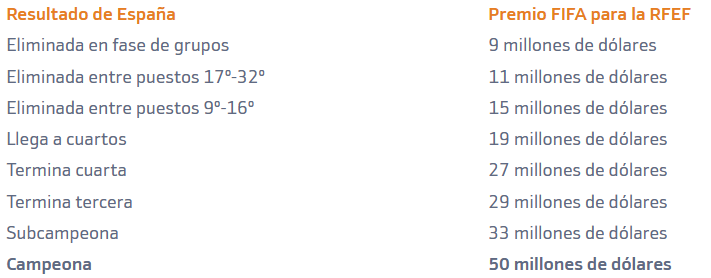
do world cup athletes get a big bonus for world cup participation from their govts and/or FIFA?
It is up to their respective Football Federation (Spain: RFEF, England: FA, Germany: DFB, etc.), but FIFA pays each Federation a bonus: https://intereconomia.com/wp-content/uploads/2026/07/image-2...
In the average country players agree the bonus conditions with their Federation.
FIFA pays federations on a result basis. It's then up to the individual federations to redistribute that money as you see fit. As you can imagine, a lot of that does not end up in the athletes' pockets... I believe clubs get some (low) compensation for injuries, but it's also common knowledge that players who play deep into summer will end up performing poorly the following season.
There is no MODEL for pure Argentine magic. vamos carajos! vamooooooooo con todo!!! Our time has come again.
Hahaha, as a Brazilian, this hurts. But as a man of science, I can't argue with the numbers. Congratulations, hermano.
> the model identifies Argentina (28.0%) and Spain (21.1%) as the leading championship candidates
Survivor bias
!remindme tomorrow
A good AI would calculate refereeing decisions and put Argentina at 100% unless England can pull off a miracle against FIFA today.
No good AI would cherry-pick data to this extent. Only people are capable of that
Maybe, but it's been widely reported. BBC wrote about it here: https://www.bbc.com/sport/football/articles/cx2wkwd7e6go
Since that article was published, England had the red card ban for Quansah extended to two games instead of one with no appeal so he couldn't play against Argentina if England were to get that far, and shortly after equalising in the quarter final Switzerland had a red card for a second yellow against Embolo for diving which had originally been given to Argentina. If you don't know, there is no right for VAR to give a yellow card in this case - it can only be done if it's mistaken identity, which is what they claimed. https://www.theguardian.com/football/2026/jul/12/switzerland...
Now of course none of this is evidence of bias, but it's worth noting that this has been happening after claims of pro-Argentina bias has been widespread enough that the BBC and other institutions wrote about it.
It's been widely reported that the coach of a side that lost in unfortunate circumstances to Argentina whinged a lot about the match officials disallowing one of his side's goals. This is normal, as is media reporting on silly conspiracy theories. Since the article the super conspiratorial "all Argentine refeering team" also failed to do any damage to France's prospects against Morocco whatsoever, and the Norwegians have joined the Ghanaians in complaining that England have been getting scandalously bad decisions too!
Nobody with an adult understanding of sport honestly believes that the ban for Quansah is some sort of conspiracy to guarantee Argentina won. I mean, apart from him getting the normal ban for a bad tackle, the only chance he'd get of making the starting lineup against Argentina was as an out-of-position option that would by marginally easier for Argentina to play against.
The "mistaken identity" rule was very clearly changed before the World Cup to allow it to be used to review decisions when the referee mistakenly carded a player or awarded a penalty for something actually caused by his opponent (not just when he booked a different player on the same team). Your assertion is simply false, as your own link confirms. Also, of the few "mistaken identity" decision reversals, Embolo's ridiculous dive to try to [initially] get his opponent into trouble was by far the most obvious and deserving. But yes, losing sides will generally whinge more about rule changes which mean their player can't get away with cheating like he might have done in the past than they will about their player's decision to cheat costing them a game they might have won.
Really, the only major decision involving Argentina that's not completely consistent with other games was Messi avoiding trouble for accidentally studding an opponent's calf (a bit like the much-debated Balogun incident) in a low pressure group stage game, and we don't need a massive conspiracy to understand match officials might be scared to send off the world's most famous player in his last tournament for an inconsequential bit of clumsiness, if they even saw it clearly.
Does the model account for the blatant favouritism in the refs? We used to laugh about it before but as the cameras have gotten better it has become a lot more visible. And in this case, is turning the tournament into a bit of a joke.
-- Egypt was robbed.
The FIFA-planned game schedule is also surprising. Argentina have not had to face a single 'big' contender through the tournament, until now.
It's not at all surprising: the seeded the winners and the three highest ranked teams to make it impossible for them to meet until this stage if they won their group in the group stage, with the group stage having its own seeding system to make it very winnable for them.
They also missed a potentially tricky first knockout round tie against local rivals Uruguay because Uruguay underperformed and Cape Verde unexpectedly overperformed.
The top 4 countries got seeded so they avoid each other.
It's quite unlikely football is one of the few sports without a doping problem and with only very few cases where the referee was paid off.
Since ancient times in Rome where they said "bread and games" are needed to keep the commoners happy, many generations of rulers had time to optimize large-scale sports events.
My personal theory is that these kind of extremely unfair decisions in football are a net benefit to stability of society, and there's no incentive for the leadership to aim for full fairness in sports.
Hear me out: When a team loses in unfair manner due to bad decisions of the referee, large masses of people feel the psychological pain of being robbed of a win. This feeling of "unfairness" makes the masses more resilient to experiencing "unfairness" in their day-to-day life, for example when a billionaire is not prosecuted in the same way than a common person.
If we turn the logic around and assume that football would always be perfectly fair, then the masses would demand the same kind of fairness also in their day-to-day lives. Obviously this demand for fairness is not aligned with an establishment class that wants to extract the maximum value possible from their citizens, and push as far as they can without risking stability of the country.
From an establishment perspective, it makes a lot of sense to condition the masses for "unfairness", and sports is the perfect way to do it. I'm not saying that the individual referees are paid off to let a certain country win, just that the establishment who runs each country (and thereby also run international sports organizations like FIFA) have no incentive to actually create total fairness.
This might also explain issues like the IOC re-instating russia for olympic games, even though they have not retreated from Ukrainian territory yet. It triggers people who strongly feel about morals and ethics, and it brings the point home that the world is unfair and it makes no sense to push for fairness in the greater context.
The benefit is psychological conditioning for people to accept unfairness.
edit: replaced "soccer" with "football"
I don't know why you are calling it 'soccer'.
It's FIFA World Cup - Fédération Internationale de Football Association. Football, not soccer.
> I don't know why you are calling it 'soccer'.
Probably because the sport is called [association football] of which soccer is one of the short forms (from the British) same as football, and is generally used to distinguish itself in places where other sports from the same football category are prevalent.
FIFA is an association that governs various association football variants including futsal. Using acronym expansion on FIFA as a canonical source for what to call any particular variant of association football would be misguided.
Valid point, I've been brainwashed in school to use the American term even though I live tens of thousands of kilometers away from the US.
and how many models did you model?
how statistic significant is it.
now back your claim with money and bet accordingly on betting sites to see if you uncovered some actual alpha here
"They've done studies, you know. 60% of the time, it works every time." - Brian Fantana, Anchorman
One of the founders of Renaissance Technologies, which runs some of the most successful quant funds of all time, said ""We’re right 50.75% of the time... but we’re 100% right 50.75% of the time."