Emacs appearances in pop culture
ianyepan.github.ioIn Elif Batuman's 2017 novel The Idiot, about a naive Harvard student, her not-really-a-boyfriend Ivan, a math student, enthuses to her about Emacs. The book is set in 1995.
I enjoyed the book. It got good reviews and was a Pulitzer Prize finalist.
Yes, good book! If I remember correctly, he is just learning emacs and is confounded and a bit annoyed with it. Which sounds about right.
Hilariously, the Arctic Blast screenshot seems to be the Audacity audio editor with Emacs overlaid! https://ianyepan.github.io/images/arctic-blast-emacs.png
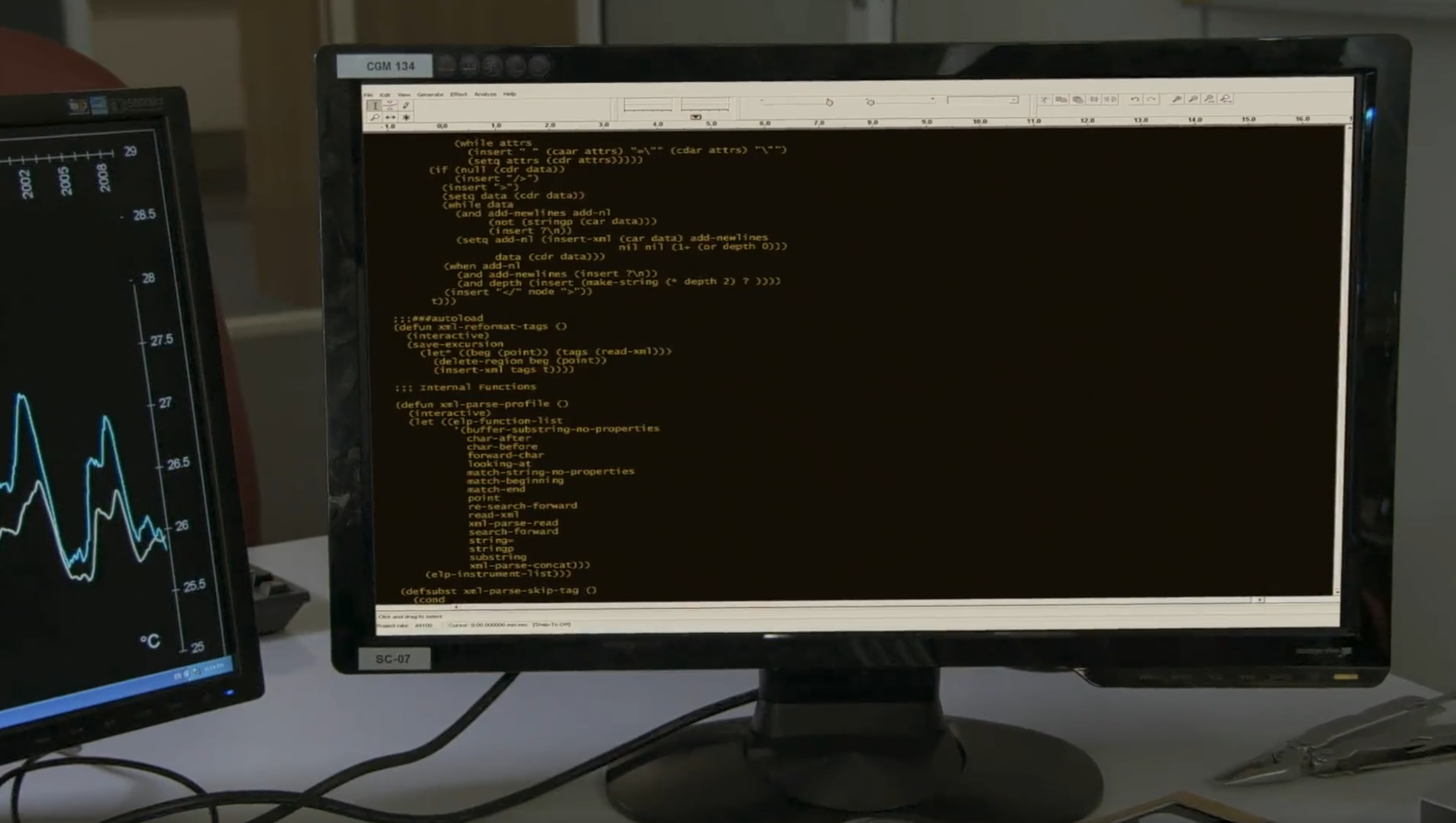
How to sell drugs online fast was a great show because they kept stressing how they had to have the test pass in their Vue front end.
I always whenever I see code on a show/movie I wonder if it's real, a lot of times it's a mix of random languages. Sometimes just jibberish.
Also recently watched Nirvana 1997 really good.
The T-800s HUD scene in the first Terminator used 6502 assembly from Nibble magazine.
https://www.theterminatorfans.com/the-terminator-vision-hud-...
Like that time Kelly Rowland sent Nelly a text using excel https://www.reddit.com/r/popculturechat/comments/1b8xawt/kel...
It was 100% not Excel: https://blog.jgc.org/2023/07/unfortunately-kelly-rowland-cou...
Also, we're really close to the 24 year anniversary of "Dilemma": https://hollawhenyougetthis.com
for regular people spreadsheet program -> excel.
Which is pretty funny like was that a picture or actually running excel
Replicator code in Star Gate was iirc (it’s been a good while) the html/js for the royal bank of Canada (appropriate since it was mostly filmed in Canada).
I always assumed Rodney was an emacs user. And Zelenka vim.
now that's cool, the OG star gate movie? I watched SG-1 multiple times and watched the other ones too, too bad about the reboot being cancelled.
TV show, replicators didn’t show up in the movie, they were an Asgard/SG1 villain.
oh right, that was great the O'Neill here's a brand new ship, immediately sacrifices it to the replicators
One of the great onscreen code moments was in Superman III¹ where Richard Pryors’ character has written some “impossible” program and when the listing is shown on screen it’s pretty much five screens of BASIC REM statements.
⸻
1. A movie which exists primarily to set up a joke in Office Space.
5 CLS 10 PRINT "PLOT BILATERAL CO-ORDINATES" 15 PRINT : PRINT 20 GOSUB 5000 25 PRINT "INPUT CO-ORDINATE X : " 31 PRINT "4"; 33 PRINT "2"; 35 PRINT "Y" : PRINT 40 PRINT "INPUT CO-ORDINATE Y : " 41 IF INKEY$ = "" THEN 41 : IF 42 PRINT "Z"; 43 IF INKEY$ = "" THEN 43 : IF 44 PRINT "+"; 45 IF INKEY$ = "" THEN 45 : IF 46 PRINT "X" 47 GOSUB 5000 50 CLS 60 PRINT "0010 N = RND(900)" 70 PRINT "0020 Z = 1 TO N" 80 PRINT "0030 X = 1 TO 31" 90 PRINT "0040 Y = 1 TO 15" 100 PRINT "0050 SET(31-X,16-Y,Z)TO(31+X,Y," 110 PRINT "0060 SET(31+X,Y,Z)TO(31-X,16-Y," 120 PRINT "0070 SET(X,16+Y,Z-Y)TO(X,Y,Z)" 130 PRINT "0080 SET(X,16-Y,Z+Y)TO(16+X,Y+)" 140 PRINT "0090 GOTO 500" 150 PRINT "0100 NEXT X:NEXT Y:NEXT Z 160 PRINT "0110 CLS" 170 PRINT "0120 DATA 1.13.2.67.2." 180 PRINT "0130 DATA 12.45.90.3.23.56.2.56" 190 PRINT "0140 DATA 3.6.1.43.92.56.2.9.08" 200 PRINT "0150 DIM P(9)" 210 PRINT "0160 B$ = CHR$(191)" 220 PRINT "0170 FOR X = Y - Z : PRINT X" 230 PRINT "0180 FOR Y = X - Z : PRINT Y" 240 PRINT "0190 END" 250 PRINT 260 PRINT 270 PRINT 280 PRINT 290 PRINT 300 PRINT 310 PRINT 320 PRINT 330 PRINT 340 PRINT 350 PRINTNote: everything beyond the 30th column is derived from the observed output of the program (which is also shown in the movie), but not everything can be deduced exactly. Specifically, lines 41, 43, and 45 are very likely incomplete.
The program listing ends with line 350, but this is incomplete; the program must has more lines than those shown in the movie. The missing lines have a known functionality, and, infering them from their observed functionality, they could be something like this:
These specific line numbers are merely guesses, except the line number 395, which is known to be the end point, since that is the line number where the program is interrupted.360 PRINT 370 CLS 372 PRINT 374 PRINT 376 PRINT 378 PRINT 380 PRINT 382 PRINT 384 PRINT 386 PRINT 388 PRINT 390 PRINT "CO-ORDINATES ACCEPTED" 391 PRINT 392 PRINT "PROGRAMME RUNNING" 395 GOTO 395The listing is also missing line 5000, referenced on lines 20 and 47. I am guessing it may have been a subroutine to play an audible beep.
More great on screen code moments (I haven't got round to Superman III, yet): https://behind-the-screens.tv But Superman III is not just REM statements.
Oh, it’s been a long time since I’ve watched the movie. Unlike I&II it does not bear rewatching, so I’m going by a memory of watching this for the first time in the 80s, probably on TV.
Waiting for him to get around to Jumpin' Jack Flash.
I paused a bunch of times and I forget the details, but I remember everything always looking good, especially his brainstorming about the site and making notes about pgp and onion services and the like.
I also loved them knowing Lenny wrote some code, as he was the only person in the world who uses snake case in javascript, because I’m also a snake case heretic.
Mr Robot was generally pretty good for this kind of thing
They placed a lot of importance in realism, and the show had top notch advisors.
https://onlinegrad.syracuse.edu/blog/mr-robot-cybersecurity-...
> a lot of times it's a mix of random languages. Sometimes just jibberish.
And sometimes it's just a directory listing.
Something similar: Nmap In The Movies https://nmap.org/movies/
Cryptonomicon has the use of a highly custom version of Emacs called OrdoEmacs.
https://dev.to/hyenast2/neal-stephenson-s-cryptonomicon-and-...
There's a perl script in the book that does some encryption/decryption. I remember typing it out and fixing it so it worked.
Not only does Enoch run everything as root, he also has an account in my system, and in yours. But I guess he was there first...
Enjoyable list but I’m not sure the AlphaGo documentary counts as pop culture :).
It’s interesting how people talk about vi vs emacs, can’t remember ever meeting anyone who chose vi over vim, let alone enough people to make th at the debate.
> can’t remember ever meeting anyone who chose vi over vim
Pleased to meet you.
Most of my console dev time is spent in *BSD, where nvi is where I land. I find the the default creature-features of vim annoying, so I end up having to configure it to be a bit more quiet, and I don't know anything so compelling about it (a vi clone (to an extreme, acknowledged)) that nvi isn't a good enough place to be. I have vim installed, but it's not my go-to.
> I don't know anything so compelling about it
For me, it'd be primarily having more than one undo. Not being able to undo the second-to-last change is pretty bad. In fact, vim's undo being set up as a tree that can be walked with g- and g+ is excellent. It's impossible to lose a state of the buffer, even if you undo and make changes. It's a lot more practical to navigate than Emacs' undo, too.
EDIT: I just realized that nvi can undo more than one change by having u toggle the direction and . continue in that direction. I don't think ex-vi could. busybox vi seems like it can undo multiple with u but it seems to have no redo.
> It's a lot more practical to navigate than Emacs' undo, too.
What the heck are you talking about?
Emacs undo is simply the State monad over a zipper into a persistent tree of buffer states.
I can't see how you could make it more practical?
> For me, it'd be primarily having more than one undo
Do you mean infinite undo? nvi has that. I'm not sure what you mean "set up as a tree" wrt undo, but i'll look into it. I think of nvi's undo as linear - I can 'u' to "undo" and implicitly set my "undo direction" "backward in time" (as one would expect). If I want to "undo, even more", '.' (dot, period) to "do that last command again" is what I'll do. If I want to "undo an undo", 'u'. That has the effect of moving the "undo direction" back towards the state of the buffer we had at the beginning of our discussion here.
...and, now I see your edit ;)
^[u..........:wq
> I'm not sure what you mean "set up as a tree" wrt undo
:h undo-branches
There's also a plugin to show a visualization of the tree, but the tree is implemented within vim.
Nice. I like it. Advanced history mgmt in between commits is compelling.
The only times I encounter vi (and so not sure what version, but likely barebones Linux), it doesn't indicate whether you are in insert or normal mode. So I immediately install vim (once possible).
Is that something you just get used to, or was I using some weird vi?
I always assume I am in normal mode unless I am actively typing. If I stop to think I ESC. Then, when I gave thought, I know what I need to do next.
So for me there isn't really any time of looking at the screen and not knowing. And if there ever was some ambiguity I would reflexively hit ESC to get to a known state.
So, not sure it would bother me. But my editor does give me an indication of whether I am in normal, insert, visual, visual block, or Emacs mode.
> can’t remember ever meeting anyone who chose vi over vim
As a sysadmin, I prefer a basic "vi" as in most cases I want quick open/edit/close and don't need fancy colours and such. (I.e., vim.tiny on Deb/Ub rather than vim.basic.)
> can’t remember ever meeting anyone who chose vi over vim, let alone enough people to make th at the debate.
Because vim generally offers everything vi has.
vi does have one advantage though. It's a lot lighter. vim is like 5.4MiB in size with 82 shared library dependencies, while vi[1] is like 260KiB with 2 library dependencies (libc and ncurses).
For resource constrained systems, don't overlook busybox vi.
Right. Sometimes all you need is to edit a couple lines in a config file and get out, in which case hjkl, i/a, and Esc (and then :wq) are all the editor really has to implement. (And a few more movement tools like w/b and so on). Plugins? Colorschemes? You don't need 'em to edit a couple lines in a config file. (I'll grant that syntax highlighting that makes the comments a different color from the actual lines can be helpful, but if it comes at the cost of a much larger binary it's not always worth the cost on those resource-constrained systems).
I traded emacs for vscode several years ago now but this post made me wonder if I'd be insane for dusting off my herd of finely shorn yaks to try typescript dev again with it.
At the time I left for vscode, emacs had a REALLY bad Typescript story and it felt like a revelation doing TS in vscode.
Surely emacs has gotten a definitive TS solution since, idk, 2018? 2019? Right?
I guess so - I use built in TypeScript modes, and integrate with tsc via the built-in LSP client, eglot. Works well. Front-end specialists may disagree.
I have a cat named Emacs.
Now you need a dog named Vim, a bird named Nano and a goth girlfriend named Kakoune
Naming a dog after an inferior text editor would be cruel and demeaning! ;)
Perhaps VI would make a good snake name, though: VIper.
There's an obscure Polish film from 2002, "Haker" (Hacker), obscure for many reasons and not in a good way; it's absolute drivel, not even accidentally funny in a MST3K, B movie kind of way - it's just really, really bad.
In this gem there is a conversation about hacking into some system, and a character asks another a completely nonsensical semi jargon question, which goes like this: "Did you try Emacs via Sendmail?". I shit you not.
This expression firmly cemented itself into Polish tech speak as a way to refer to or call out someone having absolutely no idea what they are taking about.
That expression reminds me of another old meme in Russian: "How does one patch KDE2 under FreeBSD?"
Even Emacs through sendmail couldn't penetrate the double wall of fire.
A common US equivalent comes from a Dilbert strip where the boss wants him to investigate databases, with the suggestion that “mauve has more RAM”.
That's in TFA including a screenshot...
Wasn't there yet when I read it.
A nerd shibboleth, love it!
Bro- read the article before commenting!
I swear it wasn't there when I first read it! Must have been my firewall.
Deldo - Vibration Control and Teledildonics Mode for Emacs
https://www.youtube.com/watch?v=D1sXuHnf_lo
Interview with an Emacs Enthusiast [Colorized]
https://www.youtube.com/watch?v=urcL86UpqZc
Writing an Emacs implementation in C (Gosling Emacs) | James Gosling and Lex Fridman
Not exactly an appearance, but I definitely give emacs a shout-out in the end notes of my new novel: https://www.amazon.com/dp/B0GYCZJVGX
That’s funny, I launched a startup novel three days ago [1] where I also referenced emacs in one of the scenes
That sounds really interesting, would like to read it. Amazon is not an option for me though since they don't let you download your ebook files anymore. Any other way I can get a copy and pay you for it?
Sample chapter here, DRM-free: https://frequal.com/novels/
The Amazon file is also DRM-free, I picked that option when self-publishing: https://www.amazon.com/dp/B0GYCZJVGX
Amazon! Are you selling an e-book? I couldn't access the site. I wouldn't buy from them anyway as I am sure they require DRM. I don't buy DRM.
I chose the DRM-free route on Amazon for "Means & Motive" ( https://www.amazon.com/dp/B0GYCZJVGX ) . Self-published authors can choose to be DRM-free on Amazon now. You can also buy it via Barnes & Noble (paperback), links here: https://frequal.com/novels/
Nice. I've never seen any of these things except for Tron: Legacy; and I either didn't notice it was Emacs or immediately forgot if I did (you could also sorta take it to be tmux or something if you don't look closely enough to see the *eshell*). But this is the sort of thing I would generally never let my acquaintances hear the end of if I spotted :)
Same on the not spotting emacs, I was too focused on the fact that the commands looked right. (A `ps` to find out which process it was, then a `kill -9` of the PID). It was nice to see realistic Unix commands rather than Hollywood Hacking, for once.
JT Nimoy, responsible for the Tron scenes, had a nice write-up about their work on it as well:
https://web.archive.org/web/20120502000130/https://jtnimoy.n...
> In a scene (Season 3, Episode 6) where protagonist Richard is coding with his new girlfriend Winnie at her apartment (okay, yeah… that’s not how all software engineers date, whatever the outside world may think), the two clash over the use of spaces versus tabs. Richard, a stubborn advocate of the tab character for indentation, argues: “I mean I do not get why anyone would use spaces over tabs. I mean, why not just use Vim over Emacs?” To which Winnie replies, “I do use Vim over Emacs.” Richard then breaks down, yelling, “Oh, God help us!”
Gotta admit that I use Emacs and favor spaces over tabs. And K&R braces. And you’re wrong if you make any other choice.
Wow, I use Emacs and tabs over spaces. And K&R braces. Now we must fight to death.
That escalated quickly. ;-)
Allman FTW!
(With you on spaces, though.)
waves Vim and spaces over here as well. Emacs is a great tool, I just can't stand its keyboard shortcuts. In theory I should try out evil mode, but I've got NeoVim configured how I like it and I don't want to spend the time on switching.
As for tabs vs spaces, in theory, tabs are more flexible than spaces and allow everyone to view the file with their preferred indentation levels. In practice, I have only seen one codebase — ONE — in all my years of programming that was using tabs and yet did not end up with spaces getting mixed in with those tabs at some point along the way. (In the indentation, I mean: obviously once the non-indentation part of the line starts, you want spaces there). And that codebase had precisely two people committing regularly to it. Occasional PRs from other contributors, but only two primary maintainers.
Every other tab-using codebase I've seen (of non-trivial size and complexity, that is), someone, somewhere, had been lazy, or had a misconfigured editor, or something, and spaces snuck into the tabs. The worst offender I ever saw was a file that had been edited by multiple people over the years, who must have had different tab settings in their editors. There was one section where they had tried to line up a bunch of variable assignments and values. (Yes, I know, bad idea, but stick with me for a minute, I'm getting to the punchline). None of the pieces of code that were supposed to line up were actually lined up. (This was C# code, so indentation didn't truly matter like it would in F#, or Python, or ... well, I won't list all of them since I'm trying to get to the point). Here's the really hilarious part. I tried all sorts of tab settings to see if I could get that file to line up. I tried 8. I tried 4. I tried 2. I even tried 3, the setting for the people who can't make their minds up between 4 and 2. Then I tried really oddball settings like 16, 5, or even 7. Nothing worked. There was no tab-size setting I could use that would make the code line up. Which entirely negates the whole point of tabs, that you can set your own indentation.
That was the day I said "Forget about tabs, just use spaces, you won't have that problem with spaces." Tabs have great promise, but in practice, in my experience at least, you end up having to tell your colleagues "hey, you need to set your tabs to 4" (or 8, or 2, or ... well, you better not be using any other numbers) "before editing this file". Which basically negates the whole point of tabs. They're great in theory, but I've only seen ONE codebase that made them work in practice.
I’ll overlook your poor choice in editors. :-) The rest of this is spot on. Yea, that’s bad. A project like that screams for a code formatter to be plumbed into a pre-commit hook. Like you say, I’ve never really found a great argument for tabs either, and with more and more indentation-sensitive languages, any argument to the effect that programmers can choose their own indentation really goes out the window. These days, I program in Clojure with Emacs’s aggressive-indent-mode minor mode. It re-indents the whole top-level function you’re working in every time you pause typing. It keep everything properly indented pretty much all the time. Sometimes your commit diffs will be larger, though.
> you end up having to tell your colleagues "hey, you need to set your tabs to 4"
Vim's modelines (and Emacs' equivalent) can solve this part at least, no?
Yes, but then how many different editors are people using? What about VSCode? SublimeText? Etc. you’re just trading one problem for another.
These days .editorconfig compliance is everywhere, thankfully, so there's a cross-platform solution. At least for that bit. (Note that while usually "cross-platform" means OS's, this time it means editors).
I was a diehard spaces-over-tabs person until I saw this scene in Silicon Valley. I had rather naively assumed that the tab-indent default in emacs was an oversight rather than a considered decision. This scene actually educated me.
Do you lose all street cred if you use Emacs keyboard shortcuts whenever you can, but will use vim/nvim if there is no other choice?
You can just use evil mode inside emacs and get the best of both worlds.
Vim and Emacs barely overlap in functionality.
I do the same, vim is just more accessible on headless servers.
You always have a choice. Sometimes the best move is not to play.
A long time ago I was doing some on-site programming at a swiss bank, and the only available editors were vi on a Sun, or EDIT on a VMS machine (the project involved both.) I learned rudimentary vi on the fly while waiting for ftp-by-mail-over-uucp to deliver GNU emacs sources :-)
There is some trainspotting I can identify with!
Fuuck. Did Spud use vim?
We know Sick Boy (Zero Cool) would be an emacs user.
I've often felt that Emacs is more popular in Japan than I'd expect. Could just be blue car syndrome on my part.
There's two reasons for this, I think. The most obvious is that emacs has better CJK support compared to any other editor of the time. The less obvious is that Japan liked lisp machines and lisp in general a lot
Notably, Yukihiro Matsumoto took substantial inspiration from Lisp while designing the Ruby language. You can see historical Lisp terminology in the Ruby interpreter sources (at least last I checked, which was a long time ago), like the use of “Q” to refer to a dynamically typed datum that can be stored in a cell.
(Hah, I just looked around a bit more, and Wikipedia cites an archived mailing list message that I don't remember seeing before: https://web.archive.org/web/20181027195101/http://blade.naga... I remember at some point Emacs Lisp specifically being cited as an inspiration, but I might be confabulating that, I didn't find a source for it.)
Also, here's a fun paragraph from the opening comments of quail.el (lightly reformatted):
> [There was an input method for Mule 2.3 called ‘Tamago’ from the Japanese ‘TAkusan MAtasete GOmen-nasai’, or ‘Sorry for having you wait so long’; this couldn't be included in Emacs 20. ‘Tamago’ is Japanese for ‘egg’ (implicitly a hen's egg). Handa-san made a smaller and simpler system; the smaller quail egg is also eaten in Japan. Maybe others will be egged on to write more sorts of input methods.]
Just yesterday I stumbled across an article from 2005 titled "Why Ruby is an acceptable LISP": https://www.randomhacks.net/2005/12/03/why-ruby-is-an-accept.... I don't agree with all of his points about macros, e.g. I think his line about "The most common use of LISP macros is to avoid typing lambda quite so much" is simply incorrect. But his point about how Ruby allows building DSLs, and so it gives you quite a lot of what you want from Lisp macros, is broadly correct, I think.
And now it's more clear to me why that is.
Having skimmed the article, I think he's correct about the most common use of macros (by far the single most common type of macro I write in CL is a body-to-lambda transformation, though being able to tweak the sugar makes a difference too), but then I think he kinda equivocates in implications between “80% of the usage” and “80% of the impact”. I also think Ruby DSLs cover a big chunk of that last gap (and it sounds like you might agree with me). Part of the classic Lisp Curse is that easy access to advanced metaprogramming indirectly increases social fragmentation, but part of the Blub Curse is that lack of access to advanced features causes people to have to solve the same dumb problems over and over again, so you lose efficiency and create different fragmentation. Having fancier metaprogramming functionality require a bunch of rigamarole but be possible to work through when you need it might plausibly hit a sweet spot in the middle there.
Now that I've read through the Common Lisp HyperSpec and realized that there's no standard shortcut syntax for lambda, you have to spell it out every time (or define l as lambda), I'm realizing that yes, that is probably the most common use. I'm also starting to understand why Janet has the `short-fn` macro with special reader syntax for it: |(> $ 0) is short for (lambda (x) (> x 0)), which is SO much less typing. (It also handles multiple arguments: you can say |(> $0 $1) if for some reason you're allergic to just typing > to accomplish the same thing).
In fact, I think next time I'm writing Common Lisp code, I'm going to figure out how to create Janet's | as a reader macro.
FWIW, the common utility library Serapeum offers ‘op’ which it claims is from GOO, which is quite similar as a short positional function utility macro without being a reader macro that has more potential for character clashes: (op (> _ 0)). (But don't let that stop you from recreating it if you wanted to do so for educational purposes!)
Yukihiro Matsumoto is an Emacs user as well[1]. He is also the original author of ruby-mode.el[2].
[1] https://news.ycombinator.com/item?id=6094610 [2] https://github.com/emacs-mirror/emacs/blob/master/lisp/progm...
That's the source! That's the one I remembered but couldn't find! Thank you.
He also wrote a emacs mail client
I’ll always think this is the greatest Emacs pop culture appearance https://www.youtube.com/watch?v=1kcOfWSDEjg
I was hoping for Pantheon too (I’m 90% sure Holstrom uses EMacs instead of Vim?)
Amazing show btw, highly recommend it
Jamie Zawinski should be on the list. He hacked on XEmacs for ages.
If so, balance good and evil by including marca of A16Z, once an Epoch maintainer.
I'd add rms/Richard Stallman to that list of famous emacs users. He's famous for way more than just gnu emacs, so it's not quite cheating.
I also wondered why RMS is not in the list of famous people using Emacs. He's the frickin creator and also famous. Or is he a persona non grata now?
I found it kinda funny he's not on the list; he should be the first there, without him Emacs would probably be a footnote in SW history.
Anyone know of an equivalent list but for Vi/Vim?
i have been using it from collage. 15 years+ now, i still love it for it's design, and i would expect to use for another 15 years.
Someone please make a Vim version.
Sadly no film or tv depiction exists because they ran out of film and budget waiting for the actor to figure out how to exit.
I think you mean Ed, the standard editor.
I first read this in the jargon file when I must have been… 10? 12? And it’s been stuck in my head ever since.
good one lol
See also https://www.emacswiki.org/emacs/EmacsStories
The air traffic control one is my favorite :)
-----
And when searching for emacs air traffic control I stumbled on https://www.idsairnav.com/main-areas/aim/airport-em-environm... haha:
> EMACS, Electromagnetic Control and Survey, is an AIM (aeronautical information management) tool that applies advanced simulation techniques to perform airport and Enroute electromagnetic environment analysis as well as airport and en-route electromagnetic site verification.
Time for an elisp port of Doom
now someone do a "VIM appearances in pop culture" :)
See https://www.reddit.com/r/neovim/comments/1u0vg28/vim_appeara...
This is from the person who wrote the original article on Emacs.
Yann LeCun is an Emacs user
That TRON theme linked in the article is cool, thanks for sharing.
At risk of being downvoted into oblivion by the emacs gang, I wonder if someone’s got a similar theme for vim?
There’s aren’t that hard to make, rip the palette and vibecoding a theme is viable.
Bonus points for silicon valley doubling the Emacs references with vim AND spaces vs tabs
IIRC there’s another scene in Silicon Valley where they have a post-it board of feature ideas for their software and one of them is “emacs keybindings.”
"Jokes on you, Lenny. I use Emacs with Evil-mode – the best of both worlds!" <fistbump>
Pfft. (neo)vim FTW ;)