Why Not Venus?
mceglowski.substack.comI'm currently reading (Re-reading actually) Cosmos by Carl Sagan, and in a chapter where he talked about Venus and how hot Venus is (Venus is actually the hottest planet in the solar system despite Mercury being closer to the Sun - although this wasn't mentioned in the book), and how the space probes that were sent there met an ugly fate, he had this interesting footnote which I want to share -
"In this stifling landscape, there is not likely to be anything alive, even creatures very different from us. Organic and other conceivable biological molecules would simply fall to pieces. But, as an indulgence, let us imagine that intelligent life once evolved on such a planet. Would it then invent science? The development of science on Earth was spurred fundamentally by observations of the regularities of the stars and planets. But Venus is completely cloud-covered. The night is pleasingly long - about 59 Earth days long but nothing of the astronomical universe would be visible if you looked up into the night sky of Venus. Even the Sun would be invisible in the daytime; its light would be scattered and diffused over the whole sky - just as scuba divers see only a uniform enveloping radiance beneath the sea. If a radio telescope were built on Venus, it could detect the Sun, the Earth and other distant objects. If astrophysics developed, the existence of stars could eventually be deduced from the principles of physics, but they would be theoretical constructs only. I sometimes wonder what their reaction would be if intelligent beings on Venus one day learned to fly, to sail in the dense air, to penetrate the mysterious cloud veil 45 kilometers above them and eventually to emerge out the top of the clouds, to look up and for the first time witness that glorious universe of Sun and planets and stars."
. . .
Carl Sagan is an amazing author, and I've shared the famous excerpt from his book Pale Blue Dot multiple times before - https://news.ycombinator.com/item?id=47565381
A few mentions of his books in my blog post here - https://www.rxjourney.net/30-things-i-know
> sometimes wonder what their reaction would be if intelligent beings on Venus one day learned to fly, to sail in the dense air, to penetrate the mysterious cloud veil 45 kilometers above them and eventually to emerge out the top of the clouds, to look up and for the first time witness that glorious universe of Sun and planets and stars."
like when in matrix revolutions they climb up above the clouds and see the sun for the first time :')
Haven't seen that. Any YouTube link of that scene?
here you go https://www.youtube.com/watch?v=I7UC3TdBx-8
So - somehow, I’ve not seen any of the Matrix series after the original one (which I, of course, loved).
Now I want to sit down and watch them all, so thanks for that I guess!
Get ready to be disappointed
Thanks
> The development of science on Earth was spurred fundamentally by observations of the regularities of the stars and planets.
perhaps on Venus, it would be spurred on by the creatures there trying to understand why a gaseous swirl goes in a certain direction, or why a vortex does what it does for as long as it has to
they may be better at fluids and flow than we are :) worth sending a message in a bottle at least
Yeah I think even if we didn't have the stars, there's plenty of other natural phenomena to spark science. Sparks being one of them. But pretty much any field other than astronomy could be a starting point. Meteorology is certainly a possibility
Lots of people live in places were they will never see the stars! But luckily we can travel. I was awestruck visiting La Palma.
Sagan is good for high schoolers maybe.
Not really scientific books at all. He is popular because he was hyped in the media for being accessible.
Those people dumb down science for the masses - it harms society on the long run imo
This really struck a chord for me. The majority of the people I know - including me - want to be drawn into a topic somehow and that somehow is story telling. People like Sagan and Tyson are amazing story tellers, they will draw you in with their use of language, their voice and pace and will open the doors for everything else. This is how great teachers do it and this is what is missing for most of the people to be interested into a topic, no matter how basic it is.
It’s ironic what you wrote because it was Carl Sagan who first developed the theory to explain the Venusian climate.
I met Carl Sagan and he was not a person who dumbed down anything. He had a profound impact on planetary science on top of inspiring many including myself to pursue physics.
I think the fact that we are all still talking about Carl 30 years after his death is strong evidence of his impact.
If a science book is too heavy, you'll get less people interested in science than would normally be.
Carl Sagan significantly influenced Neil deGrasse Tyson (another popular science writer), for example. But I'm not sure if Tyson would have pursued science regardless of Sagan's influence.
And me. I have a PhD in computational fluid dynamics
I took classes in high school in subjects that weren’t even discovered yet when Oxford was founded.
It’s only “scientific” because it’s new, not because it’s too difficult to understand.
This is a terrible take, and I say this having a PhD in Physics.
Many physicists have written popular articles and books for the general population. Eg Einstein, Stephen Hawking, Brian Cox. Improving accessibility of advanced concepts is nothing to scoff at.
> Sagan is good for high schoolers maybe.
Even though I think you are wrong on this, you seem to be saying it like it's a bad thing ? Why ?
What, exactly, is wrong about inspiring high-schoolers ?
https://xkcd.com/397/ (the zombie feynman one)
As an ex-physicist, I cannot disagree more.
When explaining something to people outside of science, I was ok with 60% accuracy. Even 50% and some technical lies was fine if this would encourage them to learn more. Some came back to say "you lied!!" and these were one of my most cherished victories.
In lectures for 1st year students, I would have here and there an asterisk with "almost true", to which we would come back a semesters or two later.
Dumbing down science to dumb up people is wonderful.
do you want to gatekeep science even more than it is?
Making information more accessible and approachable never harms society in the long run.
Your view is just a snobbish and rigid one, Sagan made science topics interesting for more people, from those people very likely many got inspired enough to pursue deeper science training.
Dumbing down is necessary to make it interesting for people who feel it's unapproachable, it breaks a barrier, I have no idea how you look at this and think "this is harming society"...
I’ve read a lot of hot takes on HN, but Carl Sagan harming society is on a whole new level.
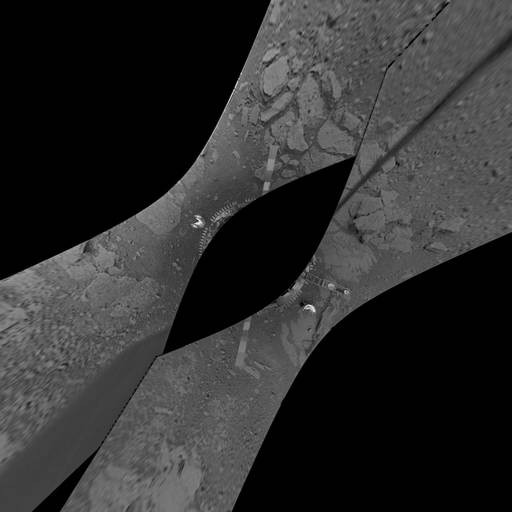
Nitpick: the photos are labeled as "Colorized images of the surface of Venus taken by a Soviet Venera lander in 1981", but
1. those photos are from Venera 13 and 14, which were taken in color
2. the photos were taken in 1982 (though the probes launched in 1981)
and 3. those aren't the original photos, they're 'enhanced' ones that have been upscaled and extended to show more of the horizon and sky than the originals. The bottom 1/4 or so is the actual original, give or take a few details that have been changed/added in the upscale process, but the rest is artistic interpretation
You can look at the actual photos here: https://www.planetary.org/articles/every-picture-from-venus-...
This site suggests it's just a remap:
The Venera panoramas are spherical projections. They can be remapped to perspective projections and overlayed (using Adobe Photoshop CS2) to produce views that give a better subjective impression of the Venusian surface
That does seem to be what the page is implying at first glance; though the images clearly show features not visible in the raw photos, so it can't be the case. I'm guessing that paragraph is actually referring to the 'overhead' image [0] next to the one in question, since it mentions how the remapped perspective makes the uniform shadows apparent.
I'll shamelessly resurface a comment I made a few years back.
There's a school of thought which views Venus as a better colonization candidate than Mars, and as early as the 70's scientists envisioned floating cities. From https://en.wikipedia.org/wiki/Colonization_of_Venus:
In effect, a balloon full of human-breathable air would sustain itself and extra weight (such as a colony) in midair. At an altitude of 50 kilometres (31 mi) above the Venusian surface, the environment is the most Earth-like in the Solar System beyond Earth itself – a pressure of approximately 1 atm or 1000 hPa and temperatures in the 0 to 50 °C (273 to 323 K; 32 to 122 °F) range. Protection against cosmic radiation would be provided by the atmosphere above, with shielding mass equivalent to Earth's.
Being able to wear a simple breathing mask while working outside instead of a full pressure suit is a boon. Of course high windspeeds and the constant bombardment of acid rain would be a problem.
I could imagine Venus one day being an exotic, cloud-top paradise for the rich (reminiscent of BioShock Infinity) that's expensive to maintain, and Mars a brute workhorse that eventually displaces it as a more resilient habitat over the very long term (eg. after terraforming).
Zeppelins on Venus are the perfect mix of scifi and steampunk, I would really wish to see that one day
Likely the Moon or Mars will be where we do a lot of bulk commodities, since the Delta-V to get the goods off of them will be lower. Then you'll have raw resource extraction in the asteroids and other very light moons. Earth will remain as the furnished goods and services location due to labor availability.
A classic triangle trade ala the sugar, rum, and slave markets in the North Atlantic in the 17-1800s.
The way you capitalized the 'V' in Delta-V had me thinking that somehow the Delta rocket family was back for a fifth iteration
I'd think the moon would be the best primary target due to proximity and the ability to possibly use large rail guns to get finished goods up into orbit.
There was this project idea that some researchers at Langley developed in the mid-2010s called HAVOC (High Altitude Venus Operational Concept) [0] for a 5-stage mission to send humans to Venus's habitable-ish cloud layers. It never really got anywhere, but there was apparently some media attention around it for some time.
Because the nitrox atmosphere we're used to is a lifting gas in the Venusian atmosphere, you could theoretically just fill a big balloon with our atmosphere and live inside it, with lots of Teflon on the outside and suits made of Teflon to work outside the habitat. I also (kind of?) remember reading about using metal nets to capture and condense H2SO4 from the clouds and process it into water, oxygen, and hydrolox rocket fuel.
[0] https://ntrs.nasa.gov/api/citations/20160006329/downloads/20...
Colonization of Venus, Geoffrey A. Landis, NASA Glenn Research Center, 2003
https://ntrs.nasa.gov/api/citations/20030022668/downloads/20...
Landis has a ton of good papers around Venus for those who want to nerd out deeper.
"Even the gravity on Venus (0.91g) is homelike, which means that airship habitats, sensors, smoke detectors, toilets, and all the rest can be developed on Earth instead of forcing us to build a space station that can simulate Martian gravity."
-----------
Imagine living on an airship high above the Earth, with the hard rule that you can never land. You must be entirely self-sufficient save for a tiny amount of material delivered infrequently. Now imagine trying to land on that airship from orbit or get back into orbit (and beyond) from that airship. None of this is easy here on Earth.
A mission that merely orbited Venus and returned without attempting to muck about with airships might be an intermediate step on the way to Mars. Trying to get closer to the surface than orbit would make things a lot harder.
> A mission that merely orbited Venus and returned without attempting to muck about with airships might be an intermediate step on the way to Mars.
I think that's exactly what the article is arguing for. The part about manned airships is just a whimsical aside to the much safer, entirely feasible, and nearly as scientifically valuable prospect of using unmanned balloons.
> Now imagine trying to land on that airship from orbit or get back into orbit (and beyond) from that airship. None of this is easy here on Earth.
Also, if anything goes wrong on Earth and you're in the atmosphere, there's still a chance you might soar to lower altitudes, eject, parachute, and get rescued. On Venus it's a death sentence.
Venus is similar to Earth in volume but a little lower in density. So gravity there would be similar to Earth but a little less, despite that it would feel like being at the bottom of the ocean or sinking into Jupiter due to the increased atmospheric pressure.
https://en.wikipedia.org/wiki/Atmosphere_of_Venus
Lets also not forget the 872F surface temp that will spontaneously ignite anything primarily composed of carbon or the dense sulfuric acid clouds that will destroy most metals in as little as 45 minutes.
> spontaneously ignite
Melt, but not ignite. There's no free oxygen to allow burning. A nitpick, sure, but probably worth mentioning.
The average lifetime of probes landing on Venus counting in minutes might have something to do with that?
"So that’s the bad part. But once you move past it, you start to notice that everything gets easier on Venus."
If wishes were fishes ...
Venera 12 holdes the record I think for 110 minutes.
Did you read the rest of the post? The author acknowledges the lander issues as well
Yes, but he only looked at Venus from the aspect of research which is missing half, or more, of the point of a Mars mission.
The advantage of Mars is that it is ( hypothetically ) acceptably compatible with persistent surface-based habitation. Not an easy life, certainly not compared to Earth, but more sustainable than balloons floating in sulphuric clouds.
Venus doesn't offer an 'alternative cradle' option unless we invent anti-gravity. Until then the emphasis will be on finding a way to improve human civilisation's resilience.
The point of the blog post is that while flying humans across the solar system to Venus so they can float in clouds of opaque sulfuric acid above a hellscape of certain death sounds and objectively is ridiculous, it's still easier and arguably more sensible than trying to send humans to Mars and back.
Yes, that is the point. It’s a good point.
But, if our airship in the Venusian atmosphere finds nothing interesting (no life signs), then there’s not much more to do at Venus, because atmosphere is all mixed and all the same. Going to the surface, even for a day or two, is hard and very expensive.
OTOH Mars - that can be explored for many years, on the surface and below the surface. We might still find nothing, but it’ll take hundreds of years to be sure.
So they solved the refueling problem you'll have when "floating" in the Venus atmosphere? Seems to me going to Venus is a one way trip.
The same problem exists on Mars and is even harder because you're at the bottom of a gravity well.
> Missions to the clouds of Venus are either going to find life or some kind of brand new chemistry, either of which will be a breakthrough discovery in planetary science. There’s basically a guaranteed Nobel prize waiting in the skies of Venus for whoever wants to collect it.
why dont they send a probe to scoop up some venus air and bring it back? seems much easier than going with humans around the moon
> why dont they send a probe to scoop up some venus air and bring it back?
Better, why don't they do some sort of "ocean fertilization" experiment on Venus cloud decks. Putative life high on Venus atmosphere must be limited by low levels of minerals. Sending a probe with a few tons of salts to disperse in a cloud patch should be enough to produce a local equivalent to an algal bloom, detectable through imaging from orbit.
Anyone who saw Night of the Living Dead knows this won't end well.
> why dont they send a probe to scoop up some venus air and bring it back?
Well, there's the scenario where a Venusian superbug, having evolved in the roughest possible conditions (temp, acidity, etc...) in the upper Venusian atmosphere, will find Earth's conditions warm, balmy, and altogether ideal to reproduce at 1000x the rate it was constrained to back home :D
Pretty sure it's not going to find earth conditions to be warm. If it's an upper atmosphere bug, it may not find Earth to be too cold, but it won't find it to be warm.
"Scientists are overjoyed to announce that the Venus Sample Return Mission has successfully scooped out a significant quantity of deadly sulfuric acid, sulfur dioxide, hydrogen fluoride, and other mysterious chemicals that have no business being in anyone's atmosphere. Scientists are describing components of the atmosphere as a 'supercritical fluid'.
"The probe's cargo vessel has a really awesome ablative heat shield on it, as well as some extremely reliable parachutes, and Mission Control is projecting a very soft touchdown in the Utah desert within the next 12 hours. If anyone in the Western United States sees a huge fireball going slower than most meteors, it is probably the Venus Sample Return vessel full of dangerous chemicals! Go VSRM!"
Selenian Boondocks did a whole series on Venus and what could be usefully extracted from the atmosphere a decade back. https://selenianboondocks.com/category/venus/
Lol Instead of article about Venus I read the one linked in the article https://idlewords.com/2025/02/the_shape_of_a_mars_mission.ht...
Because, to be honest, whats the point? We can pretty much determine the composition of the atmosphere with spectroscopy, and we can't land without being crushed, boiled and dissolved at the same time. If we go to Mars, we can potentially find things on the surface (eg interesting geological formations) much faster than a rover could, and potentially run more in-depth scientific tests on what we do find, rather than just what we can send on a single rover
We shouldn't set foot on Mars for a long, long time. Read the bit about contamination.
> We can pretty much determine the composition of the atmosphere with spectroscopy
I don't believe (could be wrong, not an expert) that spectroscopy is sharp enough to tell you about the structure of complex molecules in Venus's upper atmosphere.
Please read the article.
> The phosphine detection was controversial when it was first announced in 2022, but it has since been corroborated by multiple measurements.
I thought it was resolved as SO2, not phosphine
I thought so too, but the phosphine signal turns out to be small but real. What everyone involved in the back and forth debate over it agrees on is the need to send better sensors.
Kurzgesagt's Venus video:
The biggest problem is it's spin rate: a Venus day is 116 days Earth days or so.
Being completely tidally locked would be better because near the transition zones the permanent sun would make solar power and plants quite productive.
But an ecosystem where the planet spends most of the year in darkness or dim light?
Basically it's relatively easy to redirect comets to provide gas and liquids for the surface of Mars: that's technically demonstrated technology now.
There's almost no plausible way we could add momentum to Venus to give it a more reasonable day night cycle (I have seen some suggestion that shearing asteroids into it might be possible, but just the magnitude of momentum you're trying to add is staggering).
If I remember correctly, the habitable-ish cloud layers have super-fast winds that circle the planet once every 4 days or so. [0]
[0] https://en.wikipedia.org/wiki/Atmospheric_super-rotation
> But an ecosystem where the planet spends most of the year in darkness or dim light?
If you're floating you don't have to track the ground.
Does the atmosphere itself track the ground? I'd expect the slow rotation to drive persistent winds, potentially keeping weather systems somewhat tidal-locked as well
True but you basically lose the benefits of being on a planet. The point at which you're just floating in atmosphere I would argue you might as well be in orbit for all the resupply complexities, but few of the benefits - I.e. an orbital structure without significant atmosphere around it means high Isp low thrust engines like ion drives are practical to come and go from it and a lot of the energy is free from solar.
> you might as well be in orbit for all the resupply complexities
The difference is in air pressure and gravity.
Gravity means comfort for astronauts. It also makes, I suspect, science and industry a bit easier.
I don’t know what air pressure means. Spacewalks probably get easier. But now your structures have to deal with aerodynamic forces, which is annoying. Making up for that, you’re suspended in a soup of precursors and reagents—that opens up ISRU possibilities. And you should be getting less radiation in atmosphere.
On the whole, if you’re doing planetary science, I think being in the atmosphere is hard to beat. If you’re doing any industry, being near raw materials beats shipping anything unprocessed out of a gravity well. So if you’re staying for a while, you dip in. If, on the other hand, you’re just visiting for a few days, yeah, take a lander and then get back out again.
There are other advantages versus orbital habitats, not least that your station doesn't have to be a pressure vessel - equal pressure within and without makes big structures a lot simpler.
The atmosphere would also block the majority of radiation, which is a huge concern for proposed orbital or Martian settlements.
All right, but if outside is one atmosphere of sulfur dioxide, you still don't want any air leaks.
The atmosphere has a perfectly reasonable 110 hour day/night cycle.
> But an ecosystem where the planet spends most of the year in darkness or dim light?
How would that work? Averaged over the planet, you get half the year in darkness and half the year in light. There's no other option.
We have that same ecosystem on Earth.
Why not the Sun?
People laugh, because we can't do it because it's so hot, but what they don't get is we'll go visit at night.
What are you going to do 12 hours later when it's daytime again?
We'll just launch from the Arctic during winter.
I'm pretty sure the sun is on the equator
I’ve had a hypothesis ever since studying biology and things like complexity and emergence years ago:
We will find life almost everywhere there is an energy gradient, a sufficiently rich substrate, and phase transition boundaries. Life is just a thing that forms in such places.
In our solar system that is Venus, Earth (of course), Mars, Titan (I predict very slow metabolism cryogenic life with a hydrocarbon solvent), and subsurface oceans like Europa if they have a heat source that creates phase boundaries and energy gradients.
It will be mostly simple life though. What we won’t find everywhere is complex life. That took billions of years on Earth. It probably takes a very stable very rich large scale ecosystem with a huge energy flux to cook things like complex multicellularity and cognition, and there are reasons to believe Earth is a rare sort of environment.
Life is merely an orderly decay of energy states, and survival requires the continual discovery of new energy to pump into the system. He who controls the sources of energy controls the means of survival.
-CEO Nwabudike Morgan
"The Centauri Monopoly"
Why not the Pacific Ocean
Venus is in what I call the thermolocks zone, not the goldilocks zone. The thermolocks zone is optimal for solar power and perhaps therefore for computation, although heatsink radiators are essential.
The atmosphere of Venus in particular is very resource rich, and so it would be incredible to mine it for heavy use by a space economy. This mining is supposed to use free solar power. All of this is a job for robots, not humans.
Fuel for interplanetary rocket barges (coal lined tubes fed from liquid tanks oxygen), produced in the floating factories of Venus.
Sure, why not?
The advantage is that the inevitable chemical spills won't make the atmosphere any more hazardous.
I think it's important to preserve the integrity of the Venus surface for when we have substantially mined its atmosphere. That's when Venus could begin to present an opportunity for limited human habitability. We'd then have to use mirrors to redistribute sunlight evenly and boundedly across its slowly-rotating lit and dark sides. We could try to create an artificial ozone layer to block UV. We'd still have to neutralize the residual corrosive substance (unreacted chlorine, sulfur, fluorine) using water and alkali chemistry and scrubbers. The raw materials for alkali would come from the planet itself. Water would have to be imported from the space economy, probably from asteroids, also as hydrogen from Neptune's atmosphere using fusion powered lift.
Why not Zoidberg?
Very longterm the human species needs to get further away from the (growing) sun.
Venus is the wrong direction, with useless challenges. And thus a waste of resources.
Outwards. Not necessarily Mars, but outwards. No compromises.