One reason an expedition to Mars is forever two decades away is because of the leap in difficulty between landing to the Moon and going to Mars.
There’s not a big difference in energy between the two destinations. Any rocket that can land on the moon can easily put a crew in Martian orbit. The issue is time.
As we saw recently with Artemis II, a spaceship can get human cargo to the Moon and back in about ten days. But orbital mechanics makes it hard to complete a trip to Mars in less than two years, and rigid launch windows further constrain options for abort or rescue. Bridging the gap between the two weeks we’ve spent on the Moon and the long, committal journey we’d have to make to Mars runs us into a thicket of difficulties.
In other words, the ladder to the stars is missing some rungs.
It would be nice if there was a class of mission intermediate in difficulty between the Moon and Mars, one that didn’t take us so far out of our experience base and had better abort options than ‘press the red button and wait two years’. Even better if the mission had a milder radiation environment, shorter communications delay, and a high potential for scientific discovery.
This class of mission exists, but no one likes to talk about it:
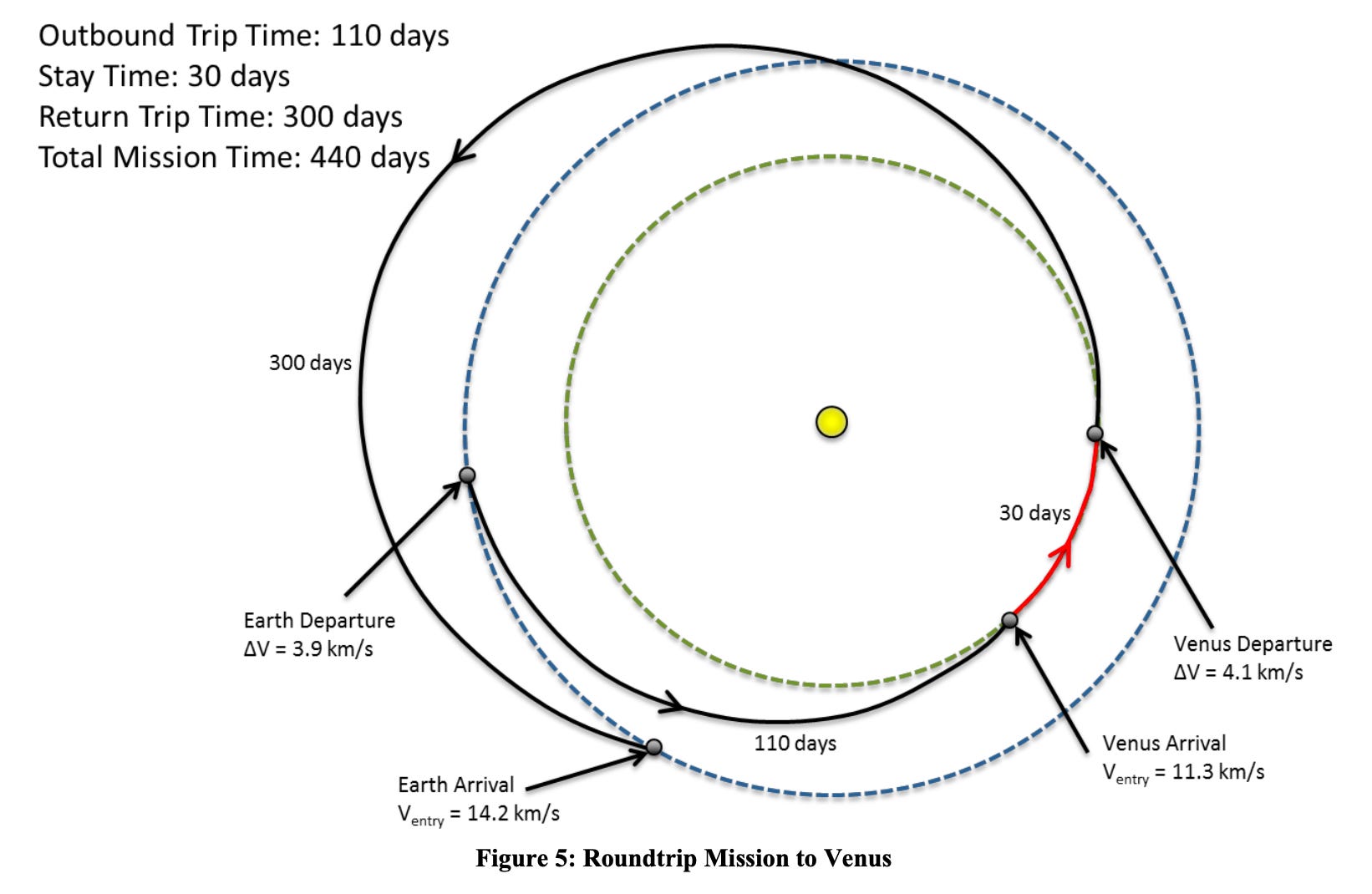
An orbital trip to Venus is like one of those gorgeous high-rise apartments in Jersey City. Everything about it is perfect except the location.
And I understand the reluctance! Venus is the biggest heartbreak in the Solar System. The planet could have been Earth’s twin, but instead became an acid-washed nightmare and climatological horror story. People have never recovered from the big reveal in the early Space Age that the clouds enveloping our beautiful planetary neighbor covered a hell world.
But with Venus, you have to adopt a ‘glass half full’ approach, even if the thing the glass is half full of is concentrated sulfuric acid.
To get the bad stuff out of the way, the surface temperature on Venus is around 470°C, about as hot as a pizza oven, and the pressure is 92 times what we enjoy here on Earth. The high cloud layers, while temperate, are mostly sulfuric acid. And because volcanic activity has reworked the planet’s surface within the last billion years, there is little hope of finding Mars-like relics of the planet’s habitable past, even if we could build the rovers to look for them. If young Venus had temperate oceans or harbored life, the evidence for it has been buried about as thoroughly as anything in this solar system can be buried.
So that’s the bad part. But once you move past it, you start to notice that everything gets easier on Venus. The atmosphere is great at blocking radiation. Solar panels can be small, and the pressure and temperature in the high clouds are so Earthlike that, if not for the acid, an astronaut could sit in the gondola of a Venusian blimp wearing only an oxygen mask and a swimsuit.
Launch windows to the planet recur every 19 months, compared to 26 months for Mars, and the round trip communications delay is about half of what a Mars-bound crew will face. Abort trajectories still aren’t great, but are about twice as fast as trying to make it home from Mars. And everything goes faster: the orbital mission I cited would get the crew home just three days past the absolute duration record for human spaceflight.
Even the gravity on Venus (0.91g) is homelike, which means that airship habitats, sensors, smoke detectors, toilets, and all the rest can be developed on Earth instead of forcing us to build a space station that can simulate Martian gravity. An entire class of hard problems around physical deconditioning just goes away. Astronauts flying the friendly Venusian skies could recover from the short transit from Earth in a sunny, homelike environment, and if they ever wanted to roast a turkey, they would only have to lower it a few kilometers through the atmosphere on a fishing pole.
There are anomalies in the Venusian atmosphere that are consistent with the presence of life. Unlike on Mars, where any living microbes are presumably deep underground, life on Venus can only exist in the clouds and should be easy to observe (or rule out) with cheap balloons and aerostats.1
Maybe the strongest piece of circumstantial evidence is the detection of phosphine, a gas that has no business being in the atmosphere and should degrade rapidly (within days or weeks) in sunlight. The phosphine detection was controversial when it was first announced in 2022, but it has since been corroborated by multiple measurements. Like the detection of methane on Mars, the pattern of occurrence of the gas remains puzzling.
But the presence of phosphine is just part of a larger pattern of anomalies:
The lower part of the Venusian atmosphere contains an ‘unknown absorber’ that captures about half of the incident ultraviolet light. Its changing large-scale patterns and absorption characteristics are reminiscent of phytoplankton blooms on Earth.
There is an unexpectedly high proportion of water vapor to sulfur dioxide in the high atmosphere. The two gases share a common volcanic origin and should have a similar abundance profile, but SO2 is significantly depleted.
Ammonia exists in the cloud layers, although it should not be possible for it to be there.
There is molecular oxygen in the clouds with no identifiable source.
The clouds at around the 45 km level contain a population of particles called the ‘Mode 3 haze’ . The composition of this haze is unknown, but the particles that comprise it are not spherical, and so cannot be droplets of liquid.
The atmosphere in general is not in chemical equilibrium.
I wrote a few weeks ago that the key constraints for life on Earth are temperature and water activity. For all that the climate in the Venusian clouds is balmy, it’s insanely dry, a hundred times drier than the Atacama Desert. Any life that existed there would have to fight for each molecule of water against sulfuric acid, which is desperately hygroscopic. While complex organic chemistry can exist in acid droplets, it would not resemble anything like the biochemistry we know on Earth.
This is why the detection of ammonia in the otherwise hyperacidic atmosphere is so intriguing. If there’s a mechanism that raises the pH in at least some droplets to around ~1, then Earth-like extremophiles could thrive and be able to photosynthesize in the clouds of Venus2.
Venus researchers Janusz Petkowski and Sara Seager have made an intriguing case that all the anomalies I list can be explained by the presence of microorganisms that produce ammonia from nitrogen and water. The ammonia would react with sulfuric acid to create a kind of slurry, accounting for both the depletion of SO2 and the Mode 3 haze. The pH in such a neutralized droplet would be close to 1, a perfectly livable environment for acidophiles we find on Earth. And a byproduct of their metabolism would be molecular oxygen.
The appeal of this theory is that it’s ridiculously easy to test. Unlike Mars, where we have to delve deep underground to hope to find relic life, we can just go look at the clouds on Venus with a party balloon. The mission is simple enough that Petkowski and Seager are flying a private version of it with RocketLab as a side project, funded by an anonymous benefactor.
The way I like to think about this question is that we can’t lose. Missions to the clouds of Venus are either going to find life or some kind of brand new chemistry, either of which will be a breakthrough discovery in planetary science. There’s basically a guaranteed Nobel prize waiting in the skies of Venus for whoever wants to collect it.
A more sober case for exploring the planet is that we only have three terrestrial worlds to work with. We should learn all we can about how they formed, how they function, and why their fates diverged if we want to better understand exoplanets that humanity won’t be able to physically visit for millennia. Right there is no way to distinguish Earth-like from Venus-like worlds in exoplanet surveys, or even to identify meteorites on Earth that have a Venusian origin. What we learn on Venus will compound our understanding of planets across the sky, not to mention our own planet’s climate.
As a NASA paper points out, humanity has accumulated 31 years of surface time on Mars and 49 years in Martian orbit, but we’ve spent just 4.5 days spent exploring the Venusian atmosphere, and 9.4 hours on the surface. When you consider that every mission to Mars has brought fundamental shifts in our understanding of the solar system, it would be strange if Venus didn’t have surprises waiting for us as well.
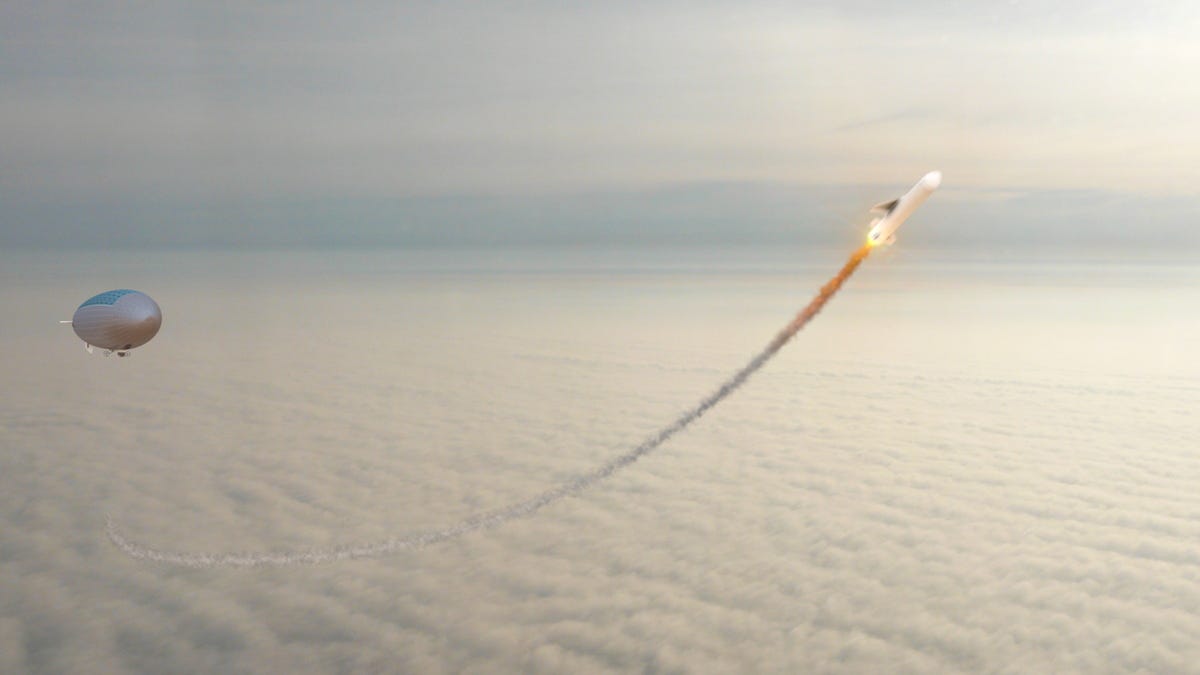
There is no planet friendlier to the extraterrestrial balloonist than Venus. Since the gravity, pressure, and temperature in the high atmosphere are all close to Earth, all you need is to apply a little acid protection to your aerostat, and you’re good to go.
And in fact, balloons on Venus were the first aircraft to fly off Earth. Two Soviet Vega probes in 1985 each delivered a French-made helium balloon to the atmosphere. The balloons cruised around at 54 kilometers for about two days before their batteries ran down, covering about 10,000 kilometers in the process.
There are different balloon designs, from easy to hard. The easiest type to fly is a fixed-altitude balloon, which is just a weatherproofed version of the Chinese spy balloon that terrorized America back in 2024. Such a balloon would drift around with the wind and could take advantage of the fact that solar panels in the reflective clouds can point in any direction, with no need to track the Sun.
The next step up from this design is a variable altitude balloon. These balloons use pumps, reservoirs of boiling/condensing water, or just brute force to compress the lifting gas in their envelope, allowing them to vary their altitude by several kilometers. Such a balloon could dip down into the lower cloud layers that are too hot for sustained operations, as well as explore conditions through the full putative habitable zone (45-65 km).
The most ambitious balloon design is a hybrid balloon/flying wing that looks like a B2 bomber that really let itself go. The flying wing would be buoyant, but also sufficiently plane-like to move freely around the atmosphere. The hard part about getting one to Venus is the atmospheric entry. The behemoth would have to serve as its own heat shield, which means it would probably take several practice attempts to stick the initial landing.
And finally, there is the solar-powered airplane. A large enough model could outfly the winds and linger on the sunlit side of the planet for weeks or months. The difficulty here again is delivery. A plane would have to fold up tightly to fit into an aeroshell, and how to get it unfolded and flying in midair is the big technical challenge.
But these are fun problems to have! The science return on any airship design with 2026 sensor technology would be phenomenal, and they could all be rigged to drop a series of sondes or mini-landers down to the surface.
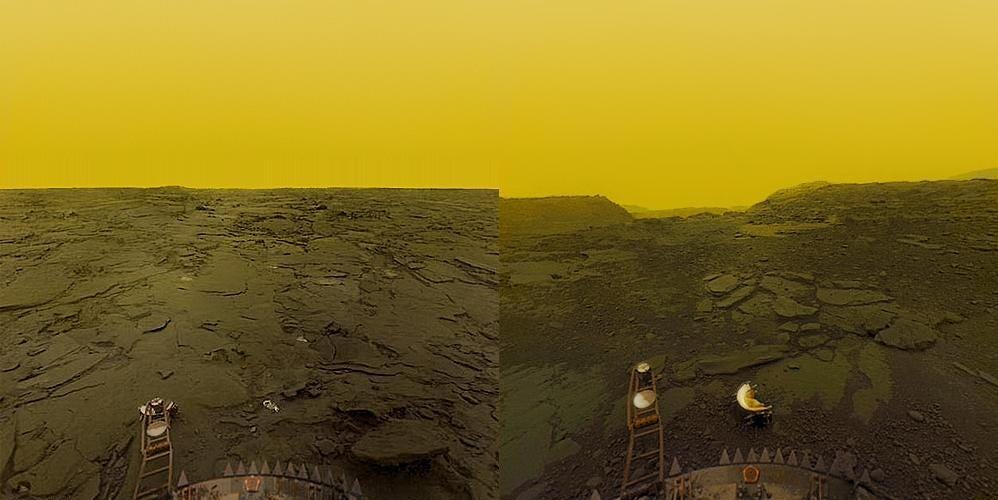
There are three approaches to handling the problem of heat on the surface of Venus.
The simplest one is denial. You send down a chilled probe wrapped in all the insulation you can manage, and try to arrange a high-bandwidth conversation with an orbiter to maximize the amount of data the lander sends before it cooks. The Soviet Venera landers, the only spacecraft ever to take pictures of the surface, followed this approach. They kept their instruments in near-vacuum inside a titanium sphere and likely survived for several hours after landing (their useful transmission time was limited by line of sight to the orbiter).
A second approach is to put the more sensitive electronics in a refrigerated box. Refrigeration on Venus is a relative term—the cold box on a chilled lander will still be at around 200°C, enough to beautifully roast a chicken. And running a fridge on Venus means having a hot-side radiator at some frightening temperature like 1200°C. But the overall concept is simple: you use electrical power to keep an insulated compartment significantly below ambient temperature, and maybe put in some sapphire windows for the cameras to look through. Such a hybrid design extends the lifetime of a lander from hours to several days or more.
The final and most metal approach is to dispense with refrigeration entirely. NASA has been experimenting with integrated circuits made from silicon carbide that can take a thermal beating. The Glenn research lab has kept chips running at temperatures over 500°C for a year, and even built prototypes that function at 900°C. These electronics are primitive, but more than capable of handling signal processing, amplification, basic imaging, and many of the other tasks you want in a Venus lander. There are even motors strong enough to turn the wheels on a rover. The technology level of this stuff is early 1970’s, but when you consider what kind of data we got from Viking and Voyager, the prospect of doing sustained red-hot science on the surface is thrilling.
Powering a long-duration surface probe is a challenge. Because the surface is so hot and dim, solar panels are impractical. One study estimates solar panels on the surface of Venus would generate about 8 watts per square meter, compared to ~500 watts at an altitude of 60 kilometers, and ~2000 watts in low orbit.3 Industrial batteries exist that work at temperatures near 400°C, but there is still some work to be done to get them functioning at the ambient temperatures on Venus. Nuclear RTGs could work, but have to run extremely hot.
On the plus side, because the atmosphere at ground level is thick, a small wind turbine might be enough to keep a battery topped up indefinitely. As long as we can live with low data rates, a next-generation lander could stay alive on the surface for several months.