Ultrathin business card runs a fluid simulation
github.comAdvantages of a business card sized hollow box partially filled with water:
  * more realistic fluid motion
  * cheaper, easier build
  * easier to debug
  * risk of wet butt when you sit down
* less joy of doing hard things* less joy of doing hard things
Have you tried to fabricate such a box? I wouldn't be so sure.
It also solves a fluid mechanics problem much faster and more accurately than de digital one!
I love good finger toys at my desk to keep my ADD busy while I'm working. They need to be:
- Light: If they make a clanking noise every 5 seconds when you pick them up and put them down its just distracting.
- Plastic: There are other materials that work, but in general metals and fabrics react too strongly with your fingers over time, whereas plastic can be easily cleaned.
Having a little water window isn't a problem, but the water is also not as directly cool looking. Usually in the '90s you'd get those mixed color oil/water toys where the colors would make them stand out more, but shaking them would mix the substances causing them to lose function.
As such the electronic version is quite durable in comparison.
Disadvantages:
* excessively fast fluid motion at card scaleincrease viscosity of said fluid
It doesn't work that way, unfortunately. The virtual fluid represented by the LEDs does not move anything like syrup. It's like looking at a small image of water sloshing in a big tank.
To get of fluid to behave that way on the scale of several inches, the fluid would have to be massive (very dense) while simultaneously gravity would have to be reduced.
> the fluid would have to be massive (very dense) while simultaneously gravity would have to be reduced.
/joy of doing hard things intensifies
> It doesn't work that way, unfortunately
It works exactly that way.
> To get of fluid to behave that way on the scale of several inches, the fluid would have to be massive (very dense) while simultaneously gravity would have to be reduced.
No, it would just need to be very viscous. Viscosity is literally resistance to flowing, density is not, and a less dense fluid can nevertheless also be more viscous (honey is less dense than saltwater, but saltwater is much less viscous at STP [standard temperature and pressure, 0°C and 1atm], while mercury is significantly more dense than granite but something like 23 orders of magnitude less viscous at STP.)
Viscosity is literally a function of how a fluid behaves, but okay, whatever, probably a good take
Defined as:
> a change in shape or to movement of its neighboring portions relative to one another
You can use two different fluids instead of water and air.
Starting point: Ocean waves in a bottle
things you get away with when you remove one level of simulation...
* no rust
Unless the case is iron.
Very nice, but probably a bit too expensive to just hand out.
I knew a chap that had a similar hardware business card (I don't remember exactly what it did, but it wasn't as cool as this one).
I remember that his card was pretty scuffed up, and he insisted I give it back, after he handed it to me. Bit weird.
Maybe you wouldn’t give em to just anybody, but anybody who gets one is guaranteed to remember you!
I’d probably even keep it in my desk to play with. After a few weeks I’d accidentally have this guy’s email/linkedin memorized for eternity
I'm just imagining interviewing a candidate for a job involving embedded systems and this dude pulls this out at the end and says "If you have any other questions, my email's right on there."
What an absolute baller this guy is.
Still has to respond "no" on the post interview scorecard because the given solution didn't use the optimal ObscureLeetCodeAlgorithm
I mean, the candidate can design and build innovative custom hardware, but do they remember an obscure impractical algorithm from a second semester CS course? No? Obviously not a fit for this company.
(This assumes that the guy passed through the resume filters and advanced to the in-person stage, which is not that easy. Should work on a video call though.)
I am thinking how most of the people I get business cards from are people I've already invited in to my office and are discussing some potential business relationship. They've often flown to my city, staying in a hotel, paying for transport, meals, etc. The impression they make during that 1 hour meeting is paramount and I think this is certainly going to leave a lasting impression. Most of those business cards just get tossed into a drawer or trash bin, I bet people keep this one on their desk a play around with it.
This matches my experience fairly accurately except for the one guy I met at a housewarming who handed out cards to everyone. It was so weird - I haven’t seen anyone do that in real life. He had a shop that repairs chipped windshields.
And you know what? About 8 months later my windshield got sprayed by gravel. That guy got the business (he’s a friend of a friend after all, and I had his number in my wallet).
I’d say the issue isn’t that cards are outdated. It’s that people aren’t using them correctly.
I had an ad on Facebook marketplace for a synthesizer. The guy who bought it gave me his business card - cloud architect for a competitor. He didn't give it to me because we were in similar field - we had a pleasant conversation over shareEd hobby and he gave it to me then, after which I realized we were in same field, so clearly he gave them around a lot.
If I consider changing jobs, or if I need those very particular services he's getting a call :-).
Definitely still a market for regular cheaper business cards for stuff like this. I regularly keep cards of people like this were I might need their service in the future, but they don’t need to be fancy at all and I don’t think it really adds much value when they are. The market for “good service” in trade type labor that I’d always hire a guy I have even a weak social connection with over some random person I found online. I feel like there’s a higher chance of them not price gouging and caring about the workmanship.
But, I don’t think he’d be handing out $20 BOM cards that freely. I was more validating that there is still probably a market of people where $20 cards might make sense. As in the example I posed, a business card isn’t providing any additional information. By the time I meet these people in my office, we’ve already exchanged emails and had some conversations on the phone and are acquainted. That’s what led to the in-person meeting. I know their names and have them in my contacts.
But, just as it felt like a social faux pas to receive a business card at a housewarming party, I think it also feels like a faux pas to meet someone in a business environment (where you are the selling party) and not give out a card during the initial first handshake interaction. This is a pretty low volume and high value moment for that person so a $20 card is no big deal and could easily make sense.
I have what I call my “Victorian Calling Cards.” I’m retired, and have no need to advertise or boast.
They are fairly fancy moo.com cards, with my name, email, and cellphone. Nothing else.
On the back, is a fancy “dragon head” logo (the one you see, if you look at most of my social media accounts). It’s actually my old artist signature. It’s over a burnt umber gradient.
People like them, and use them.
This is true.
I remember a story linked from here, recently, where a designer submitted a CV that was a custom-made widget of some kind.
He got the job.
In the way back days when we submitted our CVs on paper, I always cut mine to a smaller size than letter, in a branded folder. People tend to stack things with the smaller items on top. I don't know if mine actually was on top of the stack, but I can say that I basically always got the contract.
I used to subtly watermark mine with nerdy silly diagrams, in the hopes that someone noticed the hints of color and gave them a second look. I even ran a plain vs watermark experiment, and the watermark had almost double the response.
Another trick was adding a "Valid until <YEAR> in the cover". It seems counterintuitive that a CV expires, but it made a few companies approach me for an updated CV.
I believe Sears famously used that same move (probably close to 100 years ago) to cause their catalogs to be stacked right on top of the Montgomery Ward one!
I'd include a sad tomagotchi that after a week or so guilt tripped you into giving it back, its heart broken, missing its original owner.
That’s a funny way to try and get people to get back in touch with you, haha.
Feed your animal by calling me once a month to check in (and get the monthly "food code")
> but probably a bit too expensive to just hand out.
These are generally done as portfolio projects. It’s driving a lot of traffic to the website.
Producing a small number to hand out to potential freelance clients or job prospects is also common.
I half expected this to have a button/mode to show custom QR codes...
I tried, that's why it's 21x21. Still haven't managed to get it to read.
I might be wrong, but you might need need (at least) a 23x23 LED matrix to have a white border around the outside to give it the contrast needed (the "quiet zone", since QR data is black).
This is why my first prototype had a white border around it. The LEDs were red back then, so I don't know exactly what I was thinking, but I was aware of the problem.
https://github.com/Nicholas-L-Johnson/flip-card/blob/main/me...
Could as well display the name and/or email, if rotated just so.
That's a good idea!
How much does it cost? The guest passes for hacker conferences are full-on computers these days, if this is in the same price bracket it would be a great idea for those.
There's a BOM, you can find out. Plus some peanuts for the PCB :)
Now whether you get it populated or not..
https://github.com/Nicholas-L-Johnson/flip-card/blob/main/ki...
Just as a point of interest perhaps for folks who are not familiar with PCB design and modern electronics: the "huge" matrix of 21x21=441 LEDs would, with the specified LED from the bill of materials (BOM) cost all of $6.
That is based on the price for low quantity (1-500 pieces) though; if you were to build more than one board you would buy more LEDs, pushing the per-LED price (way) down. You can get 4,000 LEDs for $30.'
Edit: here is the LED in question, from the BOM [1].
I don't know, I struggle with a light switch, but that doesn't look like board someone took home with a box of parts and a soldering iron to make at home.
Are there services that you can send the BOM and board files too, and not only do you get the PC board back, but it's populated? Will they do that for a onesy-twosy thing like this?
Then all you have to do is supply the battery and download the firmware (however that is done).
Yes, I’ve done it for a batch of 10 with https://jlcpcb.com/smt-assembly for around $10/board including the PCB
>$10 per business card is extremely high, though.
Not if you're at a trade show in an industry where a single deal can net millions of dollars, and a small booth might cost $15k just for the space for a few days.
There's definitely an entire business available for expensive trade show merchandise, including electronic business cards. People routinely give away shirts and other merchandise that cost far more than $10..
I wouldn't even necessarily give one to anybody. If you're looking for a job just point to this block post in your resume/site and that's equally impressive.
Giving the actual card though leaves a feeling of guilt... sort of like those old surveys you would receive in the mail, with a $1 bill included. A hyperlink is forgettable.
Or give out a regular paper business card with a QR code on it pointing to your resume website...
snicker
If you ask for it to be handed back, it's not a business card. It's a toy.
Just put a QR code on the front that transmits a vCard. Or a way to make the LEDs on the back display a QR code. Then you can still show people your digital business card, even let them hold it and play with it, but it's still obvious the idea is for them to scan the QR code and hand it back.
You don't hand out business cards to everyone, only to those who deserve one.
Exactly my thought. Just make it a desk toy.

The typical Chinese sources have been selling "digital hourglass" type ornaments that work like this for a while.
There was a whole game based on this sort of thing back on the Acorn Archimedes: Cataclysm https://www.youtube.com/watch?v=3Byyz1Vlv8w It got remade for the 360, but the original was regarded at the time as surprisingly impressive for the machines it was running on.
Wow what a cool retro fluid simulation game!
Oxygen Not Included simulates a whole bunch of different kinds of fluids and gasses, and has a sandbox mode and debug tools.
I love using it as a kidpix-like painting tool, just to see how all the different materials interact.
Is there a Digital Disco Ball?
You could make a bad analogue of such a thing using WLED - although as many people have observed it has a tendency of turning anything anywhere into looking like a vape shop.
The problem is so much of the effect of a disco ball is irregular directional beams reflecting off it, which would be hard to do.
If you like this, you'll also love Mitxela's fluid simulation pendant [0], and likely all of his work! I'm consistently astounded by how informative and enjoyable his stuff his. He shares so much, so freely and it's so well produced, with a lovely voice to boot. Inspirational! Watch his vids, read his write-ups or both! We need more people like this.
That was very clearly mentioned and linked in the article, too.
Guessing he found it from the reddit post where he mentions it in lower parts of the comment chain but not in the actual post. The project itself does clearly mention it but I had the same reaction when I first read the post remembering the mitxela project clearly. https://www.reddit.com/r/embedded/comments/1mkkd4z/my_busine...
I actually found him originally from his incredible clock: https://mitxela.com/projects/precision_clock_mk_iv
Which was posted here a while back: https://news.ycombinator.com/item?id=44144750
I'm a sucker for a novel clock concept, and the level of detail he's operating at is beautiful to witness. I actually have a collection of cool clocks here: https://lynkmi.com/oisin/Clocks
Ahh, today it is my turn to fail the online reading comprehension test! My bad, I'm just very into Mitxela.
+1 for mitxela, dude never ceases to amaze
The circle works much better for the fluid simulation.
And now I can’t stop thinking about those circular LCDs and OLEDs they sell in China as (evidently if unofficially) devboards for not-overly-smart watches, thermostats and such.
I bought one recently and none of the provided code samples would compile. Zero support.
Wow that's a nice design.
£1200 for one though.. oof.
All 24 sold out very quickly, within hours.
Nice one. 28800 pounds :O
For most of us makers it's very hard to make money as our things sell for so little that it's like 3€ per hour to make them. Kudos to this guy, he really does his marketing right.
If you are curious what PCB designs or schematics look like, you can use an online viewer for KiCad files to find out yourself:
https://kicanvas.org/?github=https%3A%2F%2Fgithub.com%2FNich...
@creator of the card (phirks?): have you considered further interactivity or maybe using the LED matrix for showing text or other information?
You could use touch buttons for control as they basically add nothing to the BOM?
Edit: this is of course really awesome as it is
I was thinking of throwing in a game like Tetris with just accelerometer controls. That'll be after I find a job though. Numbers were actually the first things I displayed, I actually still have all the code to display them still sitting unused.
Text has been less of a success. Having the letters be easily legible takes more space than I would have thought, and the small pixel fonts don't look great with the big spacing between the LEDs. Maybe some scrolling text would look good, but I haven't focused on it too much. I tried getting a QR code displayed, but it didn't want to scan.
For buttons, I'm kind of married to the idea of no buttons. The accelerometer does recognize clicks and double clicks in different directions, so that might be useful for something.
I encourage anyone who wants to fork/contribute/post issues on this to do so and I'll try to be a good maintainer.
Thanks for the detailed reply. I actually like the idea of using the accelerometer as input device and the design choice of using no buttons.
What’s the update rate of the LED matrix if I may ask? Maybe the combination of an accelerometer and the LEDs lends itself to a persistence of vision display?
> That'll be after I find a job though.
I can't imagine you'll be on the job market for long (and I certainly hope not).
This is such an amazing looking for work ad, I'd imagine you'll get snapped right up.
Major kudos on this. It's amazing!
>Amazing project, but the font on the back of the card is gross.
>It sort of reminds me of those research professors that have received multiple awards and their website is an unstyled HTML page with 4 links
>If they used a sans-serif font then they would have nailed it
>this particular serif font was also a poor choice out of the variety of serif fonts out there
>that's awesome, but i think since it's a business card the text on the back should be more legible (nicer font and/or bigger)
Ok, for real though, can someone just tell me what font to use? We can all see this isn't my strong suit and now you're in my head.
A few business card typography tips off the top of my head:
— White on black (inverse) is less legible, so all else equal compared with black on white the font should be bolder and/or bigger for equivalent readability. (Using caps or small caps is also OK in display text like titles, if it reads easier.)
— Legibility is also impaired by visual noise around the text (it’s not a single color but there is some pattern, for example). Compensate for that, too.
— Unless you really know what you are doing, stick to one font. You can use bolder/lighter variants of the same font.
— Never compress fonts vertically or horizontally. Instead, pick a different font. Many fonts have condensed/compressed alternatives, or there is also Impact if you want it.
— Use white space. Padding lets it breathe.
— Use typographic features. Em dashes (separate them by thin spaces), bullets.
> Embedded Design⠀⠀⠀Hardware ∙ Firmware
or
> Embedded Design — Hardware, Firmware
vs.
> Embedded Design - Hardware/Firmware
That said, everything except the first two is subjective. A relaxed vibe of “don’t give a damn about it” might be strategic if you are good at what you do (and crucially it is not design), as long as your card is legible and does its function.
Is this any better? I hid the vias
https://github.com/Nicholas-L-Johnson/flip-card/blob/main/me...
https://github.com/Nicholas-L-Johnson/flip-card/blob/main/me...
I personally think it is better and I like it a lot more. On the other side the concise “Shake Me” is fun, and “Powered by Rust” makes sense there. Curious how would it look when in physical form…
Thanks for all the help. I'll be ordering this soon and I'll be sure to post it.
You should see the font on Paul Allen's card.
My defaults are sans-serif Helvetica or Roboto, serif Roboto Serif, and monospace Fira Code
swoons


> board edge usb-c port
This is awesome. I bet we see a lot of these in the future once people realize it's possible to have a USB-C port on your board with no extra parts and zero soldering.
That must be very fragile! Gotta be careful when unplugging, pulling very straight.
I thought this was one of the most impressive parts of the design, had no idea this was possible.
Off topic, but where should one start learning writing physical simulation?
Several years ago I ran into this project [0] and got overwhelmed even the algorithm can be written in 88 lines of C++. I realized that out of all CS topics, physical simulation is probably the one I knew the less (not saying I'm a compiler/database expert or something, but at least I've implemented a toy compiler and some basic data structures used in database. When it comes to physical simulation my bran just draws a blank.)
Probably what you want is "numerical methods" and "computational physics".
"Physical simulation" is a very broad scope, so your code for simulating fluids is going to be very different from your code for simulating planetary orbits, and at times it may feel a bit ad hoc. But at its foundation physical laws are written in differential equations and linear algebra.
So whatever algorithm lets you numerically integrate several inter-related variables is going to be broadly applicable to simulating any physical phenomena. At the simplest end of the spectrum you just naively approximate integration by brute force. Eg at each step just update your physical state variables by doing velocity += acceleration, position += velocity. This is called Euler's method, and while simple, it accumulates unacceptable errors rather quickly in most circumstance. The more advanced approach is to use a method like Runge Kutta. In circumstances where you have some known property, like say energy conservation, you can implement a method which explicitly imposes the constraint. This is good for cases where the motion is highly periodic as it prevents the numerical error from accumulating exponentially in orbits that spiral out of control.
Of course at some point you'll have to grapple with the issue of if you are simulating trajectories of free particles or values of neighboring grid points in a field. This question of how best to encode physical systems and simulate them cuts to the heart of physics.
I'll leave it at the old cliche "information is physical"
Rigid body simulations are much much simpler. There’s a siggraph course from 2001 [0] which is a bit of a dense read but it will bring you all the way up to a full blown rigid body simulation and understanding the math behind it too.
Ive done one myself. Very fun and very valuable project, with alot of optional deapth.
Solar system simulation is another fun one, leaning more into nummerical differental equations solving.
Though in this case there's not much more than 500 points, which even if you scale up is manageable.
It’s less about the number of points and scaling and more about understanding the fundamentals. Any sort of particule simulation (which is the easiest way to get into cloth, soft body and fluid dynamics) requires about the first half of that paper I linked anyway.
One thing that helped me was doing some tutorials for pico-8, an intentionally 'weak' game platform, one of which is a platform game with a simple / understandable inertia / gravity simulation (jumping, running left/right; think Mario). It was understandable enough with an x / y position for the character and a delta-x / delta-y representing their current speed. Every frame the dx / dy would get changed depending on player input and/or character state.
Ex: if player presses jump button, set state to 'jumping' and dy to 1. Every frame, dy = dy * 0.9. When dy <= 0, set state to 'falling'. Every frame, dy = dy * 1.1 until dy = 1 (terminal velocity). Then add some collision detection.
I think those basics are also behind the simpler physics simulations, the 'falling sand' types would be ideal for an application like this.
Gravity is constant acceleration (in most games). Your algorithm is broken.
For statistical mechanics, I really liked [1]. Comes with loads of python programs.
To see what might peak you interest, the videos in [2] could be a good starting point.
[1]: https://www.coursera.org/learn/statistical-mechanics
[2]: https://matthias-research.github.io/pages/tenMinutePhysics/i...
Just go to Perplexity or something like that, its well trodden ground. And essentially, what you're doing is discretizing the relevant differential equations and getting that to run in a 2D or 3D cellular automaton.
I'll give you a simple example. For diffusion of heat between 2 points, the rate of change (first derivative) is proportional to the difference in temp between them. So you make an update rule for points on a grid that says "calc the average difference of a cell's temp with that of its neighbors, multiply by some constant, and that is the amount to update this cell at this time. Run that for every cell in parallel, many times." Then you tack on a visualization and you can watch the heat diffuse. A fun example would be the cooling of the proto-Earth. You can watch the crust form.
Heat diffusion is a good starter problem. So is gravitational interaction.
Essentially all physics simulations are either particle based or based on integration of differential equations (although in a computer both approaches involve a discretization which makes them somewhat computationally similar). You can consider reading through Numerical Recipes which is sort of the bible for this stuff for physicists, but it is aimed at scientific audiences with weak CS background. Something like Computer Simulation of Liquids by Allen could be a good start too. Let's be clear that the approach I'm talking about here is focused more on physical correctness: if you are a game designer it's not important that your fluid simulations are physically correct and more that it looks physically correct to a player, and there are a variety of more heuristic techniques for something like that.
The Nature of Code by Daniel Shiffman is an excellent entry point - it teaches fundamentals of physics simulations with clear examples in Processing/p5.js.
For water simulation, look towards learning compute shaders.
Eulerian (grid-based) simulation is one of the classic examples.
State of the art in 2009:
https://www.tokyoartsandspace.jp/en/creator/index/B/124.html
Beautiful design! I want to say as a maybe helpful review point that I see overlapping silk in a few spots. Ideally it would be nice to clean that up, possibly removing all designators which for my personal preference would work, but some people might like to see those. Also I would choose a more playful font for the back text but I like playful. This is an excellent project, nicely done! I’m doing a lot of RP2350 LED work right now, I’ll have to see if I can run your code on the pendant I am designing.
Would love to see more information about how it was built. He must have worked with a company that can do the surface mount assembly?
Electronics can be surprisingly easy and cheap to build these days. He designed the circuit and layout with software called KiCAD (free and open source) then submitted the designs to a fabrication house - probably a popular offshore one - that easily can handle that level of board and component placement complexity. It would probably cost only a few hundred to build and ship, with 1 month turnaround time.
You can also hand-assemble surface mount parts by applying solder paste carefully to the pads, then placing all the components on the paste and heating the board until all the solder melts. That would have very time consuming for all those LEDs!
There's also some homebrew pick-and-place machines and soldering ovens, but that's probably a bigger upfront investment than the offshore companies can offer.
As long as there aren't surprise 50% tariffs.
This was something I had to look into earlier this year. We found that even if tariffs were 200-300%, JLC and PCBway are still half the cost of domestic USA board houses, while also somehow providing half the leadtime. They are an absurdly good deal.
I remember William Osman (who established Open Sauce) talking about how they manufactured the badges for the convention, which are mostly just one large pcb, and how they looked into having them made in the US but there were no companies even offering the same kind of service. So it is not just that the Asian suppliers are cheaper, it is also that there isn't really a competitive US made alternative even if you were willing to pay more for it.
Here is the link to the episode (without a timestamp): https://www.youtube.com/watch?v=S78lYvjo2JQ
And this is how the badges looked/worked: https://www.digikey.com/en/maker/tutorials/2025/assembling-y...
Yep. And if you go to Shenzhen, some shops will take on varying amounts of board design and prototyping for you. It's possible to get boards fast and for cheap, like less than a few days and even cheaper when the goal is larger quantities for semi-serious products.
For a few hobby or toy things, the fixed rate board stuffing shops are the way to go.
>He must have worked with a company that can do the surface mount assembly
He did (there are centroid files in the production folder, which tell the board house where to put the components), but you'd be surprised at how possible it is to assemble something like this by hand. You won't believe me, but I find it easier than through-hole soldering (because you don't have to keep flipping the board over).
But there's a 99.9% chance this was done in-house at JLC or PCBWay.
Indeed, JLC for this one, though I did start off by hand assembling the first version with a 3D printed jig to locate the LEDs.
No need to reinvent the wheel. Hand assembling all those leds looks like a nightmare.
You can get boards like these made for single-digit dollars per unit* even at prototype scale, through companies like jlcpcb.
*I haven't looked at the specific parts for this board, the LEDs look nice and could be a little pricey.
Boards, but can you get the pick and place and the soldering done? I wouldn't want to be soldering that many LEDs by hand!
Every major chinese PCB supplier has offered very affordable PCB assembly ("PCBA") for several years now where you give the gerbers for the boards along with a BOM with part numbers from a mutual supplier catalog and p'np / solderpaste mask data and they will load up a p'np machine and oven run a small batch of boards for you.
e.g.:
That price is including PCBA. Without it would be <$1/board
Yeah, wondering how the LEDs were aligned so precisely. Some kind of silicone grid-like jig to hold them while the solder reflows? Or is it just pick & place robotics doing what they do with precision?
The surface tension of the solder will pull them into alignment if the pad shape and solder volume are correct.
i absolutely love the form factor!
a similar one was beamu (eink screen, nrf52 with bt): https://nicgardner.com/2020/05/09/beamu-first-impressions/
(this was an actual product, if a bit pointless. i have one still)
any others?
This is so cool. I wish something like this had the ability to load your debit/credit cards into it. Advantages over using the card directly or a wallet app on your phone.
1. You don't voluntarily give your financial transaction info to big tech.
2. Your card details are hidden. So if your wallet gets stolen, less danger of fraudulent transactions.
3. Carry one heavy card instead of many light ones.
4. Don't have to memorize the pin of all the cards. Or the pin just shows on the mini screen after finger print authentication.
Do you use any of the features? This is kinda cool, I love when people pack way too many features into a single product :P
didn't really buy it for the advertised features, although networked tic-tac-toe works fine. :-)
Instead of a business card, I'd love an ultrathin pleasure card you can refill with virtual beer and virtually drink! You could input your weight, and it could track you BAC!
I made "PalmJoint", a beamable Palm pleasure card for CodeCon 2002, when everybody was beaming their contacts around by IR at conferences, I would beam an interactive doobie simulator a bunch of people could play together in a circle. Each person gets their own doobie, and you can have contests to see who can virtually smoke theirs the quickest, or keep it lit for the longest time. I never get around to implementing an IR token passing network:
https://donhopkins.com/home/images/PalmJoint.png
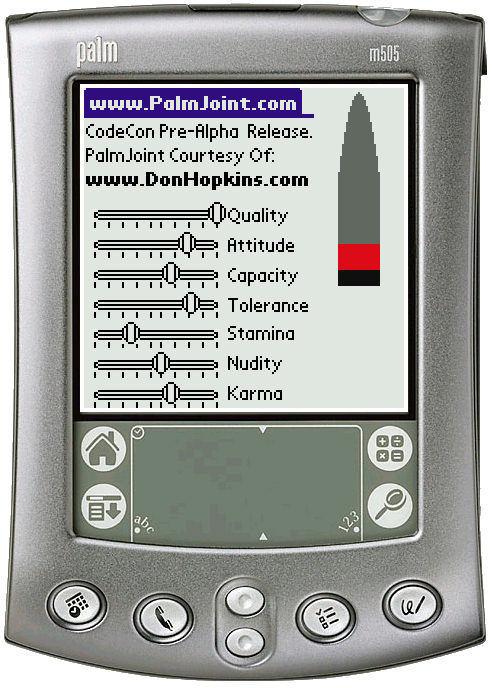
https://donhopkins.com/home/PalmJoint/Src/PalmJointMain.cpp
Some conferences of the era had kiosks with IR LEDs that beamed out a Palm app with a conference map and schedule, which would have been great to hijack for beaming out PalmJoints instead.
Ha! That's pretty cool.
My first thought with this card was that it could be "gamified" into something that kids would probably love. A clique-y, social thing where kids could "pour" some of their fluid into another's card, with NFC or something. User preference colors that don't change when "poured" could help indicate how many different people have interacted with your card.
But enough spitballing. There's no killer idea there. Just something I'll be amused to see show up as a value-add for some other kind of toy, or whatever.
Stuff like that is dead now btw (yes, it makes me sad too). Kids have iPhones; the idea is great but can just be an app. Which tbf makes more sense because you get the benefit of imu & everything else for that behaviour.
Remember those little LCD cube block toys with the stick dudes that lived in 'em, then when you plug 'em together they interact? Those were the days.
The Movable Feast Machine (movablefeastmachine.org)
44 points by mekaj on Nov 20, 2015 | hide | past | favorite | 11 comments
https://news.ycombinator.com/item?id=10600001
The T2 Tile Project:
https://www.youtube.com/channel/UC1M91QuLZfCzHjBMEKvIc-A
Artificial Life Creation T-0 and Launching - T2sday Update 3135:
Cool thanks for the links but are they mass produced commercial products known & bought worldwide? Because that's what I was referring to; kinda the digital but pre-touchscreen-slab type devices age of 80s-2010s.
Those little cube world blocks were neat: https://corporate.mattel.com/brand-portfolio/cube-world
Maybe I grew out of the age range or maybe the whole market of silly knick-knacks has died out but they definitely drove my interest in all things electronic.
Liquid Pokemon Eggs and Sperm! Gotta catch it all!
Then you can lay the fertilized eggs at any GPS coordinate to gestate and hatch later on.
That could start a whole genre of AI (Artificial Insemination) Life Simulation games.
Until hackers get in and add Pokemon STDs >>
Thus the Pokemon Plug-In STD SDK.
I love it; I bought a secondhand Palm just before smartphones became a thing for cheap and had a lot of fun with it. I wonder if I still have it somewhere and whether it still works, I haven't seen it in ages though so probably not.
small ad-hoc networks like that with IR and early bluetooth were a lot of fun.
For beaming a lit joint around, you would definitely need an acknowledgement that it was safely passed, lest it drop on the floor! But how would you prevent duplication if several people received the same joint? I'd just mark that bug "Intended Feature: Will Not Fix."
The Bluetooth Bong was a vast improvement over the MIDI Bong.
MIDI aftertouch on the carburetor was a nice improvement over your grandfather's old Serial Acoustic 300 Baud ASCII Bong, but the Bluetooth Bong HID has a much higher bandwidth, multitouch chording, accelerometer tilt tracking, modular monophonic splash resistant microphone, and they weren't as easy to accidentally knock over because they were wireless. An extremely important feature if you have cats around.
But nothing beats a high-end spill-proof Rooᴙ 802.11be NVB (Network Video Bong) with fully submersible IPX8 smoke resistant stereo mics.
I love when people don't have to talk to explain how the hell they are expert in a domain.
This is a very good example, nice work !
that's awesome, but i think since it's a business card the text on the back should be more legible (nicer font and/or bigger)
Agreed. I'd never hire this embedded system engineer to do graphic design. /s
Amazing project, but the font on the back of the card is gross.
That’s cred, man. Real cred.
Wack font. Circuits exposed. Pixels with fat borders between them. An ugly charging port. But more stuff, packed into a small sleek volume than reasonably possible. Working perfectly.
That’s not Jobs. Oh, no. It’s effing Woz.
The guy is a true hardware engineer.
It sort of reminds me of those research professors that have received multiple awards and their website is an unstyled HTML page with 4 links
Sort of, but if the objective is to get hired for a hardware design job, I think that even the font aside, the overall aesthetics of the PCB aren't great. There are several places where component text overlaps other markings, some components are slightly offset from others for no reason, the pattern of stitching vias is pretty chaotic... I think it's actually the software part of it that's most worthwhile.
For the most part I agree, but the purpose of a business card is to be read. You can barely read that text.
The render is pretty gnarly, but it's not quite that bad in person
https://github.com/Nicholas-L-Johnson/flip-card/blob/main/me...
The card is so impressive that it doesn’t matter much, but I think that if you remove half of the text in that card and make it very legible it would burn your name into people’s brain.
The card should not have any text on it, but show his info on the screen when the card is first shaken, and after it has been held still for 4 seconds, before going to sleep after another 10 seconds of no motion.

Impressive, very nice. Let's see Paul Allen's card!
Awesome project, but why is this considered “ultrathin”?
I would think a business card that is as thick as a usbc port + pcb would be considered pretty thick.
It's not as thick as a usbc port, look at the picture of them charging... the usb plug is much thicker than the card.
ah I see, its still several times thicker than a business card though.
so is it ultrathin relative to a phone?
The simple box-shaped container and low framerate/low gravity simulation doesn't show off what the FLIP algorithm can do.
The algorithm is a more expensive combination of two simulation methods to support both splashes and incompressibility, but the benefits are barely visible in the simple container.
One note for the readers here: an electronic business card has a VERY LARGE effect on those you give it to. More than I expected when I made mine. It is surprisingly effective. Even if the BOM is $30, it'll pay for itself in the ease it adds to a job hunt easily
It's not white, it's bone.
Now, let's see Paul Allen's ultrathin business card that runs a fluid simulation.
> One of the more difficult features was the rechargable battery.
Flat ones do exist. I have one eink TOTP card that's no thicker than a normal credit card.
And also an airtag style tracker that's about twice as thick. Maybe it uses the same kind of battery.
O.4mm thick rechargeable battery:
https://www.lithium-polymer-battery.net/ultra-thin-lithium-p...
Standard credit card: 0.76mm thick
seems dangerous to have terminals of battery exposed, shorting (and with rechargeable, burning) hazard
Some conformal coating spray would probably be all that’s needed.
Very cool. Though, I was waiting for the video to properly 'shake' the card.
Interview with the maker:https://usesthis.com/interviews/tim.jacobs/
My bad: "That's actually not the same guy. He made the pendant that this project is based on."
THANK YOU phirks for the correction. Much appreciated.
That's actually not the same guy. He made the pendant that this project is based on.
I like this one: https://michaeldriver.co.uk/The-Business-car-d-1
If they used a sans-serif font then they would have nailed it
That and the overlapping silkscreen hurt to see, but otherwise a super cool project. Although they're very minor things that don't technically matter, it can give off certain impressions to people.
Not nearly as tasteful as Paul Allen's card.
disagree, a nice serif font is more distinctive with most of everything using a very tight cluster of boring sans-serif fonts.
In that case I will add that this particular serif font was also a poor choice out of the variety of serif fonts out there.
I sort of like it. Looks like a Neon Genesis Evangelion episode card
It would be cool to have a USB C connector that goes through the PCB so total height is that of the connector and not board+connector.
Like this one:
https://www.adafruit.com/product/5180?srsltid=AfmBOopEIapZEq...
But with supports along the sides that could solder one the top and/or bottom of the PCB. You'd have a notch cut out for the connector.
It is.
rather it's even smaller, it simply has the inner part of a usb c connector - exactly the thickness of the pcb
similar to https://github.com/cnlohr/ch32v003_3digit_lcd_usb/
In the implementation, the design uses a 'card edge' type connector with the whole PCB fitting into the constraint of the thickness of the center blade of the USB-C connector. So when charging, the board slots into the cable-end connector, and when not charging there is only the PCB. The PCB has cut-outs for the cable-end connector to fit into the PCB -- so like you're saying, but even thinner.
Thought the same but from what I can see those are somewhat uncommon, presumably you are unable to affix them to the board as securely as the typical connectors
The images in the GitHub show that the card has this.
For those that want more details on how the software works, this guy goes into a bit more detail for his version
Fluid simulation pendant https://mitxela.com/projects/fluid-pendant
No issues mentioned with battery being exposed on both terminals? Seems like easy short hazard.
Is a cr2032 shorting it is not dangerous, it can’t supply the current to get hot enough do any real damage.
It says rechargeable, maybe a CR2032 size but prob lithium chemistry. Even a small size could create quite a hazard if shorted.
The C in CR2032 means lithium fwiw. As in it's lithium either way.
The LiR2032 (rechargable lithium) are slightly higher voltages but pretty much the same total energy.
Fwiw if you ever have electronics that require 3V minimums the LiR2023 is better than the CR2032 since it's 3.7V vs 3V in the same form factor. It's common knowledge that the ESP32 for example can glitch on a CR2023 since it needs 3V minimum but it'll actually run fine on a LiR2032.
Yep, the rechargeables of this form factor are also pretty safe. They just don’t have much current capacity, as they are meant for long life (years) and long current draw.
I was expecting a regular business card where the paper was so thin it flowed like fluid.
Nice work, awesome presentation
they should've added this card in that American Psycho scene
Cool toy or business card? Either way, it’s unforgettable.
lol, if you look at the firmware, it is essentially a bunch of if-else statements, rather than very complex simulation code.
The fluid simulation logic is split into a separate crate.
https://github.com/Nicholas-L-Johnson/flip-card/tree/main/fl...
This beats the Bateman card. Excellent work!
But does it beat the Joel Bauer business card? It took 25 years to design!
Any way to buy one maybe?
point of order: these are thicker than normal business cards.
Amazing. Just don't show it to Patrick Bateman.
Practically pregnant with electric potential
"I can't belllieeeve RMDNZ preferred L-Johnson's card to mine"
"Silian Rail"
Surprise no one's mentioned yet that the firmware is written in Rust. As someone who's struggled with getting started with embedded Rust (the landscape seems to be changing quite a lot?) it looks like a good example.
Also it's a bit startling to see floating-point code used so freely. Shows how rapidly the capabilities of MCUs have developed. 15 years ago, doing floating point on a microcontroller would be unspeakable /s
Yeah embassy has improved tons recently. This is because embedded Rust is receiving a lot of investment from industry, embedded engineers desperately want a real C alternative there.
[flagged]
He's an hardware engineer, not a software engineer.
After many years of self-hosting an email server I also came to the realization that it's not worth the hassle (in terms of maintenance / problems) and I switched to Proton Mail.
Using a custom domain with Proton Mail is not free (and all the other alternatives I know of are the same) and there's little advantage other than having a nice name. I think for a HW Engineer this is good enough.
I wouldn't recommend self-hosting email to anyone, but the expense of paying Proton Mail is absolutely worth the peace of mind (you are in control of your email & can effortlessly switch email providers) and professional appearance.
We're talking about someone handing out $17/ea business cards here.
To be fair it fits in with the Github and LinkedIn links.
We getting our stories from Reddit now?
You’re going to get downvoted obviously but this appeared on Embedded (or electronics?) and then made its way here. It’s a bit telling the actual hacking communities are on “that awful site” that’s so beneath us, meanwhile our pristine HN is full of gushing AI ads as front page hacker material.
I only mention this because this was posted here at, approximately, 08:00 EST 2028-08-08, and posted on Reddit at, approximately, 00:00 EST 2028-08-08.
They’d rather post there than here. https://www.reddit.com/r/embedded/comments/1mkkd4z/my_busine...
This will finish in the trash at some point like any other business card, but, good job.