Orthic Shorthand – Write as fast as you type
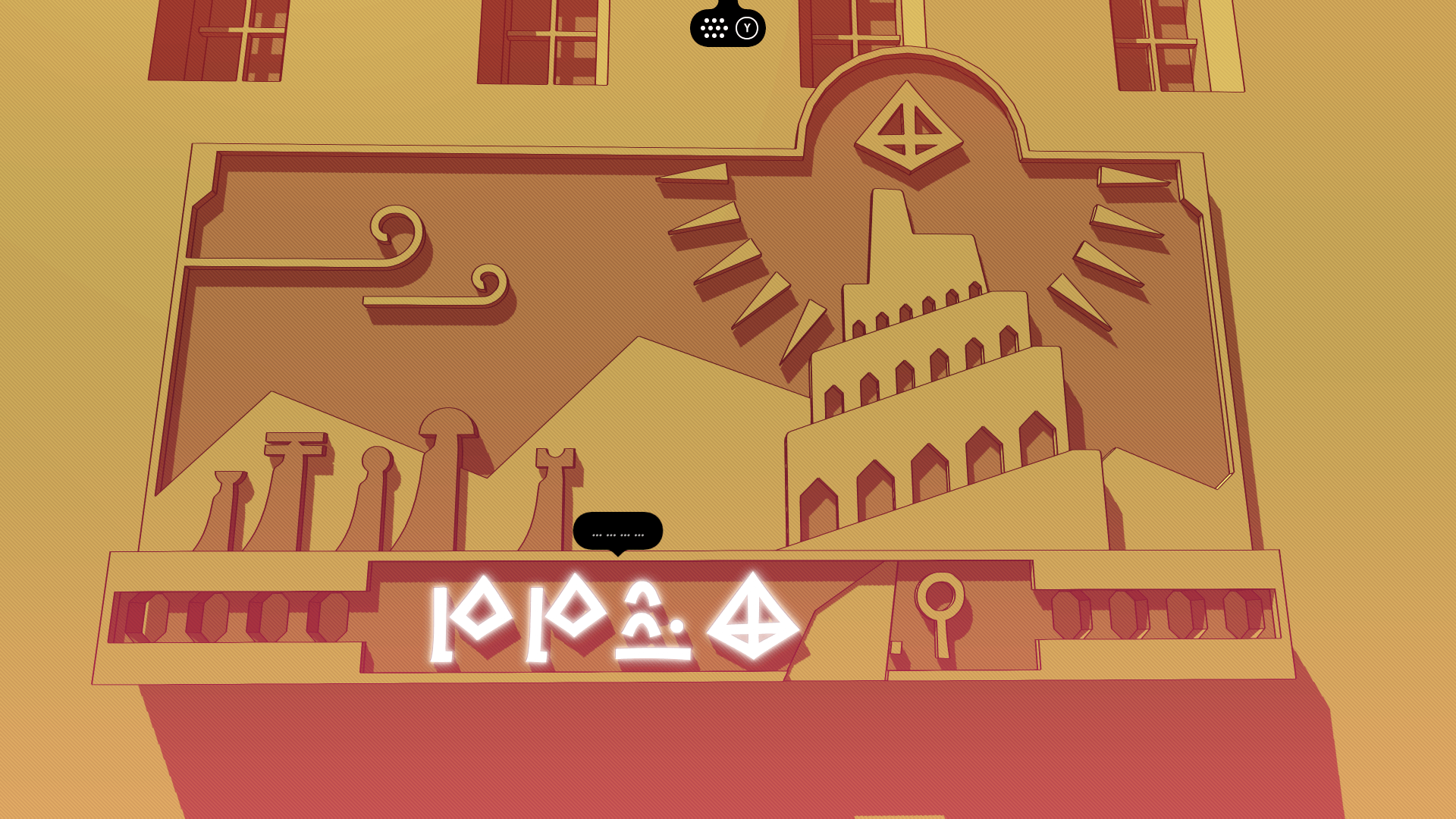
orthic.shorthand.funLooking at images of shorthand makes me remember how much I just enjoyed playing the 2023 game Chants of Sennaar: https://www.rundisc.io/chants-of-sennaar/
The game’s dialogue and story are all written in a series of ever more complex writing systems, unseen and novel to the game. There’s a mechanic where you get to prove to the game you understand what is being written or said (characters have subtitles also in the writing systems) and it’s really good fun!
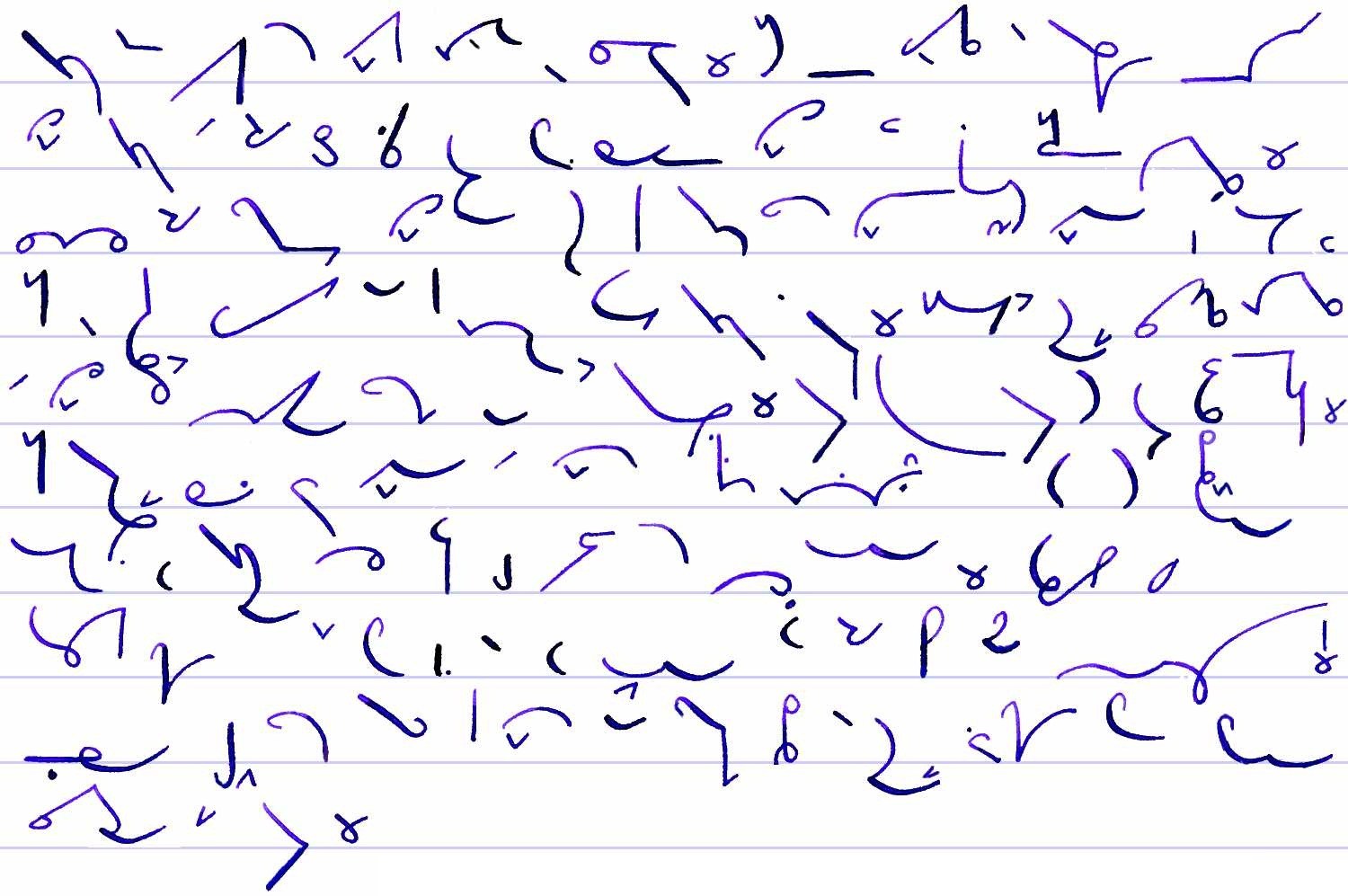
Pittman shorthand: https://4.bp.blogspot.com/-6Wr53ouD4Ok/WhxIZR6AOZI/AAAAAAABI...
Sennaarian writing: https://cdn.focus-home.com/fhi-fastforward-admin/resources/g...
I prefer Gregg shorthand to Pittman because Gregg doesn't require variable stroke width and thus it's easier to write with a ballpoint pen.
(Pitman doesn't require variable stroke width, but variable stroke darkness/pressure - important nitpick because you can vary pressure with a normal pencil, but need a fountain pen or uncommon carpenter's pencil for varying stroke width).
Most ballpoints aren’t very good at delivering variable stroke darkness, either.
That reminds me a lot of the game TUNIC, where, similarly, a big part of the game is figuring out the language.
You're able to actually translate the language? I assumed it was not decipherable and you just have to figure it out from the parts that are translated, trial and error, and interpolating/extrapolating.
Yep, the language is consistent! Although you can usually always get by with the later.
A similar game is The Expression Amrilato, a love story where you gradually learn the language Esperanto. After beating the game, you've learned a real language, and can now speak with people from around the world. You also learn, however, an idiosyncratic writing system which is only useful within the game.
I learnt Pittman shorthand (and some Greg), and taught it to my kids as a "secret code". They use it in class to jot notes the teacher cannot read :)
Both of these make the writing faster, but reading slower. I once spoke the world's champion shorthand writer - I've forgotten her name. She said the even she cannot read shorthand as fast as regular text.
Which made sense before computers, when a stenographer needs to write very quickly, and English is written long.
Bt, nowadays we need the opposite - a "shorthand" which, once you have learned, can be consumed quickly. I know from experience that it takes much less time to read Hebrew than to read the same text in English (even though my mother tongue is English), since the vowels are assumed and abbreviations are extremely common - the actual text is shorter and quicker to read.
I can scan a long article quickly, but I wish there was a way to convert that to a writing system that was quicker to intake.
Use other languages, perhaps? English is a relatively compact language in terms of visual space, but there are even more compact languages. Typical examples include East Asian languages (Chinese, Japanese and Korean) and Nordic languages (Danish, Finnish, Norwegian and Swedish).
I remember seeing a study about the "information density" of different languages and of all the languages covered, English was #2 in terms of information per syllable while Vietnamese was #1.
A shorthand system is free to represent words phonemically instead of orthographically, and most languages have fewer phonemes per word than letters (or strokes/radicals/jamo if you're looking at Asian characters), so it would make sense to just always do that. So maybe Vietnamese would be the most compact if you used a phonemic system, but I actually think it's more complicated than that.
There are a limited number of different types of strokes you can include in a shorthand system before they become too similar to each other, so you are capped in how much information per second can be written regardless of the language. Different languages have different numbers of phonemes (Rotokas has just 11, while Taa has over 100). If you have very few phonemes, you can group clusters together into single strokes, whereas if you have many phonemes then you may need multiple strokes for a single phoneme.
So what you'd really want is the language with the greatest information per phoneme divided by the total number of phonemes, or another way of putting it, how well it fits into a .zip file :)
Japanese isn't compact. It generally uses fewer characters to convey the same meaning (unless the sentence is full of loanwords from English), however the problem is that the characters are usually written significantly larger than Latin characters, simply because they're so much more complex, so the amount of actual space on the page comes out roughly the same.
Han characters are of course much larger than Latin characters, but the resulting space usage is more nuanced AFAIK. My data about the relative compactness of languages mostly comes from localization researches [1], and I believe CJK is generally more compact even when such differences are accounted for (but the actual expansion ratio can greatly vary).
[1] Search for "text expansion translation" to get the general idea. I've mainly referred to the guideline from https://eriksen.com/language/text-expansion/ but many other guidelines agree. See https://www.w3.org/International/articles/article-text-size.... about the general phenomenon.
The only thing that was correct in your link regarding Japanese is "varies".
As for Han characters, Chinese uses those. Japanese uses a mixture of kanji (ancient Chinese characters) and native phonetic characters. So the space needed really depends on the content. As I said before, if it's full of English loanwords (or worse, English technical terminology that's been adopted into Japanese), it'll likely be larger, since all that is expressed in katakana (phonetic characters). If it's something that can be written in mostly kanji, then it'll be quite compact.
Korean does not use Han characters at all. It uses Hangul, an artificial phonetic writing system invented about 100 years ago.
> The only thing that was correct in your link is "varies".
Because I didn't bother to link all guidelines I've found. ;-) Other sources, for example, say that Japanese has a relative contraction of 10% to 55% [1], which is really variable but still supports my claim. There is also an inforgraphic about specific scenarios [2] with a similar conclusion for all CJK languages. It might be possible that some guidelines only show the character count and thus adjusted for the visual space, but I see no reason that most guidelines, primarily from professional translation companies, would get that same point wrong.
[1] https://gtelocalize.com/text-expansion-and-contraction-in-tr...
[2] https://d1sjtleuqoc1be.cloudfront.net/wp-content/uploads/202...
> So the space needed really depends on the content. As I said before, if it's full of English loanwords (or worse, English technical terminology that's been adopted into Japanese), it'll likely be larger, since all that is expressed in katakana (phonetic characters). If it's something that can be written in mostly kanji, then it'll be quite compact.
You are correct (I do speak Japanese), but again, the general concensus seems that average Japanese texts do have enough kanjis that make up for some loanwords. I'm well aware that the balance has been greatly changed in recent decades though, so I'd like to be corrected if there is a well-known analysis.
> Korean does not use Han characters at all. It uses Hangul, an artificial phonetic writing system invented about 100 years ago.
Hangul was invented in the 15th century. Only the specific orthographic rules and the current name "hangul" were established ~100 years ago. It took more decades (i.e. circa 1990) for Han characters to be mostly gone from the written Korean, and I observed the final transition as a native Korean speaker.
Sorry, no, Nordic languages are not compact. They may stuff more words together (e.g. generalforsamling instead of general/annual meeting), but just putting two words together doesn't make it more compact or easier to read.
As I noted in the other comment, there does exist multiple guidelines that do suggest a relative text compaction of many Nordic languages when translated from English. Guidelines themselves may have been biased to specific set of texts, of course. If it's the case I'd like to hear counterexamples.
> Nordic languages (Danish, Finnish, Norwegian and Swedish)
Do you have a citation for that? I know some Swedish and often need to read documents in it and I don't get the impression that it's any more compact than English.
Any Estonian will tell you that Finnish is similar to Estonian except that it takes twice as long to say anything.
Finnish is not remotely similar to Swedish, and it's Swedish that I'm skeptical about.
Try out Forker shorthand. You can learn it gradually, and the first steps are omitting vowels and simplifying some letters. You then progress to various abbreviations. Ultimately, it's based on the English cursive so there's nothing too exotic to learn in terms of orthography, although I guess if you are younger there is a chance you never learned a cursive style! I'm a novice but feel like it doesn't hurt readability that much, and it's quick to learn.
Quick intro: https://imgur.com/a/zYyON
English is flexible. Concise writing reads faster.
> Which made sense before computers, when a stenographer needs to write very quickly, and English is written long.
Stenography is where it was at! My mom's second husband was working at the local parliament and had to take notes, in real time, about what politicians were saying and he'd use stenography. He'd then hand his "stenographed" notes to a secretary that'd convert them back to english, which he'd then proofread.
It was french btw, which is even longer than english (about 20% longer).

Another one is Teeline: https://en.wikipedia.org/wiki/Teeline_Shorthand
I used to be a journalist and tried to adapt it for my language (Estonian) years ago, but eventually gave up. Possibly tried it with Gregg also, which is the coolest one visually IMO. Orthic is entirely new to me, thanks a lot for this link!
I tried to learn Shavian and struggled with it because of its phonetic nature. Every time I wanted to spell something, I had to think about how I pronounce the word.
Also Shavian was designed around British sounds that makes using for Americans cumbersome
I can’t even read my own cursive, so I can’t imagine how illegible my shorthand cursive would be.
Does anyone have any experience with this that suggests that maybe it can be clearer than cursive?
One can always hope…
I have some experience with a German shorthand style (DEK) and it is more important to write clearly. Shorthand removes most of the redundant information that is present in regular alphabets and words. With regular writing, a small error somewhere can be error corrected using the surrounding context. When I wasn't being careful, I could often read the text shortly after I wrote it, but after a few hours or days it became illegible to me.
There are multiple levels of shorthand, the faster ones drop more and more information from each word if it can be inferred from the context (for someone familiar with the topic, i.e. yourself mainly).
Shorthand never really stuck for me. Learning to write and read it wasn't that difficult actually, but I couldn't quickly scan shorthand notes like I could with regular writing. I suppose that's a matter of practice and I wasn't ready to sink hundreds of hours into just that. One thing I learned from the experience was how frustrating of an experience it is if you're not good at reading. I have always been an above average reader and I couldn't understand how people struggled so much with it. Reading shorthand was effortful and slow, especially at the very beginning for me and that gave me some perspective of how some of my classmates must have felt.
I suppose it's a little like UIs. Old school, green screen UIs have a learning curve and can result in very efficient usage. Modern, friendly UIs sacrifice speed for presentation and accessibility.
If you want to optimize for legibility rather than speed, a fountain pen with a stub nib might help. Stub nibs are designed to make handwriting look a bit like classic cursive with no effort from the person. But they can also improve handwriting legibility by providing a particular feedback, basically, it stops some bad movements you hand might be doing.
I have most success with nibs which are very smooth but stubby. TWSBI Diamond 580 with 1.1 mm stub nib worked best for me, but it takes bottled ink.
I have found my cursive hand getting much better after spending some time with Gregg shorthand.
The emphasis on curve and proportion in Gregg has made my cursive hand much more regular, flowing and pleasing to the eye. I’m sure similar benefits would accrue to learning and practising Orthic where specific curves, angles and joins have meaning.
oh interesting, i had the opposite experience. my handwriting has always been barely legible and after i started experimenting with gregg it became so much worse!
For pure legibility, abandon cursive and shorthand of all forms. Learn technical lettering, and then relax it a little.
I use Orthic to jot down notes. It has been perhaps two years since I implemented it. I view it as a tradeoff - it is way easier and faster to write… but harder and slower to read. This is why I use it for brief notes primarily. Perhaps the most consistent issue is mixing up the letters “e” and “u” but there are other ambiguities that creep up too, so sometimes you have to read a word a few times. I think I am getting better though.
Oh yes, and it takes up way less space, so it is very economical, you can cram a lot of notes into a single page of a pocket-sized notebook
My mom went to a professional school for "company secretary" or something like that in the 70s and learned shorthand notation (and typing). I recall trying to learn from her books as a kid, it's not that hard.
But she never seemed to actually use it later in her life (she still touch typed tho!).
I wonder how useful shorthand is in these days when cheap recording devices are available in everyone's pocket.
Maybe people who keep hand written diaries still use it?
My mother-in-law was taught shorthand in the 1960s UK and still uses it regularly. We work together in a family business and any meetings we go to she'll jot notes down using it, the amazing thing [to me anyway] is that she can read it afterwards!
It's a fantastic skill but so rare to see these days, it was mainly used by secretaries dictating notes to then type up I think. Now we are our own typists, it's largely relegated to history.
I keep a handwritten journal. I definitely do not use it.
Funny but I do use it. My license signature is even in Gregg
Is anyone aware of any good iPad apps for writing notes in shorthand, then converting to text? I currently use an app called Nebo to write notes and journal entries, then convert them to text before uploading into other systems. It works well, and I really appreciate being able to get away from a keyboard, but I'm a much slower writer than typist.
Imagine the rennessaince in shorthand if this became a thing. It feels like the best of both worlds (writing and typing).
But much worse for reading. If the system can translate it into text though (conceptually no different from the dictation button) then I agree it could be a big win.
I like the idea of a faster handwriting script. I've actually found the old Graffiti script pretty good (fast and clear) for writing notes. I remember I used to see it on whiteboards when MBAs were writing -- probably showing off. Unfortunately if I write on my ipad (my main use of it) the OS does a pretty good job of OCRing it so I can search my notes. The same thing isn't possible with anything abnormal like Graffiti.
Classic shorthand has never worked for me as it records the sound rather than the semantics. This is reasonable as a way to time delay dictation (when you read the shorthand you hear the sound in your head, so you type as if you were hearing the person speaking in realtime). But when I read I don't hear any sounds, so this would be like listening to the person speak, which defeats all the advantages of reading.
Just for context, the word "Graffiti" is talking about the proprietary single-stroke writing system from Palm, Inc. https://en.wikipedia.org/wiki/Graffiti_(Palm_OS)
This looks like a super hard version of the old school palm pilot shorthand.
During the time I had a Pilot and even for a few years afterwards, I would find myself writing Graffiti glyphs on paper as mentally that's how letters were written!
Graffiti!
Trading off writing speed for legibility seems wrong to me. Writing fast is a skill that can be learned by regular practice. If you spend half the time to learn an illegible code like orthic on simply practicing your usual handwriting you'll end up writing quite a bit faster while increasing legibility. I would try that first.
It's meant to be decoded into regular text later. Main usage is taking notes or dictation.
Trying to write as fast as an average person speaks makes it very hard to do anything else, like be an attentive conversation partner, but scribbling some notes down in shorthand so you can return to them later is really useful.
Orthic has a much greater economy of strokes, so it's as much about convenience as it is about speed. That is, you can write quite quickly without actually rushing.
It also does not take long to learn because many of the consonants are simplified versions of ordinary letters (such as 'C', 'G', 'b', 'n', 'm' and so on), whereas the vowels are just lines.
And so I don't think your recommended strategy would pay off.
It’s legible to those who know it.
Right. And 90% of the writing I do today is writing out notes to myself while I plan or work through problems in my notebook. That kind of writing doesn’t need to be legible to anyone else.
Shorthand was never a commonly used technology by "normal" people and as I understand it even proficient users would not use it for their personal notes. It was used in situations where minimizing writing time was important, and then transcribed into standard writing shortly afterwards, while it was still fresh in their minds. It's not a replacement for writing, it's a replacement for a tape recorder.
Writing fast with the English alphabet puts a strain on one's hand. You won't feel it unless you already have hand issues. You can keep adjusting how you grip the pen to improve things, but there is a baseline limit due to the orthography.
One of the things I like about Gregg is that similar sounds p/b f/v t/d have similar shapes so when reading, if it’s ambiguously or wrongly written, by pronouncing what’s there, I can figure out which one was meant. Also, since Gregg is phonetic, I don’t have to worry about how to spell either.
Orthic has some of that, but not to the extent of Gregg.
The best shorthand for onscreen writing is the way SwiftKey keyboard supports. Basically you swipe your finger in one continuous path between letters stopping between words. It let's one write in comparable speed to typing on a smartphone onscreen keyboard.
I'm still salty that there's no FITALY[1] equivalent for iOS. MessageEase[2] has the same kind of idea but is nowhere near as easy to learn and use. I could whip through text at great(ish) speed on my Palms and PocketPCs using FITALY...
While it’s nice (nowadays, many keyboards actually support "swiping), it still gets so much wrong, and accuracy plummets for bilingual writing (For myself, I decided that the annoyance of getting nothing right because I’m in the wrong language is better than introducing more subtle errors). For those reasons, I still wish there were phones with full physical keyboards.
You might like Clicks in that case: https://www.clicks.tech/
Even if I were to ever use an iPhone (which I won’t), it bulks up phones even more. I already find modern phones far too large. I was thinking more of something like the Nokia E71 [0] or for a bigger screen, a slide out like the HTC Desire Z / T-Mobile G2 [1], both phones I had before, and loved at the time.
You might like the Unihertz Titan series. The Titan Pocket is very similar to the E71: https://www.unihertz.com/products/titan-pocket
Ohh, that looks awesome. A bit thick, but otherwise great! My current one is only 2 years old, but I’m saving this.
The Titan Slim is newer and thinner but has a > 4" screen on top of the keyboard, making it quite tall.
Yeah, I saw that. I’d like a combination of both :D But it will be at least another, maybe 2-3 years, so who knows what they’ll have out by then. I’d also have to check the support story.
I have had 2 Unihertz phones and I'd classify the support as "better than you'd expect for the price, but only so-so in absolute terms"
Inventing an entire writing script was not what I expected "shorthand" to mean.
They kind of resemble Arabic writing. Especially the words "adder", "fed", "hit" or "city".
Isn't there a theory that writing medium effects scripts? IE the angles of Runes lended themselves well to carving. And something about left-to-right scripts was to avoid smudging.
So I wonder the writing medium Arabic was for. Roman Alphabet does lend itself reasonably well to stone work I feel.
Or is that one of those linguistic myths that doesn't play out like that.
I don’t think it’s a myth at all. Arabic was written with a reed pen or ‘qalam’ [0], and that can certainly be seen in the modern script (e.g. [1], to take the first random example I found). But its ‘joined-up’ nature seems to have been a regional style — it’s also found in scripts like Syriac, Avestan, Mandaic, Manichaean, and even the delightfully bizarre Bactrian Greek (there’s some nice samples in [2]).
[0] https://en.wikipedia.org/wiki/Qalam
[1] https://www.youtube.com/watch?v=mppajQ7TLGs
[2] https://greekasia.blogspot.com/2020/01/the-bactrian-language...
There might be some stretches of imagination there, but the base is solid - cuneiform writing was definitely formed by the medium (pressing a cut reed into clay).
Honestly, I'm more interested in keyboards that use vowels or other combinations to write over something like this. It's interesting, but I never need to write anything anyway. But the ability to type much faster would be helpful in certain situations.
If you haven't seen it one of the many dozen times it's been here, Plover - Open Steno Project https://www.openstenoproject.org/plover/, allows machine stenography (write a letter, syllable, word, or phrase with one chorded stroke) on your phone or computer.
It's definitely faster, but it's a steep learning curve.
For a slightly easier learning curve, I suggest ASETNIOP - https://asetniop.com/. The are/were keyboards built with a single row (maybe + thumb keys) that speak ASETNIOP, but I can't seem to find any at the moment.
Ah, finally I will be able to understand my doctor's handwriting.