Only virgin type of olive oil consumption reduces the risk of mortality: study
nature.comLots of people are going to respond to this with comments about how most olive oil in the US is fake.
This is based on an old study [1] and is no longer the case.
It's now FUD perpetuated by DTC brands as part of their marketing. [2]
[1] https://www.aboutoliveoil.org/uc-davis-olive-center-olive-oi...
[2] https://www.oliveoiltimes.com/briefs/brightland-drops-claims...
Your [1] is an olive oil industry marketing site that provides no evidence.
Better would be a similar study to the original UCDavis study, to check if quality has improved.
Greek olive oil is considered the best in the world and doesn't suffer from Mafia infiltration which is a huge problem in Italy [1] [2] [3].
Here is some good quality Greek olive oil available in US, reasonably priced, that you can buy without fear of adulteration or other shadiness:
https://www.amazon.com/Terra-Creta-Kolymvari-Protective-Desi...
https://www.amazon.com/Iliada-Extra-Virgin-Olive-Liter/dp/B0...
The Greek extra virgin olive oil sold at Trader Joe's is also very good.
Avoid the - Whole Foods & 365 branded - Greek EVOO at Whole Foods: it was rancid every single time I've tried it.
[1] https://www.reuters.com/article/us-italy-crime-food/italian-...
[2] https://www.oliveoiltimes.com/olive-oil-basics/mafia-olive-o...
[3] https://www.forbes.com/sites/ceciliarodriguez/2016/02/10/the...
I wasn’t aware you could buy anything from Amazon at all without fear of adulteration.
Yeah I would never buy anything electronic, or anything to consume or put on my body from amazon.
If you actually want cheap highly reproducable electronics amazon is fine. It is alibaba but twice as expensive for an order of magnitude reduction in shipping speed.
With a functional return policy!
I do not like Amazon for many reasons (treating employees being the main). However I bought crapload of electronics there for personal use and for my business and it was fine either right from the start or was refunded / replaced without problems even when not being fulfilled by Amazon.
Is Amazon really that bad to work for? I had two roommates who were warehouse managers, and they didn't really seem to dislike their jobs much.
They employ over a million people. There’s going to be a pretty wide range of experiences.
I worked for AWS, it was one of the best jobs I’ve had and the only one in decades where I could leave the office, not think about work at all until I came back in, and not feel the slightest bit guilty or anxious about that. I know others have had a very different AWS experience.
Also anecdotally, I’d always chat to the facilities team/janitors at if they were in the kitchen while I was having lunch. All of them also worked shifts at the distribution center that opened up nearby. Their only complaint was they couldn’t get enough shifts there. It paid better than cleaning the kitchens in the corporate offices. Again, no doubt there’s a wide range of experiences.
Yeah people enjoy bashing it like second mcdonald, but simple truth is a lot of people around the world enjoy working there compared to other corporations.
Is it a dream job since your childhood? Hardly, but they are fine. I have one friend back home in eastern europe, basically full time categorizing new items added on marketplace for couple of years. Clear promotion paths (he was promoted 3x so far IIRC), perks, he wanted to switch to full WFH anywhere and he could easily, no push to return to offices after covid heights. He had tons of opportunities to change job but he is content with where he is.
The EU has a minimum level of labour laws not present in the US federation.
I think the parent refers to news about some packaging workers being mistreated, forming unions, and then those workers and unions being ignored and sidestepped.
Stuff like that https://www.forbes.com/sites/jackkelly/2021/10/25/a-hard-hit...
>"I had two roommates who were warehouse managers"
Try packaging workers instead and see what happens
This works poorly when you buy something like an SD card, store something you care about on it, and then try to read it back off the card later.
Not to defend counterfeits products, but I wouldn't trust even the best SD card on earth to store something I care about.
For an SD card, “store something you care about” will very often mean photos or video. You have no choice but to trust the SD card for the time it takes you to get to your computer where you can dump the contents into something more reliable.
High end cameras usually have dual card slots to help deal with this, but even that won’t help when the failure mode is trying to write past the cards’ actual physical capacity, because the counterfeit advertise more storage than what’s actually there.
“Care about” could even just mean wanting the thing to provide at least, say, two nines of reliability. If my Raspberry Pi stops working after 2 years because the SD card failed, fine. If it stops working after 1 day because the SD card falsifies its capacity, I have zero nines and I’m not happy.
It just generally works poorly without large amounts of luck. Lots of counterfeit or garbage goods will work okay at first but wear out quickly or just be dangerous to operate due to cheap parts.
Even if you buy it from the manufacture's official Amazon store?
Thanks to Amazon comingling inventory, you can buy something from one seller and have it fulfilled from the inventory of another. There's no protection from fakes and counterfeits. Even the reviews aren't enough to be sure.
That's not necessarily true in the context of the parent comment.
It only applies to deliveries directly from Amazon and drop shipping sellers, but Amazon is essentially a marketplace and the original sellers don't have to co-mingle.
You're completely safe from co-mingleing if you're actually buying through Amazon from the original manufacturer and the article information says something like "sold and delivered by TheOriginalManufacturer"
By the way (since I see this a lot, and I've thought the same thing before), it's commingling, not co-mingling.
Only if the original manufacturer does the shipping, which is not always true. If it says "prime" it's warehoused by Amazon, original manufacturer or not, and subject to commingling.
Yes, that's why I explicitly said that the article information has to include
> "sold and delivered by TheOriginalManufacturer"
It's commingled if it says "sold by TheOriginalManufacturer, delivered by Amazon"
It's a pretty small line next to the price.
(Prime delivery tag isn't an indicator btw, sellers can get prime certified and still handle their own shipping.)
This is not correct. All that means is that the inventory is stored and fulfilled from Amazon’s warehouses. Commingled is a (minority) subset of that.
Right, i was imprecise with that and should've said "commingling is only an option if the delivery is fulfilled by Amazon". The rest of my comment was entirely on point though.
Kinda a stretch to say it's a minority though. There wouldn't be such an issue with counterfeit articles from Amazon if it wasn't the norm
Greek olive oil is considered the best in the world
This is a pretty meaningless statement. It's like saying French wine is considered the best in the world. Perhaps true in some narrow sense, but the variations within a country are every bit as large as the variations between countries. Every country that produces olive oil produces some really top quality oil and some garbage oil
Personally I mostly buy Spanish olive oil these days. Not because Spanish olive oil is 'the best', but because the best oil I've found for the price I'm most often willing to pay at the store I normally shop at happens to be from Spain.
Greek olive oil is considered the best in the world[0] and doesn't suffer from Mafia infiltration which is a huge problem in Italy [1] [2] [3]
[0] Mediterranean fighting words, with no footnote for comment's boldest claim
Perhaps, but consuming Greek olive oil comes at a grave price. The current life expectancy for Greece in 2022 is 82.64 years. The current life expectancy for Italy in 2022 is 83.86 years. Consuming Greek as opposed to Italian olive oil will reduce your life expectancy by nearly a year and 4 months. Thanks, but no thanks.
Recent studies show[1] that adding a bracketed number after a claim increases credibility, as most people don't actually check the claim[2] anyways.
There is very good olive oil in Italy available. You just need to know where to look.
I can highly recommend this very good Swiss magazine testing many oils throughout Italy: https://shop.merum.info/de/taschenf%C3%BChrer/taschenf%C3%BC...
I recently had some very good Australian olive oil, Colbram brand. I expect there's less problems with fakery in Aussie EVOO, but not certain.
Australian olive oil is world standard
Plenty of supply and it's not a relatively massive export so I'd wager the incentive to fake it just doesn't exist
Good point. Hard to know who to trust, when it comes to olive oil, with so many scams, fakes, and contamination.
It depends on where you live. If you live in California, you should not be purchasing Greek olive oil as it will oxidize by the time it gets to you. 100% Californian olive oil is the way to go for health. Or better yet just use coconut oil and butter/ghee.
Coconut oil and butter are saturated fats, whereas olive oil is monounsaturated fat. While saturated fats might not be as bad as we thought, they are still still strongly associated with cardiovascular diseases. Not really in the same league as olive oil.
I believe that the question of whether saturated fat is unhealthy is still an open question.
olive oil has plenty of unsaturated fatty acids, butter/ghee less so, coconut oil is outright advised against.
use ghee for high temperature (pan frying), olive oil for salads and normal cooking (like tomato sauce) and leave coconuts on the trees.
> Greek olive oil is considered the best in the world and doesn't suffer from Mafia infiltration which is a huge problem in Italy
The current life expectancy for Greece in 2022 is 82.64 years. The current life expectancy for Italy in 2022 is 83.86 years. Clearly, Italian olive oil reduces mortality for 1 year, 3 months, 25 days, 4 hours and 48 minutes longer than Greek olive oil. And since Greek civilization had at least a few hundred years longer than Italian civilization at perfecting olive oil's mortality reduction, we can assume that given the same amount of time, Italian olive oil will always reduce mortality more than Greek olive oil.
Greek here, never heard of Terra Creta or Iliada, but the PDO stamps look legit (they are from famous oil-producing areas).
Terra Creta was everywhere in Crete when I was visiting there. Maybe it doesn't ship to the mainland very much?
Hm yeah, probably. I also don't notice oil brands very much, but these aren't some of the big ones (Altis, Elais, etc).
Holy moly, another Greek on ycombinator!!!! I am greek as well.
California olive oil is pretty good too.
I would also recommend Croatian oil.
Maybe greek olive oil is the most famous, but not the best; I don't think there is an official competition or comparison.
A decade ago a friend of my mother that had a small olive farm in Jordan used to send us a couple of 5 liter cans of oil and olives every year. I can say that was the best olive oil and the best olives in my life, but there is no way to prove it.
I like Grecian olive oils, but I also like Israeli olive oil. Very high quality. If you live in an area in the US where it's available (NY, and LA mostly) it's worth trying:
https://www.touristisrael.com/israel-olive-oil-industry/2819...
I will top that with Croatian olive oil is the best in the world, earned many prices, but is not available to buy internationally.
I personally like to buy Sicilian olive oil, from a local seller for only 7€ per Liter. It's so virgin that a bottle exploded that I had put a cap on. Quite the mess, but the quality speaks for itself.
What do you mean it exploded?
I am only speaking about taste but various italian olive oils I have tested are too... acrid in my opinion. In comparison, all greek olive oils I have had access to ranged from good to amazingly good. Speaking from the pov of someone whose main fodder is bread, olive oil and lettuce.
I am a big fan of the Spanish virgin olive oil at Costco (the one in the tall green bottle), so I got excited when I saw their olive oil from Italy. I thought it would also be great, but it tasted very very strange. I don't know what 'acrid' is, but the word sounds like what that oil tasted like.
Costco sells a few different Italian olive oils. The best flavor is the Toscano or Val di Mazara. (Which one they have varies from year to year.) They only have these for a while from late spring until they runs out, and it is the most recent October/November harvest. They are in tall square green bottles, perhaps similar to the Spanish you mention.
Yes, I should have been more specific. Out of the two italian olive oils in tall bottles, the one with the purple colors tasted bad to me. I think it says Italy on it in big letters. The green label bottle, also from Italy but which says Toscano, tasted just fine (though I still prefer the Spanish bottle).
Do you make sandwiches with olive oil and lettuce? Genuinely curious.
I'm not that commenter, but dipping toasted bread in olive oil is delicious. And with the lettuce, you can mix olive oil and balsamic with a bit of seasoning to make a simple vinaigrette for a dressing.
I am that commenter and exactly this (lemon is great too) The best there's some kind of cheese or fish around
Nice. How would one go about finding such suggestion for consumption in Europe?
Most EU supermarkets should have some Greek EVOO (Tesco in UK and Jumbo in Netherlands have Iliada, Sainsbury's has a selection of Greek olive oils). Alternatively, find a Greek deli/market/imports place, they are in every country I've been to in northern Europe. They typically supply restaurants and should have a good selection of foods.
Look for PDO / Agrocert stamps.
Visit tour local Greek deli? They're not very numerous, but they're out there.
Thank you! The prices aren't even that bad.
What about Spanish olive oil?
Spanish person here. Spain is the biggest olive oil producer in the world. So big that Italia, and others buys the oil and pack it with its own label. There, is where some adulteration may come from. In Spain you can buy directly from the producers called "Cooperativas agricolas".
Olive oil is very good whether Spanish/Greek/Californian.
The processing is the problem and the cultivation.
In my religious/fasting cakes I use olive oil and in my non-religious cold pressed sunflower oil instead of butter/margarine.
On urban US supermarket shelves virtually every bottle of olive oil advertises itself as "virgin" or the "even better" varieties ("extra virgin", "first cold pressed" etc). I have read that many of these labels are hogwash, and that the contents of your typical supermarket "extra virgin olive oil" bottle pretty often include adulterants like palm, canola, or sunflower oil.
I can definitely taste the diff between supermarket stuff and super-premium olive oil where I know who the importer is (in New York City, my go-to is the house brand of a restaurant called Frankie's 457 Spuntino who imports their own oil). But I'm not sure whether that reflects the quality of olives/processing, or is an indicator of "real" vs "fake" olive oil...
The North American Olive Oil Association maintains a list of genuine olive oils. They send people into grocery stores to randomly buy a bottle of one of the listed brands/varieties and test it in their lab.
https://www.aboutoliveoil.org/64-certified-pure-and-authenti...
Interesting, from the article:
> Does the fact that an olive oil does not have your seal mean that the olive oil is not authentic?
> The answer is emphatically no. According to a study conducted by scientists from the FDA in a study published in 2015 that the risk of purchasing a bottle of adulterated EVOO is low (less than 5%). The scientists randomly sampled 88 bottles of EVOO that they purchased from supermarkets and online stores, and did not find a single instance of adulteration
I wonder where the opposite fact that I hear on the internet that most olive oil is adulterated comes from.
> I wonder where the opposite fact that I hear on the internet that most olive oil is adulterated comes from.
I think it might come from conflating two different issues. Most EVOO in the US is "legit" - it actually is EVOO, although there are exceptions. On the other hand, a whole bunch of EVOO is "low quality", or more precisely, rancid. I've even heard that it's so common that Americans have come to prefer the taste of rancid olive oil over fresh.
Here's an article on FiveThirtyEight that explains the connection between the two problems:
> You may have heard by now that the olive oil in your kitchen cupboard may be an impostor. After a 2010 report found that 69 percent of imported olive oil in the U.S. failed to meet international standards, thousands of news stories were published, often incorrectly describing the presence of “fake” olive oils in grocery stores. ... The hysteria recently led Congress to assign a new job to the the Food and Drug Administration: sampling imported olive oil to see whether it’s adulterated or fraudulently labeled. ... But there’s something that not even the mighty FDA can fix: most of us don’t know the difference between a high- and low-quality olive oil.
> Though there’s a long history of scandal in the olive oil world, the problem in the U.S. for consumers is less about oil that isn’t made from olives, and more about olive oil that doesn’t meet the quality standards declared on its label. But since most people in the U.S. can’t tell fusty and musty from pungent and fruity, low-quality olive oil masquerading as extra virgin is a hard problem to fix. ... “We call the U.S. the world’s dumping ground for rancid and defective olive oil. We don’t know the difference,” said Sue Langstaff ... Studies have shown that even frequent olive oil consumers in the U.S. don’t know what the extra virgin or cold pressed designations mean, let alone have the ability to taste the difference. And in blind taste tests, consumers often prefer lower-quality olive oils.
https://fivethirtyeight.com/features/most-of-us-are-blissful...
> I wonder where the opposite fact that I hear on the internet that most olive oil is adulterated comes from.
If someone on the internet is telling you something is bad, they probably got their information from someone else on the internet. The number of people willing to guess based on their gut feelings is too damn high. People don’t know what they’re talking about and letting everybody know how bad for you something is is a toxic infectious idea disease.
Where does it come from? I’m guessing in this case the trend of making a product like salad dressing that advertises its evoo content and neglects to mention it also contains a majority of cheaper oils unless you actually look at the ingredients.
Although there is still some amount of self-interest there (presumably the North American Olive Oil Association still indirectly benefits from increased olive oil consumption, even if it's not olive oil sold by one of its members), it's quite refreshing to see a certification organization straightforwardly assess the risk to consumers from getting a non-certified product with absolutely no waffling about. Too often certification organizations resort to FUD to play up the amount of danger in getting something without their stamp of approval.
I read several times 2 stories in the past 5 years: the exported quantity of olive oil in Italy is bigger than the entire country's production and the global sales of Motul engine oils is 3 to 5 times bigger than their production capacity. I am not 100% of these stories, but at the time I read these they were from multiple reputable sources.
Is this one of those schisms like exists between USDA organic and California organic? Because your list doesn't include any olive oils I would actually eat, whereas they are all on this list: https://cooc.com/certified-oils/
According to the OP’s website:
> “In 2010, the UC Davis Olive Center, an organization created to promote the sale of California olive oil, published a report funded by California olive oil producers and companies. The purpose of the report was to make news that would discredit their competition – imported olive oils.”
https://www.aboutoliveoil.org/olive-oil-fraud
So it seems like these two organizations are at odds with each other. But the California study was based on subjective “taste tests” to identify fake olive oils… Big red flag there.
That's funny because UC Davis also publishes an annual report for olives, like they do for all other crops, which conclusively demonstrates that nobody can, and nobody has, ever made a profit growing olives in California. So they're boosters on the one hand and realists on the other.
I live in Portugal where most olive oil is good quality.
The taste and appearance among good olive oil varies wildly and the super-premium ones will usually taste quite different from standard decent quality supermarket extra virgin.
I can confirm, we have a single huge olive tree in a small piece of land my grandpa bought in the 80s to have extra food and this single tree gives 3 people enough olive oil for the whole year (portuguese standards, so cooking with it plus codfish "drowning" in it on the plate). We hit the tree so they fall, then take it to a guy that presses it and you have your olive oil.
Definitely completely different from store olive oil, and definitely on a completely other league to what I had in the US.
I lived with a Greek flatmate for a while. By far the best olive oil I've had was from their family owned olive grove. Usually brought back from his trips home in reused milk jugs.
There used to be a vineyard in Lake County (CA) that made small-batch olive oil from trees on their estate. Sadly, the trees were destroyed in a fire a few years ago. I'll never forget the taste; it had a very strong olive flavor and was so acidic it actually felt spicy on your tongue. Have never found its equal in a store, no matter how exotic and/or pricey.
A great oil finishing with a strong black pepper taste is fairly achievable if you know where to look.
Zingerman's Mail Order does a phenomenal job of sourcing olive oils like this but also of specifically calling out the tasting notes and the differences in their options.
Two that they have that specifically hit this spiciness you're looking for:
https://www.zingermans.com/Product/petraia-olive-oil/O-PET https://www.zingermans.com/Product/la-spineta-olive-oil/O-SP...
But in my experience, their live chat or phone service is absolutely amazing at guiding you to a great option, too.
Zingerman's product selection is great, but their customer service is truly next level. I send folks gifts via Zingerman's frequently, and Zingerman's sends me random unsolicited gifts in return. I don't know how I couldn't continue to patronize them.
Early harvest olive oil is like that. It’s from olives that aren’t ripped so the flavor is spicier. It’s quite expensive too; two to three times the price of the normal one.
I went to farmers markets in the Bay Area and was able to find that kind of spicy olive oil easily enough. If there’sa grumpy old man selling oil, tell him what you want.
My default these days in Canada is Greek or Chilean olive oil. I've lived in Cyprus for almost half a year. I know what good olive oil tastes like, and yes, the grocer olive oil back home in Canada isn't as good, but it's way better than the local or even Italian stuff. It tastes like real olive oil.
I don't know what is going on with Italian olive oil these days, and maybe I've just had a bad couple batches in a row, but it will take a long time for me to trust it again. It almost always tastes diluted with other oils to my pallet.
Yeah, all I've got is unlabeled jugs of oil a friend pressed himself
I am so envious of you right now, to have even tasted this.
I think these fears are overblown, at least based on this 2015 study by the FDA:
"The authenticity of 88 market samples of EVOO was evaluated ... with purity criteria specified in the United States Standards for grades of olive oil and olive-pomace oil. Three of the 88 samples labeled as EVOO failed to meet purity criteria, indicating possible adulteration with commodity oil and/or solvent-extracted olive oil."
Source: https://www.researchgate.net/publication/286479191_Authentic...
My understanding is that's mostly an issue with imported "blends" that claim olive oil from multiple sources. Single origin stuff is usually safer, and domestically produced Californian olive oil is usually what it says it is. You can also look for harvest dates and seals from the various olive councils for purity.
It's trickier than you let on.
At least for California, you have to look for the California Olive Oil Council seal if you want to be sure:
https://cooc.com/about-the-seal/
For example: there is a company called "California Olive Ranch." It used to have a popular olive oil sold in a lot of larger grocery stores that had the COOC seal. Then it started to source olives (oil?) from somewhere outside California and blend with the California olives[1]. That broke the rules of the COOC seal-- to have the word "California" on the label you can't blend with non-Californian olives. So the seal is no longer on that bottle, but the name "California Olive Ranch" is obviously on that label because it's the name of the company.
Thus, a shopper would be misled by your second sentence and buy an oil with olives and whatever else from imported non-Californian sources. That means the third sentence is also wrong-- looking for harvest dates and COOC seal isn't something that the shopper can do to double check their choice. Rather, that is the only thing they can do to be sure they're getting actual virgin olive oil of sufficient quality (the seal) that isn't rancid (the harvest date being within less than a year).
Edit: I don't have a link, but there was a recent COOC fiasco where a lot of the smaller farms got up in arms due to a proposed language change in the requirements for obtaining the seal. Don't remember the details, but it sure sounded like it would have made it easier for a member to blend with some amount of imported olives and still carry the seal.
Honestly, I think there's enough intrigue and drama in this topic of finding bona fide olive oil to start a substack subscription thingy if anyone is interested in that. :)
> At least for California, you have to look for the California Olive Oil Council seal if you want to be sure
Is there a ranking of olive oil certifying organizations? I ask b/c I when I googled for olive oil testing, I came across the Olive Oil Commission of California, which apparently both does testing and requires members to also do testing, and California Olive Ranch is still a member in good standing of that one. http://www.oliveoilcommission.org/trusted/
Does this mean that even if they sourced olives from outside of California, it still meets some lab tests for pure extra virgin olive oil? If I care more about the "is actually extra virgin olive oil" question than where the olives were grown, I should be satisfied?
Also, I'm annoyed that even if multiple parties are doing tests, we don't really see published that "Brand X isn't pure olive oil, according to independent lab", or even "Brands X, Y, Z were tested, and Brands Y, Z are real olive oil". I'm assuming this is for legal reasons?
> Is there a ranking of olive oil certifying organizations?
Even skimming, the COOC guidelines look to be more rigorous.
In addition to lab tests (by one of three labs approved by COOC), there's a blind sensory test by olive oil experts, a requirement to print the harvest date on the vessel, and a requirement to print a "best by" date as well.
I understand your desire to find out the quality regardless of the provenance of the olives. But given the rampant fraud in the industry, I just can't see a persuasive argument for speculating about an oil that doesn't pass both certifications in California. Especially when the company in question has the word "California" in its name, more especially when its oil was previously certified by COOC. By the time you figure out the answers to all your questions, we'll be on to the next harvest and the bottle of olive oil you wanted to buy will have gone bad.
I get California Olive Branch “100% California” EVOO because I heard it was genuine. Do you know if this is true, and if not, which brands are?
I only add like 1tsp of oil to the pan when cooking so I can justify using the more expensive brands, though i don’t really taste a difference
Once you heat it, the differences become negligible to nonexistent. Good-quality oils are most important in raw uses, such as dips and salad dressings.
It's a hassle to maintain a "cooking olive oil" and a "raw olive oil", so the worst you're doing is wasting a tiny bit of money for the convenience of keeping around just one bottle.
As for the particular brand you mention... yes, it's very well reputed. Being produced in the US, there are fewer opportunities for fraud that occur when importing mass-produced oils. (Imported artisan oils are often extremely good, but pricey because of the overhead.)
You probably would notice the difference if you were to compare it to other brands -- especially when the bottle is newly opened. In cooking... eh, I just use a bottle of whatever's cheap.
> It's a hassle to maintain a "cooking olive oil" and a "raw olive oil"
I find the price difference(between supermarket extra virgin olive oil, and actually delicious stuff) is pretty significant (4x-5x). Well worth keeping around to bottles.
I think that is the brand I picked up at Walmart one time. And I really did notice the difference -- it had a more buttery texture, and was delicious on my salad.
That buttery flavor might have been canola oil mixed in.
If one trusts Consumer Reports they do a study every so often on best tasting (one of the cheaper Trader Joe's brand came out on top with EVOO in the middle tier off the top of my head), though if you use only small amounts for cooking one may not be able to tell a big difference. Also some studies showed people preferred rancid oil! so who knows, what we grow up with probably has a heavy influence on taste preferences. You might want to try some white bread and maybe a little garlic mixed in your oil and use that as a dipping sauce to get a sense of the flavor (over just drinking it. :) ). UC Davis might have a California bent and be California ag sponsored but because it has an agricultural college there are plenty of studies originating there about olive oil. Just search UC Davis and olive oil.
> Also some studies showed people preferred rancid oil!
I was once in a casual, blind taste test at an Anheuser-Busch facility where at least half of the dozen testers preferred the beer whose kegs had been sitting out in the hot sun for two weeks, instead of the kegs of the same vintage that had been sitting in the refrigerated warehouse during that time.
As they say, "there's no accounting for taste."
People living in industrialized societies, especially the US, are accustomed to the taste of old food, and fresh food tastes wrong to them. Testing packaging that reduces the rate of oxidation exposed this taste preference: in tests many US people preferred slightly oxidized milk, etc., although objectively this is a form of spoilage. Similarly, some people prefer the distorted sound of LPs to accurately reproduced music. People prefer what they’re used to.
I can't stand even slightly rancid oils, and I've found that most people don't notice it at all until you point it out to them. Rancid vs fresh peanut butter is the most noticeable one to let people taste test next to each other. Once they identify the rancid smell and flavor they all agree the fresh is better. Though a couple of times I've hit people who just cannot tell the difference. I envy them.
> I get California Olive Branch “100% California” EVOO because I heard it was genuine. Do you know if this is true, and if not, which brands are?
Broadly speaking, get what you know and what's close.
Have a friend in Italy, Greece or Spain? Get it from them. Live in California? Get it from there. The longer the supply and trust chains for something like olive oil, the higher the chances of funny business.
the 100% california stuff is genuine, although a blend from california farms (so not single olive estate, which the best stuff is. i think they also sell single olive oils but they are very expensive). The blended stuff from south american olives is also probably real. It certainly tastes real if not as nice and peppery as the good stuff. If you're ever in northern california a lot of the wineries in sonoma / napa also grow and press olive oil, those are worth grabbing and savouring. wonderful by the spoonful.
I like that wherever I travel I can find Kirkland's EVOO. It's not the freshest but it's not fake (combined with low quality vegetable oils).
Hmm, I recently switched from TJ Greek Kalamata to a super-market brand because the former didn't taste good to me anymore. Now I learn that that particular TJ stuff is "authentic" (or "orthentic" as Paulie Senior liked to say) so YMMV.
> On urban US supermarket shelves virtually every bottle of olive oil advertises itself as "virgin" or the "even better" varieties ("extra virgin", [...]
That's interesting, I was thinking (in pure headline reaction) I don't think I've ever seen (in the UK) anything other (w.r.t. virginity anyway) than 'olive oil' and 'extra virgin olive oil'. Never 'virgin' or 'slightly more virgin' or 'supremely virgin'.
In NYC you are spoiled for choice, my go-to is Mani marketplace that periodically gets a batch in from their dad's grove in the Mani :)
Virgin olive oil is more expensive.
The most important, and well known confounding factor in observational health research is socioeconomic status - rich people live longer than poor people.
This research attempted to control for it in a limited fashion, but that's not nearly enough.
The study was in Spain were both the quality of olive oil is very high and the retail cost fairly low comparatively with the rest if the world.
Also many arguably poor farmers will grow their own olive trees and distribute the oil yield among their wider family.
So perhaps not so case closed as you say.
If that was true why would anyone use refined oil ?
You will have to live in Spain and know people to get high quality cheap oil. I have my own olive trees and we bring our olives to a small cooperative press; in that community the oil costs next to nothing, however, when it’s exported (and most here is for local production and is sold locally only), it is priced to what you find in the shop.
But isn't this study done on people from Spain?
If Spain is anything like Croatia you are not really poor if you own olive trees - you're probably middle class. Poor people sell that kind of inheritance very fast, and also buy cheap supermarket olive oil.
Land with olive trees is really not worth selling where I am unless it’s huge (and even then; people have 100000s m2 and no one is interested in it; you have to maintain it because of fire hazard and you cannot build on it). If it has a (legal) house on it then, depending on the state (if it’s inherited it will be almost or completely classed as a ruin most likely as it wasn’t kept up properly), it’s worth more, but still not a jackpot.
If you are poor and want to live here you are better of putting a caravan on your land than selling it for peanuts and not being able to do much of anything with that money (maybe 1-2 months rent). At least working the land will pay you something and you can trade olives for other goods (many of my neighbours live like that).
Most land / ruins won’t get sold at all; people move away to the cities for jobs and just forget about it, or, family feud and they cannot agree; the result is the same. Usually the neighbour just uses it as their own ‘until they come back’ (which often is never).
Or simply that people who care more about their health are more likely to purchase extra virgin olive oil. Unsurprisingly, those people might have lower mortality. These kinds of studies are often useless. The authors try to control for some confounding factors, but reality is just too messy.
This is so common in these kinds of studies that I tend to ignore them. I saw a similar one recently that linked certain types of meat and dairy consumption to longevity but didn't control for wealth. The real problem isn't diet but being poor.
Yeah, it's almost looks they're written by statistics professors trying to illustrate the concept of confounders.
This.
Looking at this kind of research is a kind of game: statistically most such research is wrong [1], so the game is to spot the mistake as to why the research is wrong.
I think you are winning this round!
In this field of observational epidemiology, "most" is an understatement.
Typically you're suppose to add "in mice" to the end of headlines but in this case it's "in Spanish people".
Actually this study is consistent with several studies done in rats, but I do not remember now the links.
In the studies done in rats, the purpose was to determine whether a high-fat diet causes or prevents atherosclerosis.
In rats, the worst outcome was caused by a diet high in saturated fat and much better outcomes were caused by a diet enriched in oleic acid, e.g. by using high-oleic sunflower oil.
However, the extra-virgin olive oil had an additional protective effect against atherosclerosis, in comparison with the other vegetable oils with a similar fatty acid profile.
So the conclusion is that EVOO includes some unidentified substance, perhaps a phenolic compound, which is good for cardiovascular health.
This, together with the fact that the olive oil has an optimal fatty acid profile with high content of oleic acid and with enough linoleic acid, makes it a very good choice for the main source of fat in the food.
I get a couple of gallons of olive oil in a small village directly from the press in November each year. It's not filtered so it has a lot of particles in suspension and it goes bad faster, maybe after a year or so. But it tastes nothing like supermarket extra-virgin olive oil, the taste is so much more concentrated.
Olive oil has a pretty short shelf life. The best way to get the good stuff is to make sure you buy:
- the latest harvest (they're usually harvested in early fall)
- non-filtered
- stored in a dark bottle, somewhere cool (light oxidizes it)
- single origin (if it's not, then they're likely mixing old rancid and new oils)
- first press, cold extracted
Yup. Fresher is better.
A friend once sent me a gallon from his family's harvest. Nectar of the gods.
--
California Olive Ranch is available in (my) local groceries. They helpfully imprint the harvest date on the label. Any thing on the shelf is probably over a year old. Meh.
I've pre-ordered their harvest reserve (autumn). Two weeks from tree to mouth. Very good.
Nothing on their web site about harvest reserve 2022. Maybe it's only announced on the mailing list. https://www.californiaoliveranch.com
Caveat emptor: Ordering their non-harvest online was the same old stuff available retail. Rip off.
--
I'm sure other growers are happy to oblige. https://cooc.com https://txaoo.org
A useful test for olive oil is its taste when swallowed. If it produces a hot sensation in the throat this is due apparently to oleocanthal, a major polyphenol in the oil. Oleocanthal has been cited in numerous publications as having anti-inflammatory and anti-cancer properties.
https://www.jneurosci.org/content/jneuro/31/3/999.full.pdf
[Unusual Pungency from Extra-Virgin Olive Oil Is attributable to Restricted Spatial Expression of the Receptor of Oleocanthal]
Edit: reading this back, it sounds somewhat like an attempt to shill a product. So, disclaimer: I have absolutely no affiliation with Jeff or the Cultured Oils, I’m just fascinated by it.
Serial entrepreneur Jeff Nobbs recently launched a new product in the food oil space: Cultured Oil*
I came across his writings* on the perils of seed oils earlier this year and it radically changed the way I eat.
After becoming aware of the danger high linoleic acid diets pose, as well as the climate implications of other oils, Jeff’s Cultured Oil looks incredibly impressive, albeit I haven’t had the chance to try it yet as they don’t ship to New Zealand.
In summary, from their FAQ:
“Cultured Oil is cooking oil made by fermentation, resulting in high levels of healthy fats, a small environmental footprint, a clean taste, and a high smoke point!
Fermentation describes the process of microorganisms (or "cultures") consuming natural sugars and converting those sugars into entirely new foods. Just as there are sourdough and wine cultures, there are also oil cultures. An oil culture converts sugar into the healthy delicious fats that make up Cultured Oil.
Cultured Oil is primarily monounsaturated fat, the heart-healthy and heat-stable fat also found in olive and avocados.
In every serving of Cultured Oil (1 Tbsp - 14 grams), there are about 13 grams of monounsaturated fat, 0.5 grams of saturated fat, and 0.4 grams of polyunsaturated fat. Olive oils and avocado oils contain between 55-83% monounsaturated fat, and up to 21% polyunsaturated fat. Cultured Oil contains over 90% monounsaturated fat and less than 4% polyunsaturated fat
* https://www.jeffnobbs.com/posts/what-causes-chronic-disease
I recently saw cultured oil as well and have been doing some in depth research on adjacent topics since I have a family history of CVD. How has his writing changed how you eat, and have you noticed any differences in health metrics?
> [a] How has his writing changed how you eat, and [b] have you noticed any differences in health metrics?
[a]
Well, I now avoid vegetable oils quite intensely. The higher-order effect of being more aware and intentional of what I eat & cook has lead me to much healthier eating habits over all; I now mainly consume un-processed foods.
In fact, it's nigh impossible to remove seed oil from ones diet without cutting out processed foods, as you quickly realize it's in (nearly) everything.
[b]
I track a bunch of health metrics via an Oura ring and Apple Watch, but it's hard to parse what improvements have come from the reduction in seed oils vs. the myriad of other positive changes I've made over roughly the same time period (daily weight lifting, running, improved sleep hygiene etc.).
I can say that my resting heart rate has decreased, my sleep quality has improved & my VO₂ max is better than it's been since I began recording it (about a year) etc. etc.
I recently had my bloods, testosterone, cholesterol & liver functions tested and everything came back healthy.
—
Overall, I've gone from being frequently fatigued, rundown and mentally overwhelmed (frequent anxious & depressive thoughts) earlier in the year to the other end of the spectrum as of writing. I can't recommend making the jump to cut-out seed oils enough.
On a side note, as a 20-something year old, this experience has been a real eye opener. I've always held a healthy skepticism of conventional healthcare/medical wisdom as my father was a doctor and his insider views on things were very revealing. Now that I've gone through a dietary/health metamorphosis of sorts, I feel enlightened to the fact that you simply cannot rely on populist knowledge & guidelines to ensure you're being healthy, or for much else for that matter.
Whether it be a consequence of the monolithic & slow moving nature of health science, or something more nefarious [lobbying, misaligned financial invectives, greed over health & welfare], the fact that seed oils were (and still are) praised & pushed as being a healthy alternative to olive oil, butter etc. is nigh insanity.
A few months ago I finally stumbled down the PFAS chemicals rabbit hole, and my dull sense of terror & disappointment increased further still. It's a strange world we live in. The phrase 'boring dystopia' springs to mind.
Thanks for posting about this. I bought two bottles of the cultured oil gonna see how it works out. I wouldn't have learned about this without your post.
Hey, no worries! Enjoy. I'll get around to having some shipped to NZ someway-somehow sooner or later, I can't wait to try the stuff myself.
> Edit: reading this back, it sounds somewhat like an attempt to shill a product.
I don't know about that, but you may be right to be suspicious. In my experience, most research into the health effects of extra virgin olive oil is funded by Spanish, Italian or Greek institutions. For example, the affiliations of the authors of the study in the article above are mainly to Spanish institutions.
Sorry, I meant it in reference to my comment as opposed to the research you posted
there're plenty of nz olive oil growers pay them a visit and buy during pressing season (May-June)
Noted, thank you!
It's almost as if human nutrition and mortality are complex systems and a single foodstuff doesn't have any significant effect.
Not only that but surely nobody is surprised that the people who can afford the more expensive version of a product live longer.
Why have we not given up on this nonsense idea of miracle foods already?
Quoting DoingIsLearning from these comments:
The study was in Spain were both the quality of olive oil is very high and the retail cost fairly low comparatively with the rest if the world. Also many arguably poor farmers will grow their own olive trees and distribute the oil yield among their wider family.
So perhaps not so case closed as you say.
That's a fair point, although I would argue that if good quality olive oil is very cheap, then perhaps it's the other way round. Only the very poorest are forced to consume non extra virgin olive oil.
Also, I'm not sure about Spain but farmers generally have noticeably higher life expectancy than the average.
So the study does not account/adjust for other factors.
Very interesting.
It does, but at some point a bigger study will come along that accounts for more factors, and that will find there's no effect.
did you read it?
it just says unheated OO is better than the heated stuff. Pretty obvious that heating food can kill the good stuff, if there is good stuff in it to start with, that it.
Where does it say that?
Seeing a lot of comments about how supposedly a lot of EVOO sold on store shelves isn't actually pure olive oil, and I'm curious where this belief comes from. Any data or studies you can point me to?
Here's an FDA report of 88 EVOO bottles purchased from supermarkets that were tested, three of which were identified as impure enough to possibly indicate they were adulterated: https://www.researchgate.net/publication/286479191_Authentic...
It's not "adulteration" so much as fraud by mixing it with cheaper oils or labeling oil as "extra-virgin" when it's not.
https://en.wikipedia.org/wiki/Olive_oil_regulation_and_adult...
That's what "adulteration" means. From the study I referenced:
"Three of the 88 samples labeled as EVOO failed to meet purity criteria, indicating possible adulteration with commodity oil and/or solvent-extracted olive oil."
3 out of 88 is not that bad. If you read this thread everyone is thinking most EVOO is adultered. If you buy from a trustworthy company, you would most likely be ok.
We only use OO in our house and almost all of it from Cosco.. Refined + 15% EV for cooking and Organic cold press EV for salads and cold dishes.
If one tablespoon of virgin olive oil a day is reducing the mortality risk to half, immagine the effect of two tablespoons of virgin olive oil.
Certain death.
you talk about cholesterol? My grandma got it.
Well, you could read that a few ways. But death is certain no matter what you do, so in that sense any action or inaction brings with it certain death.
I’m kind of bad at parsing these studies so maybe someone can help:
Did they control for people opting for virgin OO having other confounding lifestyle factors that would cause the effect?
I certainly lean towards virgin OO when I’m feeling that I want to be healthy.
Virgin olive oil is more expensive.
The most important confounding factor in observational research is socioeconomic status - rich people live longer than poor people.
This research attempted to control for it in a limited fashion, but that's not enough.
Though the price difference is quite a lot less pronounced in Spain, where the study was done.
It seems like most olive oil is labeled "extra virgin". But there are definitely issues of authenticity (see: https://www.goodreads.com/book/show/10955085-extra-virginity )
> I certainly lean towards virgin OO when I’m feeling that I want to be healthy.
Fwiw the use case for non-virgin olive oil is different. You’d want to use non virgin in anything that involves heat as it won’t burn or break down as easily.
For anything that you’ll taste (eg dressings) you’d want an extra virgin oil that will have more of the plants’ taste. Could be worth splurging on nice oil for dressings/dipping oil but don’t waste it on anything that’ll be heated.
Some of this is contrary to what I've read and my personal experience:
Subjecting EVOO to an electric blender results in a distinctly bitter taste. For salad dressings that involve a blender, I stick with non-EV olive oils.
> Subjecting EVOO to an electric blender results in a distinctly bitter taste.
I've never considered using a blender to make a dressing. I was thinking "drizzle oil over leaves with some vinegar" type of dressing. Something like that is where you'd be able to taste the flavors of the oil. But I'm one of those weird people who goes to oil tasting rooms to find the ones I like so maybe its not a universal advice.
Nor me. I mix oil, cider vinegar, seasoning and a dash of mustard (emulsifier) in a small jar with a lid, and shake hard.
I don't cook enough to justify multiple bottles of OO. For cooking, I generally use butter with a splash of OO: the OO seems to stop the butter scorching.
I feel like you always want virgin olive oil. Just don’t hear it too high. If you have uses that require high heat then use a completely different oil like coconut.
I am an olive oil producer, in Portugal, and we're harvesting as I type.
I have made some remarks about olive oil production on HN in the past, but here are some remarks about olive oil quality, grading, and production:
Olive oils do degrade with time, which means triglycerols break into free fatty acids and glycerol (E → F + _ ). Of course aroma also changes with time, but this is more subjective, and decided by actually tasting samples.
So olive oil freshness comes in three gradings, defined by free fatty acid content: extra virgin (<0,5%), virgin (<2%), and lampante (>2%). These grades will generally decide the market value, but differentiation can change this (special varieties and a good aroma allow for a better price). Extra-virgin can, in principle, be sold as virgin (e.g. if aroma is not good enough for some reason) but not the other way around.
All my production is extra virgin. That is 100.00% extra virgin. I have never, nor my family has ever, produced anything but extra virgin olive oil. The worst I have seen around me was a producer getting 0,4% free acidity, which is still extra virgin.
Today, olive oil is industrially extracted by crushing the olives and separating water and fatty phases in a centrifuge, at cold temperatures.
Olives have around 20% w/w directly extractable oil, but the fatty content of the pomace contains around 40% fat. This oil can be further extracted in centrifuges, up to a point were some temperature will be needed. This fat won't be completely extracted, and that is up to the plant processing it, that usually keeps the pomace for itself. Heating does lower the quality of olive oil, and as such its price, but some data is good to put things into perspective.
Around 95% of Portugal's production was virgin/extra virgin, followed by the US (~90%), Greece (~75%), and Italy and Spain (both ~65%) the latter being the largest producer (~35% of world total). Portugal now ranks 7th in production volume, and is the first to put olive oil in the market, although the market is controlled by Spain. Future markets usually keep prices down for the starting weeks, and I hope this will change in the following years as Portuguese production increases.
Having this objective measure in mind, and without disregard for other characteristics that can improve olive oil general quality, one can say that Portuguese olive oil is the best, modesty aside.
But it does seem the US know what they're doing, although in smaller quantities!
Italy is one of the largest importers of Portuguese olive oil. I have no idea what they do with it.
> Italy is one of the largest importers of Portuguese olive oil. I have no idea what they do with it.
Spanish neighbor here; as far as I know they resell it as Italian olive oil, as it is better known around the world and can command higher prices.
That is changing though; I live in a small city in Japan, and even here, the local supermarkets are bringing more and more Spanish and Portuguese olive oil.
Yes, many people do say that about Italian olive oil, but I have no first hand confirmation. I have also heard some professional testimonies that suggest mediocre practices at several points of the value chain that simply are not compatible with the final perceived quality. Which is weird, to say the least.
It's really nice that our olive oil is reaching small cities in Japan! And it shows that Spanish and Portuguese producers are making an effort to build brands abroad and to get known.
How do we know that the olive oil we buy from the grocery store is actually authentic? I thought most of the olive oil in the US contains cheaper seed oils, just like most of the honey contains corn syrup.
If it says "Extra Virgin" it's supposed to be olive oil, cold extraction, probably first press (leaving alone frauds). If it doesn't (just says "olive oil"), it's probably olive oil mixed with all sorts of other vegetable oils.
> If it doesn't (just says "olive oil"), it's probably olive oil mixed with all sorts of other vegetable oils.
Do they not have to declare the other ingredients on the packaging?
In the US, yes. And if it's a mixture of olive and something else they also just can't call it "olive oil" on the front label either.
On the other hand that's just what's required. If nobody's looking closely, who's to say what you're actually doing, or what has happened from your upstream suppliers with or without your knowledge?
> Do they not have to declare the other ingredients on the packaging?
They do but it's the same with everything else: there are definitions of what is something and sometimes they allow unexpected ingredients or mixtures that we wouldn't have expected.
I think milk or milk-based is one of those things. Same for beef burger (if it's 62% beef than it's allowed to be caled a beef burger, no matter if it tastes like cardboard).
Adulteration of OO is definitely an issue. There's not a lot of testing. I tend to think that if you buy CA grown/produced olive oil it's more likely to be authentic.
Only buy from Costco.
The less Linoleic Acid in your oil the better[1]. This image[2] is a good reference. Also, and as opposed to common beliefs. You can cook on olive oil[3]
[1] https://openheart.bmj.com/content/5/2/e000898
[2]. https://www.doctorkiltz.com/wp-content/uploads/2021/04/LA-in...
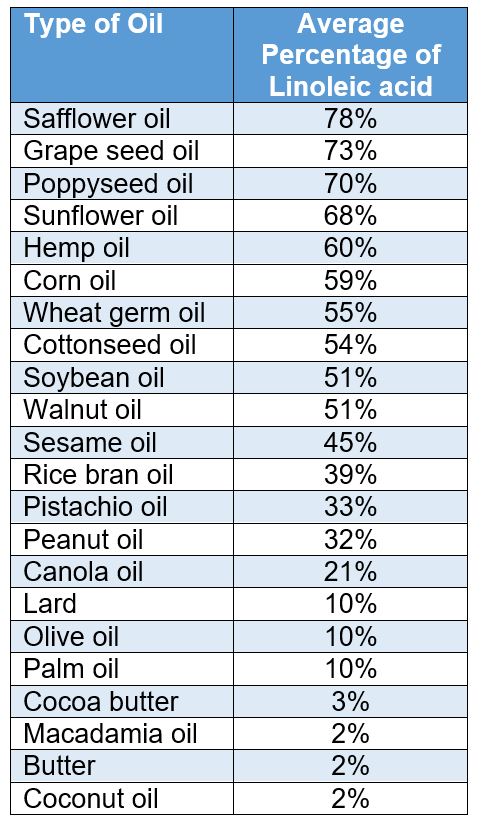
[3]. https://www.sciencedirect.com/science/article/pii/S092422442...
Wait, less... or more? :|
https://www.hsph.harvard.edu/nutritionsource/2014/11/05/diet...
Like for most nutrients, both too much and too little are bad.
The olive oil and the other vegetable oils with high content of oleic acid, e.g. high oleic sunflower oil, avocado oil and others, also include adequate amounts of linoleic acid, which is an essential nutrient (e.g. when the daily intake is too small, various skin problems appear).
The cheaper vegetable oils, e.g. classic sunflower oil, corn oil, soy oil and others, contain far too much linoleic acid (which can cause liver problems). The use of such vegetable oils in human food has begun very recently, only in the 19th century, after their industrial production has been developed.
For example, I choose carefully the sources of fat in my food and in a typical day the fat comes from 54 g (60 mL) of olive oil + 33 g of almonds + 9 g (10 mL) of cod liver oil. (That started after being diagnosed with some incipient heart problems, which seem to have been corrected after a year of more careful food choices.)
Both olive oil and almonds contain fat where oleic acid is the most abundant fatty acid. Their quantities are computed so that they also provide adequate daily intakes of linoleic acid and vitamin E. The fish oil adds an adequate amount of omega-3 fatty acids.
less[1]. this video[2] is not the best reference but a very good summary on the industrialized oils and they alternatives
"Instead of using butter, cream, lard, and other animal fat as the primary source of culinary fat, one should use liquid vegetable oils like soybean, corn, olive, and canola oils for cooking, on salad and at the table."
Uh...
We now know that this statement was false. Sadly, to the detriment of hundreds of millions.
>Also, and as opposed to common beliefs. You can cook on olive oil
Common beliefs by whom? (the USA)?
Loosely in Europe all mediterranean area countries have a tradition of cooking on olive oil since forever. (and of course Portugal, northern Africa countries, the Middle East, they all use oil for cooking).
It's cookable at lower temperatures but if you're going anywhere north of "5" on the stove chances are it's going to burn hard enough to stick to the pan
"Smoke point" concerns are usually overblown, it's really just the flavor that goes away making it pointless (and more expensive) too cook with EVO. https://www.youtube.com/watch?v=l_aFHrzSBrM
True, anything above 190 Cº (375 Fº) and it's going to start smoking
Your first link is from a "carnivore diet" blog, which seems to mostly sell their own line of supplements.
The dietary preferences of the owner of the site does not alter the validity of the information. The image is just a reference.
Here's the source of that table https://media.johnwiley.com.au/product_data/excerpt/06/04713...
I don't think that article is the source of the table - there's a similar table, but a lot of the items are different and the numbers mostly don't match.
Also that article seems to be primarily concerned with the health benefits of linoleic acid and how to increase consumption of it.
> The dietary preferences of the owner of the site does not alter the validity of the information. The image is just a reference.
Sourcing is important, and weird enough dietary ideas influence the trustworthiness of the chain. But more importantly the supplement-selling is a big potential conflict of interest.
This isn't surprising; cold-pressed virgin olive oil has a much lower oxidation rate than other vegetable oils
Italian mobs selling "virgin olive oil" likes that article.
My main point is that I am not able to tell real virgin olive oil from scam one. From what I understand most of "virgin olive oil" on supermarket shelves is scam.
Try finding bottles that explicitly list the acidity of the oil. The good stuff is really low. Extra virgin is considered .8% or less. I would shoot for something that explicitly lists 0.3% or better.
I tend to think that the California grown/produced olive oil is less likely to be adulterated vs OO from Spain and Italy.
When buying in the US, I assume that you mean.
Do you have evidence to support that?
Adulteration of olive oil typically happens in transit/shipping by wholesalers, not by producers. Spanish or Italian olive farms aren't diluting with corn oil or whatever during production on the farm/when pressing, it's by aggregators who are buying and selling oil in bulk by volume. So if you're buying olive made, processed, and bottled by a single farm whose origin is local you're structurally at less risk than a generic "Italian" oil or one that says the country of origin could one of 3-4 countries. Also California has a mandatory sampling and testing program https://www.oliveoilcommission.org/
If you want to go deep on the topic, this is a great read: https://www.goodreads.com/book/show/10955085-extra-virginity
Primarily because there are stricter requirements via FDA on the US food supply. If a US producer gets caught adulterating they're going to face legal issues that a foreign producer will not face. Not saying it's not possible that CA producers could be adulterating, but if they get caught there will be consequences that an importer won't face - the importer can just say they were trusting their suppliers overseas.
Also found this (from 2010): "The research team found that 69 percent of the imported oils sampled, compared with just 10 percent of the California-produced oils sampled, failed to meet internationally accepted standards for extra virgin olive oil." https://www.ucdavis.edu/news/most-imported-olive-oils-don%E2...
Actually it is Extra Virgin that is the standard (at least in EU - the US uses the name loosely)
Aka "Good job finding a class-correlate you didn't manage to control for"
If the study was done in the US, then maybe. But it was done in Spain:
> 12,161 individuals, representative of the Spanish population ≥18 years old, were recruited between 2008 and 2010 and followed up through 2019.
Where nobody can prepare food without olive oil. It's the law.
> Where nobody can prepare food without olive oil. It's the law.
Like everywhere else, Spain is a place where virgin olive oil is more expensive than the defiled version.
Depends where they did this research: outside the big cities (Madrid and Barcelona) and especially in the south, you can find enough places outside supermarkets where you can buy extra virgin cheaper than other oils in supermarket. Especially when you buy per 5 liter from local farmers (which is what I do).
If you live there (or if the research was done there), there would be no point buying oil in the supermarket and you always have the best oil on tap for next to nothing. Hence everyone there uses it for everything.
That, and also if you've grown up eating EVOO, even not the best quality one you can get from the village etc, you won't tolerate other vegetable and seed oils in your food, and certainly not in your salad.
I had a friend from Canada who returned Home a while ago and he went to the supermarket to buy oil to put on his salad. He saw the price of EVOO and came back with a bottle of sunflower oil, scoffing about the "scam" of EVOO. A couple of weeks later he told me "well, it's really better though isn't it?" and he started buying EVOO after that. I don't know what changed his mind.
Anyway I get it that EVOO sounds like a class marker and I've no doubt it is, in some parts of the world. Another poster was talking about virtue signalling. But in the neck of the woods I'm from (the Mediterranean) it's just not considered posh, or hip, to buy good olive oil, nor do you ever hear anyone bragging about it. It's just how people eat, and they prefer the best quality stuff than the lower quality stuff. Of course, the low quality stuff also sells just because some people can't afford the good quality stuff, and I guess there's also people who are not used to it, even if they're born in one of the places that are famous for it.
There's just a completely different mentality about EVOO (and some other foodstuffs: bread, wine, cheese maybe) in some parts of the Old World. It's about culture and (gulp) identity rather than fashion and those preferences will not change when EVOO (etc) goes out of fashion.
that's my gut reaction too, haven't dug into it though and probably won't put in the time
There's so much rampant mis-labeling of olive oil (see [1]) in many cases it's adulterated with other oils and in some cases it's not actually virgin olive oil.
[1] https://www.goodreads.com/book/show/10955085-extra-virginity
I buy Palestinian olive oil as it tastes the best and it supports a people living under apartheid and occupation.
At this point these studies sound like the ticker on Sim City 3000.
https://simcity.fandom.com/wiki/List_of_news_ticker_messages
“All Raccoons Cheat At Poker, Animal Researchers Say”
You simply won't be able to find world-class olive oil in supermarkets or on amazon. I can wholeheartedly recommend https://villahumbourg.it/en-index.html, 100% oil from one farm in Tuscany, for sure no Mafia infiltration and the new oil is just being harvested these days.
How I know that? It's from my mother, who I just visit for my holidays. I know I'm biased, but it's just the truth ;-)
I did a wine tour in Tuscany a few years ago and most of the small vineyards also grew olives and made olive oil and it was the best olive oil I ever had. I wish I had bought more. Thanks for the link, I might be ordering some soon. grazie!
Didn’t you just bring down her website?
The paper concludes, in part: “Our results also suggest a negative synergism between high virgin OO consumption and total physical activity on all-cause mortality.”
I take this to mean that to some extent, either virgin olive oil and/or physical activity reduce all-cause mortality; they overlap. Am I reading this correctly?
Also, I was disappointed at the extent the discussion degenerated to a procurement hearsay scuffle. Not our usual standard of discourse.
It's crazy to me all the weird games people play with food names and sources and content that can vary from batch to batch even from "reliable" sellers when we know it's simply the polyphenols providing antioxidant mechanisms.
You can get polyphenols/antioxidants from much cheaper, easier, reliable consistent sources.
This isn't 1822 or 1922 but 2022, we should use technology to have real nutrition labels for things we eat.
Weirdly enough I haven't seen non-virgin olive oil in German stores.. is that an American thing?
Go to Aldi. Read the label of the cheapest olive oil you find. It will almost certainly be non-virgin.
For example
https://www.aldi-nord.de/sortiment/nahrungsmittel/saucen-oel...
You’ll find the store brand sometimes having a cheaper “olive oil” here in Australia, which is still 100% olive I believe but probably includes second press. But any brand name oil will basically always be virgin/“extra-virgin”.
Warning on all studies published in Nature: they changed their policies recently to only publish studies that agree with their political opinions. This is now an opinion mag, not a science publication.
This isn't even published in Nature but in EJCN, which is published by Springer Nature.
With impact factor of 4 I'd caution against taking the results at face value.
If you're interested in increasing EVOO consumption for the health benefits based on polyphenols, look into Moroccan olive oil, as it has very high polyphenol levels - as high as 30x regular EVOO.
Sounds like another study discovering that wealthy people are healthier.
Not surprising, since health is wealth.
The "risk of mortality" is 100%. Perhaps there are some foodstuffs that increase expected lifespan; but youcan't reduce the risk of mortality. We're all mortal.
Mortality is the number of deaths within a particular society and within a particular period of time:
Prove it. /s
Risk of mortality? I thought mortality was a fact. :)
Clearly, those are just alternative facts.
Good thing I put that in practically all my food anyway. I always thought extra virgin olive oil tastes better than vegetable oil
Virgin olive oil has a strong flavor and very low smoke point, which makes it unsuitable for most types of food. You may like the taste of olive oil better than vegetable oil, but it’s kind of weird to taste olive oil in most foods. Kind of like how you wouldn’t but blue cheese on everything, or truffles on everything, or bacon on everything, even if you like the taste of those things—they taste a bit weird when combined with the wrong dish.
Vegetable oil is chosen in situations where you don’t want to taste it at all, where it’s just used to cook the food.
> Virgin olive oil has a strong flavor and very low smoke point, which makes it unsuitable for most types of food.
Extra virgin olive oil (EVOO) doesn't have a "very low smoke point". This table on wikipedia gives the smoke point of "Extra virgin, low acidity, high quality" EVOO at 207°C/405 °F:
https://en.wikipedia.org/wiki/Smoke_point#Temperature
The same page gives standard home cooking temperatures as follows:
So premium-quality EVOO has a smoke point comfortably above the temperatures where most people will cook with it. I suspect the idea that EVOO has a low smoke point comes from confusion between extra virgion olive oil and "extra virgin" olive oil (i.e. between the real deal and the stuff sold in its place). Anyway anecdotally, me, both my grandmothers, my mother, and everyone else I know has been cooking with EVOO for ages and I've never heard of anyone actually managing to make it burn (though I've certainly burned the food cooking in it). And we cook most, or rather, all, types of food in it.Pan frying (sauté) on stove top heat: 120 °C (248 °F) Deep frying: 160–180 °C (320–356 °F) Oven baking: Average of 180 °C (356 °F)You're perfectly right though that EVOO has a strong flavor. That's the whole point.
Searing or frying meats on the stovetop can easily exceed 400f. Below sufficient temperature the process will take too long and the meat will dry out. A steak seared at 350f will likely have a non-charred exterior. Air frying dense meats after baking and pressure cooking also demands high heat to add a glaze and retain moisture.
The OP said that "virgin" olive oil has a "very low smoke point" that "makes it unsuitable for most types of food" and neither of that is true.
Sorry, yes, most food types do not require high heat.
Non-refined olive oils — even your rare low-acidity example — do have a low smoke point in practice. All store bought “extra virgin” olive oils in my experience also burn closer to 300-350 degrees fahrenheit.
Are you a vegetarian by chance? You said most people cook well below 405 degrees. Traditional American households do exceed that temperature on the grill and the stove.
When olive oil burns, the smoke isn’t always highly visible. Examine close up and from the side. The rising smoke can look a lot like heat distortion.
As a final point, for anyone still here, smoke points aren’t an automatic reason to avoid a cooking oil. Chemical stability is variably correlated, so maybe do some more reading.
> All store bought “extra virgin” olive oils in my experience also burn closer to 300-350 degrees fahrenheit.
Yes, of course. Because of the "air quotes".
I am not vegetarian. I cook everything with olive oil, including searing meats in my French oven. So does everyone I know. I think what you are talking about and what I'm talking about are entirely different substances. I suspect the information on wikipedia, and in your sources, is also far off the reality of olive oil as it's used by people in the region of the world where it's traditionally the shortening of choice. Otherwise, we'd have stopped using it long ago.
> You said most people cook well below 405 degrees.
To clarify, that wasn't me, but wikipedia. I don't personally know what temperatures most people cook with and, I suspect, neither do you. What I know is that there's a few million people in countries around the Mediterranean that cook almost exclusively with olive oil and if it was as easy to burn it as you insist, that wouldn't be the case.
I suspect that you are relying on second-hand information but do not have first-hand experience of a lifetime (and a long tradition) of cooking with olive oil. I've heard more weird things coming from the same place, of lack of first-hand experience, for example that olive oil turns bitter if you heat it, something that I heard for the first time from an American dude with a youtube foodie channel, but not of course from my many friends, family and acquaintances that cook with olive oil as a matter of course. Again, if that sort of thing were true, we wouldn't be using it.
This is really the question to ask yourself: where does your information come from? Is there any evidence to the contrary?
I wasn't citing or referring to anything external, just to my own experiences cooking. Still, I appreciate learning about your culture. If there are extra virgin olive oils that withstand medium-high and high heat, I'm jealous! I think I'll try experimenting with some of our local suppliers.
Edit:
> This is really the question to ask yourself: where does your information come from? Is there any evidence to the contrary?
I cooked almost exclusively with olive oil for many years. You can ask anyone in America about their experiences with it, and it will probably be the same. I can't speak about taste, but the olive oils found in our stores begin to smoke extremely easily.
That's interesting, and unexpected. Then it really must be a very different kind of olive oil you were using.
Why did you continue to cook with it if it was smoking so easily?
Sorry, I didn't see your follow-up! It was just the standard Bertolli, Pompeian, and California Olive Ranch stuff found in our supermarkets. I was still learning to cook at the time, and the combination of the smoke being ventilated, indistinct, normalizable, and mildly pleasant to foul made me unaware. Some of my later housemates had to clue me in!
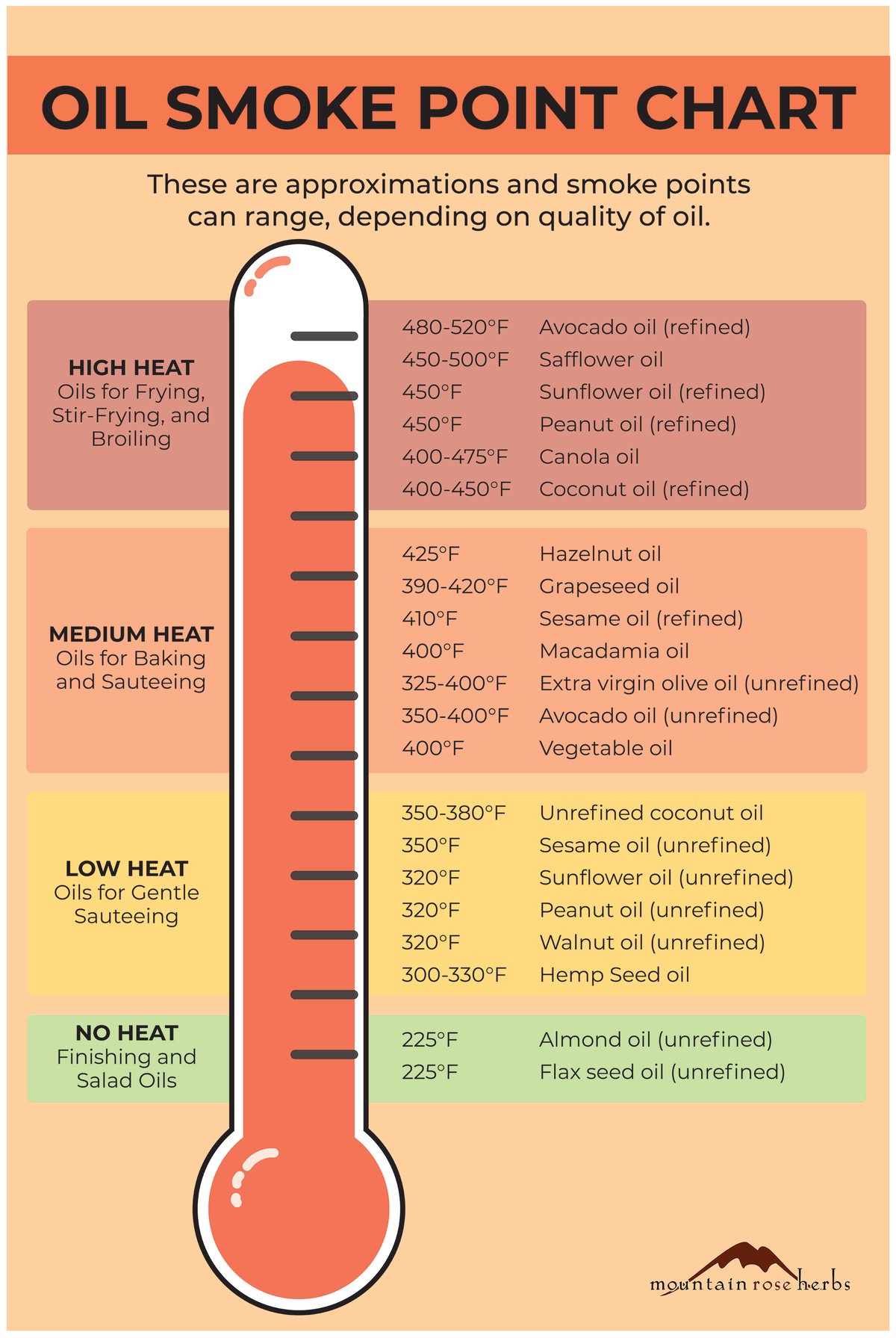
Vegetable oil smokes at a very similar point than olive oil [1]. The only reason people uses vegetable oils is 1. it's cheap. 2. does not add extra flavors.
[1] https://blog.mountainroseherbs.com/hs-fs/hubfs/CulinaryOil_S...
I agree. My partner's family in Spain have some land with olive trees (400 old ones plus 300 they planted recently) and sometimes we go there to help them pick the olives from the trees/ground, for us it's more like some festive days with the family than work.
The thing is, every year they give us more cold pressed olive oil than we can consume, and they don't do it in exchange for our "work", they also get more than they can consume, and no, they don't sell it (not worthy considering the legal/health paperwork and fees that would involve). We love it, its taste is amazing, and we know where it comes from and how it has been processed.
Yet... we still have to buy and use sunflower oil for a lot food! The taste is just too hard for some stuff and is less than ideal for deep frying. Olive oil for a stew? Some cooked rice or pasta? A salad? Toasted bread with garlic or tomato? Sure! But it we are frying anything, from fries to churros, we do it with vegetable oil.
I use avocado or safflower oil. Avocado has the highest smoke point at 520 degrees F.
If cooking with oil, everything cooked with safflower oil tastes better to me.
Maybe it's not a bad idea to remove all the foods that need unhealthy vegetable oils.
> or truffles on everything, or bacon on everything,
Speak for yourself there buddy
I somehow survived the “let’s put bacon on everything” craze of the 2010s but it was not a good time.
I even found bacon flavored chapstick at a bacon novelty store back then.
so, the 2020s appear to be shaping up as the "truffles on everything" decade and I hate it. Maybe I'd enjoy a real truffle here and there but the truffle flavoring I usually encounter is offensive to my tongue.
Truffles, I can handle.
But I'm still scarred from the 1990s "put capers in everything" era.
IDK man. Maybe its because I mostly just eat fish and veggies, but I find that it works well for the types of dishes I cook.
It’s not about the ingredients, it’s about the styles. If you want to cook fish and veggies in a cantonese style, olive oil is going to give it a bit of a weird flavor.
Man this oil stuff is exhausting. I’m now trying to avoid seed oils but they put them in everything.
Now I have to worry about olive oil?
I wrote a small post explaining why the EVOO industry is rampant with fraud and ho to go about looking for good olive oil: https://medium.com/@faizan_ali/extra-virgin-olive-oil-9c9cf1...
The obvious confounder of income/wealth was apparently not accounted for.
the main point of this comparison is - you should choose the best quality food that you can - so unheated OO over the heated stuff, for example. If it ain't broke, don't fix it.
Fortunately all the oil consumption I do is of the virgin type
Obligatory link mentioning 80% of olive oils are fake (fake virgin & extra virgin grading, country of origin, etc) [1].
I wish there is reliable and rapid in-situ testing, but not lab based sample testing that is not reliable and slow (companies can always send the good samples for testing and still selling the fake versions).
My hypothesis is that hyperspectral camera imaging technology can perform the in-situ reliable and rapid testing for screening the fake expensive foods namely virgin olive oils, honey, etc.
[1]https://www.forbes.com/sites/ceciliarodriguez/2016/02/10/the...
Is there something for Olive Oil like IFOS for fish oil?
The IOC (International Olive Counsel) https://www.internationaloliveoil.org/
My conclusion is that olive oil consumption has no effect on mortality. Finding an effect in 1/2 of your data, and not in the other half, is a classic sign of p-hacking.
Olive oil consumption is unsustainable. What we need is wide adoption of electric olives.
Obligatory Fat Gold plug: https://fat.gold/
It's incredible. If you can afford it, the subscription is always great and an excellent chance to try oil from different olives that typically don't get pressed.
Virgin type of consumption? Risk of mortality?
Is it me or is that title extremely oddly phrased?