Ask HN: What old or deprecated software do you wish was still updated?
Recently I was thinking about older software that is either no longer maintained, deprecated, or effectively in maintenance mode, and it got me wondering: if I was able to revive an old piece of software or something that was deprecated, what would I pick?
Could be interesting to see what Amiga OS would look like if it was still maintained to this day. There are some systems that are binary compatible with Amiga OS that still see a bit of development, but they are mostly niche projects (still very cool projects though). Picasa - the photo management program, it had really good facial recognition, and ran locally. Unfortunately, the last version has a bug that swaps face tags in an image with more than one face. 8( Digikam is not an acceptable substitute, it's got lots of quirks, and tends to abend. So many people around me love using Picasa. It offers everything they need in a user friendly fashion, and no more. Such a shame it was abandoned. WordPerfect. Yes, technically it still exists in some form, but not really. The modern version shares little in common with the DOS port - apart from unicode incompatibility, and that's hardly desirable. Corel have even acknowledged how good the DOS version was by attempting to have a "Classic Mode" with a similar interface. But the macro system is completely incompatible, and all the menus are different. It's a skin-deep facelift, nothing more. For me, WordPerfect in Spanish. It was a very professional translation, and all the relevant associated tools worked too. Now, sometimes you get all the bells and whistles in English and a couple more languages, and then only core functionality in the rest. I still use WordPerfect 6.2 for DOS regularly, particularly during the beginning of a writing project when I'm most prone to being distracted. If you emulate through DOSBox-X, you can use TTF fonts for screen output, and even print directly from the application. (Happy to share information on how to set this up with anyone who might be interested.) Internet Explorer but hear me out before you cry: The current browser ecosystem has more or less two engines: WebKit based browsers and Firefox. We have basically WebKit monoculture. If you'd find a fundamental flaw in WebKit, you'd be able to break most browsers.
If Internet Explorer would be open source we would have the chance to get a third engine running. Browser engines aren't trivial and IE also had some good sides after all these years. I guess if IE would become FOSS this would bring some fresh air to the ecosystem. WebKit and Blink are two different engines. They split off 9 years ago. There’s no such thing as a WebKit monoculture. There may be a Blink monoculture depending on how much you care about mobile browsers, mobile Safari is still very popular especially in the US. iPad Safari is close enough to desktop Safari now that it switched to the same user agent as desktop Safari. That surely helps to bump Safari’s marketshare. We already have Firefox and few people use it compared to chrome. A third engine does not matter. Yes, but not the IE. Opera Presto! Source code even leaked after Opera switched to webkit, and some Russians tried patching new things, but legal status made unsustainable :(. DuckDuckGo are building new native browser apps for Mac and Linux. Not sure how far along they are, but I know they have teams working on each. It is for Mac and Windows, not for Linux. They also are using WebView/WebView2, so they aren't building an engine. https://www.theverge.com/2021/12/21/22848133/duckduckgo-brow... Those are just wrappers around the platform WebView I think. I would be happy enough if Dillo parsed the video and audio tags as <a> links. Google cloud print.
To share physical printers on the cloud. Google reader.
For RSS with blazing speed. I discovered that my Android phone can now print directly without Google cloud print when in the same wifi. Yes but what I used to was to print, online receipts, invoices, etc. In my mothers house. That way I could help her. Or ask a friend for his color printer and send stuff there. Python (before Python 3 decided to abandon backward compatibility and burn billions of dollars in code) 32-bit macOS and iOS (before Apple set fire to all the 32-bit games and other software) Backward compatibility with older versions of macOS and iOS in general Desktop software in general (before everything became a crappy web app) Non-subscription software Smartphone games without horrible monetization schemes Web sites without adtech The short lived BlackBerry playbook It runs QNX and you could get a terminal emulator for it, through which you had a functional unix like environment with a text editor, compiler, python, etc. It's not updated and all the root certs (I think I'm using that correctly, not my area) are expired, so it doesn't connect with anything that needs https. Otherwise I think it could be an awesome terminal tablet (it needs a better keyboard too) I'd add BlackBerry phones as well. Would exchange my iphone in a jiffy to 9900 or Q10 if it would work with latest apps. Marcomedia (Adobe) Fireworks - simply the most intuitive bitmap and vector graphics editor. Oh yes, I miss Fireworks! Symbian OS was weird, but extremely efficient. It would run circles around Android, as far as performance goes. I miss it. Two roguelikes: - Avanor https://libregamewiki.org/Avanor - Abura Tan http://aburatan.sourceforge.net/ More abandoned games: - Fanwor. The sprite should pallete-swap/blink when it's hit. https://github.com/gsantner/mirror__fanwor Now, software. ROX filer + rox desktop.
Fluxbox may work as an Oroborox
replacement, but Rox-Lib is tied to Python2. It works under
Slackware 15 because we have Python2 and 3 for sure,
but other distros are screwed. This runs circles over XFCE and even LXDE on speed. http://rox.sourceforge.net/desktop/ ROX related repos: Flash HyperCard Two flawed but amazingly empowering tools that expanded the world of computing. HyperNext Studio is a kind of spiritual successor to HyperCard
http://www.tigabyte.com/index.html KEdit with the selective editing feature. No current editors have that capability to my knowlege, but it's super useful. KEdit still has a web page, and can be downloaded. It would be nice if VSCode would implement the selective editing feature. Old OS Printer Drivers - I can deal with a lot of old programs, just run them on old computers, but being able to print when classic printers are either in short supply or hard to maintain is an issue. So I would advocate for having modern printers with some open or legacy OS driver support. Alternative would be having some printer server/emulator which interfaces and emulates as popular legacy printer(s) and serves it out appropriately to modern devices. If it's important enough, you might be able to get them working from network through a raspi and CUPS. Looks like there are some people working on it - https://www.retroprinter.com/ This one is a raspberry pi one so far emulates text, ESCP, ESC/P2, PCL, PostScript, has a Centronics connector - which is a start (Mac serial would be nice) Also see print capture devices which can intercept/log printer output (for data conversion/preservation) http://www.photologic.ca/cap.html Going to have to look into this more :-D Lotus Improv - the spreadsheet that allowed you to use formulas that could be defined like, "Profit = Income - Expenses," and didn't need to be specified in terms of cell references. You could also drag and drop rows and columns around easily. It was once described as "the first spreadsheet program good enough to be worth criticizing." Media Rage, a Mac application that had a broad and rich set of features to manage metadata, find duplicates, and organize media files like music, photos, etc. The developer’s site (Chaotic Software) doesn’t exist any longer, but here’s an old page elsewhere [1] with a description of what it could do. [1]: http://mac.majorgeeks.com/files/details/media_rage.html Notational Velocity (https://notational.net/) a fast, no frills note-taking app for Mac. There’s a fork called NVAlt that is maintained Winamp This was my exact thought as well.
There was just something special about customizing it and using it as your digital media console. I feel as if everyone was always excited to show off what skin they were using.
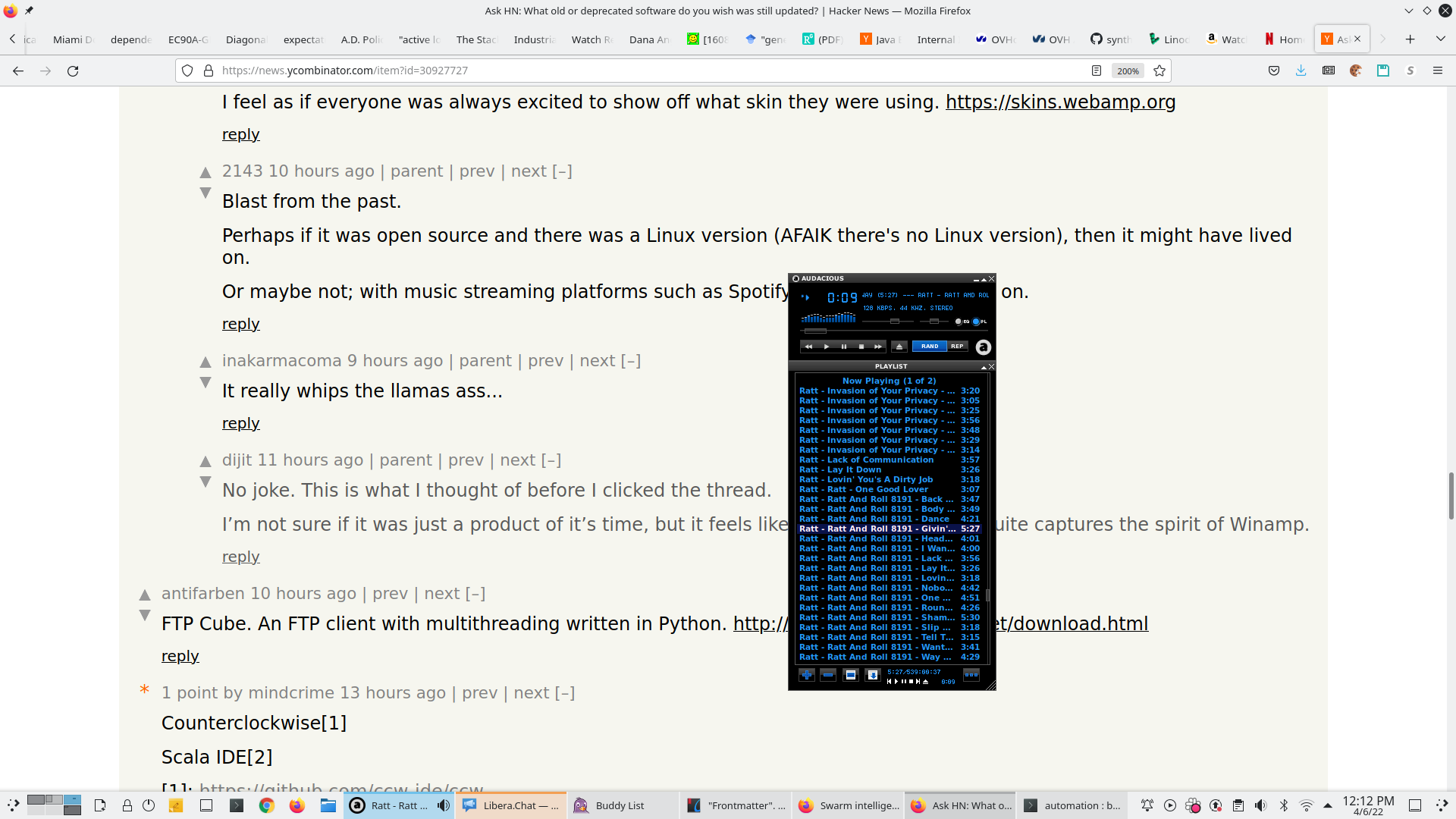
https://skins.webamp.org No joke. This is what I thought of before I clicked the thread. I’m not sure if it was just a product of it’s time, but it feels like there’s nothing that quite captures the spirit of Winamp. Blast from the past. Perhaps if it was open source and there was a Linux version (AFAIK there's no Linux version), then it might have lived on. Or maybe not; with music streaming platforms such as Spotify, the world has moved on. No Open Source version per-se, but Audacious[1] is awfully close. It even supports classic Winamp skins AIUI. Screenshot: https://fogbeam.com/audacious.png It really whips the llamas ass... It's 2022 and I can't visualize my music like my friend did in 1997. Apple Aperture - still missing it‘s DAM and automatic library management capabilities which IMHO were lightyears ahead of what Lightroom is even today Wow I had no idea these were no longer active projects. I guess at the same time though… Eclipse. Ship GitHub client: https://www.realartists.com/blog/ship-is-open-source.html Still nothing that comes close to UX of it. Looks like Amiga OS gets updated still just very slowly. Have you tried MorphOS? I looked into MorphOS before, but IIRC you need PowerPC hardware to run it. Is there an x86 or ARM version I'm not aware of? I don’t believe so. FTP Cube.
An FTP client with multithreading written in Python.
http://ftpcube.sourceforge.net/download.html YNAB4 Still works but performance is starting to slow down with almost 10 years of data Space Empires 5 (a sequel would be ideal, but better support for current-gen OS's would be nice). Stellaris is good but doesn't quite stratch the itch the same way SEV did. Debian GNU/kFreeBSD. It was nice to be able to use pf on systems without having to use unfamiliar variants of the rest of the tools. SoftICE Is there even a modern equivalent? Running your target in a vm? Or two at once. Bochs + Bochs-debugger. Pocketpc 6.5 and similar handwriting builtin systems with slideout keyboards. There were gnu tools compiled to it, even emacs. VB6 Visual Basic 6 allowed almost anyone to automate things, and get on with their lives. The amount of labor saved by it could be staggering. Any cool DOS game. You can still play those using Dosbox (an emulator) and downloading the games from various archives. There are also browser ports for several games. One of the recent ones I saw, which was also shared here, was Prince of Persia (https://princejs.com/ ). POP has a native source port for any platform, SDLPOP. Also, https://osgameclones.com has zillions of source port and clones for everything. Stack ScummVM on top and lots of DOS games can be replayable today without burning zillions of cycles at DOSBox. What would be ideal for me would be having everything set up and ready to go. It is a bit of a hassle to install dosbox, copy the files to the internal file structure of the dosbox, then install the software and configure. I know I'm being picky but taking 25 minutes to set up a new game or an old program just isn't usually worth the hassle for me. Also, Dillo. Dillo. Seriously. I have more than enough resources to run Ungoogled-Chromium with the custom crapware and FX removed, but that small browsers rocks on a highly loaded machine
when I am compiling some SlackBuilds such as WebKitGTK4. The repo is at https://hg.dillo.org/dillo. You need Mercurial, FLTK devel libraries and MBedTLS.
With a proper user Agent such as Lynx or the PSP one it will work for a big list of sites. No JS, but meh. HN works, so does Lobste.rs, Simply Translate, 68k.news... Google Cardboard Somewhat related, I used to use this 360 photo sphere thing a while back, would load them up in Google Cardboard. Really cool feature flex perl5