The Pip
en.wikipedia.orgIf you want to have a listen to the Pip yourself, as well as many others like the squeaky wheel and the buzzer, check out this WebSDR implementation:
http://websdr.ewi.utwente.nl:8901/
and for a much wider list of frequencies of number stations, and radio anomalies you can take a look at:
they have times they broadcast figured out there. if you enjoy this kind of stuff, i suggest picking up an SDR yourself, i know i do. my $20 RTL-SDR works well for playing around with this.
More info about it (from priyom.org):
---
Location: Rostov-na-Donu, Russia, 47°17'58"N 39°40'25"E (72th communication hub, callsign Akaciya), South Military District main command network
Antenna (StreetView): https://www.google.com/maps/@47.2985646,39.6750428,3a,75y,32...
Occasionally voice messages are sent in various formats, main purpose is to send command messages for South Military District of Russia.
Here is what an operator station looks like:
http://priyom.org/media/124724/akaciya.jpg
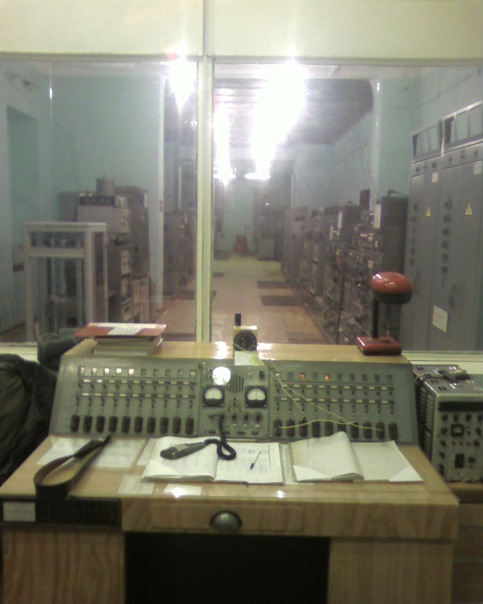
And it uses the traditional Russian military Monolith format:
http://priyom.org/military-stations/russia/monolyth-messages...
They have a nice dossier on it as well:
I've always been fascinated by numbers stations/the conet project/etc. The aforementioned websdr program has given me hours of entertainment in the past. It's always fun when there is a genuine unsolved mystery to theorize about in our modern times ;)
It makes me think of the series Lost when I read these articles. Alternatively, I feel like its these super isolated bunkers that check in every so often and if they stop doing so, nuclear warheads are launched at the US.
It's easy to think this is something dramatic and mysterious, but it's much more likely that it's actually quite mundane.
Building a dead man's switch that operates over shortwave is a pretty iffy proposition. People might jam you just for fun. You could experience prolonged channel degradation. Also, your transmitter could just plain break. If it were that kind of device, operating continuously since the 1980s, I'd be surprised if it hadn't triggered accidentally already.
Oh I totally agree- I was more just saying that is what I picture in my mind when I read about these "mysterious" transmissions. Seem like a subplot to a movie.
Is there really no readily available technology to find locations of radio stations?
Yes and no. At short range there are devices like doppler direction finders [1] that are remarkably affordable and can make quick work out of locating some signals. This is for signals that arrive over a straightforward single path, though.
These shortwave transmissions do not have that convenient property. HF transmissions at high powers will duct through at the atmosphere, bounce off of the geography, and in general propagate in all sorts of strange ways that result in them arriving simultaneously via multiple paths to any given position. This means that standard direction finding methods will not be very effective. Because of the long wavelengths of these signals, very large antennas are also required to even attempt direction finding, usually circular structures hundreds to thousands of feet across, a common type being a Wullenweber antenna [2].
Very few organizations possess substantial HF direction-finding capability. The FCC has monitoring stations that can do this in many cases, and they use it for enforcement purposes, I believe primarily when public safety users report jamming problems. As a fun fact, one of these monitoring stations is located in Livermore, although I believe that station is remote-control and has no staff. The FCC is not very public about how these monitoring stations operate, I believe their positioning is based on differential analysis of the reports from all of their 14 stations across the country though. Most of what I know about them is from a rather outdated source [3] although their locations are listed in 47 CFR s. 0.121 since they are afforded special protections against interference.
On the international scale, if you looked at the Wikipedia article on Wullenwebers you may have noted that that was originally a code name. Various militaries and intelligence agencies operate large direction finding stations, but because of the challenges of locating HF signals even these large facilities have limited efficacy. Nonetheless, I assume that the NSA has confirmed transmitter locations for these signals (probably by a combination of direction-finding and good old fashioned on the ground tradecraft) and has simply chosen not to share.
[1] http://kn2c.us/ [2] https://en.wikipedia.org/wiki/Wullenweber [3] http://blackradios.terryo.org/documents/publications/e-FCC.p...
There certainly are methods. This is often called "fox hunting" https://en.wikipedia.org/wiki/Transmitter_hunting
You can build an antenna with a cardiod pattern, which has a wide range but a very deep, narrow null at one end. When you see the signal strength dip off, the transmitter has to be aligned with the null (sort of, there are also multipath issues to consider)
But, doing this requires you can move freely to track the transmitter. Hunting a transmitter on Russian soil by non-Russian entities might not be viewed very kindly :)
And the location probably wouldn't be too surprising. I remember reading that some number station transmitter was tracked down to a Russian military base. Pretty much where you'd expect it to be.
"Hi, I'd like to step on the base for a bit to have a look at your radio transmitter." ;)
This confused me too. Unless there are boosters of some kind, the power of a signal seems to follow a pretty predictable decay pattern. You would need to do a sample of the power around a certain radius and find some derivative in that field of where the power is increasing or decreasing the most in proportion to moving across that particular diameter in the circle. Then you've at least established a geodesic line to circumnavigate and hit the station at.
You've also narrowed down the total set of longitudes/latitudes based on the geometry of Russia and with high-confidence, assuming that the station's language can be taken as evidence of anything.
I am not an expert, this is just speculation. But that seems like a reasonable sketch of the problem solving method that would have to be involved.
Some German intelligence officer confirmed some weeks ago that they can locate any FM station in Africa by 100 meters with some radio installation in Germany.
actually we do know of its former location, but they do tend to move them. checkout this page for a picture of where the pip was formerly broadcast:
Never mind The Pip, The Woodpecker is far more interesting:
There are lots of things more interesting than The Pip, but they're unrelated. Is there some connection between the Pip and the Russian Woodpecker that I'm missing?
"The Duga systems were extremely powerful, over 10 MW in some cases, and broadcast in the shortwave radio bands. They appeared without warning, sounding like a sharp, repetitive tapping noise at 10 Hz, which led to it being nicknamed by shortwave listeners the Russian Woodpecker."
Maybe this bit? "potential connection to a Soviet Cold War-era structure, the Duga over-the-horizon radio antenna"
That's going to be terribly off-topic, sorry for that, but I have to: I hoped the article was about "Pip pan" from amazing kids book "Kastrullresan" ("The Saucepan Journey" in English) by Edith Unnerstad.
If anyone of you have kids (6+) don't miss that one (and others from that author too)!
I hoped the article was about Python's pip. I love me some `pip`.
Python? How quaintly modern.
http://www.shaels.net/index.php/cpm80-22-documents/using-cpm...
I suppose the most likely scenario is that these are part of some long-running experiment or are used for some fairly mundane purpose like radio navigation or calibration. My first thought was that it might be for a military or intelligence fail-deadly system (e.g. to mount an attack, perform subterfuge, deploy suitcase nukes across U.S. cities, or check in with a handler).
My first thought was some sort of nuclear assurance. In the UK we have radio 4 broadcasting constantly, if there's no communication and radio 4 isn't broadcasting then we assume a London may have been bombed and a nuclear alert is issued.
http://www.manchestereveningnews.co.uk/news/greater-manchest...