In early modern France, the monarchy kept running into the same problem. Wars were expensive, revenue was not steady, and every obvious solution came with a political price. New taxes were politically explosive. Borrowing was finite. So the crown found an interesting idea to fund its endeavors. It sold offices, judicial positions, and administrative posts.
People with money, mostly nobles, bought them. The crown got cash upfront. The buyer got status, income, and often a path to keep the office inside the family through mechanisms like the paulette.
In the short term, it worked. The treasury gained funding without raising taxes. Over time, office creation became a fiscal lever. When funds were needed, new posts were minted and sold. Administrative layers expanded, courts multiplied, and the number of officials grew.
This is the story of the tech world over the last two decades. Companies hired more and grew more until they reached the ceiling. If you already have everyone using your app, what comes next? Maybe more features, but everything has a limit. Then what happened? During Covid-19, companies hired surplus workers, only to lay them off later.
Long-term resilience is hard to measure. Expansion is easy to see. Once visibility becomes success, behavior bends toward visibility.
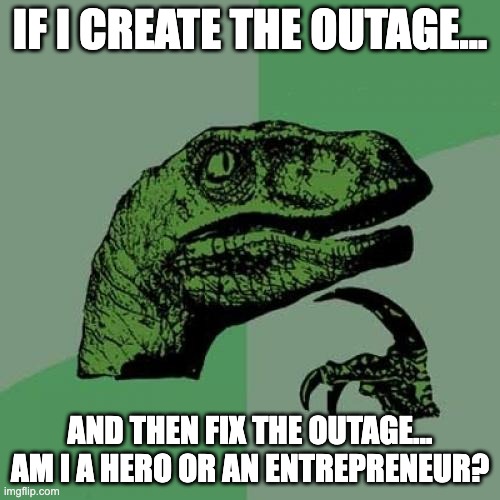 If I create the outage…
and then fix the outage… am I a hero or an entrepreneur?
If I create the outage…
and then fix the outage… am I a hero or an entrepreneur?
Value Is Invisible, Proxies Are Visible
When leadership cannot directly observe value, they pay for signals. That is not malice. It is an information problem. The tragedy is what happens next. Signals do not stay signals. They become targets. And once a signal becomes a target, the fastest career path becomes manufacturing the signal.
Why Value Is Invisible
From the outside, a resilient system and a fragile one can look identical. So leadership does what any principal does under information asymmetry.
- You can’t tell resilience from a screenshot.
- A simple architecture and an over-engineered one can both work until they don’t.
- Most real value is counterfactual. The outage that never happened, the page that never fired.
- The best incident is the one you never hear about, which means it never becomes proof.
- The most important work often looks like subtraction, and subtraction has no demo.
The principal wants outcomes, revenue, growth, reliability. But they cannot directly observe the thing that caused the outcome. They see a shipping cadence. They see who tagged in to the office. They see headcount. They see artifacts.
Proxies Are Visible Because They are Legible
When value is hard to verify, the organization rewards legibility. Velocity. OKRs. Story points. These begin as instruments and end as scoreboards. Once a scoreboard is tied to promotions, Goodhart’s law takes over. People stop optimizing the system and start optimizing the measurement of the system.
The Principal Agent Trap
This is a classic principal agent problem with brutal information asymmetry. The principal cannot reliably tell if:
- a team of 50 is necessary scale, or
- a team of 50 is empire building delivering the work of 5.
So the principal uses what they can see.
- For engineers, it becomes velocity, big projects, and heroic moments.
- For managers, it becomes a span of control and org size.
And once promotions and compensation correlate with those proxies, the rational strategy is to optimize them.
When the Proxy Becomes the Target
As we set wrong incentives, our target becomes the proxy. So, gaming begins. In my career, I’ve seen more than once, someone built a complex and fragile system to make something great again. As a result, incidents started to happen. They saved the day. From upper management, it looked like someone delivered. Then, when it comes to operations, they hold the line. In reality, they solved the incidents they caused.
A few Archetypes
Once you understand the proxy game, you also get to understand typical archetypes. These aren’t personality flaws. They are strategies inside incentive systems.
- The Empire Builder optimizes for headcount as a primary metric of power. These guys never have resources for anything. You ask for one thing. They invent 10 more things to support what you asked. Hence, they need more people.
- The Optician optimizes for dashboards and optics. These guys are always green. I always wonder why nobody asks how come they are always green. You are either very slow or not taking any risks if there’s no red.
- The Promotion Hunter builds initiatives that generate artifacts, then leaves before the mess matures. These guys get the promo and immediately move to another org or company. Someone then has to babysit the mess they created.
- The Magpie selects shiny technology based on its external market price, usually hype rather than its internal utility; they’ll add Kafka or Redis not because the architecture demands it, but because their resume does.
- The Efficient Martyr does the boring real work, reduces cost, maintains legacy systems, removes complexity, then gets punished or ignored because it is invisible. It depends on the manager who’s doing the selling but these guys can get ignored. A lot.
You will see these folks everywhere because incentives are similar. I’m sure you have seen some of these guys. All I can say is don’t hate the player, hate the game. They are just optimizing the best outcome for their career.
If you want the underlying mechanism, it is rent-seeking dressed up as execution. In France, the rent was the office itself, a scarce, status-bearing unit controlled by the crown. In tech, the rents are headcount, scope, and initiative ownership, scarce units controlled by leadership. Once those units are how status is allocated, effort shifts from creating value to capturing allocation. This waste is not accidental. It is the predictable cost of making allocation itself the prize.
The Anatomy of a Transformation
Take Sarah. Her first year is textbook stewardship. She deletes flaky alerts. She hardens the brittle edges in the legacy code. She thinks of what good looks like in everything she does. Pager volume drops. Deployments stop feeling like Russian roulette. She implements service overload strategies. The amount of churn in man hours cut down in half. Overall, the system feels quieter. People feel more relaxed when Sarah is around.
Then performance review season arrives. Her feedback is positive, but vague. “Strong contributor.” “Reliable.” “Good teammate.” Then the real question lands: what did she deliver?
She has no shiny launch. No migration. No rewrites. No before-and-after KPI or UI. Her best work is that nothing happened, and “nothing happened” does not fit inside a promotion packet.
Meanwhile, someone else gets promoted for launching a massive platform rewrite, then leading the recovery when the rewrite predictably burns. From the outside it looks like an impact. Yet, when there’s no noise people might not reward it.
Sarah learns the actual rules of the system. So next cycle, she stops doing invisible prevention. She pitches a loud, unnecessary architecture initiative, because artifacts are legible and resilience is not.
 the incentive drift loop
The Incentive Stack
To understand why this happens, we have to look at the incentive stack, the ladder of translations that turns high-level goals into dysfunctional daily behaviors.
Layer 1: Outcomes
This is what leadership wants. Revenue. Reliability. Growth. Resilience. These are real. They are also vague, delayed, and hard to attribute. Outcomes lag, and attribution is messy.
Layer 2: Proxies
This is what leadership can measure. The number of projects for engineers. The number of hires/fires for managers. This is the pivot. Once you cannot verify quality, you verify activity.
Layer 3: Rewards
This is where things harden. Promotion packets, performance ratings, comp bands, title thresholds. They attach to the proxy because it is legible and comparable. So the rational move is no longer delivering value. It is to deliver complex systems or acquire the resources that qualify you to advance.
Layer 4: Adaptation
People adapt to incentives. Once complexity or headcount is the unit of progress, it becomes people’s career strategy. Complex infrastructure rationalizes more headcount. This bias alters what kinds of contributions accumulate career capital.
Layer 5: Drift
This is what organization eventually becomes. Now the stack produces predictable artifacts.
- Fake work and performance review theater, because gaming the system beats outcomes.
- Empire building, because span of control is treated as proof of importance.
- Resume-driven and promotion-driven engineering, because internal value and market value diverge.
- Institutional amnesia, because the person who launches the initiative leaves before the failure mode arrives.
And underneath all of it is risk asymmetry. So when you look at bloat, rewrites, point inflation, crisis hero culture, and endless initiatives, you realize the incentive stack is doing exactly what it was built to do.
 incentive stack
The Incentive Audit
If incentives drive behavior, then the only honest question is not what the organization says it values. An incentive audit ignores what an organization claims to value and looks strictly at what the system demonstrably pays for in cold hard capital: promotions, bonuses, and status. We need to look at observable correlations between behavior and advancement, and ask whether those correlations produce durable value. Below are the fault lines to examine that I have on top of my head.
1. Promotion Signals
Let’s start with promotion patterns. What behaviors consistently precede advancement? People rarely get promoted for maintaining the thing. They often get promoted for replacing it. The signal is disruption, not stability.
If title and compensation scale with headcount, bloating is rational. The audit question becomes simple:
- Does reducing complexity ever increase influence?
- Does expansion consistently correlate with status?
If contraction reduces promotability, growth will dominate regardless of necessity.
2. Metric Behavior Under Pressure
Once metrics are evaluative, expect reporting to change before reality. The question is whether maximizing the number improves the system. If it doesn’t, the number is the job.
3. Visibility vs. Stewardship
Now, let’s examine how the organization allocates recognition. If recognition consistently follows visible intervention rather than quiet resilience, the system will drift toward volatility. If artifact production correlates more strongly with advancement than long-term system health, the organization is biased toward replacement over stewardship.
The audit question becomes whether boring excellence is rewarded at the same rate as visible initiative. If not, the system will not remain boring for long.
4. External vs. Internal Incentives
Let’s take a look at the labor market boundary. Often, engineers want to make the tech stack as thick as possible so that they can say they worked with X, Y, Z. Fulfilling the business case with minimal effort is good for the business but really bad for the resume.
If external market rewards diverge from internal value creation, rational actors will hedge. Risk asymmetry compounds this. If a failed rewrite costs the organization but not the promoter, rewrites will multiply. If fragility is socialized and promotion is privatized, volatility follows. As long as the upside is personal and the downside is collective, optimization will skew toward spectacle.
The audit question here is straightforward. Does long-term stewardship increase market mobility? Or does novelty outperform durability? If the latter, churn and architectural volatility are predictable.
5. Population Drift
Finally, let’s examine exit patterns. When strong contributors exit, average performers remain, and overall quality drifts downward.
The audit question becomes. Who advances? Who quits? And what behaviors differentiate them? If optimizing the proxy correlates more strongly with survival than optimizing value, drift is inevitable.
If you are in leadership, remember your performance system shapes behavior more than your cultural values ever will. Incentives beat values. Pay for visibility and you’ll get theater. Pay for durability and you’ll get durability.
Designing Better Incentives
If behavior follows incentives, then misalignment is not a moral failure. It is a design flaw. And design flaws can be addressed. But, we need to be intentional. The question is not whether incentives exist. Obviously, they do. It is whether they are aligned with long-term value creation.
1. Reward Subtraction
Most systems reward creation. New initiatives, new teams, new platforms. Very few reward subtraction. Yet the highest leverage engineering work often removes complexity, reduces scope, and lowers operational burden. To counter this, organizations must explicitly make reduction promotable.
- Reward teams for retiring systems or stopping unfruitful projects.
- Reward leaders for shrinking unnecessary scope.
- Reward engineers for eliminating categories of work.
If removal never shows up in performance discussions, it will never dominate behavior. Yet, be careful. Every metric can be gamed. Even subtraction can become a performance surface.
2. Separate Information from Evaluation
Metrics should inform, not determine advancement. It means distinguishing between planning and performance tools. Velocity can inform capacity. It should not determine compensation. Defect trends can signal risk. They should not automatically gate bonuses. When a metric directly affects career outcomes, assume it will distort behavior. Design accordingly.
3. Make Stewardship Visible
If the system cannot see quiet excellence, it will reward visible intervention. Designing better incentives requires creating structured visibility for invisible work.
- Long-term system health reviews.
- Resilience metrics tracked over multi-year horizons.
- Explicit credit for avoided incidents and reduced operational toil.
If maintaining a system for five years without drama does not map to advancement, rewrites will always be more attractive.
4. Decouple Status from Headcount
If the only path upward is more people, then more people will accumulate. Organizations that want durable leverage must create advancement paths that do not require headcount growth.
Influence through impact, not scale. Compensation should really be tied to outcome leverage. Otherwise, the managerial tournament logic will dominate. And complexity will follow. Last but not the least, expand the terminal layer salary bands so someone can still do the job well and be paid without requiring them to be promoted.
5. Align Internal and External Incentives
Engineers operate inside two markets: the company and the labor market. When internal value and resume value diverge, rational actors hedge. Better incentive design acknowledges this.
- Reward deep ownership.
- Reward long-term system mastery.
- Make durable contributions legible in ways that are portable and credible externally.
If novelty consistently outperforms stewardship in both markets, volatility becomes inevitable.
6. Audit Risk Distribution
Incentives are shaped by who bears downside. If employees are downstream of the risk, they will optimize for mobility and safety. Better incentive systems distribute upside and downside more symmetrically.
Compensation structures that reward sustained health, not just short-term growth. If risk and reward are asymmetrical, optimization will be asymmetrical.
7. The Managerial Shield
While systemic change starts at the top, an engineering culture's immediate health depends on the middle manager’s ability to act as a shield. In a visibility-driven system, the manager’s job is to translate the invisible value of their best people into the legible proxies that leadership demands. This requires a proactive reframing of boring reliability and debt reduction not as mere maintenance, but as vital risk mitigation and capacity unlocking. One way to think about this, doing the same work with fewer people, less time, or less money. Find ways to measure what fewer/less means in your context.
Because the system often ignores efficient martyrs, managers must document counterfactuals. This is needed to build an invisible promotion packet that proves value through what didn't break. On the flip side, resist the urge for managers to build an empire. Represent the business. The only thing that really matters is business outcome. If someone can achieve the outcome with fewer people. Fight for their compensation even if it doesn’t mean promotion.
Finally, budget time for stewardship, we as managers must ensure that contributors like Sarah aren't forced to choose between career survival and architectural integrity, making boring excellence a viable path to advancement.
8. Measure Drift, Not Just Output
Finally, incentives should be evaluated over time.
- Track retention of high performers.
- Track system complexity growth.
- Track operational load over multi-year horizons.
If career success correlates with increasing fragility, the system is misaligned. If career success correlates with compounding resilience, the system is working.
 The Reward Surface Model
In Consequence
What we call dysfunction is often successful adaptation. The French crown did not set out to invent administrative bloat. It set out to fund wars without lighting itself on fire politically. Selling offices worked, until it rewired the incentives of the entire state.
Modern organizations repeat the same mistake with better vocabulary. They reward what they can audit, then act surprised when people optimize for auditability. If you want durable value, the reward surface has to pay for durability. Otherwise the machine will keep producing volume that looks like progress.