It’s clear that men use AI more than women. Although most adults under 30 are generally likely to interact with AI multiple times a day or week, a working paper at the Harvard Business School (HBS) from last year found that men were 10-20 percent more likely to engage with it than women. The paper consolidated data from 18 different studies, and in all but one, women adopted AI at significantly lower rates than men. Not only did this gap hold across occupations, education levels, and geographic backgrounds, it also persisted across different AI tools.
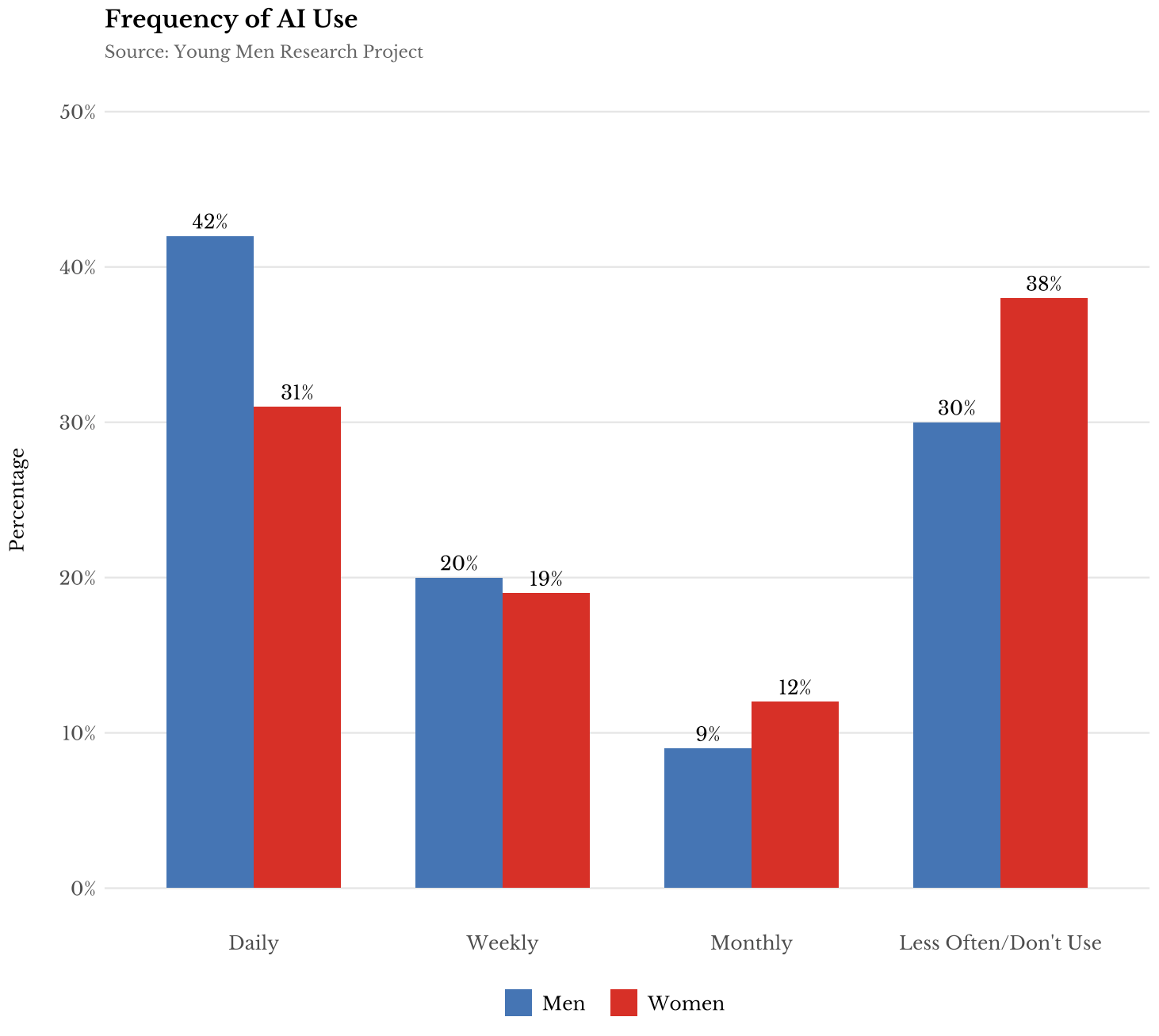
This aligns with the latest polling from Young Men Research Project (YMRP). In the October poll, a nationally representative survey of young Americans ages 18-29, 42 percent of young men said they use AI daily, compared to 31 percent of women. Conversely, young women were more likely than young men to say they used AI less often than once a month or not at all.
This disparity isn’t about access. When HBS researchers presented the same prompt to download ChatGPT for free, women were 13 percent less likely to adopt it. The gender gap in AI adoption has less to do with availability and more to do with something different: trust.
In the YMRP poll, 45 percent of young men said that they are “excited” about AI—the most common response. The most popular choice among women was “anxious,” receiving 38 percent of the votes. This anxiety may stem from several issues.
For one, there are heightened privacy concerns, informed in part by the fact that women are more likely to experience harassment and abuse related to technology that collects data. Nearly a third of men trust that AI companies will keep their data secure, compared to just 18 percent of women. Many young women are skeptical of its opacity and complexity, especially when they don’t know where the responses are coming from. More broadly, women tend to be more wary of new technology.
Young women may have reasonable belief that they will face more scrutiny or be labeled as “cheaters” for using generative AI, especially at work. In one study, female coders were penalized on competence over twice as harshly as their male counterparts for AI-generating code—even when that was the encouraged policy. AI already has a gender bias in that it is trained on data that reflects real-world disparities, where men are more likely to be scientists and women are more likely to be nurses, for example. Furthermore, research shows that women tend to be more risk-averse and reluctant to immediately incorporate new trends, especially when they impact areas like finances or private data.
Coinciding with this higher trust, young men are more likely to use AI for emotional and sexual intimacy. While the data is very early, a variety of studies have found that young people are more likely to have experience using AI for pornography and online companionship. Young adults are more than twice as likely to have interacted with a simulated romantic companion as their older peers, and young adult men are more than twice as likely to view AI pornography as young adult women.
Counterfeit Connections, a long-form study from the Wheatley Institute, found that AI use for intimate and emotional purposes was consistently highest among young men, and that using AI for romantic reasons correlated with higher rates of depression and loneliness.
If AI ends up becoming a fixture of the modern workplace, being comfortable and fluent in working with AI tools may set up young men for greater economic success. As we’ve covered, young men are increasingly considering careers that don’t require traditional degrees, in part due to a range of education and economic challenges.
Although a majority of both men and women in the YMRP poll said that AI would decrease jobs by eliminating the need for human effort, there is a higher proportion of men who are optimistic: just 17 percent of women agreed that AI will lead to more jobs, compared to 29 percent of young men.
What’s ironic is that despite differing attitudes about the technology, there is no clear answer on whose jobs AI will impact, and how. Some research says that fields which women are overrepresented in, like clerical and administrative roles, are more likely to be transformed by generative AI. On the other hand, traditionally male-dominated fields like computer programming are also facing major job cuts due to AI, while women go into more technology-proof areas requiring human interaction, like healthcare and teaching. Nearly every field and demographic will see some shift—and it is hard to predict how young men and women will be impacted.
-
In many ways, the gender gap in AI use isn’t highlighting anything new. It mirrors young women’s fear of harsher consequences if the technology goes awry. It also reflects young men’s dissatisfaction with dating, higher education and the job market, and the subsequent desire to find a replacement for these essential milestones. What’s clear is that AI is quickly embedding itself in the lives of young men, with unclear implications for this generation and society.