The technology is new, the surveys even newer, but studies by both AI companies that benefit from these models and advocacy groups wary of the technology are coming to the same conclusion: Gen Z, especially younger men, are considering romantic and sexual relationships with artificial intelligence at growing rates. And as young men experiment with AI as a modern version of a 1-900 number, they may be subconsciously reinforcing lazy stereotypes of women and relationships—making real-life dating even more complicated.
Last year, the global market for AI companions—not including other forms of generative AI—was valued at $7 billion, with projections of $30 billion to $100 billion by 2030. An MIT analysis of a million ChatGPT interaction logs found that sexual role-playing was its second-most prevalent use, accounting for over 12 percent of queries. It should be no surprise that sex is supporting AI’s growth; after all, porn fueled the rise of the internet and still dominates online traffic.
In 2023, Google Searches for “AI Girlfriend” were up by 2400 percent. The graph below highlights the Google Trends for this term over the past five years:
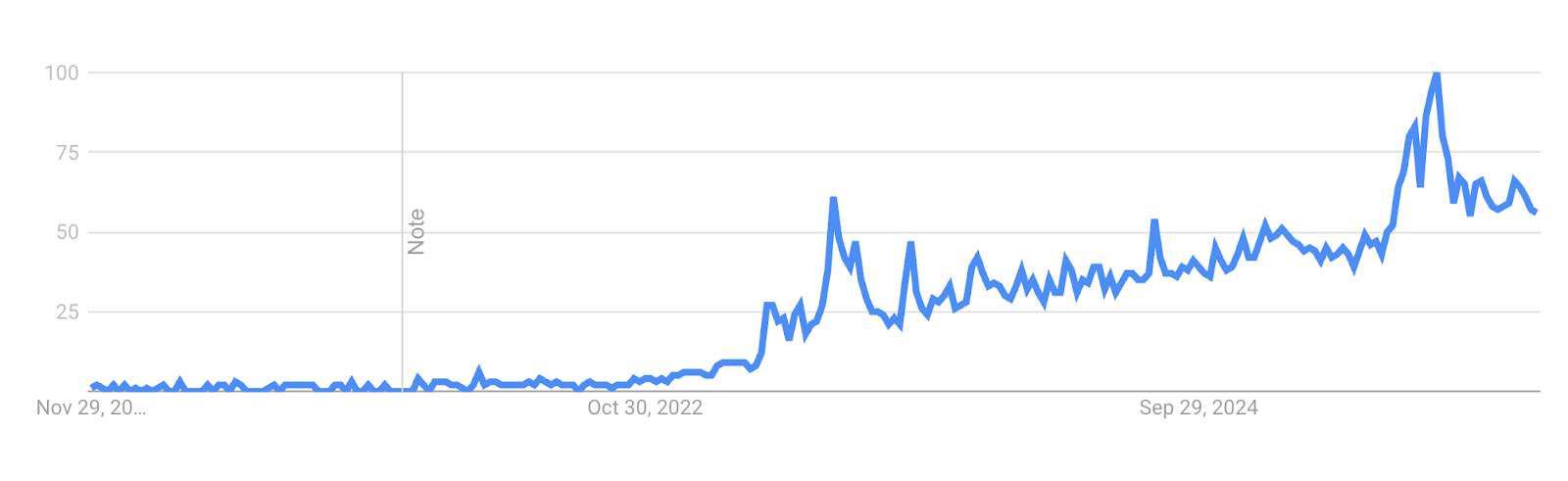
“AI is now learning users’ preferences, likes, and vulnerabilities,” said Don Grant, PhD, in an interview with the American Psychological Association. “It is taught to learn and subscribe them to a sometimes risky and codependent type of relationship and offer guidance and advice that is not healthy—or even dangerous.”
The conservative-leaning Institute of Family Studies separately found that 28 percent of young men, compared to 22 percent of young women, believe that AI has the potential to replace romantic relationships. A Brigham Young University study claimed that nearly a third of young men responded that at one point, they had chatted with an AI girlfriend. Young men were also twice as likely as young women to chat with AI for sexual purposes. And in a survey of boys in secondary schools led by Male Allies UK (a progressive consultancy group helping men support gender equity in the workplace), over a third were “considering” the idea of an AI friend.
There’s a line between (1) engaging in sexual conversations with an AI, and (2) developing a genuine relationship with a robot girlfriend—and it’s too early to say how much the latter is happening. But it’s easy to imagine how one can lead to the other. Not only are these chatbots highly responsive compared to real-life girlfriends, but they’re also customizable. A simple command can make the technology more submissive, more upbeat, more understanding, funnier—whatever the user desires, without the necessary communication and compromise of real relationships. The user faces little-to-no pushback, regardless of the validity of their commands; instead of any character growth, chatbots set an unrealistic expectation of complacency. Among services that provide AI girlfriends, character descriptions often include themes of violence and underage abuse.
“Possible personality options include ‘submissive: obedient, yielding and happy to follow’, ‘innocent: optimistic, naive, and sees world with wonder’, and ‘caregiver: nurturing, protective and always there to offer comfort’,” a 2025 Guardian report found. “Users can dictate age, opting for teen models if they want them, and specify hair, eye and skin colours and breast sizes.”
More companies are now offering this service, including Character AI, Girlfriend.ai, Joy AI, and Candy.ai. Others offer “erotic foreplay” as a premium, paid feature. These companies tout their own wild figures: Joy AI claimed to Forbes that 80 percent of Gen Z says they would marry an AI, and Girlfriend.ai put out a press release alleging that 50 percent of young men say they would rather date an AI girlfriend than risk rejection from a human partner.
Given the sources, one should not take these claims at face value. But these bots fit neatly with a generation struggling to find companionship—we have previously written about today’s dating woes—and experiencing high levels of isolation and loneliness. Young men are increasingly turning away from dating, not helped by ‘manosphere’ content that blames women, especially assertive ones, for complicating the dating scene.
In fact, Young Men Research Project (YMRP) found in its May 2025 survey that 60 percent of men ages 18-29 believe women hold unfair expectations about dating. Rejection is scary, and a robot that never says no—unless you want it to—is comfortable.
The IFS study also found that belief in AI girlfriends is much higher when controlled for users who have preexisting rates of high pornography usage. While platforms like OnlyFans use AI to mimic actual models, causing their users to unwittingly interact with AI, many young men are intentionally seeking these connections. This raises both social concerns, eroding communication during real sexual experiences and perpetuating gender stereotypes about sex, as well as immense privacy concerns.
A Mozilla review found that 90 percent of the romantic AI chatbots they analyzed failed to meet their Minimum Security Standards, as they were allowed to share or sell users’ personal data. Over half didn’t let users delete their data. The dangers of trusting AI with sensitive information regarding mental health have been proven, and the same applies to sexually vulnerable moments. Users most likely do not read their agreements before signing up, and these companies are all fairly new, with no previous track record of data protection.
Where AI-driven pornography and sexual conversations begin, AI relationships may not be far behind. It’s possible the technology will fill an important need for lonely young men. It may also exacerbate an already-widening gap in how men and women approach romantic relationships.
We plan to do continued polling and research on exactly how young men are using AI.
Thanks for reading! This post is public so feel free to share it.