According to the Oulu University of Applied Sciences, this tour marks the first time that a fully certified electric aircraft has crossed areas of open sea.
- Yle News
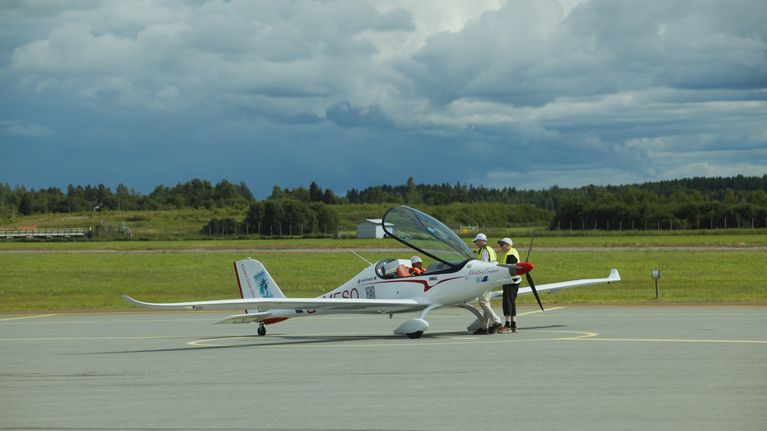
An electric plane arrived at Vaasa Airport on Finland's west coast on Tuesday, having flown from Umeå, Sweden.
The flight was part of the North Circuit tour co-arranged by the Oulu University of Applied Sciences (Oamk), which says this tour marks the first time that a fully certified electric aircraft has crossed areas of open sea.
The approximately 5,600-kilometre emissions-free tour began last Tuesday in Bavaria, Germany, continued through Sweden to Vaasa.
After several stops in Finland, it is to fly via the Baltic states back to Central Europe. Its Finnish visit includes the Kuhmo Fly-In event, where members of the public can climb inside the plane.
According to the university, the idea is to show that electric flight is possible over relatively long distances and in variable northern conditions.
The entire tour is being flown by 77-year-old Uwe Nortmann, an experienced test pilot for aircraft manufacturer Elektra Solar. He told Yle that the crossing of the Quark Strait between Sweden and Finland went smoothly and faster than expected.
However, the trip in Sweden was not without challenges. During a thunderstorm at Storvik Airport, a lightning strike damaged the aircraft's charging system. A replacement part was quickly delivered from Germany.
"Since then, it has been smooth flying and smooth charging," he said.
Aviation history in the making
The tour includes three open sea crossings: from Germany to Sweden, from Sweden to Finland, and from Finland to Estonia.
According to Timo Hyvönen, a senior researcher at Oamk, the North Circuit tour is the first time that a certified electric aircraft has crossed open seas. He points out that this is a commercially available plane rather than a test aircraft.
"This machine is certified in Germany and can be purchased in a store," he said.
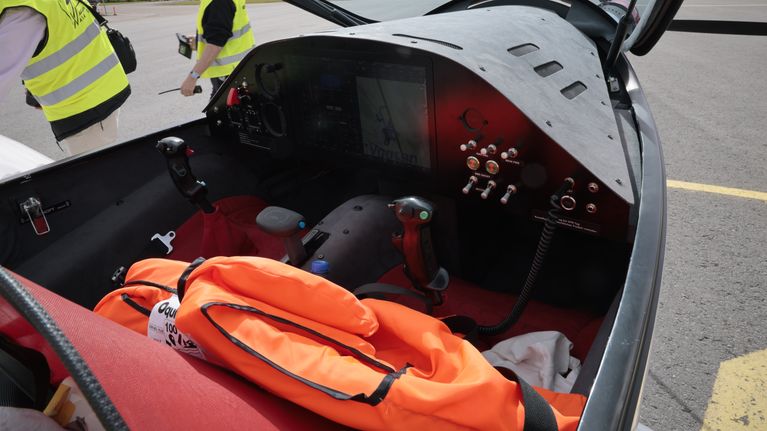
Oamk has bought a similar plane for research purposes.
"Our plane won't arrive until next spring. That's why we agreed with the factory to do a tour like this, so we can learn about how it operates over long distances," Hyvönen said.
The tour is also a test of the charging infrastructure for electric aircraft.
The two-seater Elektra Trainer was designed from the start as an electric aircraft, which according to Hyvönen is still rare.
"Almost all other small aircraft that have been electrified are based on the old combustion engine. That's why this one has a slightly different shape than traditional aircraft," he noted, adding that the Trainer consumes less than half the electricity that would be required to fly a converted traditional aircraft of the same size.
The machine has a battery life of about two and a half, while charging takes about three hours. In comparison, the only other type-certified European electric aircraft, the Pipistrel Velis Electro, has a range of about 50 minutes.
Challenges before passenger flights
According to Hyvönen, electric aircraft could revitalise smaller airports in Finland and increase cross-border aviation carrying up to 20 passengers, although this will require certification of longer-range electric aircraft and construction of charging infrastructure.
According to Lasse Pohjala, project manager at the Vaasa Region Development Company, battery technology is the main stumbling block to developing electric planes.
“Batteries still weigh too much, but the development has been surprisingly fast," he told Yle.