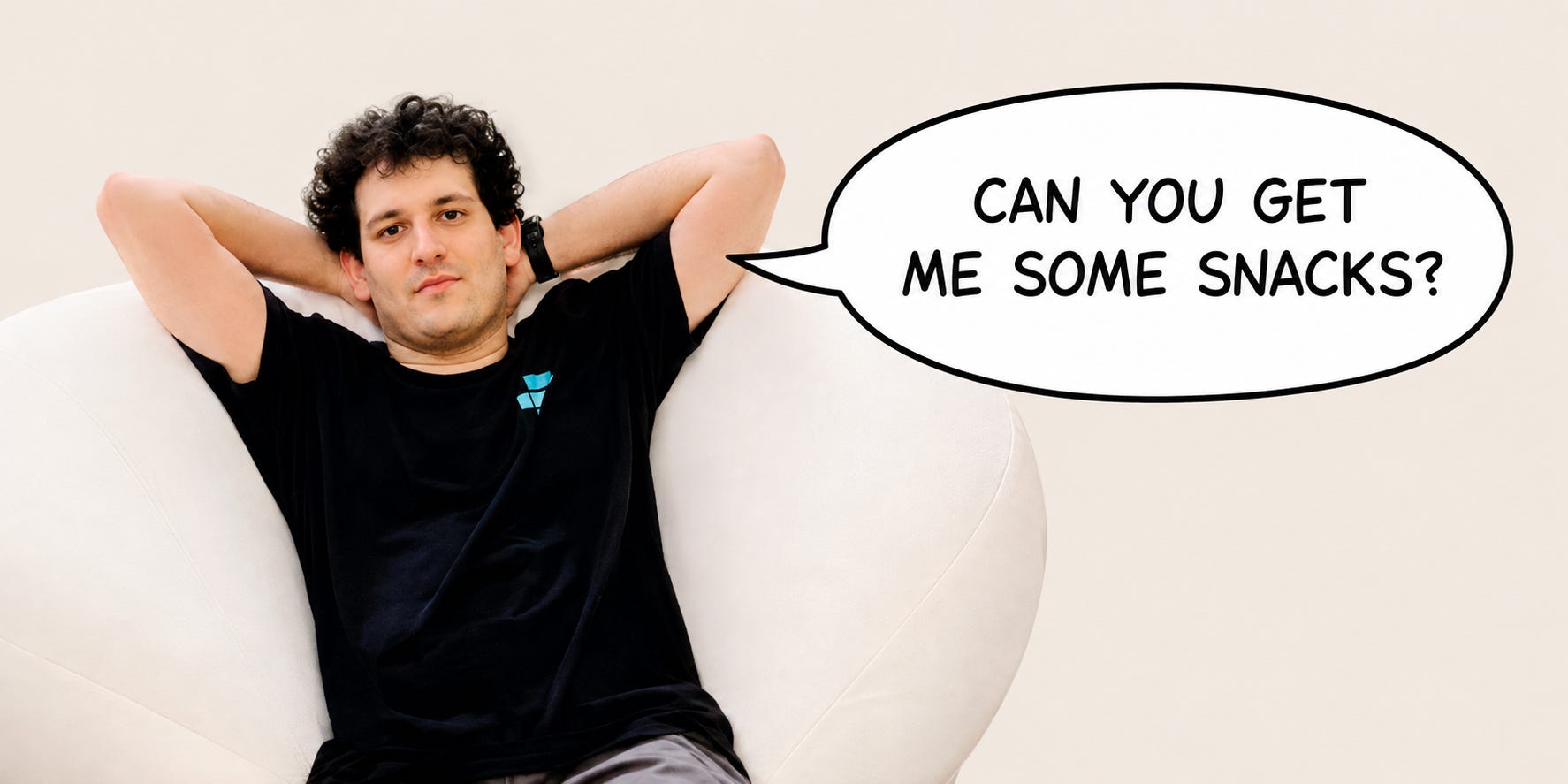
Doing operations work tends to feel bad because:
You are supporting the people doing the interesting things, rather than doing the interesting things yourself;
It’s often dull;
It means you might be stupid.
By operations work, I’m broadly referring to the type of work that supports the behind-the-scenes running of an organization, from finances to human resources to systems management to events to run-of-the-mill administrative work. It’s a necessary function, both for most organizations and mankind, yet its necessity fails to make up for its lack of fulfillment.
It feels bad to not be the one coming up with the interesting ideas, making the new discoveries, or creating new things in the world. It's depressing to watch your peers publish exciting new research while you announce the latest edition of the company privacy policy. Operations deliverables simply never feel like "creations".
While there are people who enjoy things like balancing the books and drafting employment contracts, I imagine most would agree that these tasks do not rate very highly in the grander scheme of possible human experiences. Every office job has moments of staring blankly at your screen, wondering if this is all there is, but I find ops jobs tend to induce these questionings at a higher rate.
Many operations-adjacent folks (me) will go to great lengths to run away from this low-status existence.
For example, they will try to graduate from “Operations Associate” to “Operations Specialist” as quickly as possible, or at least get “Senior” attached to their title before “Associate”, helping remove themselves from the bottom of the food chain. Better yet, they’ll get the word “Strategy” added to their “Operations” title, so people know they at least have the capacity for thought.
Chief of Staff sounds quite fancy too, I think because the word “Chief” imbues the title with a sense of militaristic spirit, and lots of people like to respect the military.
Even the pinnacle of an operations person’s career, becoming an acclaimed COO, as fancy-sounding as it is, will never be as fancy as CEO. The “E” simply looks more intimidating than the “O”. And the E lets you be ranked first on the website.
For me, this sense of feeling lesser-than has felt especially potent in the Effective Altruist (EA) community, a community I’ve spent most of my early career in.
While founded on a belief that all sentient beings are worth moral consideration, it mostly feels like they care about the ones who are “high impact”. While these people technically are more valuable, at least in the economic sense, I find they often hold this subtle disdain for those not as “impactful” or intelligent as them.
The EA sales pitch for why you should do operations work is roughly: you will be saving the time of more important people. Apparently some people find this motivating?
One need not look any further than the book Going Infinite, a chronicle of fallen EA angel Sam Bankman-Fried, to learn that if you are doing operations work, it means many higher-ups secretly think you are a bit dim.
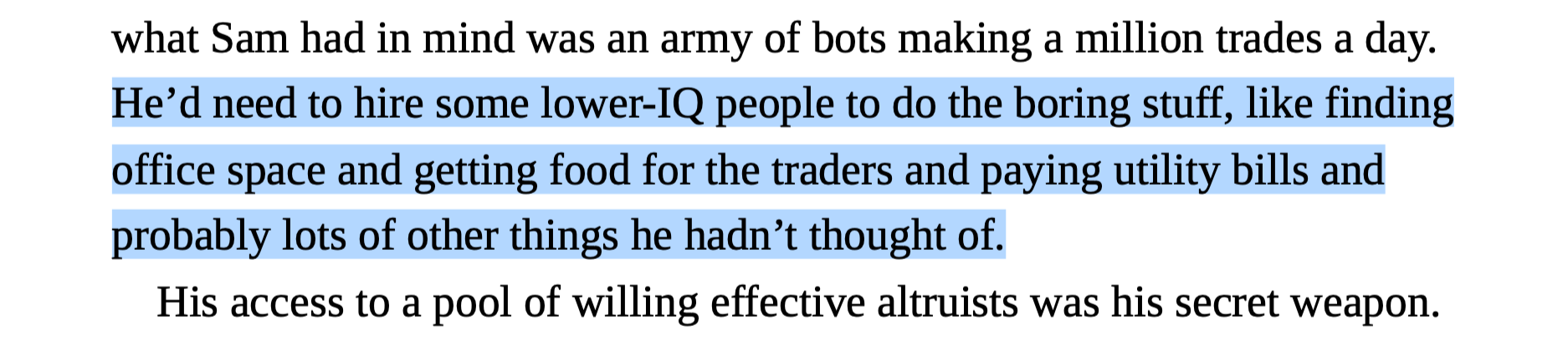
Being dim would be easier to accept if you felt the people who thought you were dim still believed you had inherent worth. It often does not feel like this is the case.
I remember asking the following question in my Daily Poll WhatsApp group: At what point, if any, would you choose to sacrifice one random human life to save a certain number of goats?
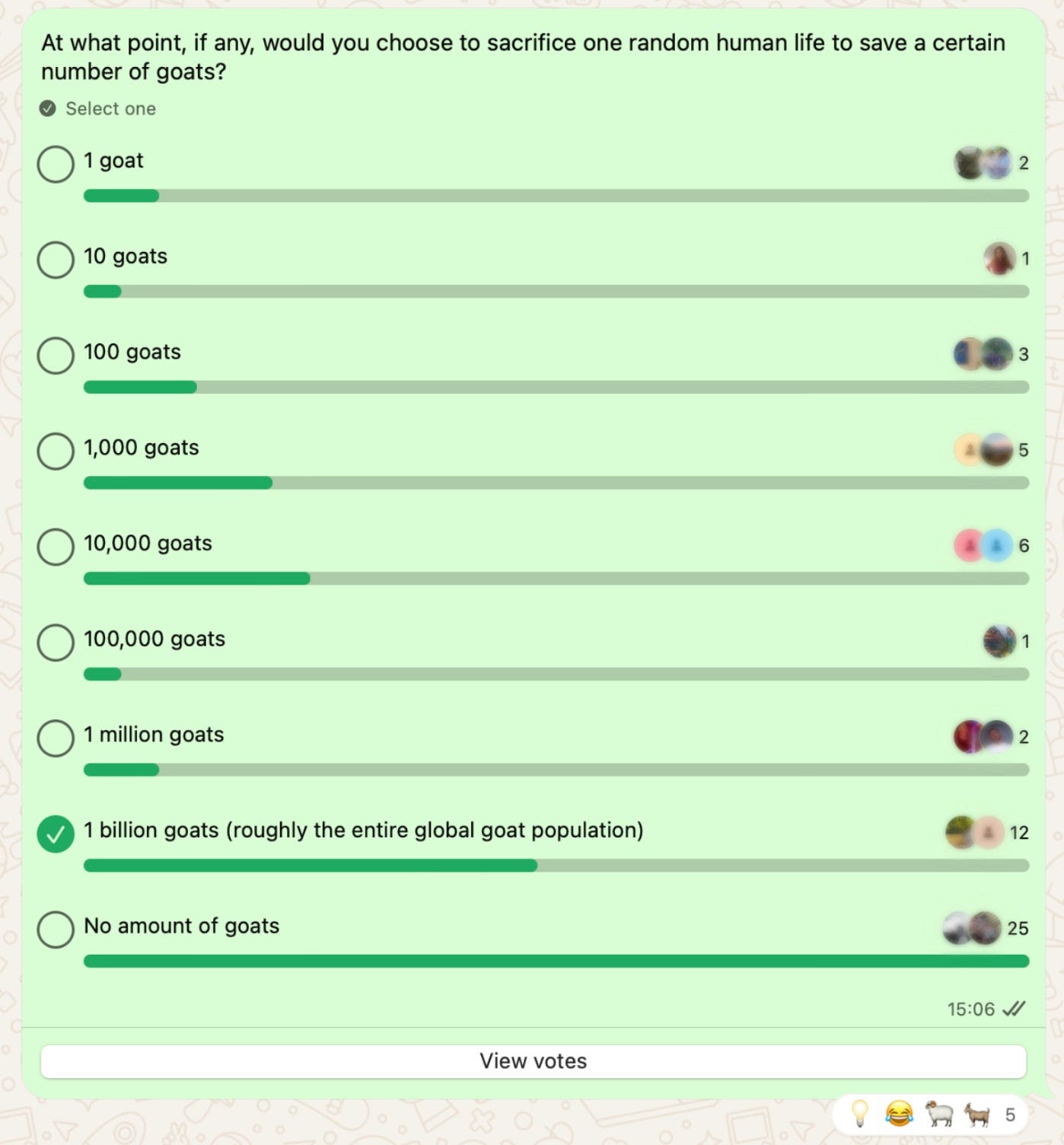
It got me thinking: if this hypothetical scenario were real, and we indeed needed to collectively sacrifice one or multiple humans in the name of goat preservation, how would we go about choosing which human to sacrifice? Perhaps it’d be a lottery draw, but if it were chosen by a selection committee, I imagine they’d start with the serial killers and raging pedophiles, but then after a certain point would arrive at us regular folks, and would probably opt to keep the frontier AI researcher and sacrifice the person in charge of managing their schedule.
Video by Brian from Serendipity Lab, filmed serendipitously the day I wrote this piece
The reality is that more senior titles generally are good proxies for higher levels of skill, experience, and responsibility. And if you were a genius you probably wouldn’t be doing office management (and that’s fine)! Also, you don’t usually end up in places by complete chance. You’ve probably consistently demonstrated a comparative advantage in being a well-organized and highly conscientious person, and so it makes sense that you have ended up doing operations work.
Moreover, you like some of this stuff! You feel intrinsic satisfaction when helping reduce chaos; when puppeteering humans at scale; or when experiencing the aesthetic pleasure of looking at a well-organized spreadsheet or a beautifully organized shelf.
I think most of my disappointment and sadness about my career so far comes from a difference between what I deem a valuable person to be (a researcher, scientist, entrepreneur, creator) and how I perceive myself to be (a helper, supporter, generalist). While I do deep down hold this belief that every single human has inherent worth by mere act of existence, I continuously fail to apply this belief to myself.
This post was written on day 1 of Inscribe - a week-long writing residency in the Spanish hills that I co-organized with Chiaramente, where everyone has to publish at least 500 words per day, or go home.