There’s a reasonable consensus out there that AI does not yet substitute for human effort. Instead, it makes people more productive. In particular, it isn’t usually “better than the best” at any given job, but it might be better than all but the very best. So, AI helps all but the best workers to achieve the same result. The relationship between talent and output looks like this:
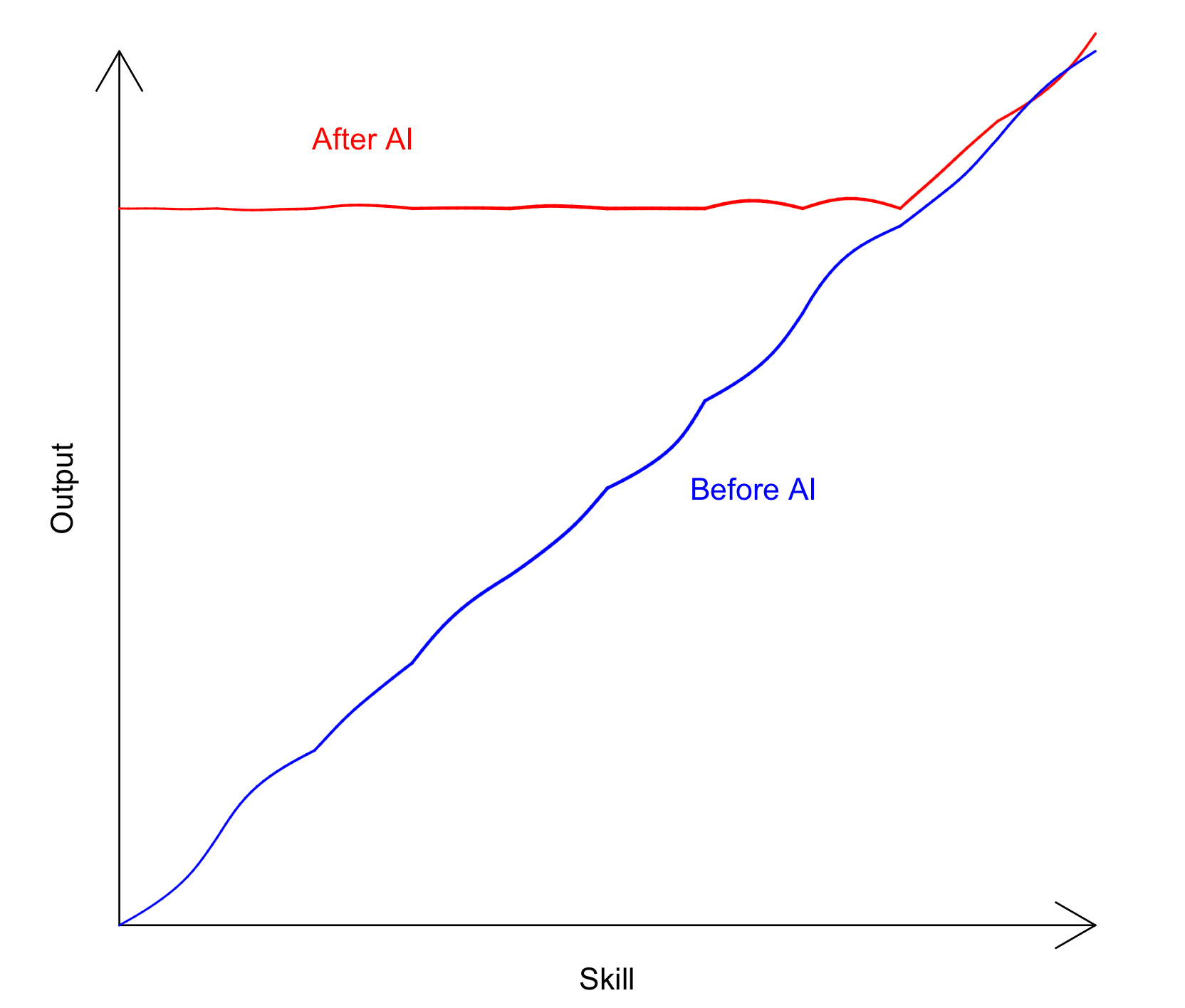
That looks like a straightforward increase in productivity. But might it have paradoxical effects?
Some activities are valued not in themselves, but as signals of underlying talent.
There’s a well-known theory that education is a signal. A maths degree increases your value in the labour market, even if you will rarely get an urgent call from head office to integrate a function along a curve. That’s probably because people who can complete a maths degree are likely to be smart in general. In previous centuries you might have proved the same thing by learning Ancient Greek.
A lot of graphic design works on the same principle. Nice logos and carefully posed photographs probably don’t add to the value of the underlying product, but they may send messages like “this is our flagship product, we believe in it” or “we are a solid firm, you’re in safe hands”.
Crisp prose and correct spelling make you seem smart, whatever the value of the underlying information being communicated.
… and so on.
Pre-AI, there is a one-to-one map from talent to output. A good artist will draw a good picture, and a better artist will draw a better one. AI destroys this correspondence, because now everybody can achieve at least AI’s output level.
But that removes the signalling value! An email full of AI slop will not persuade anyone you are smart, because anyone can do that now. And I think it is quite likely that degrees will lose their signalling cachet for the same reason. Grade inflation and low standards were already a problem, but now anyone, literally anyone, can get a degree from any university that is not proactively tackling AI cheats.
When the first AI image models came out, everyone wanted to use them. Now, like out-of-date memes, they seem a bit naff. If I see an AI image on a poster for an event, it makes me less likely to want to go, because I know they didn’t have the resources/make the effort to get a proper designer. Maybe soon it will be impossible to tell AI images from the real thing. Then there will simply be no marketing value in having a nice poster. Anyone can do that!
If AI is especially good at tasks with high signalling value, then its long-run effects on the economy may be smaller than in the short run. Right now your lazy and untalented coworkers may be filling your inbox with slop, but in the long run, people will wise up and that activity will stop paying off. Maybe many of these tasks will simply die out, leaving companies and inviduals to find other ways of showing off and proving their value. If so, then AI capabilities on these tasks will ultimately be of no use.
David Graeber’s funny book Bullshit Jobs suggested that many or most jobs in the modern economy were unproductive. Categories of bullshit jobs included flunkies, box-tickers and taskmasters. A major part of bullshit employment is signalling — flunkies signal their boss’s status; box-tickers enact compliance theatre and busywork; taskmasters exist to make themselves seem important. The last two of these especially seem to involve many tasks that AI can now do: speedrunning the latest compulsory HR training, or puffing your own importance on LinkedIn. I’d expect AI to increase the amount of these bullshit tasks, for now, and that seems to be what is happening. But maybe in future, we could just stop doing them!