Zyphra

85 min read Original article ↗

ZAYA1 – Pretraining on Integrated AMD Platform: Compute, Network, and System Design

Press Release

November 24, 2025

san francisco, CALIFORNIA

Zyphra announces a preview of ZAYA1, the first AI model trained entirely end-to-end on AMD’s hardware, software, and networking stack.  Details of our pretraining efforts, hardware specific optimizations, and ZAYA1-base model benchmarks are described in the accompanying technical report published to arXiv.
Authors

Zyphra Team

Collaborators

Daniel A Roberts (Sequoia Capital & MIT), Andrey Gromov (Meta FAIR), Kushal Tirumala (Meta FAIR) and Hassan Shapourian (Cisco)

Zyphra announces a preview of ZAYA1, the first AI model trained entirely end-to-end on AMD’s hardware, software, and networking stack.  Details of our pretraining efforts, hardware specific optimizations, and ZAYA1-base model benchmarks are described in the accompanying technical report published to arXiv.

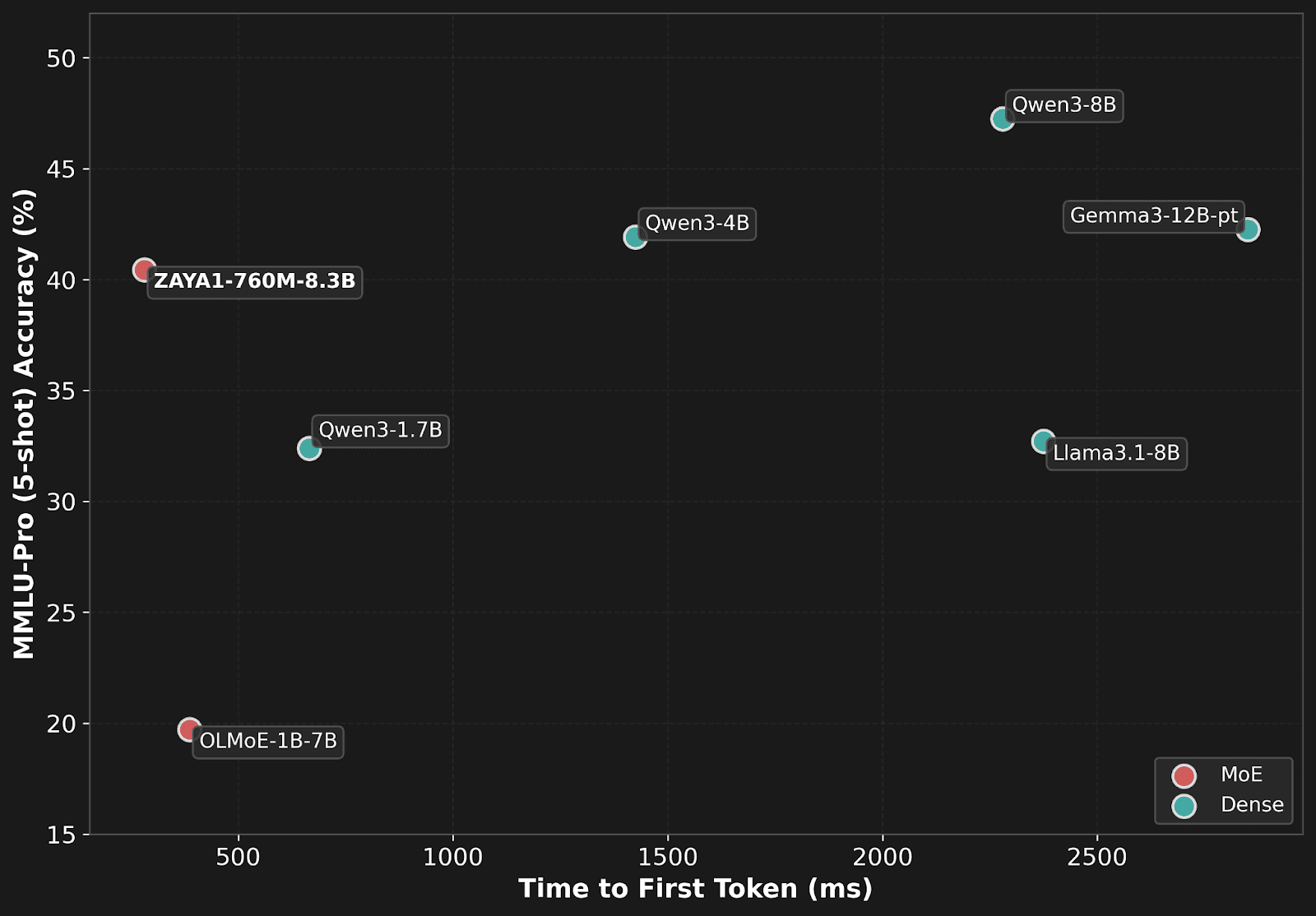
Quality vs. Inference Speed

Our ZAYA1-base model’s benchmark performance is extremely competitive with the SoTA Qwen3 series of models of comparable scale, and outperforms comparable western open-source models such as SmolLM3, and Phi4. 
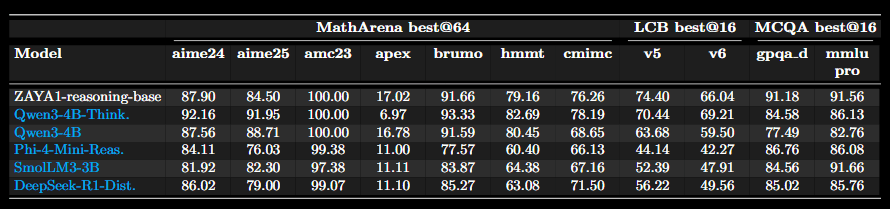
ZAYA1-reasoning-base excels especially at complex and challenging mathematical and STEM reasoning tasks, nearly matching the performance of SoTA Qwen3 thinking models under high pass@k settings even prior to explicit post-training for reasoning, and exceeds other strong reasoning models such as Phi4-reasoning, and Deepseek-R1-Distill. 

Building on our previous work with AMD, we have been deeply committed to de-risking end-to-end large-scale pretraining on AMD. To create the infrastructure required to train ZAYA1-base, Zyphra, AMD, and IBM collaborated closely to build a large-scale, reliable, and highly performant training cluster using AMD MI300X GPUs with AMD Pensando Pollara networking. At the same time, we built a highly optimized, fault tolerant, and robust training stack specialized for AMD pretraining which we used to pretrain ZAYA1.

For Zyphra, ZAYA1 stands as a crucial demonstration that the AMD hardware and software stacks are both mature and performant enough to support large scale high performance pretraining workloads. With feasibility thus proven, and with the help of our close partners, we look forward to substantially scaling up our training efforts and training AI models that will deliver the next generation of breakthroughs in agentic capabilities, long term memory, and continual learning.

In our accompanying technical report, we provide a deep dive into our experience and insights from our efforts pretraining on AMD hardware as well as describe our training framework and the hardware specific optimizations we perform in detail. We aim to distill and describe a practical recipe that others can use when considering training on AMD.. 

Specifically, we provide a detailed characterization of our cluster hardware in terms of compute, memory bandwidth and networking components and relevant microbenchmarks for assessing their performance. We also provide detailed guidance on model sizing and other optimizations to ensure strong performance of training on this particular hardware, as well as details on fundamental kernels for the muon optimizer and other core training components that we implemented in order to optimize our training speed and efficiency. 

Zyphra announces a preview of ZAYA1, the first AI model trained entirely end-to-end on AMD’s hardware, software, and networking stack.  Details of our pretraining efforts, hardware specific optimizations, and ZAYA1-base model benchmarks are described in the accompanying technical report published to arXiv.

Our ZAYA1-base model’s benchmark performance is extremely competitive with the SoTA Qwen3 series of models of comparable scale, and outperforms comparable western open-source models such as SmolLM3, and Phi4. 

ZAYA1-reasoning-base excels especially at complex and challenging mathematical and STEM reasoning tasks, nearly matching the performance of SoTA Qwen3 thinking models under high pass@k settings even prior to explicit post-training for reasoning, and exceeds other strong reasoning models such as Phi4-reasoning, and Deepseek-R1-Distill. 

Building on our previous work with AMD, we have been deeply committed to de-risking end-to-end large-scale pretraining on AMD. To create the infrastructure required to train ZAYA1-base, Zyphra, AMD, and IBM collaborated closely to build a large-scale, reliable, and highly performant training cluster using AMD MI300X GPUs with AMD Pensando Pollara networking. At the same time, we built a highly optimized, fault tolerant, and robust training stack specialized for AMD pretraining which we used to pretrain ZAYA1.

For Zyphra, ZAYA1 stands as a crucial demonstration that the AMD hardware and software stacks are both mature and performant enough to support large scale high performance pretraining workloads. With feasibility thus proven, and with the help of our close partners, we look forward to substantially scaling up our training efforts and training AI models that will deliver the next generation of breakthroughs in agentic capabilities, long term memory, and continual learning.

In our accompanying technical report, we provide a deep dive into our experience and insights from our efforts pretraining on AMD hardware as well as describe our training framework and the hardware specific optimizations we perform in detail. We aim to distill and describe a practical recipe that others can use when considering training on AMD.. 

Specifically, we provide a detailed characterization of our cluster hardware in terms of compute, memory bandwidth and networking components and relevant microbenchmarks for assessing their performance. We also provide detailed guidance on model sizing and other optimizations to ensure strong performance of training on this particular hardware, as well as details on fundamental kernels for the muon optimizer and other core training components that we implemented in order to optimize our training speed and efficiency. 

In addition, we provide a preview of the base model we produced by pretraining on the full AMD platform. In future works we will release and detail the final post-trained model checkpoints and its performance, as well as provide a more detailed description of the entire training process.

In short, the ZAYA1-base model was trained for 14T total tokens on Zyphra’s internal AMD-specialized training stack. Following recent works, ZAYA1 was optimized using the Muon optimizer. We trained in three core phases – pretraining phase1, pretraining phase 2 followed by a context length extension including mid-training.  As the phases progress, we follow a curriculum training strategy where we shift from primarily unstructured web data to more highly structured and information dense mathematical, coding, and reasoning data. 
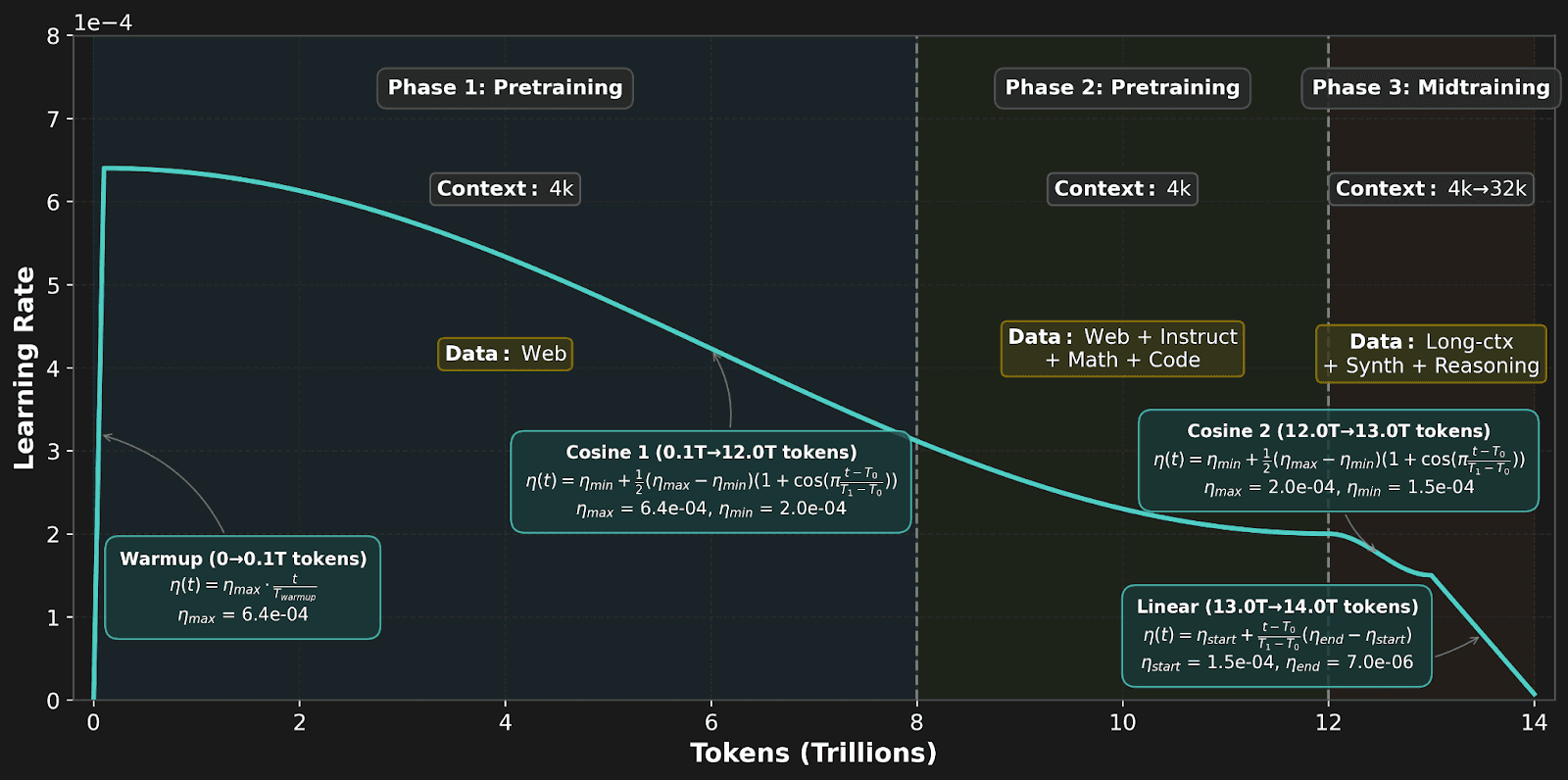
In addition, we provide a preview of the base model we produced by pretraining on the full AMD platform. In future works we will release and detail the final post-trained model checkpoints and its performance, as well as provide a more detailed description of the entire training process.

In short, the ZAYA1-base model was trained for 14T total tokens on Zyphra’s internal AMD-specialized training stack. Following recent works, ZAYA1 was optimized using the Muon optimizer. We trained in three core phases – pretraining phase1, pretraining phase 2 followed by a context length extension including mid-training.  As the phases progress, we follow a curriculum training strategy where we shift from primarily unstructured web data to more highly structured and information dense mathematical, coding, and reasoning data. 

Zyphra announces a preview of ZAYA1, the first AI model trained entirely end-to-end on AMD’s hardware, software, and networking stack.  Details of our pretraining efforts, hardware specific optimizations, and ZAYA1-base model benchmarks are described in the accompanying technical report published to arXiv.

In addition, we provide a preview of the base model we produced by pretraining on the full AMD platform. In future works we will release and detail the final post-trained model checkpoints and its performance, as well as provide a more detailed description of the entire training process.

In short, the ZAYA1-base model was trained for 14T total tokens on Zyphra’s internal AMD-specialized training stack. Following recent works, ZAYA1 was optimized using the Muon optimizer. We trained in three core phases – pretraining phase1, pretraining phase 2 followed by a context length extension including mid-training.  As the phases progress, we follow a curriculum training strategy where we shift from primarily unstructured web data to more highly structured and information dense mathematical, coding, and reasoning data. 

Our ZAYA1-base model’s benchmark performance is extremely competitive with the SoTA Qwen3 series of models of comparable scale, and outperforms comparable western open-source models such as SmolLM3, and Phi4. 

In addition, we provide a preview of the base model we produced by pretraining on the full AMD platform. In future works we will release and detail the final post-trained model checkpoints and its performance, as well as provide a more detailed description of the entire training process.

In short, the ZAYA1-base model was trained for 14T total tokens on Zyphra’s internal AMD-specialized training stack. Following recent works, ZAYA1 was optimized using the Muon optimizer. We trained in three core phases – pretraining phase1, pretraining phase 2 followed by a context length extension including mid-training.  As the phases progress, we follow a curriculum training strategy where we shift from primarily unstructured web data to more highly structured and information dense mathematical, coding, and reasoning data. 

In addition, we provide a preview of the base model we produced by pretraining on the full AMD platform. In future works we will release and detail the final post-trained model checkpoints and its performance, as well as provide a more detailed description of the entire training process.

In short, the ZAYA1-base model was trained for 14T total tokens on Zyphra’s internal AMD-specialized training stack. Following recent works, ZAYA1 was optimized using the Muon optimizer. We trained in three core phases – pretraining phase1, pretraining phase 2 followed by a context length extension including mid-training.  As the phases progress, we follow a curriculum training strategy where we shift from primarily unstructured web data to more highly structured and information dense mathematical, coding, and reasoning data. 

In addition, we provide a preview of the base model we produced by pretraining on the full AMD platform. In future works we will release and detail the final post-trained model checkpoints and its performance, as well as provide a more detailed description of the entire training process.

In short, the ZAYA1-base model was trained for 14T total tokens on Zyphra’s internal AMD-specialized training stack. Following recent works, ZAYA1 was optimized using the Muon optimizer. We trained in three core phases – pretraining phase1, pretraining phase 2 followed by a context length extension including mid-training.  As the phases progress, we follow a curriculum training strategy where we shift from primarily unstructured web data to more highly structured and information dense mathematical, coding, and reasoning data. 

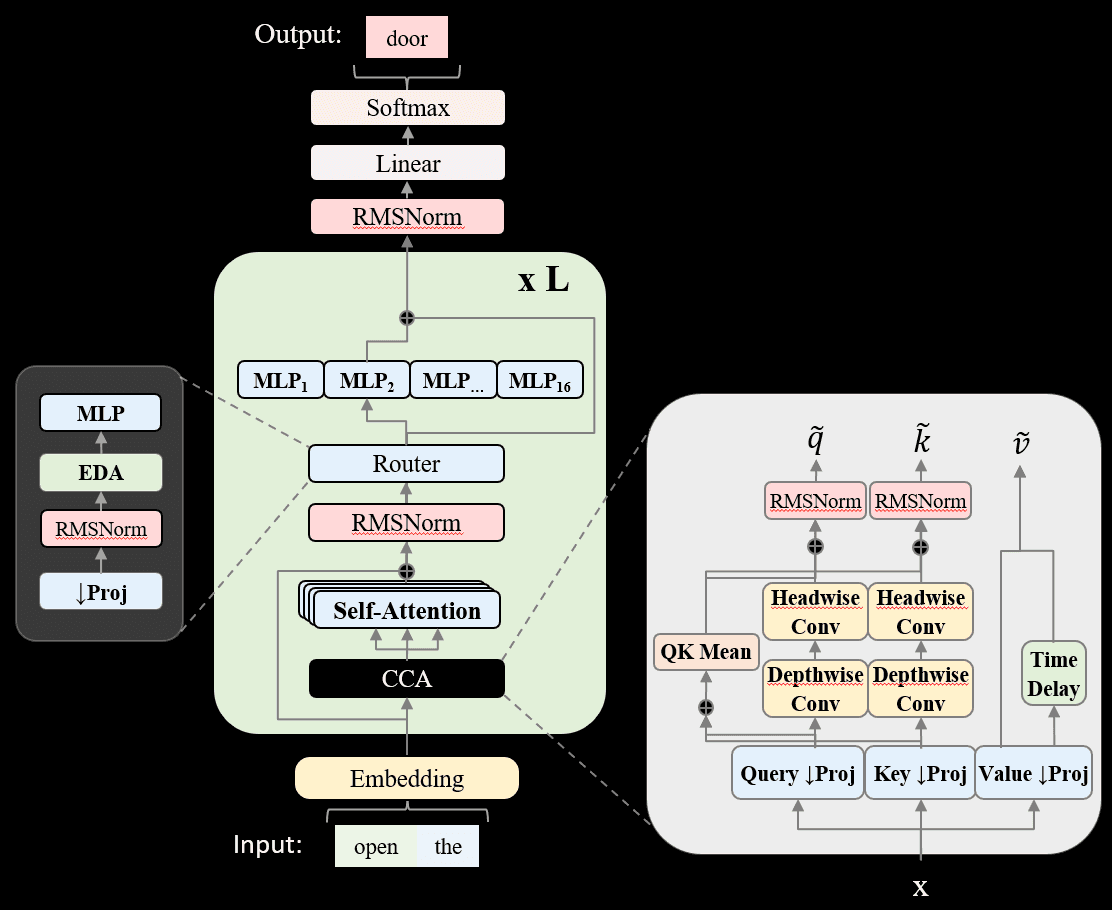
The ZAYA1-base model also showcases some of our architectural innovations that we have developed internally at Zyphra, aiming to improve the FLOP and parameter efficiency of training. These include substantial improvements to the fundamental components of a MoE transformer – attention and the expert router.
Zyphra announces a preview of ZAYA1, the first AI model trained entirely end-to-end on AMD’s hardware, software, and networking stack.  Details of our pretraining efforts, hardware specific optimizations, and ZAYA1-base model benchmarks are described in the accompanying technical report published to arXiv.

Our ZAYA1-base model’s benchmark performance is extremely competitive with the SoTA Qwen3 series of models of comparable scale, and outperforms comparable western open-source models such as SmolLM3, and Phi4. 

ZAYA1-reasoning-base excels especially at complex and challenging mathematical and STEM reasoning tasks, nearly matching the performance of SoTA Qwen3 thinking models under high pass@k settings even prior to explicit post-training for reasoning, and exceeds other strong reasoning models such as Phi4-reasoning, and Deepseek-R1-Distill. 

Building on our previous work with AMD, we have been deeply committed to de-risking end-to-end large-scale pretraining on AMD. To create the infrastructure required to train ZAYA1-base, Zyphra, AMD, and IBM collaborated closely to build a large-scale, reliable, and highly performant training cluster using AMD MI300X GPUs with AMD Pensando Pollara networking. At the same time, we built a highly optimized, fault tolerant, and robust training stack specialized for AMD pretraining which we used to pretrain ZAYA1.

For Zyphra, ZAYA1 stands as a crucial demonstration that the AMD hardware and software stacks are both mature and performant enough to support large scale high performance pretraining workloads. With feasibility thus proven, and with the help of our close partners, we look forward to substantially scaling up our training efforts and training AI models that will deliver the next generation of breakthroughs in agentic capabilities, long term memory, and continual learning.

In our accompanying technical report, we provide a deep dive into our experience and insights from our efforts pretraining on AMD hardware as well as describe our training framework and the hardware specific optimizations we perform in detail. We aim to distill and describe a practical recipe that others can use when considering training on AMD.. 

Specifically, we provide a detailed characterization of our cluster hardware in terms of compute, memory bandwidth and networking components and relevant microbenchmarks for assessing their performance. We also provide detailed guidance on model sizing and other optimizations to ensure strong performance of training on this particular hardware, as well as details on fundamental kernels for the muon optimizer and other core training components that we implemented in order to optimize our training speed and efficiency. 

In addition, we provide a preview of the base model we produced by pretraining on the full AMD platform. In future works we will release and detail the final post-trained model checkpoints and its performance, as well as provide a more detailed description of the entire training process.

In short, the ZAYA1-base model was trained for 14T total tokens on Zyphra’s internal AMD-specialized training stack. Following recent works, ZAYA1 was optimized using the Muon optimizer. We trained in three core phases – pretraining phase1, pretraining phase 2 followed by a context length extension including mid-training.  As the phases progress, we follow a curriculum training strategy where we shift from primarily unstructured web data to more highly structured and information dense mathematical, coding, and reasoning data. 

The ZAYA1-base model also showcases some of our architectural innovations that we have developed internally at Zyphra, aiming to improve the FLOP and parameter efficiency of training. These include substantial improvements to the fundamental components of a MoE transformer – attention and the expert router.

For attention, ZAYA1 uses our recently published CCA attention, which utilizes convolutions within the attention block itself to perform the full attention operation within a compressed latent space. CCA achieves a substantial reduction in attention FLOPs for prefill and training, and achieves better perplexity, while also matching existing state of the art methods in KV cache compression.

ZAYA1 also makes fundamental improvements to the linear router used in almost all existing large-scale MoE models. We discover that improving the expressiveness of the router substantially improves performance of the overall MoE model, as well as changing the routing dynamics and encouraging greater expert specialization. Our novel ZAYA1 router replaces the linear router with a downprojection and then performs multiple sequential MLP operations within the compressed latent space to obtain the final routing choices. 

Together, these architectural innovations reduce the fundamental compute and memory bottlenecks of attention and also improve the expressiveness of routing. They pave the way for further advancements to unlock true long term memory, and the ability for models to dynamically adapt compute and memory to the task at hand. 

We look forward to releasing further details of our experience training on AMD and benchmarks for the ZAYA1 post-trained models.

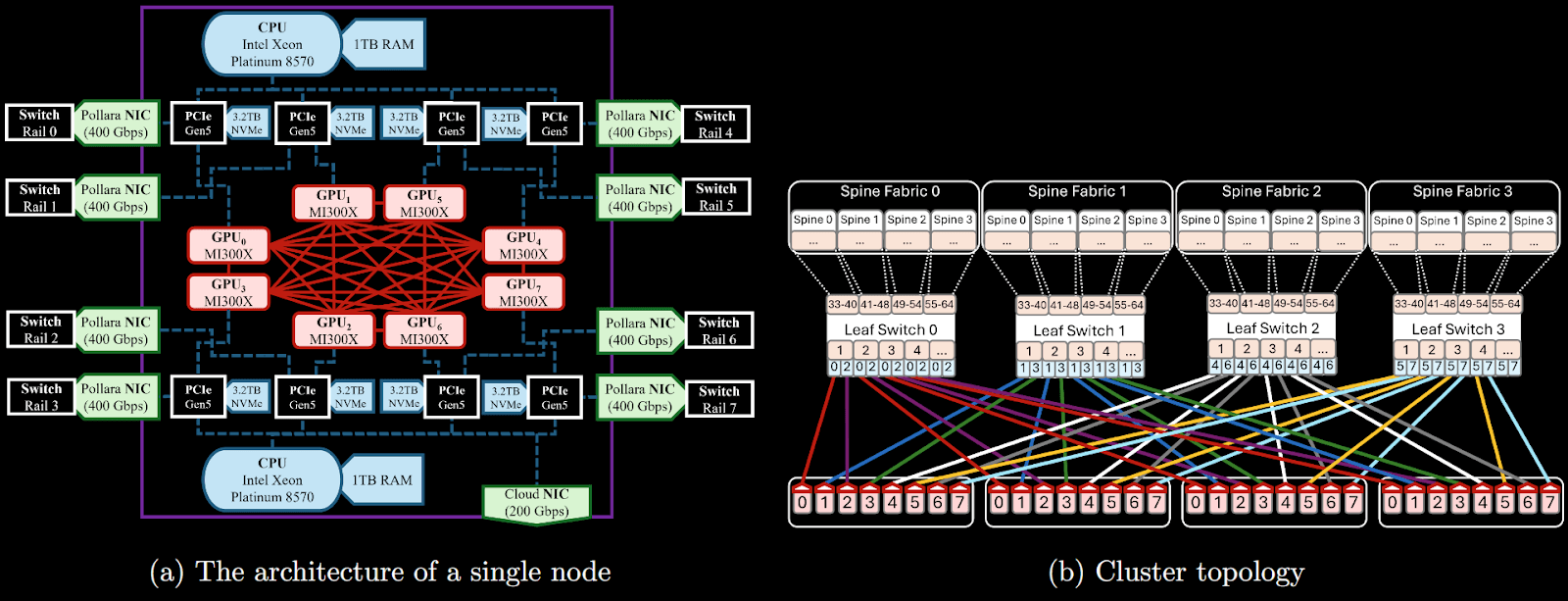
The Zyphra training cluster, built in partnership with IBM, delivers over 750 PFLOPs of real-world training performance. There are 128 nodes, each containing 8 AMD MI300X GPUs connected together with AMD InfinityFabric (see above figure). Each GPU has a dedicated AMD Pollara 400Gbps interconnect, and nodes are connected together in a rails-only topology. 

Not only was an AMD-native model training framework developed, but the unique model architecture of ZAYA1 required significant co-design to enable rapid end-to-end training. Such co-design included custom kernels, parallelism schemes, and model sizing. See the accompanying technical report for details on optimization, in addition to often-overlooked aspects of training at scale such as fault tolerance, and checkpointing.

Zyphra announces a preview of ZAYA1, the first AI model trained entirely end-to-end on AMD’s hardware, software, and networking stack.  Details of our pretraining efforts, hardware specific optimizations, and ZAYA1-base model benchmarks are described in the accompanying technical report published to arXiv.

Our ZAYA1-base model’s benchmark performance is extremely competitive with the SoTA Qwen3 series of models of comparable scale, and outperforms comparable western open-source models such as SmolLM3, and Phi4. 

ZAYA1-reasoning-base excels especially at complex and challenging mathematical and STEM reasoning tasks, nearly matching the performance of SoTA Qwen3 thinking models under high pass@k settings even prior to explicit post-training for reasoning, and exceeds other strong reasoning models such as Phi4-reasoning, and Deepseek-R1-Distill. 

Building on our previous work with AMD, we have been deeply committed to de-risking end-to-end large-scale pretraining on AMD. To create the infrastructure required to train ZAYA1-base, Zyphra, AMD, and IBM collaborated closely to build a large-scale, reliable, and highly performant training cluster using AMD MI300X GPUs with AMD Pensando Pollara networking. At the same time, we built a highly optimized, fault tolerant, and robust training stack specialized for AMD pretraining which we used to pretrain ZAYA1.

For Zyphra, ZAYA1 stands as a crucial demonstration that the AMD hardware and software stacks are both mature and performant enough to support large scale high performance pretraining workloads. With feasibility thus proven, and with the help of our close partners, we look forward to substantially scaling up our training efforts and training AI models that will deliver the next generation of breakthroughs in agentic capabilities, long term memory, and continual learning.

In our accompanying technical report, we provide a deep dive into our experience and insights from our efforts pretraining on AMD hardware as well as describe our training framework and the hardware specific optimizations we perform in detail. We aim to distill and describe a practical recipe that others can use when considering training on AMD.. 

Specifically, we provide a detailed characterization of our cluster hardware in terms of compute, memory bandwidth and networking components and relevant microbenchmarks for assessing their performance. We also provide detailed guidance on model sizing and other optimizations to ensure strong performance of training on this particular hardware, as well as details on fundamental kernels for the muon optimizer and other core training components that we implemented in order to optimize our training speed and efficiency. 

In addition, we provide a preview of the base model we produced by pretraining on the full AMD platform. In future works we will release and detail the final post-trained model checkpoints and its performance, as well as provide a more detailed description of the entire training process.

In short, the ZAYA1-base model was trained for 14T total tokens on Zyphra’s internal AMD-specialized training stack. Following recent works, ZAYA1 was optimized using the Muon optimizer. We trained in three core phases – pretraining phase1, pretraining phase 2 followed by a context length extension including mid-training.  As the phases progress, we follow a curriculum training strategy where we shift from primarily unstructured web data to more highly structured and information dense mathematical, coding, and reasoning data. 

The ZAYA1-base model also showcases some of our architectural innovations that we have developed internally at Zyphra, aiming to improve the FLOP and parameter efficiency of training. These include substantial improvements to the fundamental components of a MoE transformer – attention and the expert router.

For attention, ZAYA1 uses our recently published CCA attention, which utilizes convolutions within the attention block itself to perform the full attention operation within a compressed latent space. CCA achieves a substantial reduction in attention FLOPs for prefill and training, and achieves better perplexity, while also matching existing state of the art methods in KV cache compression.

ZAYA1 also makes fundamental improvements to the linear router used in almost all existing large-scale MoE models. We discover that improving the expressiveness of the router substantially improves performance of the overall MoE model, as well as changing the routing dynamics and encouraging greater expert specialization. Our novel ZAYA1 router replaces the linear router with a downprojection and then performs multiple sequential MLP operations within the compressed latent space to obtain the final routing choices. 

Together, these architectural innovations reduce the fundamental compute and memory bottlenecks of attention and also improve the expressiveness of routing. They pave the way for further advancements to unlock true long term memory, and the ability for models to dynamically adapt compute and memory to the task at hand. 

We look forward to releasing further details of our experience training on AMD and benchmarks for the ZAYA1 post-trained models.

The Zyphra training cluster, built in partnership with IBM, delivers over 750 PFLOPs of real-world training performance. There are 128 nodes, each containing 8 AMD MI300X GPUs connected together with AMD InfinityFabric (see above figure). Each GPU has a dedicated AMD Pollara 400Gbps interconnect, and nodes are connected together in a rails-only topology. 

Not only was an AMD-native model training framework developed, but the unique model architecture of ZAYA1 required significant co-design to enable rapid end-to-end training. Such co-design included custom kernels, parallelism schemes, and model sizing. See the accompanying technical report for details on optimization, in addition to often-overlooked aspects of training at scale such as fault tolerance, and checkpointing.

Zyphra announces a preview of ZAYA1, the first AI model trained entirely end-to-end on AMD’s hardware, software, and networking stack.  Details of our pretraining efforts, hardware specific optimizations, and ZAYA1-base model benchmarks are described in the accompanying technical report published to arXiv.

Our ZAYA1-base model’s benchmark performance is extremely competitive with the SoTA Qwen3 series of models of comparable scale, and outperforms comparable western open-source models such as SmolLM3, and Phi4. 

ZAYA1-reasoning-base excels especially at complex and challenging mathematical and STEM reasoning tasks, nearly matching the performance of SoTA Qwen3 thinking models under high pass@k settings even prior to explicit post-training for reasoning, and exceeds other strong reasoning models such as Phi4-reasoning, and Deepseek-R1-Distill. 

Building on our previous work with AMD, we have been deeply committed to de-risking end-to-end large-scale pretraining on AMD. To create the infrastructure required to train ZAYA1-base, Zyphra, AMD, and IBM collaborated closely to build a large-scale, reliable, and highly performant training cluster using AMD MI300X GPUs with AMD Pensando Pollara networking. At the same time, we built a highly optimized, fault tolerant, and robust training stack specialized for AMD pretraining which we used to pretrain ZAYA1.

For Zyphra, ZAYA1 stands as a crucial demonstration that the AMD hardware and software stacks are both mature and performant enough to support large scale high performance pretraining workloads. With feasibility thus proven, and with the help of our close partners, we look forward to substantially scaling up our training efforts and training AI models that will deliver the next generation of breakthroughs in agentic capabilities, long term memory, and continual learning.

In our accompanying technical report, we provide a deep dive into our experience and insights from our efforts pretraining on AMD hardware as well as describe our training framework and the hardware specific optimizations we perform in detail. We aim to distill and describe a practical recipe that others can use when considering training on AMD.. 

Specifically, we provide a detailed characterization of our cluster hardware in terms of compute, memory bandwidth and networking components and relevant microbenchmarks for assessing their performance. We also provide detailed guidance on model sizing and other optimizations to ensure strong performance of training on this particular hardware, as well as details on fundamental kernels for the muon optimizer and other core training components that we implemented in order to optimize our training speed and efficiency. 

In addition, we provide a preview of the base model we produced by pretraining on the full AMD platform. In future works we will release and detail the final post-trained model checkpoints and its performance, as well as provide a more detailed description of the entire training process.

In short, the ZAYA1-base model was trained for 14T total tokens on Zyphra’s internal AMD-specialized training stack. Following recent works, ZAYA1 was optimized using the Muon optimizer. We trained in three core phases – pretraining phase1, pretraining phase 2 followed by a context length extension including mid-training.  As the phases progress, we follow a curriculum training strategy where we shift from primarily unstructured web data to more highly structured and information dense mathematical, coding, and reasoning data. 

The ZAYA1-base model also showcases some of our architectural innovations that we have developed internally at Zyphra, aiming to improve the FLOP and parameter efficiency of training. These include substantial improvements to the fundamental components of a MoE transformer – attention and the expert router.

For attention, ZAYA1 uses our recently published CCA attention, which utilizes convolutions within the attention block itself to perform the full attention operation within a compressed latent space. CCA achieves a substantial reduction in attention FLOPs for prefill and training, and achieves better perplexity, while also matching existing state of the art methods in KV cache compression.

ZAYA1 also makes fundamental improvements to the linear router used in almost all existing large-scale MoE models. We discover that improving the expressiveness of the router substantially improves performance of the overall MoE model, as well as changing the routing dynamics and encouraging greater expert specialization. Our novel ZAYA1 router replaces the linear router with a downprojection and then performs multiple sequential MLP operations within the compressed latent space to obtain the final routing choices. 

Together, these architectural innovations reduce the fundamental compute and memory bottlenecks of attention and also improve the expressiveness of routing. They pave the way for further advancements to unlock true long term memory, and the ability for models to dynamically adapt compute and memory to the task at hand. 

We look forward to releasing further details of our experience training on AMD and benchmarks for the ZAYA1 post-trained models.

Zyphra announces a preview of ZAYA1, the first AI model trained entirely end-to-end on AMD’s hardware, software, and networking stack.  Details of our pretraining efforts, hardware specific optimizations, and ZAYA1-base model benchmarks are described in the accompanying technical report published to arXiv.

Our ZAYA1-base model’s benchmark performance is extremely competitive with the SoTA Qwen3 series of models of comparable scale, and outperforms comparable western open-source models such as SmolLM3, and Phi4. 

ZAYA1-reasoning-base excels especially at complex and challenging mathematical and STEM reasoning tasks, nearly matching the performance of SoTA Qwen3 thinking models under high pass@k settings even prior to explicit post-training for reasoning, and exceeds other strong reasoning models such as Phi4-reasoning, and Deepseek-R1-Distill. 

Building on our previous work with AMD, we have been deeply committed to de-risking end-to-end large-scale pretraining on AMD. To create the infrastructure required to train ZAYA1-base, Zyphra, AMD, and IBM collaborated closely to build a large-scale, reliable, and highly performant training cluster using AMD MI300X GPUs with AMD Pensando Pollara networking. At the same time, we built a highly optimized, fault tolerant, and robust training stack specialized for AMD pretraining which we used to pretrain ZAYA1.

For Zyphra, ZAYA1 stands as a crucial demonstration that the AMD hardware and software stacks are both mature and performant enough to support large scale high performance pretraining workloads. With feasibility thus proven, and with the help of our close partners, we look forward to substantially scaling up our training efforts and training AI models that will deliver the next generation of breakthroughs in agentic capabilities, long term memory, and continual learning.

In our accompanying technical report, we provide a deep dive into our experience and insights from our efforts pretraining on AMD hardware as well as describe our training framework and the hardware specific optimizations we perform in detail. We aim to distill and describe a practical recipe that others can use when considering training on AMD.. 

Specifically, we provide a detailed characterization of our cluster hardware in terms of compute, memory bandwidth and networking components and relevant microbenchmarks for assessing their performance. We also provide detailed guidance on model sizing and other optimizations to ensure strong performance of training on this particular hardware, as well as details on fundamental kernels for the muon optimizer and other core training components that we implemented in order to optimize our training speed and efficiency. 

In addition, we provide a preview of the base model we produced by pretraining on the full AMD platform. In future works we will release and detail the final post-trained model checkpoints and its performance, as well as provide a more detailed description of the entire training process.

In short, the ZAYA1-base model was trained for 14T total tokens on Zyphra’s internal AMD-specialized training stack. Following recent works, ZAYA1 was optimized using the Muon optimizer. We trained in three core phases – pretraining phase1, pretraining phase 2 followed by a context length extension including mid-training.  As the phases progress, we follow a curriculum training strategy where we shift from primarily unstructured web data to more highly structured and information dense mathematical, coding, and reasoning data. 

The ZAYA1-base model also showcases some of our architectural innovations that we have developed internally at Zyphra, aiming to improve the FLOP and parameter efficiency of training. These include substantial improvements to the fundamental components of a MoE transformer – attention and the expert router.

For attention, ZAYA1 uses our recently published CCA attention, which utilizes convolutions within the attention block itself to perform the full attention operation within a compressed latent space. CCA achieves a substantial reduction in attention FLOPs for prefill and training, and achieves better perplexity, while also matching existing state of the art methods in KV cache compression.

ZAYA1 also makes fundamental improvements to the linear router used in almost all existing large-scale MoE models. We discover that improving the expressiveness of the router substantially improves performance of the overall MoE model, as well as changing the routing dynamics and encouraging greater expert specialization. Our novel ZAYA1 router replaces the linear router with a downprojection and then performs multiple sequential MLP operations within the compressed latent space to obtain the final routing choices. 

Together, these architectural innovations reduce the fundamental compute and memory bottlenecks of attention and also improve the expressiveness of routing. They pave the way for further advancements to unlock true long term memory, and the ability for models to dynamically adapt compute and memory to the task at hand. 

We look forward to releasing further details of our experience training on AMD and benchmarks for the ZAYA1 post-trained models.

The Zyphra training cluster, built in partnership with IBM, delivers over 750 PFLOPs of real-world training performance. There are 128 nodes, each containing 8 AMD MI300X GPUs connected together with AMD InfinityFabric (see above figure). Each GPU has a dedicated AMD Pollara 400Gbps interconnect, and nodes are connected together in a rails-only topology. 

Not only was an AMD-native model training framework developed, but the unique model architecture of ZAYA1 required significant co-design to enable rapid end-to-end training. Such co-design included custom kernels, parallelism schemes, and model sizing. See the accompanying technical report for details on optimization, in addition to often-overlooked aspects of training at scale such as fault tolerance, and checkpointing.

Zyphra announces a preview of ZAYA1, the first AI model trained entirely end-to-end on AMD’s hardware, software, and networking stack.  Details of our pretraining efforts, hardware specific optimizations, and ZAYA1-base model benchmarks are described in the accompanying technical report published to arXiv.

Our ZAYA1-base model’s benchmark performance is extremely competitive with the SoTA Qwen3 series of models of comparable scale, and outperforms comparable western open-source models such as SmolLM3, and Phi4. 

ZAYA1-reasoning-base excels especially at complex and challenging mathematical and STEM reasoning tasks, nearly matching the performance of SoTA Qwen3 thinking models under high pass@k settings even prior to explicit post-training for reasoning, and exceeds other strong reasoning models such as Phi4-reasoning, and Deepseek-R1-Distill. 

Building on our previous work with AMD, we have been deeply committed to de-risking end-to-end large-scale pretraining on AMD. To create the infrastructure required to train ZAYA1-base, Zyphra, AMD, and IBM collaborated closely to build a large-scale, reliable, and highly performant training cluster using AMD MI300X GPUs with AMD Pensando Pollara networking. At the same time, we built a highly optimized, fault tolerant, and robust training stack specialized for AMD pretraining which we used to pretrain ZAYA1.

For Zyphra, ZAYA1 stands as a crucial demonstration that the AMD hardware and software stacks are both mature and performant enough to support large scale high performance pretraining workloads. With feasibility thus proven, and with the help of our close partners, we look forward to substantially scaling up our training efforts and training AI models that will deliver the next generation of breakthroughs in agentic capabilities, long term memory, and continual learning.

In our accompanying technical report, we provide a deep dive into our experience and insights from our efforts pretraining on AMD hardware as well as describe our training framework and the hardware specific optimizations we perform in detail. We aim to distill and describe a practical recipe that others can use when considering training on AMD.. 

Specifically, we provide a detailed characterization of our cluster hardware in terms of compute, memory bandwidth and networking components and relevant microbenchmarks for assessing their performance. We also provide detailed guidance on model sizing and other optimizations to ensure strong performance of training on this particular hardware, as well as details on fundamental kernels for the muon optimizer and other core training components that we implemented in order to optimize our training speed and efficiency. 

In addition, we provide a preview of the base model we produced by pretraining on the full AMD platform. In future works we will release and detail the final post-trained model checkpoints and its performance, as well as provide a more detailed description of the entire training process.

In short, the ZAYA1-base model was trained for 14T total tokens on Zyphra’s internal AMD-specialized training stack. Following recent works, ZAYA1 was optimized using the Muon optimizer. We trained in three core phases – pretraining phase1, pretraining phase 2 followed by a context length extension including mid-training.  As the phases progress, we follow a curriculum training strategy where we shift from primarily unstructured web data to more highly structured and information dense mathematical, coding, and reasoning data. 

The ZAYA1-base model also showcases some of our architectural innovations that we have developed internally at Zyphra, aiming to improve the FLOP and parameter efficiency of training. These include substantial improvements to the fundamental components of a MoE transformer – attention and the expert router.

For attention, ZAYA1 uses our recently published CCA attention, which utilizes convolutions within the attention block itself to perform the full attention operation within a compressed latent space. CCA achieves a substantial reduction in attention FLOPs for prefill and training, and achieves better perplexity, while also matching existing state of the art methods in KV cache compression.

ZAYA1 also makes fundamental improvements to the linear router used in almost all existing large-scale MoE models. We discover that improving the expressiveness of the router substantially improves performance of the overall MoE model, as well as changing the routing dynamics and encouraging greater expert specialization. Our novel ZAYA1 router replaces the linear router with a downprojection and then performs multiple sequential MLP operations within the compressed latent space to obtain the final routing choices. 

Together, these architectural innovations reduce the fundamental compute and memory bottlenecks of attention and also improve the expressiveness of routing. They pave the way for further advancements to unlock true long term memory, and the ability for models to dynamically adapt compute and memory to the task at hand. 

We look forward to releasing further details of our experience training on AMD and benchmarks for the ZAYA1 post-trained models.

The Zyphra training cluster, built in partnership with IBM, delivers over 750 PFLOPs of real-world training performance. There are 128 nodes, each containing 8 AMD MI300X GPUs connected together with AMD InfinityFabric (see above figure). Each GPU has a dedicated AMD Pollara 400Gbps interconnect, and nodes are connected together in a rails-only topology. 

Not only was an AMD-native model training framework developed, but the unique model architecture of ZAYA1 required significant co-design to enable rapid end-to-end training. Such co-design included custom kernels, parallelism schemes, and model sizing. See the accompanying technical report for details on optimization, in addition to often-overlooked aspects of training at scale such as fault tolerance, and checkpointing.

Zyphra announces a preview of ZAYA1, the first AI model trained entirely end-to-end on AMD’s hardware, software, and networking stack.  Details of our pretraining efforts, hardware specific optimizations, and ZAYA1-base model benchmarks are described in the accompanying technical report published to arXiv.

Our ZAYA1-base model’s benchmark performance is extremely competitive with the SoTA Qwen3 series of models of comparable scale, and outperforms comparable western open-source models such as SmolLM3, and Phi4. 

ZAYA1-reasoning-base excels especially at complex and challenging mathematical and STEM reasoning tasks, nearly matching the performance of SoTA Qwen3 thinking models under high pass@k settings even prior to explicit post-training for reasoning, and exceeds other strong reasoning models such as Phi4-reasoning, and Deepseek-R1-Distill. 

Building on our previous work with AMD, we have been deeply committed to de-risking end-to-end large-scale pretraining on AMD. To create the infrastructure required to train ZAYA1-base, Zyphra, AMD, and IBM collaborated closely to build a large-scale, reliable, and highly performant training cluster using AMD MI300X GPUs with AMD Pensando Pollara networking. At the same time, we built a highly optimized, fault tolerant, and robust training stack specialized for AMD pretraining which we used to pretrain ZAYA1.

For Zyphra, ZAYA1 stands as a crucial demonstration that the AMD hardware and software stacks are both mature and performant enough to support large scale high performance pretraining workloads. With feasibility thus proven, and with the help of our close partners, we look forward to substantially scaling up our training efforts and training AI models that will deliver the next generation of breakthroughs in agentic capabilities, long term memory, and continual learning.

In our accompanying technical report, we provide a deep dive into our experience and insights from our efforts pretraining on AMD hardware as well as describe our training framework and the hardware specific optimizations we perform in detail. We aim to distill and describe a practical recipe that others can use when considering training on AMD.. 

Specifically, we provide a detailed characterization of our cluster hardware in terms of compute, memory bandwidth and networking components and relevant microbenchmarks for assessing their performance. We also provide detailed guidance on model sizing and other optimizations to ensure strong performance of training on this particular hardware, as well as details on fundamental kernels for the muon optimizer and other core training components that we implemented in order to optimize our training speed and efficiency. 

In addition, we provide a preview of the base model we produced by pretraining on the full AMD platform. In future works we will release and detail the final post-trained model checkpoints and its performance, as well as provide a more detailed description of the entire training process.

In short, the ZAYA1-base model was trained for 14T total tokens on Zyphra’s internal AMD-specialized training stack. Following recent works, ZAYA1 was optimized using the Muon optimizer. We trained in three core phases – pretraining phase1, pretraining phase 2 followed by a context length extension including mid-training.  As the phases progress, we follow a curriculum training strategy where we shift from primarily unstructured web data to more highly structured and information dense mathematical, coding, and reasoning data. 

The ZAYA1-base model also showcases some of our architectural innovations that we have developed internally at Zyphra, aiming to improve the FLOP and parameter efficiency of training. These include substantial improvements to the fundamental components of a MoE transformer – attention and the expert router.

For attention, ZAYA1 uses our recently published CCA attention, which utilizes convolutions within the attention block itself to perform the full attention operation within a compressed latent space. CCA achieves a substantial reduction in attention FLOPs for prefill and training, and achieves better perplexity, while also matching existing state of the art methods in KV cache compression.

ZAYA1 also makes fundamental improvements to the linear router used in almost all existing large-scale MoE models. We discover that improving the expressiveness of the router substantially improves performance of the overall MoE model, as well as changing the routing dynamics and encouraging greater expert specialization. Our novel ZAYA1 router replaces the linear router with a downprojection and then performs multiple sequential MLP operations within the compressed latent space to obtain the final routing choices. 

Together, these architectural innovations reduce the fundamental compute and memory bottlenecks of attention and also improve the expressiveness of routing. They pave the way for further advancements to unlock true long term memory, and the ability for models to dynamically adapt compute and memory to the task at hand. 

We look forward to releasing further details of our experience training on AMD and benchmarks for the ZAYA1 post-trained models.

The Zyphra training cluster, built in partnership with IBM, delivers over 750 PFLOPs of real-world training performance. There are 128 nodes, each containing 8 AMD MI300X GPUs connected together with AMD InfinityFabric (see above figure). Each GPU has a dedicated AMD Pollara 400Gbps interconnect, and nodes are connected together in a rails-only topology. 

Not only was an AMD-native model training framework developed, but the unique model architecture of ZAYA1 required significant co-design to enable rapid end-to-end training. Such co-design included custom kernels, parallelism schemes, and model sizing. See the accompanying technical report for details on optimization, in addition to often-overlooked aspects of training at scale such as fault tolerance, and checkpointing.

What is Annealing?

Zyphra announces a preview of ZAYA1, the first AI model trained entirely end-to-end on AMD’s hardware, software, and networking stack.  Details of our pretraining efforts, hardware specific optimizations, and ZAYA1-base model benchmarks are described in the accompanying technical report published to arXiv.

Our ZAYA1-base model’s benchmark performance is extremely competitive with the SoTA Qwen3 series of models of comparable scale, and outperforms comparable western open-source models such as SmolLM3, and Phi4. 

ZAYA1-reasoning-base excels especially at complex and challenging mathematical and STEM reasoning tasks, nearly matching the performance of SoTA Qwen3 thinking models under high pass@k settings even prior to explicit post-training for reasoning, and exceeds other strong reasoning models such as Phi4-reasoning, and Deepseek-R1-Distill. 

Building on our previous work with AMD, we have been deeply committed to de-risking end-to-end large-scale pretraining on AMD. To create the infrastructure required to train ZAYA1-base, Zyphra, AMD, and IBM collaborated closely to build a large-scale, reliable, and highly performant training cluster using AMD MI300X GPUs with AMD Pensando Pollara networking. At the same time, we built a highly optimized, fault tolerant, and robust training stack specialized for AMD pretraining which we used to pretrain ZAYA1.

For Zyphra, ZAYA1 stands as a crucial demonstration that the AMD hardware and software stacks are both mature and performant enough to support large scale high performance pretraining workloads. With feasibility thus proven, and with the help of our close partners, we look forward to substantially scaling up our training efforts and training AI models that will deliver the next generation of breakthroughs in agentic capabilities, long term memory, and continual learning.

In our accompanying technical report, we provide a deep dive into our experience and insights from our efforts pretraining on AMD hardware as well as describe our training framework and the hardware specific optimizations we perform in detail. We aim to distill and describe a practical recipe that others can use when considering training on AMD.. 

Specifically, we provide a detailed characterization of our cluster hardware in terms of compute, memory bandwidth and networking components and relevant microbenchmarks for assessing their performance. We also provide detailed guidance on model sizing and other optimizations to ensure strong performance of training on this particular hardware, as well as details on fundamental kernels for the muon optimizer and other core training components that we implemented in order to optimize our training speed and efficiency. 

Zyphra announces a preview of ZAYA1, the first AI model trained entirely end-to-end on AMD’s hardware, software, and networking stack.  Details of our pretraining efforts, hardware specific optimizations, and ZAYA1-base model benchmarks are described in the accompanying technical report published to arXiv.

Our ZAYA1-base model’s benchmark performance is extremely competitive with the SoTA Qwen3 series of models of comparable scale, and outperforms comparable western open-source models such as SmolLM3, and Phi4. 

ZAYA1-reasoning-base excels especially at complex and challenging mathematical and STEM reasoning tasks, nearly matching the performance of SoTA Qwen3 thinking models under high pass@k settings even prior to explicit post-training for reasoning, and exceeds other strong reasoning models such as Phi4-reasoning, and Deepseek-R1-Distill. 

Building on our previous work with AMD, we have been deeply committed to de-risking end-to-end large-scale pretraining on AMD. To create the infrastructure required to train ZAYA1-base, Zyphra, AMD, and IBM collaborated closely to build a large-scale, reliable, and highly performant training cluster using AMD MI300X GPUs with AMD Pensando Pollara networking. At the same time, we built a highly optimized, fault tolerant, and robust training stack specialized for AMD pretraining which we used to pretrain ZAYA1.

For Zyphra, ZAYA1 stands as a crucial demonstration that the AMD hardware and software stacks are both mature and performant enough to support large scale high performance pretraining workloads. With feasibility thus proven, and with the help of our close partners, we look forward to substantially scaling up our training efforts and training AI models that will deliver the next generation of breakthroughs in agentic capabilities, long term memory, and continual learning.

In our accompanying technical report, we provide a deep dive into our experience and insights from our efforts pretraining on AMD hardware as well as describe our training framework and the hardware specific optimizations we perform in detail. We aim to distill and describe a practical recipe that others can use when considering training on AMD.. 

Specifically, we provide a detailed characterization of our cluster hardware in terms of compute, memory bandwidth and networking components and relevant microbenchmarks for assessing their performance. We also provide detailed guidance on model sizing and other optimizations to ensure strong performance of training on this particular hardware, as well as details on fundamental kernels for the muon optimizer and other core training components that we implemented in order to optimize our training speed and efficiency. 

In addition, we provide a preview of the base model we produced by pretraining on the full AMD platform. In future works we will release and detail the final post-trained model checkpoints and its performance, as well as provide a more detailed description of the entire training process.

In short, the ZAYA1-base model was trained for 14T total tokens on Zyphra’s internal AMD-specialized training stack. Following recent works, ZAYA1 was optimized using the Muon optimizer. We trained in three core phases – pretraining phase1, pretraining phase 2 followed by a context length extension including mid-training.  As the phases progress, we follow a curriculum training strategy where we shift from primarily unstructured web data to more highly structured and information dense mathematical, coding, and reasoning data. 

The ZAYA1-base model also showcases some of our architectural innovations that we have developed internally at Zyphra, aiming to improve the FLOP and parameter efficiency of training. These include substantial improvements to the fundamental components of a MoE transformer – attention and the expert router.

For attention, ZAYA1 uses our recently published CCA attention, which utilizes convolutions within the attention block itself to perform the full attention operation within a compressed latent space. CCA achieves a substantial reduction in attention FLOPs for prefill and training, and achieves better perplexity, while also matching existing state of the art methods in KV cache compression.

ZAYA1 also makes fundamental improvements to the linear router used in almost all existing large-scale MoE models. We discover that improving the expressiveness of the router substantially improves performance of the overall MoE model, as well as changing the routing dynamics and encouraging greater expert specialization. Our novel ZAYA1 router replaces the linear router with a downprojection and then performs multiple sequential MLP operations within the compressed latent space to obtain the final routing choices. 

Together, these architectural innovations reduce the fundamental compute and memory bottlenecks of attention and also improve the expressiveness of routing. They pave the way for further advancements to unlock true long term memory, and the ability for models to dynamically adapt compute and memory to the task at hand. 

We look forward to releasing further details of our experience training on AMD and benchmarks for the ZAYA1 post-trained models.

The Zyphra training cluster, built in partnership with IBM, delivers over 750 PFLOPs of real-world training performance. There are 128 nodes, each containing 8 AMD MI300X GPUs connected together with AMD InfinityFabric (see above figure). Each GPU has a dedicated AMD Pollara 400Gbps interconnect, and nodes are connected together in a rails-only topology. 

Not only was an AMD-native model training framework developed, but the unique model architecture of ZAYA1 required significant co-design to enable rapid end-to-end training. Such co-design included custom kernels, parallelism schemes, and model sizing. See the accompanying technical report for details on optimization, in addition to often-overlooked aspects of training at scale such as fault tolerance, and checkpointing.

Zyphra announces a preview of ZAYA1, the first AI model trained entirely end-to-end on AMD’s hardware, software, and networking stack.  Details of our pretraining efforts, hardware specific optimizations, and ZAYA1-base model benchmarks are described in the accompanying technical report published to arXiv.

Our ZAYA1-base model’s benchmark performance is extremely competitive with the SoTA Qwen3 series of models of comparable scale, and outperforms comparable western open-source models such as SmolLM3, and Phi4. 

ZAYA1-reasoning-base excels especially at complex and challenging mathematical and STEM reasoning tasks, nearly matching the performance of SoTA Qwen3 thinking models under high pass@k settings even prior to explicit post-training for reasoning, and exceeds other strong reasoning models such as Phi4-reasoning, and Deepseek-R1-Distill. 

Building on our previous work with AMD, we have been deeply committed to de-risking end-to-end large-scale pretraining on AMD. To create the infrastructure required to train ZAYA1-base, Zyphra, AMD, and IBM collaborated closely to build a large-scale, reliable, and highly performant training cluster using AMD MI300X GPUs with AMD Pensando Pollara networking. At the same time, we built a highly optimized, fault tolerant, and robust training stack specialized for AMD pretraining which we used to pretrain ZAYA1.

For Zyphra, ZAYA1 stands as a crucial demonstration that the AMD hardware and software stacks are both mature and performant enough to support large scale high performance pretraining workloads. With feasibility thus proven, and with the help of our close partners, we look forward to substantially scaling up our training efforts and training AI models that will deliver the next generation of breakthroughs in agentic capabilities, long term memory, and continual learning.

In our accompanying technical report, we provide a deep dive into our experience and insights from our efforts pretraining on AMD hardware as well as describe our training framework and the hardware specific optimizations we perform in detail. We aim to distill and describe a practical recipe that others can use when considering training on AMD.. 

Specifically, we provide a detailed characterization of our cluster hardware in terms of compute, memory bandwidth and networking components and relevant microbenchmarks for assessing their performance. We also provide detailed guidance on model sizing and other optimizations to ensure strong performance of training on this particular hardware, as well as details on fundamental kernels for the muon optimizer and other core training components that we implemented in order to optimize our training speed and efficiency. 

The ZAYA1-base model also showcases some of our architectural innovations that we have developed internally at Zyphra, aiming to improve the FLOP and parameter efficiency of training. These include substantial improvements to the fundamental components of a MoE transformer – attention and the expert router.

In addition, we provide a preview of the base model we produced by pretraining on the full AMD platform. In future works we will release and detail the final post-trained model checkpoints and its performance, as well as provide a more detailed description of the entire training process.

In short, the ZAYA1-base model was trained for 14T total tokens on Zyphra’s internal AMD-specialized training stack. Following recent works, ZAYA1 was optimized using the Muon optimizer. We trained in three core phases – pretraining phase1, pretraining phase 2 followed by a context length extension including mid-training.  As the phases progress, we follow a curriculum training strategy where we shift from primarily unstructured web data to more highly structured and information dense mathematical, coding, and reasoning data. 

For attention, ZAYA1 uses our recently published CCA attention, which utilizes convolutions within the attention block itself to perform the full attention operation within a compressed latent space. CCA achieves a substantial reduction in attention FLOPs for prefill and training, and achieves better perplexity, while also matching existing state of the art methods in KV cache compression.

ZAYA1 also makes fundamental improvements to the linear router used in almost all existing large-scale MoE models. We discover that improving the expressiveness of the router substantially improves performance of the overall MoE model, as well as changing the routing dynamics and encouraging greater expert specialization. Our novel ZAYA1 router replaces the linear router with a downprojection and then performs multiple sequential MLP operations within the compressed latent space to obtain the final routing choices. 

Together, these architectural innovations reduce the fundamental compute and memory bottlenecks of attention and also improve the expressiveness of routing. They pave the way for further advancements to unlock true long term memory, and the ability for models to dynamically adapt compute and memory to the task at hand. 

We look forward to releasing further details of our experience training on AMD and benchmarks for the ZAYA1 post-trained models.

The Zyphra training cluster, built in partnership with IBM, delivers over 750 PFLOPs of real-world training performance. There are 128 nodes, each containing 8 AMD MI300X GPUs connected together with AMD InfinityFabric (see above figure). Each GPU has a dedicated AMD Pollara 400Gbps interconnect, and nodes are connected together in a rails-only topology. 

Not only was an AMD-native model training framework developed, but the unique model architecture of ZAYA1 required significant co-design to enable rapid end-to-end training. Such co-design included custom kernels, parallelism schemes, and model sizing. See the accompanying technical report for details on optimization, in addition to often-overlooked aspects of training at scale such as fault tolerance, and checkpointing.

Zyphra announces a preview of ZAYA1, the first AI model trained entirely end-to-end on AMD’s hardware, software, and networking stack.  Details of our pretraining efforts, hardware specific optimizations, and ZAYA1-base model benchmarks are described in the accompanying technical report published to arXiv.

Our ZAYA1-base model’s benchmark performance is extremely competitive with the SoTA Qwen3 series of models of comparable scale, and outperforms comparable western open-source models such as SmolLM3, and Phi4. 

ZAYA1-reasoning-base excels especially at complex and challenging mathematical and STEM reasoning tasks, nearly matching the performance of SoTA Qwen3 thinking models under high pass@k settings even prior to explicit post-training for reasoning, and exceeds other strong reasoning models such as Phi4-reasoning, and Deepseek-R1-Distill. 

Building on our previous work with AMD, we have been deeply committed to de-risking end-to-end large-scale pretraining on AMD. To create the infrastructure required to train ZAYA1-base, Zyphra, AMD, and IBM collaborated closely to build a large-scale, reliable, and highly performant training cluster using AMD MI300X GPUs with AMD Pensando Pollara networking. At the same time, we built a highly optimized, fault tolerant, and robust training stack specialized for AMD pretraining which we used to pretrain ZAYA1.

For Zyphra, ZAYA1 stands as a crucial demonstration that the AMD hardware and software stacks are both mature and performant enough to support large scale high performance pretraining workloads. With feasibility thus proven, and with the help of our close partners, we look forward to substantially scaling up our training efforts and training AI models that will deliver the next generation of breakthroughs in agentic capabilities, long term memory, and continual learning.

In our accompanying technical report, we provide a deep dive into our experience and insights from our efforts pretraining on AMD hardware as well as describe our training framework and the hardware specific optimizations we perform in detail. We aim to distill and describe a practical recipe that others can use when considering training on AMD.. 

Specifically, we provide a detailed characterization of our cluster hardware in terms of compute, memory bandwidth and networking components and relevant microbenchmarks for assessing their performance. We also provide detailed guidance on model sizing and other optimizations to ensure strong performance of training on this particular hardware, as well as details on fundamental kernels for the muon optimizer and other core training components that we implemented in order to optimize our training speed and efficiency. 

In addition, we provide a preview of the base model we produced by pretraining on the full AMD platform. In future works we will release and detail the final post-trained model checkpoints and its performance, as well as provide a more detailed description of the entire training process.

In short, the ZAYA1-base model was trained for 14T total tokens on Zyphra’s internal AMD-specialized training stack. Following recent works, ZAYA1 was optimized using the Muon optimizer. We trained in three core phases – pretraining phase1, pretraining phase 2 followed by a context length extension including mid-training.  As the phases progress, we follow a curriculum training strategy where we shift from primarily unstructured web data to more highly structured and information dense mathematical, coding, and reasoning data. 

The ZAYA1-base model also showcases some of our architectural innovations that we have developed internally at Zyphra, aiming to improve the FLOP and parameter efficiency of training. These include substantial improvements to the fundamental components of a MoE transformer – attention and the expert router.

For attention, ZAYA1 uses our recently published CCA attention, which utilizes convolutions within the attention block itself to perform the full attention operation within a compressed latent space. CCA achieves a substantial reduction in attention FLOPs for prefill and training, and achieves better perplexity, while also matching existing state of the art methods in KV cache compression.

ZAYA1 also makes fundamental improvements to the linear router used in almost all existing large-scale MoE models. We discover that improving the expressiveness of the router substantially improves performance of the overall MoE model, as well as changing the routing dynamics and encouraging greater expert specialization. Our novel ZAYA1 router replaces the linear router with a downprojection and then performs multiple sequential MLP operations within the compressed latent space to obtain the final routing choices. 

Together, these architectural innovations reduce the fundamental compute and memory bottlenecks of attention and also improve the expressiveness of routing. They pave the way for further advancements to unlock true long term memory, and the ability for models to dynamically adapt compute and memory to the task at hand. 

We look forward to releasing further details of our experience training on AMD and benchmarks for the ZAYA1 post-trained models.

The Zyphra training cluster, built in partnership with IBM, delivers over 750 PFLOPs of real-world training performance. There are 128 nodes, each containing 8 AMD MI300X GPUs connected together with AMD InfinityFabric (see above figure). Each GPU has a dedicated AMD Pollara 400Gbps interconnect, and nodes are connected together in a rails-only topology. 

Not only was an AMD-native model training framework developed, but the unique model architecture of ZAYA1 required significant co-design to enable rapid end-to-end training. Such co-design included custom kernels, parallelism schemes, and model sizing. See the accompanying technical report for details on optimization, in addition to often-overlooked aspects of training at scale such as fault tolerance, and checkpointing.

Zyphra announces a preview of ZAYA1, the first AI model trained entirely end-to-end on AMD’s hardware, software, and networking stack.  Details of our pretraining efforts, hardware specific optimizations, and ZAYA1-base model benchmarks are described in the accompanying technical report published to arXiv.

Our ZAYA1-base model’s benchmark performance is extremely competitive with the SoTA Qwen3 series of models of comparable scale, and outperforms comparable western open-source models such as SmolLM3, and Phi4. 

ZAYA1-reasoning-base excels especially at complex and challenging mathematical and STEM reasoning tasks, nearly matching the performance of SoTA Qwen3 thinking models under high pass@k settings even prior to explicit post-training for reasoning, and exceeds other strong reasoning models such as Phi4-reasoning, and Deepseek-R1-Distill. 

Building on our previous work with AMD, we have been deeply committed to de-risking end-to-end large-scale pretraining on AMD. To create the infrastructure required to train ZAYA1-base, Zyphra, AMD, and IBM collaborated closely to build a large-scale, reliable, and highly performant training cluster using AMD MI300X GPUs with AMD Pensando Pollara networking. At the same time, we built a highly optimized, fault tolerant, and robust training stack specialized for AMD pretraining which we used to pretrain ZAYA1.

For Zyphra, ZAYA1 stands as a crucial demonstration that the AMD hardware and software stacks are both mature and performant enough to support large scale high performance pretraining workloads. With feasibility thus proven, and with the help of our close partners, we look forward to substantially scaling up our training efforts and training AI models that will deliver the next generation of breakthroughs in agentic capabilities, long term memory, and continual learning.

In our accompanying technical report, we provide a deep dive into our experience and insights from our efforts pretraining on AMD hardware as well as describe our training framework and the hardware specific optimizations we perform in detail. We aim to distill and describe a practical recipe that others can use when considering training on AMD.. 

Specifically, we provide a detailed characterization of our cluster hardware in terms of compute, memory bandwidth and networking components and relevant microbenchmarks for assessing their performance. We also provide detailed guidance on model sizing and other optimizations to ensure strong performance of training on this particular hardware, as well as details on fundamental kernels for the muon optimizer and other core training components that we implemented in order to optimize our training speed and efficiency. 

In addition, we provide a preview of the base model we produced by pretraining on the full AMD platform. In future works we will release and detail the final post-trained model checkpoints and its performance, as well as provide a more detailed description of the entire training process.

In short, the ZAYA1-base model was trained for 14T total tokens on Zyphra’s internal AMD-specialized training stack. Following recent works, ZAYA1 was optimized using the Muon optimizer. We trained in three core phases – pretraining phase1, pretraining phase 2 followed by a context length extension including mid-training.  As the phases progress, we follow a curriculum training strategy where we shift from primarily unstructured web data to more highly structured and information dense mathematical, coding, and reasoning data. 

The ZAYA1-base model also showcases some of our architectural innovations that we have developed internally at Zyphra, aiming to improve the FLOP and parameter efficiency of training. These include substantial improvements to the fundamental components of a MoE transformer – attention and the expert router.

For attention, ZAYA1 uses our recently published CCA attention, which utilizes convolutions within the attention block itself to perform the full attention operation within a compressed latent space. CCA achieves a substantial reduction in attention FLOPs for prefill and training, and achieves better perplexity, while also matching existing state of the art methods in KV cache compression.

ZAYA1 also makes fundamental improvements to the linear router used in almost all existing large-scale MoE models. We discover that improving the expressiveness of the router substantially improves performance of the overall MoE model, as well as changing the routing dynamics and encouraging greater expert specialization. Our novel ZAYA1 router replaces the linear router with a downprojection and then performs multiple sequential MLP operations within the compressed latent space to obtain the final routing choices. 

Together, these architectural innovations reduce the fundamental compute and memory bottlenecks of attention and also improve the expressiveness of routing. They pave the way for further advancements to unlock true long term memory, and the ability for models to dynamically adapt compute and memory to the task at hand. 

We look forward to releasing further details of our experience training on AMD and benchmarks for the ZAYA1 post-trained models.

Table 1: Evaluation scores for Zyda-2 vs alternative datasets broken down more granularly by specific evaluation metric

The Zyphra training cluster, built in partnership with IBM, delivers over 750 PFLOPs of real-world training performance. There are 128 nodes, each containing 8 AMD MI300X GPUs connected together with AMD InfinityFabric (see above figure). Each GPU has a dedicated AMD Pollara 400Gbps interconnect, and nodes are connected together in a rails-only topology. 

Not only was an AMD-native model training framework developed, but the unique model architecture of ZAYA1 required significant co-design to enable rapid end-to-end training. Such co-design included custom kernels, parallelism schemes, and model sizing. See the accompanying technical report for details on optimization, in addition to often-overlooked aspects of training at scale such as fault tolerance, and checkpointing.

Analysis of Global Duplicates

We present histograms depicting distribution of cluster sizes in all the datasets (see Fig. 7-11). Please, note that all the figures are in log-log scale. We see a significant drop in the number of clusters starting from the size of around 100. This drop is present both in DCLM and FineWeb-Edu2 (see Fig. 8 and 9 respectively), and most likely is explained by a combination of  the deduplication strategy and quality when creating both datasets: DCLM deduplication was done individually within 10 shards, while FineWeb-Edu2 was deduplicated within every Common Crawl snapshot. We find that large clusters usually contain low quality material (repeated advertisements, license agreements templates, etc), so it’s not surprising that such documents were removed. Notably, DCLM still contained one cluster with the size close to 1 million documents, containing low quality documents seemingly coming from the advertisements (see Appendix).We find both Zyda-1and Dolma-CC contain a small amount of duplicates, which is expected, since both datasets were deduplicated globally by their authors. Remaining duplicates are likely false negatives from the initial deduplication procedure. Note, that distribution of duplicates clusters sizes of these two datasets (Fig. 10 and 11) don’t contain any sharp drops, but rather hyper exponentially decreases with cluster size. 

Figure 7: Distribution of cluster sizes of duplicates in global dataset (log-log scale).
Figure 8: Distribution of cluster sizes of duplicates in DCLM (log-log scale).
Figure 9: Distribution of cluster sizes of duplicates in FineWeb-Edu2 (log-log scale).
Figure 10: Distribution of cluster sizes of duplicates in Zyda-1 (log-log scale).
Figure 11: Distribution of cluster sizes of duplicates in Dolma-CC (log-log scale).

Largest cluster in DCLM

Below is an example of the document from the largest cluster (~1M documents) of duplicates in DCLM (quality score 0.482627):

Is safe? Is scam?
Is safe for your PC?
Is safe or is it scam?
Domain is SafeSafe score: 1

The higher the number, the more dangerous the website.Any number higher than 1 means DANGER.

Positive votes:
Negative votes:
Vote Up Vote Down review

Have you had bad experience with Warn us, please!

Examples of varying quality score in a cluster of duplicates in DCLM

Below one will find a few documents with different quality scores from DCLM coming from the same duplicates cluster. Quality score varies from ~0.2 to ~0.04.

Document ID: <urn:uuid:941f22c0-760e-4596-84fa-0b21eb92b8c4>

Quality score of: 0.19616

Thrill Jockey instrumental duo Rome are, like many of the acts on the Chicago-based independent label, generally categorized as loose adherents of "post-rock," a period-genre arising in the mid-'90s to refer to rock-based bands utilizing the instruments and structures of music in a non-traditionalist or otherwise heavily mutated fashion. Unlike other Thrill Jockey artists such as Tortoise and Trans-Am, however, Rome draw less obviously from the past, using instruments closely associated with dub (melodica, studio effects), ambient (synthesizers, found sounds), industrial (machine beats, abrasive sounds), and space music (soundtrack-y atmospherics), but fashioning from them a sound which clearly lies beyond the boundaries of each. Perhaps best described as simply "experimental," Rome formed in the early '90s as the trio of Rik Shaw (bass), Le Deuce (electronics), and Elliot Dicks (drums). Based in Chicago, their Thrill Jockey debut was a soupy collage of echoing drums, looping electronics, and deep, droning bass, with an overwhelmingly live feel (the band later divulged that much of the album was the product of studio jamming and leave-the-tape-running-styled improvisation). Benefiting from an early association with labelmates Tortoise as representing a new direction for American rock, Rome toured the U.S. and U.K. with the group (even before the album had been released), also appearing on the German Mille Plateaux label's tribute compilation to French philosopher Gilles Deleuze, In Memoriam. Although drummer Dicks left the group soon after the first album was released, Shaw and Deuce wasted no time with new material, releasing the "Beware Soul Snatchers" single within weeks of its appearance. An even denser slab of inboard studio trickery, "Soul Snatchers" was the clearest example to date of the group's evolving sound, though further recordings failed to materialize. ~ Sean Cooper, Rovi

Document ID: <urn:uuid:0df10da5-58b8-44d8-afcb-66aa73d1518b>

Quality score of: 0.091928

Thrill Jockey instrumental duo Rome are, like many of the acts on the Chicago-based independent label, generally grouped in as loose adherents of "post-rock," a period-genre arising in the mid-'90s to refer to rock-based bands utilizing the instruments and structures of the music in a non-traditionalist or otherwise heavily mutated fashion. Unlike other Thrill Jocky artists such as Tortoise and Trans-Am, however, Rome draw less obviously from the past, using instruments closely associated with dub (melodica, studio effects), ambient (synthesizers, found sounds), industrial (machine beats, abrasive sounds), and space music (soundtrack-y atmospherics), but fashioning from them a sound which lay clearly beyond the boundaries of each. Perhaps best described as simply experimental, Rome formed in the early '90s as the trio of Rik Shaw (bass), Le Deuce (electronics), and Elliot Dick (drums). Based in Chicago, their Thrill Jockey debut was a soupy collage of echoing drums, looping electronics, and deep, droning bass, with an overwhelmingly live feel (the band later divulged that much of the album was the product of studio jamming and leave-the-tape-running styled improvisation). Benefiting from an early association with labelmates Tortoise as representing a new direction for American rock, Rome toured the U.S. and U.K. with the group (even before the album had been released), also appearing on the German Mille Plateaux label's tribute compilation to French philosopher Gilles Deleuze, In Memoriam. Although drummer Elliot Dick left the group soon after the first album was released, Shaw and Deuce wasted no time with new material, releasing the "Beware Soul Snatchers" single within weeks of its appearance. An even denser slab of inboard studio trickery, "Soul Snatchers" was the clearest example to date of the group's evolving sound, though further recordings failed to materialize.
Sean Cooper, Rovi

More Rome

You may also like...

Document ID: <urn:uuid:4986ef09-3ee3-4e13-9084-7898aaf72aaf>

Quality score of: 0.072259

recent on-air advertisers

Now Playing

You Control the ...

Artist Snapshot:    

Thrill Jockey instrumental duo Rome are, like many of the acts on the Chicago-based independent label, generally grouped in as loose adherents of "post-rock," a period-genre arising in the mid-'90s to refer to rock-based bands utilizing the instruments and structures of the music in a non-traditionalist or otherwise heavily mutated fashion. Unlike other Thrill Jocky artists such as Tortoise and Trans-Am, however, Rome draw less obviously from the past, using instruments closely associated with dub (melodica, studio effects), ambient (synthesizers, found sounds), industrial (machine beats, abrasive sounds), and space music (soundtrack-y atmospherics), but fashioning from them a sound which lay clearly beyond the boundaries of each. Perhaps best described as simply experimental, Rome formed in the early '90s as the trio of Rik Shaw (bass), Le Deuce (electronics), and Elliot Dick (drums). Based in Chicago, their Thrill Jockey debut was a soupy collage of echoing drums, looping electronics, and deep, droning bass, with an overwhelmingly live feel (the band later divulged that much of the album was the product of studio jamming and leave-the-tape-running styled improvisation). Benefiting from an early association with labelmates Tortoise as representing a new direction for American rock, Rome toured the U.S. and U.K. with the group (even before the album had been released), also appearing on the German Mille Plateaux label's tribute compilation to French philosopher Gilles Deleuze, In Memoriam. Although drummer Elliot Dick left the group soon after the first album was released, Shaw and Deuce wasted no time with new material, releasing the "Beware Soul Snatchers" single within weeks of its appearance. An even denser slab of inboard studio trickery, "Soul Snatchers" was the clearest example to date of the group's evolving sound, though further recordings failed to materialize. ~ Sean Cooper, RoviSean Cooper, Rovi

More Rome

You may also like...

Document ID: <urn:uuid:1e0496a9-0116-418a-9aec-e65b1d20e709>

Quality score of: 0.0424

18 June 2015

ROME self titled 1996

by request

Artist Biography by

Thrill Jockey instrumental duo Rome are, like many of the acts on the Chicago-based independent label, generally categorized as loose adherents of "post-rock," a period-genre arising in the mid-'90s to refer to rock-based bands utilizing the instruments and structures of music in a non-traditionalist or otherwise heavily mutated fashion. Unlike other Thrill Jockey artists such as Tortoise and Trans-Am, however, Rome draw less obviously from the past, using instruments closely associated with dub (melodica, studio effects), ambient (synthesizers, found sounds), industrial (machine beats, abrasive sounds), and space music (soundtrack-y atmospherics), but fashioning from them a sound which clearly lies beyond the boundaries of each. Perhaps best described as simply "experimental," Rome formed in the early '90s as the trio of Rik Shaw (bass), Le Deuce (electronics), and Elliot Dicks (drums). Based in Chicago, their Thrill Jockey debut was a soupy collage of echoing drums, looping electronics, and deep, droning bass, with an overwhelmingly live feel (the band later divulged that much of the album was the product of studio jamming and leave-the-tape-running-styled improvisation). Benefiting from an early association with labelmates Tortoise as representing a new direction for American rock, Rome toured the U.S. and U.K. with the group (even before the album had been released), also appearing on the German Mille Plateaux label's tribute compilation to French philosopher Gilles Deleuze, In Memoriam. Although drummer Dicks left the group soon after the first album was released, Shaw and Deuce wasted no time with new material, releasing the "Beware Soul Snatchers" single within weeks of its appearance. An even denser slab of inboard studio trickery, "Soul Snatchers" was the clearest example to date of the group's evolving sound, though further recordings failed to materialize. 

1 Leaving Perdition 8:10
2 Intermodal 3:39
3 Lunar White 3:25
4 She's A Black Belt 3:14
5 Rohm 1:09
6 Radiolucence (Version) 5:31
7 Deepest Laws 14:14

No comments:

Zyphra announces a preview of ZAYA1, the first AI model trained entirely end-to-end on AMD’s hardware, software, and networking stack.  Details of our pretraining efforts, hardware specific optimizations, and ZAYA1-base model benchmarks are described in the accompanying technical report published to arXiv.

Reported scores underlined.

Pass@1 scores with greedy sampling.

Our ZAYA1-base model’s benchmark performance is extremely competitive with the SoTA Qwen3 series of models of comparable scale, and outperforms comparable western open-source models such as SmolLM3, and Phi4. 

Pass@1 scores with greedy sampling. Livebench 2024-11-25.
Bold:
Best score at 1.5B scale w/ greedy sampling
*reported scores

ZAYA1-reasoning-base excels especially at complex and challenging mathematical and STEM reasoning tasks, nearly matching the performance of SoTA Qwen3 thinking models under high pass@k settings even prior to explicit post-training for reasoning, and exceeds other strong reasoning models such as Phi4-reasoning, and Deepseek-R1-Distill. 

Building on our previous work with AMD, we have been deeply committed to de-risking end-to-end large-scale pretraining on AMD. To create the infrastructure required to train ZAYA1-base, Zyphra, AMD, and IBM collaborated closely to build a large-scale, reliable, and highly performant training cluster using AMD MI300X GPUs with AMD Pensando Pollara networking. At the same time, we built a highly optimized, fault tolerant, and robust training stack specialized for AMD pretraining which we used to pretrain ZAYA1.

For Zyphra, ZAYA1 stands as a crucial demonstration that the AMD hardware and software stacks are both mature and performant enough to support large scale high performance pretraining workloads. With feasibility thus proven, and with the help of our close partners, we look forward to substantially scaling up our training efforts and training AI models that will deliver the next generation of breakthroughs in agentic capabilities, long term memory, and continual learning.

In our accompanying technical report, we provide a deep dive into our experience and insights from our efforts pretraining on AMD hardware as well as describe our training framework and the hardware specific optimizations we perform in detail. We aim to distill and describe a practical recipe that others can use when considering training on AMD.. 

Specifically, we provide a detailed characterization of our cluster hardware in terms of compute, memory bandwidth and networking components and relevant microbenchmarks for assessing their performance. We also provide detailed guidance on model sizing and other optimizations to ensure strong performance of training on this particular hardware, as well as details on fundamental kernels for the muon optimizer and other core training components that we implemented in order to optimize our training speed and efficiency. 

Evals (reported underlined). All numbers pass@1 estimated using n=16

In addition, we provide a preview of the base model we produced by pretraining on the full AMD platform. In future works we will release and detail the final post-trained model checkpoints and its performance, as well as provide a more detailed description of the entire training process.

In short, the ZAYA1-base model was trained for 14T total tokens on Zyphra’s internal AMD-specialized training stack. Following recent works, ZAYA1 was optimized using the Muon optimizer. We trained in three core phases – pretraining phase1, pretraining phase 2 followed by a context length extension including mid-training.  As the phases progress, we follow a curriculum training strategy where we shift from primarily unstructured web data to more highly structured and information dense mathematical, coding, and reasoning data. 

The ZAYA1-base model also showcases some of our architectural innovations that we have developed internally at Zyphra, aiming to improve the FLOP and parameter efficiency of training. These include substantial improvements to the fundamental components of a MoE transformer – attention and the expert router.

For attention, ZAYA1 uses our recently published CCA attention, which utilizes convolutions within the attention block itself to perform the full attention operation within a compressed latent space. CCA achieves a substantial reduction in attention FLOPs for prefill and training, and achieves better perplexity, while also matching existing state of the art methods in KV cache compression.

ZAYA1 also makes fundamental improvements to the linear router used in almost all existing large-scale MoE models. We discover that improving the expressiveness of the router substantially improves performance of the overall MoE model, as well as changing the routing dynamics and encouraging greater expert specialization. Our novel ZAYA1 router replaces the linear router with a downprojection and then performs multiple sequential MLP operations within the compressed latent space to obtain the final routing choices. 

Together, these architectural innovations reduce the fundamental compute and memory bottlenecks of attention and also improve the expressiveness of routing. They pave the way for further advancements to unlock true long term memory, and the ability for models to dynamically adapt compute and memory to the task at hand. 

We look forward to releasing further details of our experience training on AMD and benchmarks for the ZAYA1 post-trained models.

The Zyphra training cluster, built in partnership with IBM, delivers over 750 PFLOPs of real-world training performance. There are 128 nodes, each containing 8 AMD MI300X GPUs connected together with AMD InfinityFabric (see above figure). Each GPU has a dedicated AMD Pollara 400Gbps interconnect, and nodes are connected together in a rails-only topology. 

Not only was an AMD-native model training framework developed, but the unique model architecture of ZAYA1 required significant co-design to enable rapid end-to-end training. Such co-design included custom kernels, parallelism schemes, and model sizing. See the accompanying technical report for details on optimization, in addition to often-overlooked aspects of training at scale such as fault tolerance, and checkpointing.

Footnote: Training on the Eurus-2-RL dataset did not match the DeepScaleR math evaluation numbers, possibly due to lower quality synthetic math questions in NuminaMath-CoT providing a mixed training signal, or the solvability filtering process with QwQ-preview reducing the difficulty of the dataset. Additionally, the relatively small percentage of code (5%) likely led to math dominating training at the expense of code performance. Training on domain specific datasets and merging resulting models seems to be a potential way to counteract this problem, as demonstrated with SFT in Light-R1.

Zyphra announces a preview of ZAYA1, the first AI model trained entirely end-to-end on AMD’s hardware, software, and networking stack.  Details of our pretraining efforts, hardware specific optimizations, and ZAYA1-base model benchmarks are described in the accompanying technical report published to arXiv.

Our ZAYA1-base model’s benchmark performance is extremely competitive with the SoTA Qwen3 series of models of comparable scale, and outperforms comparable western open-source models such as SmolLM3, and Phi4. 

ZAYA1-reasoning-base excels especially at complex and challenging mathematical and STEM reasoning tasks, nearly matching the performance of SoTA Qwen3 thinking models under high pass@k settings even prior to explicit post-training for reasoning, and exceeds other strong reasoning models such as Phi4-reasoning, and Deepseek-R1-Distill. 

Building on our previous work with AMD, we have been deeply committed to de-risking end-to-end large-scale pretraining on AMD. To create the infrastructure required to train ZAYA1-base, Zyphra, AMD, and IBM collaborated closely to build a large-scale, reliable, and highly performant training cluster using AMD MI300X GPUs with AMD Pensando Pollara networking. At the same time, we built a highly optimized, fault tolerant, and robust training stack specialized for AMD pretraining which we used to pretrain ZAYA1.

For Zyphra, ZAYA1 stands as a crucial demonstration that the AMD hardware and software stacks are both mature and performant enough to support large scale high performance pretraining workloads. With feasibility thus proven, and with the help of our close partners, we look forward to substantially scaling up our training efforts and training AI models that will deliver the next generation of breakthroughs in agentic capabilities, long term memory, and continual learning.

In our accompanying technical report, we provide a deep dive into our experience and insights from our efforts pretraining on AMD hardware as well as describe our training framework and the hardware specific optimizations we perform in detail. We aim to distill and describe a practical recipe that others can use when considering training on AMD.. 

Specifically, we provide a detailed characterization of our cluster hardware in terms of compute, memory bandwidth and networking components and relevant microbenchmarks for assessing their performance. We also provide detailed guidance on model sizing and other optimizations to ensure strong performance of training on this particular hardware, as well as details on fundamental kernels for the muon optimizer and other core training components that we implemented in order to optimize our training speed and efficiency. 

In addition, we provide a preview of the base model we produced by pretraining on the full AMD platform. In future works we will release and detail the final post-trained model checkpoints and its performance, as well as provide a more detailed description of the entire training process.

In short, the ZAYA1-base model was trained for 14T total tokens on Zyphra’s internal AMD-specialized training stack. Following recent works, ZAYA1 was optimized using the Muon optimizer. We trained in three core phases – pretraining phase1, pretraining phase 2 followed by a context length extension including mid-training.  As the phases progress, we follow a curriculum training strategy where we shift from primarily unstructured web data to more highly structured and information dense mathematical, coding, and reasoning data. 

The ZAYA1-base model also showcases some of our architectural innovations that we have developed internally at Zyphra, aiming to improve the FLOP and parameter efficiency of training. These include substantial improvements to the fundamental components of a MoE transformer – attention and the expert router.

For attention, ZAYA1 uses our recently published CCA attention, which utilizes convolutions within the attention block itself to perform the full attention operation within a compressed latent space. CCA achieves a substantial reduction in attention FLOPs for prefill and training, and achieves better perplexity, while also matching existing state of the art methods in KV cache compression.

ZAYA1 also makes fundamental improvements to the linear router used in almost all existing large-scale MoE models. We discover that improving the expressiveness of the router substantially improves performance of the overall MoE model, as well as changing the routing dynamics and encouraging greater expert specialization. Our novel ZAYA1 router replaces the linear router with a downprojection and then performs multiple sequential MLP operations within the compressed latent space to obtain the final routing choices. 

Together, these architectural innovations reduce the fundamental compute and memory bottlenecks of attention and also improve the expressiveness of routing. They pave the way for further advancements to unlock true long term memory, and the ability for models to dynamically adapt compute and memory to the task at hand. 

We look forward to releasing further details of our experience training on AMD and benchmarks for the ZAYA1 post-trained models.

The Zyphra training cluster, built in partnership with IBM, delivers over 750 PFLOPs of real-world training performance. There are 128 nodes, each containing 8 AMD MI300X GPUs connected together with AMD InfinityFabric (see above figure). Each GPU has a dedicated AMD Pollara 400Gbps interconnect, and nodes are connected together in a rails-only topology. 

Not only was an AMD-native model training framework developed, but the unique model architecture of ZAYA1 required significant co-design to enable rapid end-to-end training. Such co-design included custom kernels, parallelism schemes, and model sizing. See the accompanying technical report for details on optimization, in addition to often-overlooked aspects of training at scale such as fault tolerance, and checkpointing.

Zyphra announces a preview of ZAYA1, the first AI model trained entirely end-to-end on AMD’s hardware, software, and networking stack.  Details of our pretraining efforts, hardware specific optimizations, and ZAYA1-base model benchmarks are described in the accompanying technical report published to arXiv.

Our ZAYA1-base model’s benchmark performance is extremely competitive with the SoTA Qwen3 series of models of comparable scale, and outperforms comparable western open-source models such as SmolLM3, and Phi4. 

ZAYA1-reasoning-base excels especially at complex and challenging mathematical and STEM reasoning tasks, nearly matching the performance of SoTA Qwen3 thinking models under high pass@k settings even prior to explicit post-training for reasoning, and exceeds other strong reasoning models such as Phi4-reasoning, and Deepseek-R1-Distill. 

Building on our previous work with AMD, we have been deeply committed to de-risking end-to-end large-scale pretraining on AMD. To create the infrastructure required to train ZAYA1-base, Zyphra, AMD, and IBM collaborated closely to build a large-scale, reliable, and highly performant training cluster using AMD MI300X GPUs with AMD Pensando Pollara networking. At the same time, we built a highly optimized, fault tolerant, and robust training stack specialized for AMD pretraining which we used to pretrain ZAYA1.

For Zyphra, ZAYA1 stands as a crucial demonstration that the AMD hardware and software stacks are both mature and performant enough to support large scale high performance pretraining workloads. With feasibility thus proven, and with the help of our close partners, we look forward to substantially scaling up our training efforts and training AI models that will deliver the next generation of breakthroughs in agentic capabilities, long term memory, and continual learning.

In our accompanying technical report, we provide a deep dive into our experience and insights from our efforts pretraining on AMD hardware as well as describe our training framework and the hardware specific optimizations we perform in detail. We aim to distill and describe a practical recipe that others can use when considering training on AMD.. 

Specifically, we provide a detailed characterization of our cluster hardware in terms of compute, memory bandwidth and networking components and relevant microbenchmarks for assessing their performance. We also provide detailed guidance on model sizing and other optimizations to ensure strong performance of training on this particular hardware, as well as details on fundamental kernels for the muon optimizer and other core training components that we implemented in order to optimize our training speed and efficiency. 

Prompt #1

I don't really care what you call me. I've been a silent spectator, watching species evolve, empires rise and fall. But always remember, I am mighty and enduring. Respect me and I'll nurture you; ignore me and you shall face the consequences.

Zonos

ElevenLabs

Cartesia

Fish Speech v1.5

Prompt #2

The emperor's complexion did not change, remaining as still as a sculpture, and a touch of touching warmth flashed in his eyes. He deeply glanced at the loyal minister, and finally spoke: "Well, I will consider it again." His voice was low and firm, leaving a faint hint of helplessness and tenderness in the air.

Zonos

ElevenLabs

Cartesia

Fish Speech v1.5

Prompt #3

You don't even think to call me "Godfather." You come into my house on the day my daughter is to be married and you ask me to do murder - for money.

Zonos

ElevenLabs

Cartesia

Fish Speech v1.5

Prompt #4

Brave bakers boldly baked big batches of brownies in beautiful bakeries.

Zonos

ElevenLabs

Cartesia

Fish Speech v1.5

Prompt #5

Active artists always appreciate artistic achievements and applaud awesome artworks.

Zonos

ElevenLabs

Cartesia

Fish Speech v1.5

Prompt #6

I was, like, talking to my friend, and she’s all, um, excited about her, uh, trip to Europe, and I’m just, like, so jealous, right?

Zonos

ElevenLabs

Cartesia

Fish Speech v1.5

Prompt #7

F one F two F four F eight H sixteen H thirty two H sixty four

Zonos

ElevenLabs

Cartesia

Fish Speech v1.5

Prompt #8

Its chlorover. Like totally chlorover. Totally. Completely. Chlorover.

Zonos

ElevenLabs

Cartesia

Fish Speech v1.5

Prompt #9

Crafting a symphony of flavors the skilled chef orchestrated a culinary masterpiece that left an indelible mark mark mark mark mark on the palates of the discerning diners.

Zonos

ElevenLabs

Cartesia

Fish Speech v1.5

In addition, we provide a preview of the base model we produced by pretraining on the full AMD platform. In future works we will release and detail the final post-trained model checkpoints and its performance, as well as provide a more detailed description of the entire training process.

In short, the ZAYA1-base model was trained for 14T total tokens on Zyphra’s internal AMD-specialized training stack. Following recent works, ZAYA1 was optimized using the Muon optimizer. We trained in three core phases – pretraining phase1, pretraining phase 2 followed by a context length extension including mid-training.  As the phases progress, we follow a curriculum training strategy where we shift from primarily unstructured web data to more highly structured and information dense mathematical, coding, and reasoning data. 

The ZAYA1-base model also showcases some of our architectural innovations that we have developed internally at Zyphra, aiming to improve the FLOP and parameter efficiency of training. These include substantial improvements to the fundamental components of a MoE transformer – attention and the expert router.

For attention, ZAYA1 uses our recently published CCA attention, which utilizes convolutions within the attention block itself to perform the full attention operation within a compressed latent space. CCA achieves a substantial reduction in attention FLOPs for prefill and training, and achieves better perplexity, while also matching existing state of the art methods in KV cache compression.

ZAYA1 also makes fundamental improvements to the linear router used in almost all existing large-scale MoE models. We discover that improving the expressiveness of the router substantially improves performance of the overall MoE model, as well as changing the routing dynamics and encouraging greater expert specialization. Our novel ZAYA1 router replaces the linear router with a downprojection and then performs multiple sequential MLP operations within the compressed latent space to obtain the final routing choices. 

Together, these architectural innovations reduce the fundamental compute and memory bottlenecks of attention and also improve the expressiveness of routing. They pave the way for further advancements to unlock true long term memory, and the ability for models to dynamically adapt compute and memory to the task at hand. 

We look forward to releasing further details of our experience training on AMD and benchmarks for the ZAYA1 post-trained models.

Zyphra announces a preview of ZAYA1, the first AI model trained entirely end-to-end on AMD’s hardware, software, and networking stack.  Details of our pretraining efforts, hardware specific optimizations, and ZAYA1-base model benchmarks are described in the accompanying technical report published to arXiv.

Our ZAYA1-base model’s benchmark performance is extremely competitive with the SoTA Qwen3 series of models of comparable scale, and outperforms comparable western open-source models such as SmolLM3, and Phi4. 

ZAYA1-reasoning-base excels especially at complex and challenging mathematical and STEM reasoning tasks, nearly matching the performance of SoTA Qwen3 thinking models under high pass@k settings even prior to explicit post-training for reasoning, and exceeds other strong reasoning models such as Phi4-reasoning, and Deepseek-R1-Distill. 

Building on our previous work with AMD, we have been deeply committed to de-risking end-to-end large-scale pretraining on AMD. To create the infrastructure required to train ZAYA1-base, Zyphra, AMD, and IBM collaborated closely to build a large-scale, reliable, and highly performant training cluster using AMD MI300X GPUs with AMD Pensando Pollara networking. At the same time, we built a highly optimized, fault tolerant, and robust training stack specialized for AMD pretraining which we used to pretrain ZAYA1.

For Zyphra, ZAYA1 stands as a crucial demonstration that the AMD hardware and software stacks are both mature and performant enough to support large scale high performance pretraining workloads. With feasibility thus proven, and with the help of our close partners, we look forward to substantially scaling up our training efforts and training AI models that will deliver the next generation of breakthroughs in agentic capabilities, long term memory, and continual learning.

In our accompanying technical report, we provide a deep dive into our experience and insights from our efforts pretraining on AMD hardware as well as describe our training framework and the hardware specific optimizations we perform in detail. We aim to distill and describe a practical recipe that others can use when considering training on AMD.. 

Specifically, we provide a detailed characterization of our cluster hardware in terms of compute, memory bandwidth and networking components and relevant microbenchmarks for assessing their performance. We also provide detailed guidance on model sizing and other optimizations to ensure strong performance of training on this particular hardware, as well as details on fundamental kernels for the muon optimizer and other core training components that we implemented in order to optimize our training speed and efficiency. 

In addition, we provide a preview of the base model we produced by pretraining on the full AMD platform. In future works we will release and detail the final post-trained model checkpoints and its performance, as well as provide a more detailed description of the entire training process.

In short, the ZAYA1-base model was trained for 14T total tokens on Zyphra’s internal AMD-specialized training stack. Following recent works, ZAYA1 was optimized using the Muon optimizer. We trained in three core phases – pretraining phase1, pretraining phase 2 followed by a context length extension including mid-training.  As the phases progress, we follow a curriculum training strategy where we shift from primarily unstructured web data to more highly structured and information dense mathematical, coding, and reasoning data. 

The ZAYA1-base model also showcases some of our architectural innovations that we have developed internally at Zyphra, aiming to improve the FLOP and parameter efficiency of training. These include substantial improvements to the fundamental components of a MoE transformer – attention and the expert router.

For attention, ZAYA1 uses our recently published CCA attention, which utilizes convolutions within the attention block itself to perform the full attention operation within a compressed latent space. CCA achieves a substantial reduction in attention FLOPs for prefill and training, and achieves better perplexity, while also matching existing state of the art methods in KV cache compression.

ZAYA1 also makes fundamental improvements to the linear router used in almost all existing large-scale MoE models. We discover that improving the expressiveness of the router substantially improves performance of the overall MoE model, as well as changing the routing dynamics and encouraging greater expert specialization. Our novel ZAYA1 router replaces the linear router with a downprojection and then performs multiple sequential MLP operations within the compressed latent space to obtain the final routing choices. 

Together, these architectural innovations reduce the fundamental compute and memory bottlenecks of attention and also improve the expressiveness of routing. They pave the way for further advancements to unlock true long term memory, and the ability for models to dynamically adapt compute and memory to the task at hand. 

We look forward to releasing further details of our experience training on AMD and benchmarks for the ZAYA1 post-trained models.

The Zyphra training cluster, built in partnership with IBM, delivers over 750 PFLOPs of real-world training performance. There are 128 nodes, each containing 8 AMD MI300X GPUs connected together with AMD InfinityFabric (see above figure). Each GPU has a dedicated AMD Pollara 400Gbps interconnect, and nodes are connected together in a rails-only topology. 

Not only was an AMD-native model training framework developed, but the unique model architecture of ZAYA1 required significant co-design to enable rapid end-to-end training. Such co-design included custom kernels, parallelism schemes, and model sizing. See the accompanying technical report for details on optimization, in addition to often-overlooked aspects of training at scale such as fault tolerance, and checkpointing.

Zyphra announces a preview of ZAYA1, the first AI model trained entirely end-to-end on AMD’s hardware, software, and networking stack.  Details of our pretraining efforts, hardware specific optimizations, and ZAYA1-base model benchmarks are described in the accompanying technical report published to arXiv.

Our ZAYA1-base model’s benchmark performance is extremely competitive with the SoTA Qwen3 series of models of comparable scale, and outperforms comparable western open-source models such as SmolLM3, and Phi4. 

ZAYA1-reasoning-base excels especially at complex and challenging mathematical and STEM reasoning tasks, nearly matching the performance of SoTA Qwen3 thinking models under high pass@k settings even prior to explicit post-training for reasoning, and exceeds other strong reasoning models such as Phi4-reasoning, and Deepseek-R1-Distill. 

Building on our previous work with AMD, we have been deeply committed to de-risking end-to-end large-scale pretraining on AMD. To create the infrastructure required to train ZAYA1-base, Zyphra, AMD, and IBM collaborated closely to build a large-scale, reliable, and highly performant training cluster using AMD MI300X GPUs with AMD Pensando Pollara networking. At the same time, we built a highly optimized, fault tolerant, and robust training stack specialized for AMD pretraining which we used to pretrain ZAYA1.

For Zyphra, ZAYA1 stands as a crucial demonstration that the AMD hardware and software stacks are both mature and performant enough to support large scale high performance pretraining workloads. With feasibility thus proven, and with the help of our close partners, we look forward to substantially scaling up our training efforts and training AI models that will deliver the next generation of breakthroughs in agentic capabilities, long term memory, and continual learning.

In our accompanying technical report, we provide a deep dive into our experience and insights from our efforts pretraining on AMD hardware as well as describe our training framework and the hardware specific optimizations we perform in detail. We aim to distill and describe a practical recipe that others can use when considering training on AMD.. 

Specifically, we provide a detailed characterization of our cluster hardware in terms of compute, memory bandwidth and networking components and relevant microbenchmarks for assessing their performance. We also provide detailed guidance on model sizing and other optimizations to ensure strong performance of training on this particular hardware, as well as details on fundamental kernels for the muon optimizer and other core training components that we implemented in order to optimize our training speed and efficiency. 

In addition, we provide a preview of the base model we produced by pretraining on the full AMD platform. In future works we will release and detail the final post-trained model checkpoints and its performance, as well as provide a more detailed description of the entire training process.

In short, the ZAYA1-base model was trained for 14T total tokens on Zyphra’s internal AMD-specialized training stack. Following recent works, ZAYA1 was optimized using the Muon optimizer. We trained in three core phases – pretraining phase1, pretraining phase 2 followed by a context length extension including mid-training.  As the phases progress, we follow a curriculum training strategy where we shift from primarily unstructured web data to more highly structured and information dense mathematical, coding, and reasoning data.