King of fruits
Ordinary yellow pineapples were once so precious they were rented for display at dinner parties, but centuries of innovation made them commonplace.

Get the best of WIP in your inbox
A free newsletter on the ideas driving scientific and technological progress

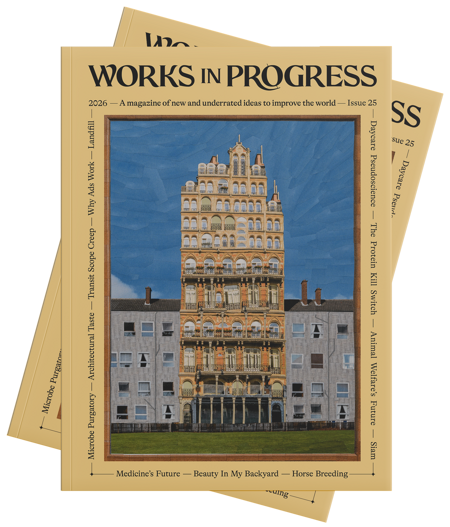
Get the print magazine
Subscribe for $100 to receive six beautiful issues per year.
Subscribe today to receive a copy of Issue 25.
Subscribe
Alex Chalmers and Rob Wiblin on why recycling is overrated
Saloni Dattani on how much faster medicine could progress
Sophie Fessl on breeding the perfect racehorse
Koji Flynn-Do and Martin Gould on farm animal welfare
Derek Hopper on how Siam avoided conquest
Samuel Hughes on beauty and building
Robert Kwolek on architectural taste
Niko McCarty on the microbes we can't use
Kevin Simler on how advertising really works
Jacob Witten on switching off proteins


Ordinary yellow pineapples were once so precious they were rented for display at dinner parties, but centuries of innovation made them commonplace.
Many women face a choice between career advancement or motherhood. But emerging fertility technologies could allow women to have it all.
The Hanseatic League united merchants to bargain with kings, blockade cities, and even win wars. But when technology changed, defections began and the coalition fell apart.
Life in the state of nature was less violent than you might think. Most of our ancestors avoided conflict. But this made them vulnerable to a few psychopaths.
Land value taxes are once again becoming a popular all-purpose solution to housing issues. But implementing them in early 1900s Britain destroyed the then-dominant Liberal Party.
China builds towers in a park, while America, and nearly everyone else, builds squat mid-rise blocks. The difference comes down to regulation, not culture.
Notes
October 2025
‘Artificial’ didn’t scare Americans in the 19th century. Why does it scare them now?
It’s incredibly hard to deliver drugs to the right organ, especially to reach the brain. Tiny gas-filled spheres that burst on command could change that.
In 1918, fifty systems supplied London’s electricity. Turning these into a grid required war, nationalization, and an act of engineering insubordination.
Long before modern science, Europeans learned to see their own time as an age of invention rather than decline.
Generations of microbes evolve in hours, not millennia. By speeding up Darwin’s clock, scientists have watched evolution happen in real time, and it’s changed how we understand natural selection.
For centuries it was a poison. Then colchicine rewrote treatment for gout, heart disease, and later, the debate over drug exclusivity.
In 1965, married American women did 34 hours of housework weekly. By 2010, that had fallen to 18 hours. The dishwasher wasn’t the only cause, but it certainly helped.
Airbus is an example of successful industrial policy and the rare European company that is better than its American rival. Could its success be copied elsewhere?
Trains often stop at the edge of town centres, forcing inconvenient transfers. Running railway lines onto tram networks provides a solution.
Lead paint was banned in the late twentieth century. Before that, it was outcompeted by a cheap and safe alternative.
Why do some neighborhoods get garden squares and graceful streets, while others don’t? The answer isn’t zoning or taste, it’s who owns the land, and how unified that ownership is.
Keeping the grid stable requires overbuilding generating capacity, driving up costs. Batteries fix that.
Pedestrian tunnels are often thought to undermine urban life. The opposite happened in Toronto.
For nearly two centuries, pain relief meant effective but addictive opioids. Scientists have finally made something better.
Pour-over coffee has long been popular with coffee enthusiasts, but it frustrated coffee shops because it takes so long to make. That’s changing.
Synthetic diamonds are now purer, more beautiful, and vastly cheaper than mined diamonds. Beating nature took decades of hard graft and millions of pounds of pressure.
How we calculate inflation has always been a subject of debate. Small changes that might seem trivial can lead to enormous changes in how well-off we think we are.
We may be close to rediscovering thousands of texts that had been lost for millennia. Their contents may reshape how we understand the Ancient World.
Libraries contain books, yes. But they also contain latex rubber, carbon fiber fabrics, and graphene aerogel. And in some materials libraries you can cut, cast, drill, sand, scrape, and sculpt too.
Advance Market Commitments allow us to buy technology from the future to support its development: vaccines, carbon capture technology, and even spacecraft. Here’s how you can start your own.
Too few people donate their organs, dead or alive. How can we make it easier to donate, but avoid the abuses that some fear from cash payments?
I was deliberately infected with Zika to test a vaccine. Human challenge trials like my one could save millions of lives by developing prophylactics more quickly.
Homeowners are often the biggest opponents of building new homes. An Israeli reform reversed this by making homeowners the main beneficiaries of development.
We used to dig up roads to put trains underneath – cheaply. Ever-better tunnel boring machines have made the disruption this causes unnecessary.
Silk is stronger than steel or kevlar. We are already using it to transport vaccines without cold chains and make automatically dissolving stitches. What else could it be used for?
SGLT2, a protein in the kidney, takes glucose out of the urine and puts it in the blood. Blocking this reduces diabetes, heart disease, and kidney disease – but we’re not exactly sure why.
Asbestos was a miracle material, virtually impervious to fire. But as we fixed city fires in other ways, we came to learn about its horrific downsides.
The earth’s core is hot. So hot, that if we drilled deep enough, we could power the world millions of times over with cheap, clean energy, supporting renewables when the wind isn’t blowing and the sun isn’t shining. But getting there is tough.
Many scientific papers receive little attention initially but become highly cited years later. What groundbreaking discoveries might have already been made, and how can we uncover them faster?
War is hell. But by allowing more effective states to rule productive regions, it may have been a catalyst for Europe’s early modern advancement.
New Zealand passed the most ambitious upzoning reforms in the world. Now comes the backlash.
Cocktails aren’t what they used to be – and that’s a good thing. The search for fresher and more novel ingredients from ever further afield continues to revolutionize mixology for the better.
Unlike nearly all other arts, architecture is inherently public and shared. That means that buildings should be designed to be agreeable – easy to like – not to be unpopular works of genius.
Local government faces incentives just like everything else. If we want voters to encourage growth near them, we need to make it worth their while.
Today’s world requires vastly more copper than you could imagine, and the world of electric vehicles will require even more. That means finding new ways to find and extract copper from the earth.
Houston was notorious for its sprawl. But it has seen a gentle density revolution since the 1990s. Allowing neighborhoods to opt out of citywide reforms was crucial in its transformation.
Building a state is not a matter of copying first world institutions. It is a tough process of deals and compromises. 19th century Mexico is a good example.
The West has been below replacement fertility once before. Then came the Baby Boom. Understanding that boom may help us deal with today’s bust.
The history of attempts to reform planning in Britain is proof that political willpower is not enough: you need to be smart, not just brave.
Thomas Edison is often accused of not having invented the things he gets credit for. He did something even harder: he built the systems needed to get them to market.
Washington, DC, has avoided the worst price rises that have plagued many other growing American cities. Arlington’s transit-oriented development might be the reason.
Cheap, safe nuclear power is possible, but is all but prohibited in most Western countries. A regulatory sandbox for fission could shake us out of our regulatory sclerosis.
Ending acid rain was one of humanity’s greatest environmental successes. Here’s how it happened.
As climate change threatens crop yields, we need a second Green Revolution – one that, this time, is driven by genetic engineering.


The world’s first round-the-world solo yacht race was a thrilling and, for some, deadly contest. Its contestants’ efforts can teach us about the art of maintenance.
When America’s economy overtook Britain’s a century ago, it remade the world order. How it happened is still debated.
Outdated forms of peer review create bottlenecks that slow science. But in a world where research can now circulate rapidly on the Internet, we need to develop new ways to do science in public.
Until recently, roads were shared between a messy mix of cyclists, stagecoaches, carts, horses, and pedestrians, with no dominant user.
Bacteriophages – viruses that infect bacterial cells – were almost forgotten in the age of antibiotics. Now as bacterial resistance grows, they may return to help us in our hour of need.
History’s most famous innovation prize—the longitude rewards—is misunderstood. Innovation prizes are best at promoting refinements, not revolutions.
Gas heating is bad for the environment. But home-built heat pumps aren’t perfect either.
Polyester went from being the world’s most hated fabrics to one of its favorites. It’s so successful that many people don’t even realize they’re wearing polyester today.
Some think of advances in science and technology through the metaphor of low-hanging fruit: we “picked” the easy ones, and the rest will be very difficult.
Duels can be brutal and even lethal. But duels emerged in societies around the world for an important reason: to control and manage violence, not just to celebrate it.
Ireland’s housing bubble and bust has become emblematic of what not to do in housing debates around the world. The only problem is nobody agrees what actually went wrong.
The height of skyscrapers is limited by physical, economic and regulatory barriers, but we should want to overcome them and build taller. Here’s how we can do it.
Society has free-ridden on women for millennia, benefiting from the children they’ve had while bearing few of the costs. But as women have gained other options, birth rates have fallen.
Many modern buildings put up today seem uglier than traditional ones around them. Some say this is because we’ve torn down the ugly old buildings, and only see the survivors. Are they right?
Plagiarism is unforgivable in academia but it’s not plagiarism itself that should trouble us. It’s carelessness and a lack of originality.
Without new humans, growth will slow, and we will be less likely to reach the stars. But pro-natalism has been captured by a range of unsavory voices. There is an alternative.
Our success is based on scientific discovery, so it’s not surprising how much faith we put into it. But we now trust science so implicitly that our trust undermines the institution itself.
The kitchen of 2020 looks mostly the same as that of 1960. But what we do in it has changed dramatically, almost entirely for the better—due to a culture of culinary innovation.
How do technologies get off the ground? As well as seed funding, many of the best technologies require Buyers of First Resort, which buy products until they improve enough to get to efficient scale.
We have eradicated smallpox, cured many bacterial diseases, and invented a vaccine for Covid-19 within the year. But for a very long time we haven’t had a single good treatment for obesity.
Could an asteroid wipe out human civilisation like it may have eliminated the dinosaurs? Big asteroids come along extremely rarely and our monitoring systems are effective and well funded.
Covid-19 brought death, suffering and financial straits, so it was unsurprising that depression rose around the world. But when the data came in, we found suicide did not – and it’s a mystery why.
Everybody loves to hate Bitcoin. Yet big business is spending hundreds of millions on it, helping to drive the price higher and higher. It’s easy to dismiss that as a marketing fad.
Researchers have known for decades that lead poisoning damages brains and worsens crime, but millions of Americans still drink contaminated water every day. Here’s how we can fix that.
Is the popularity of the Marvel Cinematic Universe a sign of art in decline? It’s common for people to assert that film, art, music and literature are getting worse. This is why they’re wrong.
Are technology and the environment friends or foes? In this wide-ranging conversation, we discuss climate policy, activism and ecomodernism with Ted Nordhaus.
The conversation around science is full of ideas for reform, but how do we know which ones will be effective? To find out what works, we need to apply the scientific method to science itself.
Critics of scientific reform say that transparency comes at the cost of speed. What can disciplines learn from each other to break away from this crisis?
Protecting people’s health during the pandemic will increase debt, but the economic consensus is that we shouldn’t be concerned.
As rental prices continue to climb in San Francisco, tech firms have looked to relocate in other cities. Without major housing reforms, the next Silicon Valley will face the same fate.
Crises upend plans, force people to re-evaluate their priorities, and bring into focus new goals. Financial markets give us hints of what we can expect from the aftermath of Covid-19.
While rents have been soaring for years in urban areas around the world, one Australian city has weathered the storm. What can the world learn from the experiences of Sydney?
Bad incentives, muddled theory and no practical use. The condition of the social sciences has been blamed on a great variety of things; what’s really at fault and how do we know?
Building traditionalist architecture today is derided as inauthentic pastiche. But this perspective turns a blind eye to the dramatic and sophisticated ways that design has been applied throughout history.
Some of the greatest advances in technology have emerged from bringing intelligent people together to solve problems. How do tech clusters develop & how can we use them to replicate past successes?
Electrical interference has restricted what humans can observe with telescopes. To make leaps as a species, now’s the time for us to build a telescope on the far side of the moon.
Scientific research today is afflicted by poor reliability and low utility, despite the best efforts of individual researchers.
Many have argued that innovation develops in a simple linear fashion – from research to experimentation to engineering.
New technologies can be dangerous, threatening the very survival of humanity. Is economic growth inherently risky, and how do we maximize the chances of a flourishing future?
In spite of major technological progress, tech is often envisioned in the media with pessimism and dread.