The Best Metro Systems Across European Capital Cities
This was originally posted on our Voronoi app. Download the app for free on iOS or Android and discover incredible data-driven charts from a variety of trusted sources.
Metro stations are essential to urban life, but their quality and level of modernization vary across Europe’s capital cities.
High-quality transportation networks play a crucial role in driving business productivity by enhancing mobility and expanding access to a broader labor pool. Moreover, investment in metro systems is connected with higher foreign direct investment. These investments boost a city’s appeal by improving commuting speed and accessibility.
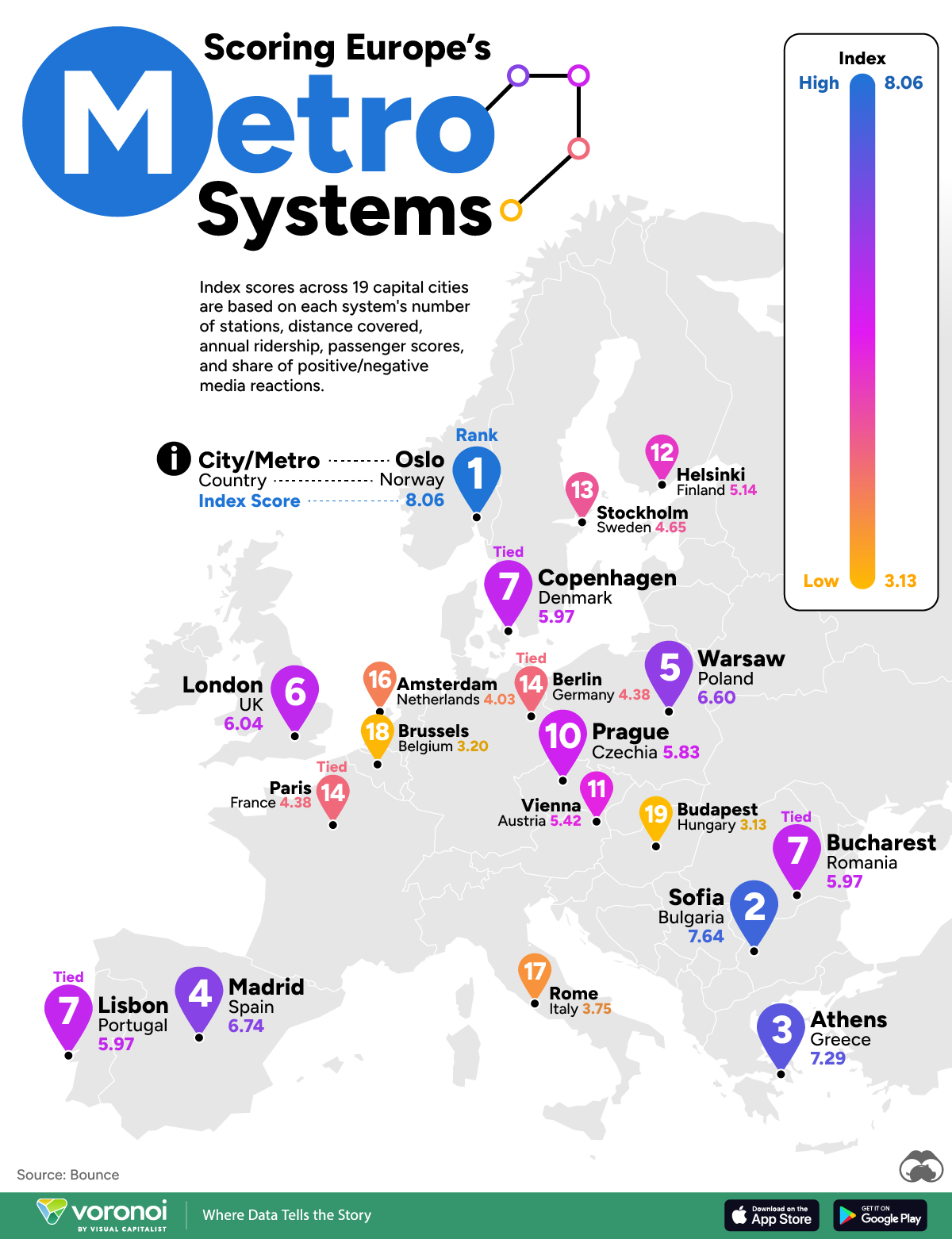
This graphic ranks the metro systems of European capital cities, based on data from Bounce.
Methodology
For the ranking, metro systems across 19 European capital cities were scored according to the following metrics:
- Number of stations
- Annual ridership
- Distance covered
- Google review scores
- The share of positive and negative online reactions to articles about each metro system
Due to travel advisories, Belarus, Ukraine, and Russian capitals were excluded. Overall, metro systems were measured out of a score of 10.
Norway is Home to Top Metro System in European Capitals
Oslo, the capital of Norway, tops the list with 101 metro stations across its transit network.
In 2023, it became the first metro system in the world to operate entirely on electric power. As the largest network in Scandinavia, Oslo’s metro stations earned an average Google review score of 4.13 out of 5 stars, with users often saying they were “very well organized” and “easy to get around”.
| Rank | City | Country | Overall Score |
|---|---|---|---|
| 1 | Oslo | 🇳🇴 Norway | 8.06 |
| 2 | Sofia | 🇧🇬 Bulgaria | 7.64 |
| 3 | Athens | 🇬🇷 Greece | 7.29 |
| 4 | Madrid | 🇪🇸 Spain | 6.74 |
| 5 | Warsaw | 🇵🇱 Poland | 6.6 |
| 6 | London | 🇬🇧 UK | 6.04 |
| 7 | Bucharest | 🇷🇴 Romania | 5.97 |
| 7 | Lisbon | 🇵🇹 Portugal | 5.97 |
| 7 | Copenhagen | 🇩🇰 Denmark | 5.97 |
| 10 | Prague | 🇨🇿 Czechia | 5.83 |
| 11 | Vienna | 🇦🇹 Austria | 5.42 |
| 12 | Helsinki | 🇫🇮 Finland | 5.14 |
| 13 | Stockholm | 🇸🇪 Sweden | 4.65 |
| 14 | Berlin | 🇩🇪 Germany | 4.38 |
| 14 | Paris | 🇫🇷 France | 4.38 |
| 16 | Amsterdam | 🇳🇱 Netherlands | 4.03 |
| 17 | Rome | 🇮🇹 Italy | 3.75 |
| 18 | Brussels | 🇧🇪 Belgium | 3.2 |
| 19 | Budapest | 🇭🇺 Hungary | 3.13 |
Sofia, Bulgaria, claims second place with the newest metro system among European capitals, established in 1998.
In contrast, the London Underground, built in 1863, holds the title of the world’s oldest metro system. Today, the London Underground emits 84% fewer carbon emissions per passenger than a gasoline car, and it’s on track to be fully powered by renewables by 2030. Overall, London’s metro system ranks sixth among European capitals.
Copenhagen’s automated metro runs 24/7, with trains arriving every two minutes during most of the day. Despite placing seventh on the list, it is frequently recognized as the world’s best metro system due to its exceptional reliability.
At the other end of the spectrum, Budapest’s metro system ranks last, with 75% of online reactions to transport-related news articles being negative. Passengers have described some metro stations as “rather unpleasant,” with cleanliness often cited as a major concern.
Learn More on the Voronoi App 
To learn more about this topic from a global perspective, check out this graphic on different transportation methods around the world.
War
Ranked: The Biggest Arms Exporters in 2025
The U.S. dominates global arms exports with a 42% share, far ahead of any competitor.

Published
13 hours ago
on
April 6, 2026
Ranked: The Biggest Arms Exporters in 2025
See visuals like this from many other data creators on our Voronoi app. Download it for free on iOS or Android and discover incredible data-driven charts from a variety of trusted sources.
Key Takeaways
- The U.S. accounts for 42% of global arms exports in 2025, over four times France’s 10% share in second place.
- Israel and South Korea are among the fastest-growing exporters, rapidly climbing the global rankings.
One country towers over the global arms trade in 2025: the United States. With a 42% share of global exports, it ships more arms than the next four exporters combined.
This visualization ranks the biggest arms-exporting countries in 2025 by share of global exports, highlighting both America’s lead and the rise of newer defense suppliers like Israel and South Korea. The data for this visualization comes from the SIPRI Arms Transfers Database.
U.S. Dominance Remains Unchallenged
The United States leads global arms exports by a wide margin, with a gap over the second-ranked country that no other exporter comes close to matching.
| Rank | Country | % of Global Arms Exports |
|---|---|---|
| 1 | 🇺🇸 United States | 42.0% |
| 2 | 🇫🇷 France | 10.0% |
| 3 | 🇮🇱 Israel | 7.8% |
| 4 | 🇰🇷 South Korea | 6.0% |
| 5 | 🇷🇺 Russia | 5.8% |
| 6 | 🇮🇹 Italy | 5.7% |
| 7 | 🇩🇪 Germany | 5.1% |
| 8 | 🇨🇳 China | 2.6% |
| 9 | 🇬🇧 United Kingdom | 2.1% |
| 10 | 🇳🇱 Netherlands | 1.8% |
| 11 | 🇹🇷 Turkiye | 1.6% |
| 12 | 🇳🇴 Norway | 1.2% |
| 13 | 🇪🇸 Spain | 1.0% |
| 14 | 🇨🇦 Canada | 0.9% |
| 15 | 🇸🇪 Sweden | 0.7% |
| 16 | 🇩🇰 Denmark | 0.5% |
| 17 | 🇧🇷 Brazil | 0.5% |
| 18 | 🇨🇿 Czechia | 0.4% |
| 19 | 🇷🇴 Romania | 0.4% |
| 20 | 🇨🇭 Switzerland | 0.4% |
| 21 | 🇵🇰 Pakistan | 0.4% |
| 22 | 🇺🇦 Ukraine | 0.4% |
| 23 | 🇿🇦 South Africa | 0.3% |
| 24 | 🇫🇮 Finland | 0.3% |
| 25 | 🇦🇺 Australia | 0.3% |
| 26 | 🇧🇪 Belgium | 0.3% |
| 27 | 🇮🇳 India | 0.2% |
| 28 | 🇮🇷 Iran | 0.2% |
| 29 | 🇸🇬 Singapore | 0.2% |
| 30 | 🇵🇱 Poland | 0.2% |
| 31 | 🇰🇵 North Korea | 0.1% |
| 32 | 🇰🇬 Kyrgyzstan | 0.1% |
| 33 | 🇦🇪 United Arab Emirates | 0.1% |
| 34 | 🇯🇵 Japan | 0.1% |
| 35 | 🇮🇪 Ireland | 0.1% |
The U.S. has six of the top 10 arms exporting companies by revenue.
U.S. exports span advanced fighter jets, missile systems, and defense technologies supplied to allies worldwide. Even at this scale, America’s share of exports still grew 2.4% year-over-year in 2025.
Rising Exporters Gain Ground
Several countries are rapidly expanding their presence in the global arms market. France ranks second with a 10% share and saw its export share surge by 36%, fueled by strong demand for its Rafale fighter jets and naval systems.
Israel and South Korea stand out even more, with export share growth of 126% and 83%, respectively. These countries are becoming key suppliers of advanced technologies, including drones, missile systems, and artillery.
Traditional Powers Face Declines
At the same time, several established exporters are losing ground. Russia, once a dominant supplier, now holds just 5.8% of global exports and saw its share shrink by 2.7%. Ongoing geopolitical challenges and shifting alliances have impacted its export capacity.
European exporters like Germany and the United Kingdom also recorded declines, with export shares falling 20% and 21%, respectively. Meanwhile, China’s share dropped sharply by 32%.
Learn More on the Voronoi App
If you enjoyed today’s post, check out Global Nuclear Warhead Stockpiles (1945-2024) on Voronoi, the new app from Visual Capitalist.
Demographics
Mapped: Population Growth in Every Country (2000–2025)
Qatar’s population surged 423% from 2000 to 2025, while Eastern Europe recorded some of the world’s sharpest declines.
Published
16 hours ago
on
April 6, 2026

Mapped: Population Growth in Every Country (2000–2025)
See visuals like this from many other data creators on our Voronoi app. Download it for free on iOS or Android and discover incredible data-driven charts from a variety of trusted sources.
Key Takeaways
- A small group of countries saw explosive population growth, led by Qatar with an increase of over 400% since 2000.
- Most countries grew, but nearly 1 in 7 experienced population decline.
- The sharpest declines were concentrated in Eastern Europe, led by Ukraine at -32.5%.
Over the past 25 years, population trends have split in two directions. Some countries have seen their populations multiply several times over, while others have steadily declined.
This map shows cumulative population change by country from 2000 to 2025, based on data from the IMF. The contrast is clear: migration-driven growth in parts of the Gulf and Africa, and sustained population decline across Eastern Europe.
Where Population Growth is Surging
The fastest-growing populations are concentrated in a relatively small group of countries, mainly in the Gulf and sub-Saharan Africa, where migration and demographic momentum have driven rapid expansion.
The data table below shows the cumulative population change of each country from 2000 to 2025:
| Rank | Country | Population Change 2000–2025 (%) |
|---|---|---|
| 1 | 🇶🇦 Qatar | 423.4 |
| 2 | 🇦🇪 United Arab Emirates | 249.7 |
| 3 | 🇬🇶 Equatorial Guinea | 166.6 |
| 4 | 🇳🇪 Niger | 157.0 |
| 5 | 🇧🇭 Bahrain | 153.9 |
| 6 | 🇵🇬 Papua New Guinea | 149.6 |
| 7 | 🇦🇴 Angola | 139.7 |
| 8 | 🇰🇼 Kuwait | 139.1 |
| 9 | 🇴🇲 Oman | 129.1 |
| 10 | 🇹🇩 Chad | 126.9 |
| 11 | 🇯🇴 Jordan | 126.3 |
| 12 | 🇧🇮 Burundi | 123.6 |
| 13 | 🇨🇩 Democratic Republic of the Congo | 121.8 |
| 14 | 🇺🇬 Uganda | 120.1 |
| 15 | 🇿🇲 Zambia | 119.5 |
| 16 | 🇲🇱 Mali | 118.4 |
| 17 | 🇾🇪 Yemen | 112.9 |
| 18 | 🇬🇲 Gambia, The | 112.8 |
| 19 | 🇲🇬 Madagascar | 108.7 |
| 20 | 🇧🇯 Benin | 106.6 |
| 21 | 🇨🇬 Republic of Congo | 107.0 |
| 22 | 🇹🇿 Tanzania | 106.4 |
| 23 | 🇲🇿 Mozambique | 102.3 |
| 24 | 🇨🇮 Côte d'Ivoire | 102.3 |
| 25 | 🇧🇫 Burkina Faso | 102.0 |
| 26 | 🇱🇷 Liberia | 101.2 |
| 27 | 🇨🇲 Cameroon | 100.4 |
| 28 | 🇲🇼 Malawi | 99.3 |
| 29 | 🇸🇦 Saudi Arabia | 98.5 |
| 30 | 🇹🇱 Timor-Leste | 97.5 |
| 31 | 🇸🇳 Senegal | 95.7 |
| 32 | 🇸🇱 Sierra Leone | 92.4 |
| 33 | 🇬🇦 Gabon | 91.4 |
| 34 | 🇳🇬 Nigeria | 90.2 |
| 35 | 🇹🇬 Togo | 90.3 |
| 36 | 🇸🇧 Solomon Islands | 88.7 |
| 37 | 🇻🇺 Vanuatu | 86.9 |
| 38 | 🇷🇼 Rwanda | 83.9 |
| 39 | 🇪🇹 Ethiopia | 83.5 |
| 40 | 🇰🇪 Kenya | 80.9 |
| 41 | 🇬🇳 Guinea | 80.7 |
| 42 | 🇬🇭 Ghana | 78.6 |
| 43 | 🇵🇰 Pakistan | 77.4 |
| 44 | 🇲🇷 Mauritania | 75.1 |
| 45 | 🇪🇬 Egypt | 71.0 |
| 46 | 🇳🇦 Namibia | 69.6 |
| 47 | 🇰🇲 Comoros | 69.5 |
| 48 | 🇬🇼 Guinea-Bissau | 69.1 |
| 49 | 🇧🇿 Belize | 66.8 |
| 50 | 🇹🇯 Tajikistan | 66.7 |
| 51 | 🇸🇹 São Tomé and Príncipe | 66.7 |
| 52 | 🇭🇳 Honduras | 65.0 |
| 53 | 🇸🇩 Sudan | 62.1 |
| 54 | 🇮🇱 Israel | 61.9 |
| 55 | 🇧🇼 Botswana | 60.0 |
| 56 | 🇬🇹 Guatemala | 59.5 |
| 57 | 🇱🇺 Luxembourg | 57.8 |
| 58 | 🇩🇿 Algeria | 54.9 |
| 59 | 🇺🇿 Uzbekistan | 54.0 |
| 60 | 🇰🇮 Kiribati | 53.6 |
| 61 | 🇲🇻 Maldives | 52.2 |
| 62 | 🇸🇬 Singapore | 50.9 |
| 63 | 🇵🇦 Panama | 50.1 |
| 64 | 🇲🇳 Mongolia | 49.1 |
| 65 | 🇵🇭 Philippines | 48.6 |
| 66 | 🇿🇼 Zimbabwe | 48.5 |
| 67 | 🇰🇬 Kyrgyz Republic | 48.2 |
| 68 | 🇧🇴 Bolivia | 47.7 |
| 69 | 🇩🇯 Djibouti | 47.1 |
| 70 | 🇰🇭 Cambodia | 46.6 |
| 71 | 🇭🇹 Haiti | 46.4 |
| 72 | 🇨🇫 Central African Republic | 45.8 |
| 73 | 🇦🇺 Australia | 44.9 |
| 74 | 🇪🇨 Ecuador | 45.1 |
| 75 | 🇲🇹 Malta | 44.7 |
| 76 | 🇲🇾 Malaysia | 44.1 |
| 77 | 🇱🇦 Lao P.D.R. | 43.4 |
| 78 | 🇮🇪 Ireland | 43.4 |
| 79 | 🇿🇦 South Africa | 42.4 |
| 80 | 🇹🇲 Turkmenistan | 42.5 |
| 81 | 🇧🇳 Brunei Darussalam | 41.5 |
| 82 | 🇳🇮 Nicaragua | 41.4 |
| 83 | 🇨🇷 Costa Rica | 41.0 |
| 84 | 🇸🇷 Suriname | 40.7 |
| 85 | 🇮🇸 Iceland | 40.1 |
| 86 | 🇮🇳 India | 38.4 |
| 87 | 🇵🇾 Paraguay | 38.0 |
| 88 | 🇧🇹 Bhutan | 38.0 |
| 89 | 🇦🇬 Antigua and Barbuda | 38.2 |
| 90 | 🇮🇩 Indonesia | 37.9 |
| 91 | 🇮🇷 Iran | 37.8 |
| 92 | 🇳🇿 New Zealand | 37.9 |
| 93 | 🇰🇿 Kazakhstan | 36.9 |
| 94 | 🇨🇾 Cyprus | 36.5 |
| 95 | 🇧🇩 Bangladesh | 36.1 |
| 96 | 🇨🇴 Colombia | 35.7 |
| 97 | 🇨🇦 Canada | 35.6 |
| 98 | 🇧🇸 Bahamas, The | 35.9 |
| 99 | 🇱🇾 Libya | 34.8 |
| 100 | 🇲🇽 Mexico | 34.2 |
| 101 | 🇹🇷 Türkiye, Republic of | 33.9 |
| 102 | 🇲🇦 Morocco | 32.5 |
| 103 | 🇨🇱 Chile | 31.7 |
| 104 | 🇵🇪 Peru | 30.4 |
| 105 | 🇦🇷 Argentina | 29.4 |
| 106 | 🇩🇴 Dominican Republic | 29.6 |
| 107 | 🇦🇿 Azerbaijan | 29.1 |
| 108 | 🇻🇳 Vietnam | 28.7 |
| 109 | 🇹🇳 Tunisia | 28.2 |
| 110 | 🇨🇭 Switzerland | 26.0 |
| 111 | 🇸🇨 Seychelles | 25.9 |
| 112 | 🇳🇴 Norway | 25.0 |
| 113 | 🇨🇻 Cabo Verde | 24.2 |
| 114 | 🇱🇮 Liechtenstein | 24.2 |
| 115 | 🇪🇸 Spain | 22.3 |
| 116 | 🇧🇷 Brazil | 22.1 |
| 117 | 🇼🇸 Samoa | 21.8 |
| 118 | 🇸🇿 Eswatini | 21.5 |
| 119 | 🇺🇸 United States | 21.0 |
| 120 | 🇳🇵 Nepal | 20.8 |
| 121 | 🇸🇪 Sweden | 20.2 |
| 122 | 🇲🇲 Myanmar | 19.5 |
| 123 | 🇱🇸 Lesotho | 19.4 |
| 124 | 🇬🇧 United Kingdom | 18.6 |
| 125 | 🇧🇪 Belgium | 15.9 |
| 126 | 🇫🇯 Fiji | 15.7 |
| 127 | 🇰🇳 Saint Kitts and Nevis | 15.6 |
| 128 | 🇦🇹 Austria | 14.6 |
| 129 | 🇱🇨 Saint Lucia | 14.5 |
| 130 | 🇳🇱 Netherlands | 13.8 |
| 131 | 🇫🇷 France | 13.4 |
| 132 | 🇹🇹 Trinidad and Tobago | 13.3 |
| 133 | 🇩🇰 Denmark | 12.6 |
| 134 | 🇬🇩 Grenada | 12.6 |
| 135 | 🇭🇰 Hong Kong SAR | 12.2 |
| 136 | 🇹🇭 Thailand | 11.7 |
| 137 | 🇨🇳 China | 10.9 |
| 138 | 🇰🇷 South Korea | 9.9 |
| 139 | 🇻🇪 Venezuela | 9.3 |
| 140 | 🇫🇮 Finland | 8.5 |
| 141 | 🇧🇧 Barbados | 8.1 |
| 142 | 🇬🇾 Guyana | 7.7 |
| 143 | 🇸🇻 El Salvador | 7.2 |
| 144 | 🇸🇮 Slovenia | 7.2 |
| 145 | 🇽🇰 Kosovo | 7.1 |
| 146 | 🇦🇼 Aruba | 6.9 |
| 147 | 🇯🇲 Jamaica | 6.6 |
| 148 | 🇨🇿 Czechia | 6.1 |
| 149 | 🇲🇺 Mauritius | 5.8 |
| 150 | 🇩🇲 Dominica | 5.6 |
| 151 | 🇹🇼 Taiwan Province of China | 5.0 |
| 152 | 🇵🇹 Portugal | 4.5 |
| 153 | 🇺🇾 Uruguay | 4.1 |
| 154 | 🇮🇹 Italy | 3.5 |
| 155 | 🇲🇪 Montenegro | 3.1 |
| 156 | 🇻🇨 Saint Vincent and the Grenadines | 2.8 |
| 157 | 🇩🇪 Germany | 2.7 |
| 158 | 🇸🇰 Slovak Republic | 0.4 |
| 159 | 🇹🇴 Tonga | 0.0 |
| 160 | 🇷🇺 Russia | -0.7 |
| 161 | 🇪🇪 Estonia | -1.6 |
| 162 | 🇯🇵 Japan | -2.8 |
| 163 | 🇦🇲 Armenia | -3.3 |
| 164 | 🇬🇷 Greece | -3.7 |
| 165 | 🇵🇱 Poland | -4.6 |
| 166 | 🇵🇼 Palau | -5.3 |
| 167 | 🇭🇺 Hungary | -6.5 |
| 168 | 🇧🇦 Bosnia and Herzegovina | -8.2 |
| 169 | 🇧🇾 Belarus | -9.0 |
| 170 | 🇲🇰 North Macedonia | -10.0 |
| 171 | 🇬🇪 Georgia | -10.3 |
| 172 | 🇫🇲 Micronesia | -11.2 |
| 173 | 🇭🇷 Croatia | -12.0 |
| 174 | 🇦🇱 Albania | -12.8 |
| 175 | 🇷🇸 Serbia | -13.1 |
| 176 | 🇷🇴 Romania | -16.1 |
| 177 | 🇵🇷 Puerto Rico | -16.7 |
| 178 | 🇱🇹 Lithuania | -17.5 |
| 179 | 🇲🇩 Moldova | -18.8 |
| 180 | 🇱🇻 Latvia | -21.6 |
| 181 | 🇧🇬 Bulgaria | -23.2 |
| 182 | 🇲🇭 Marshall Islands | -29.4 |
| 183 | 🇺🇦 Ukraine | -32.5 |
Qatar stands far ahead of every other country, with its population increasing more than fivefold (+423.4%) since 2000. This surge has been driven largely by an influx of foreign workers tied to energy and infrastructure booms. Other Gulf economies also rank among the fastest-growing, including the United Arab Emirates (+249.7%), Bahrain (+153.9%), Kuwait (+139.1%), Oman (+129.1%), and Saudi Arabia (+98.5%).
Outside the Gulf, several African economies also posted strong gains, including Equatorial Guinea (+166.6%), Niger (+157.0%), Angola (+139.7%), and Chad (+126.9%).
At the opposite extreme, several countries are shrinking rapidly. Ukraine leads the declines at -32.5%, followed by a cluster of Eastern European and Baltic states, including Bulgaria (-23.2%), Latvia (-21.6%), Lithuania (-17.5%), Moldova (-18.8%), and Romania (-16.1%).
EU accession opened westward migration routes for parts of Eastern Europe, accelerating long-term population losses in a region already facing aging demographics and low birth rates.
Large Economies Saw More Moderate Growth
Among the world’s largest economies, population growth was generally more moderate. India grew 38.4%, while the U.S. rose 21.0%, China 10.9%, and Brazil 22.1%. Canada posted a stronger 35.6% increase, and Australia climbed 44.9%.
Elsewhere in Asia, Japan declined 2.8% and South Korea rose 9.9%, both trailing the global average increase of 46.6%.
Taken together, the map shows that the fastest population expansion has not been driven by the largest economies, but by a mix of migration-heavy Gulf states and younger, faster-growing developing countries.
Learn More on the Voronoi App
If you enjoyed today’s post, check out Europe’s Population May Fall by 150 Million People by 2100 on Voronoi.