Radiation Emissions of Popular Smartphones
Smartphones have become an integral part of our everyday lives. From work and school to daily tasks, these handheld devices have brought everything into the palm of our hands.
Most people spend 5-6 hours on their phones each day. And, given that our phones emit a tiny amount of radiation, we’re exposing ourselves to radiation for hours each day.
But different phones emit different amounts of radiation.
With the help of data collected by the German Federal Office of Radiation Protection, we visualize the radiation emissions of some popular smartphones in the market today.
Radiation and SAR Values of Smartphones
Smartphones and other mobile devices emit tiny amounts of radiofrequency (RF) radiation. Humans can absorb this radiation when the smartphone is being used or is lying dormant anywhere near their bodies.
The parameter used to measure phone radiation emissions is the Specific Absorption Rate (SAR). It is the unit of measurement that represents the quantity of electromagnetic energy absorbed by the body when using a mobile device.
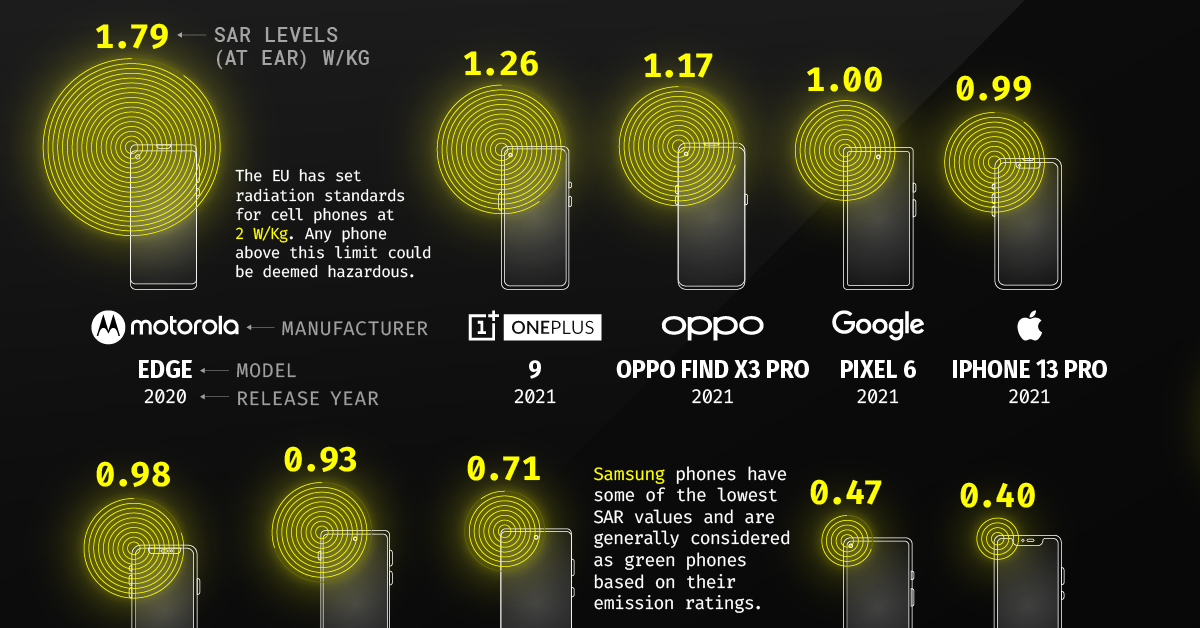
The Council of the European Union has set radiation standards for cell phones at 2 watts per kilogram, measured over the 10 grams of tissue that is absorbing the most signal.
SAR values are calculated at the ear (speaking on the phone) and at the body (kept in your pocket). For the purposes of this article, we’ve used the former calculations.
Smartphones With the Highest Levels of Radiation Emissions
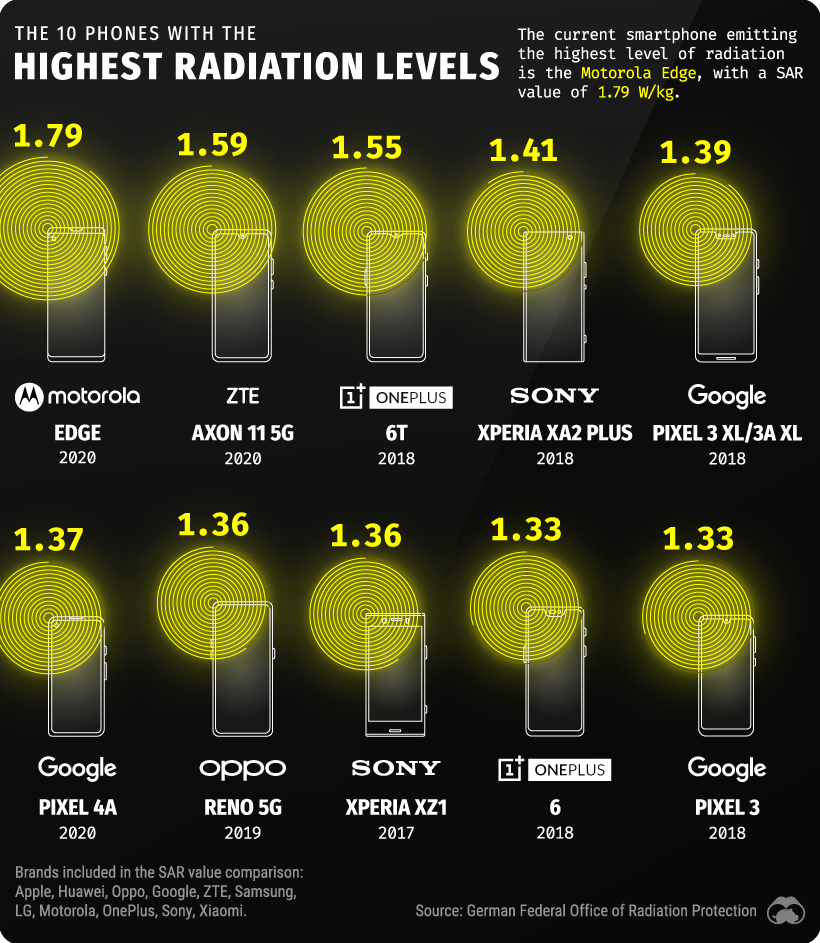
The Motorola Edge has the highest radiation emission with a SAR value of 1.79 watts of radiation per kilogram. That’s significantly higher than most other smartphone models in the market today and close to the limits set by the EU for cellphones.
Coming in second is the Axon 11 5G by ZTE with 1.59, followed by the OnePlus 6T at a close third with 1.55 W/kg. The Sony Experia AX2 Plus with 1.41 and the Google Pixel 3 XL and 3A XL at 1.39 round out the top five.
Here is a look at the 10 smartphones that emit the highest level of radiation:
Now that we have detailed the worst offenders let’s look at the smartphones with the lowest levels of radiation emissions.
Smartphones With the Lowest Levels of Radiation Emissions
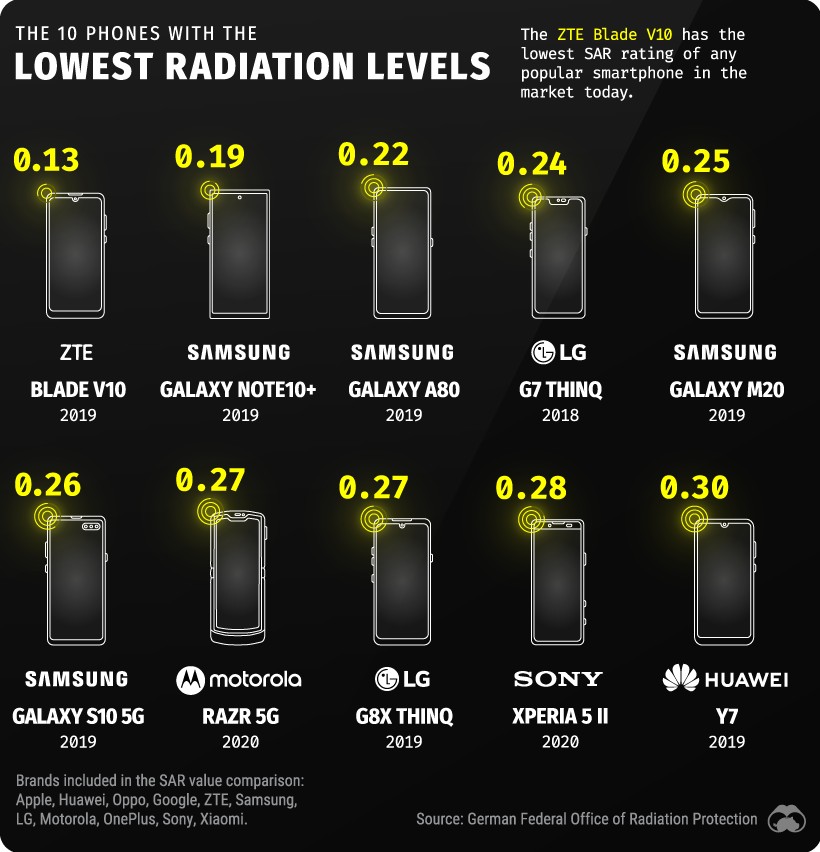
The smartphone with the lowest SAR value is the ZTE Blade V10, with 0.13 watts of radiation per kilogram.
Mobile devices by Samsung carry some of the least radiation risks. The company has four phones considered to be the best in the category. The Galaxy Note 10+ is the best model in their line-up, emitting a meager 0.19 watts per kilogram.
Here is a look at the 10 smartphones that emit the lowest levels of radiation:
There is currently no significant research proving the harmful effects of phone radiation.
Despite this, people who are in contact with their devices for extended periods can at least quantify their radiation exposure and make choices about which brands serve their needs.
Technology
Ranked: The Most Popular AI Tools in 2026
ChatGPT drew 5.3 billion web visits in June 2026, more than the next 14 AI tools combined. See the ranking of the world’s most popular AI tools in 2026.

Published
1 week ago
on
August 18, 2026

Ranked: The Most Popular AI Tools in 2026
Key Takeaways
- ChatGPT drew 5.3 billion web visits in June 2026, more than the next 14 most popular AI tools combined (4.7 billion).
- Google’s Gemini ranks second at 1.1 billion monthly visits, followed by Anthropic’s Claude at 968 million.
- 12 of the 15 most-visited AI tools are American. Canva (Australia), DeepSeek (China), and Magnific (Spain) are the only exceptions.
Less than four years after ChatGPT’s launch, AI tools have become some of the most visited destinations on the internet.
But while new tools launch constantly in a crowded market, web traffic remains highly concentrated among the biggest players.
This graphic ranks the world’s 15 most popular AI tools by monthly web visits in June 2026 using data from AITools.xyz, modeled on SEMrush and Ahrefs traffic data. Figures count website visits only, so mobile-app and API usage are not included.
ChatGPT Pulls More Traffic Than the Next 14 Tools Combined
ChatGPT accounts for roughly 53% of all web traffic among the 15 tools in the ranking, highlighting how far ahead it remains of its closest competitors.
The table below shows the 15 most popular AI tools by monthly web visits in June 2026, along with each tool’s home country:
| Rank | AI Tool | Country | Monthly Web Visits (June 2026) |
|---|---|---|---|
| 1 | ChatGPT | 🇺🇸 United States | 5,320,000,000 |
| 2 | Gemini | 🇺🇸 United States | 1,140,000,000 |
| 3 | Claude | 🇺🇸 United States | 967,910,000 |
| 4 | Canva | 🇦🇺 Australia | 759,760,000 |
| 5 | Google Translate | 🇺🇸 United States | 343,020,000 |
| 6 | DeepSeek | 🇨🇳 China | 318,810,000 |
| 7 | Grok | 🇺🇸 United States | 189,890,000 |
| 8 | JanitorAI | 🇺🇸 United States | 173,170,000 |
| 9 | Character AI | 🇺🇸 United States | 165,460,000 |
| 10 | Perplexity | 🇺🇸 United States | 140,700,000 |
| 11 | Magnific (Freepik) | 🇪🇸 Spain | 116,840,000 |
| 12 | Notion | 🇺🇸 United States | 110,640,000 |
| 13 | Zoom | 🇺🇸 United States | 96,240,000 |
| 14 | Microsoft Copilot | 🇺🇸 United States | 92,720,000 |
| 15 | Suno | 🇺🇸 United States | 81,840,000 |
The ranking is overwhelmingly American, with 12 of the 15 tools based in the United States.
The exceptions are Canva (760 million visits), the Australian design platform that has rebuilt itself around AI features, China’s DeepSeek (319 million), and Magnific (117 million), the AI image upscaler from Spain’s Freepik.
Character chat is another notable source of traffic. JanitorAI (173 million) and Character AI (165 million) draw roughly 339 million monthly visits together, more than Perplexity and Microsoft Copilot combined. That puts character-based AI among the largest consumer use cases outside the leading general-purpose assistants.
Google’s Distribution Machine Still Trails a Startup
Google is the only company with two tools in the ranking, with Gemini drawing 1.1 billion visits and Google Translate another 343 million. Together, they still attract less than a third of ChatGPT’s traffic.
That’s a striking gap for a company that owns the world’s dominant search engine, browser, and mobile operating system. Microsoft faces a similar challenge, with Copilot drawing just 93 million web visits. However, that figure doesn’t include usage built into Windows and Office.
ChatGPT also had an early advantage in building consumer awareness. It broke into the ranks of the world’s most visited websites in early 2024, barely a year after launch. Meanwhile, OpenAI, Google, xAI, and Anthropic regularly trade places in the race for the smartest AI models, but those shifts haven’t translated directly into web traffic.
Learn More on the Voronoi App
If you enjoyed today’s post, check out Global AI Adoption by country on Voronoi.
Technology
Ranked: Where the iPhone Costs the Most in 2026
The same iPhone can cost more than twice as much depending on where you buy it. See the world’s most expensive markets.

Published
4 weeks ago
on
August 1, 2026

Ranked: Where the iPhone Costs the Most in 2026
Key Takeaways
- Türkiye is the world’s most expensive place to buy an iPhone 17 Pro (256GB), with a retail price of $2,592.
- The same model costs more than twice as much in Türkiye as it does in Japan, the cheapest market in the comparison.
- Taxes, import duties, currency movements, and local regulations can add hundreds of dollars to an iPhone’s retail price.
Apple sells the same flagship smartphone worldwide, but its retail price varies significantly by market.
This graphic compares the price of Apple’s iPhone 17 Pro (256GB) across 41 markets in 2026 using data from Deutsche Bank.
The World’s Most Expensive Place to Buy an iPhone
Türkiye tops the ranking at $2,592, more than $1,400 above the U.S. price of $1,181. Brazil ranks second at $2,260, while Egypt follows at $1,872.
At the other end of the ranking, Japan has the lowest price in the comparison at $1,121, slightly below U.S. pricing. The wide gap shows how taxes, import policies, and local market conditions can outweigh the global pricing strategy of one of the world’s leading smartphone brands.
| Rank | Country | iPhone 17 Pro 256GB (USD) | Price relative to the U.S. |
|---|---|---|---|
| 1 | 🇹🇷 Türkiye | $2,592 | 219% |
| 2 | 🇧🇷 Brazil | $2,260 | 191% |
| 3 | 🇪🇬 Egypt | $1,872 | 158% |
| 4 | 🇭🇺 Hungary | $1,826 | 155% |
| 5 | 🇳🇴 Norway | $1,687 | 143% |
| 6 | 🇲🇽 Mexico | $1,657 | 140% |
| 7 | 🇸🇪 Sweden | $1,601 | 135% |
| 8 | 🇵🇱 Poland | $1,588 | 134% |
| 9 | 🇨🇿 Czechia | $1,585 | 134% |
| 10 | 🇫🇮 Finland | $1,578 | 134% |
| 11 | 🇵🇹 Portugal | $1,566 | 133% |
| 12 | 🇬🇷 Greece | $1,566 | 133% |
| 13 | 🇮🇹 Italy | $1,554 | 132% |
| 14 | 🇮🇪 Ireland | $1,554 | 132% |
| 15 | 🇩🇰 Denmark | $1,553 | 131% |
| 16 | 🇫🇷 France | $1,543 | 131% |
| 17 | 🇳🇱 Netherlands | $1,543 | 131% |
| 18 | 🇧🇪 Belgium | $1,543 | 131% |
| 19 | 🇪🇸 Spain | $1,531 | 130% |
| 20 | 🇦🇹 Austria | $1,508 | 128% |
| 21 | 🇩🇪 Germany | $1,508 | 128% |
| 22 | 🇱🇺 Luxembourg | $1,492 | 126% |
| 23 | 🇬🇧 UK | $1,476 | 125% |
| 24 | 🇮🇳 India | $1,427 | 121% |
| 25 | 🇦🇺 Australia | $1,413 | 120% |
| 26 | 🇸🇦 Saudi Arabia | $1,386 | 117% |
| 27 | 🇨🇭 Switzerland | $1,385 | 117% |
| 28 | 🇳🇿 New Zealand | $1,370 | 116% |
| 29 | 🇸🇬 Singapore | $1,364 | 115% |
| 30 | 🇲🇾 Malaysia | $1,352 | 114% |
| 31 | 🇹🇭 Thailand | $1,350 | 114% |
| 32 | 🇨🇳 China | $1,332 | 113% |
| 33 | 🇻🇳 Vietnam | $1,330 | 113% |
| 34 | 🇵🇭 Philippines | $1,326 | 112% |
| 35 | 🇨🇦 Canada | $1,291 | 109% |
| 36 | 🇦🇪 UAE | $1,279 | 108% |
| 37 | 🇹🇼 Taiwan | $1,264 | 107% |
| 38 | 🇭🇰 Hong Kong | $1,200 | 102% |
| 39 | 🇺🇸 United States | $1,181 | 100% |
| 40 | 🇰🇷 South Korea | $1,181 | 100% |
| 41 | 🇯🇵 Japan | $1,121 | 95% |
Europe accounts for much of the ranking’s upper half, partly because advertised prices include value-added tax (VAT). Standard VAT rates range from 27% in Hungary to just over 8% in Switzerland, contributing to substantial differences in final retail prices.
Why Do iPhone Prices Vary So Much?
Apple establishes regional prices, but governments also play a major role in determining what consumers pay.
Import duties, regulatory fees, and device-specific taxes can significantly increase the retail price of electronics. Currency movements also affect local pricing, particularly when domestic currencies weaken against the U.S. dollar.
Türkiye is the clearest outlier. In addition to a 20% VAT, smartphones are subject to special consumption taxes and registration fees that sharply increase their retail prices.
Why Japan Is One of the Cheapest Markets
Japan is one of the few markets where Apple’s flagship iPhone costs less than it does in the United States.
A relatively low 10% consumption tax, a highly competitive smartphone market, and Apple’s long-standing pricing strategy have helped keep prices comparatively low. Even so, Apple has recently raised prices on some products in Japan following years of yen weakness and shifting exchange rates.
Global price rankings can change quickly. As currencies fluctuate and governments adjust taxes and import policies, today’s cheapest market may not hold that position for long.
Learn More on the Voronoi App 
To learn more about this topic, check out this graphic on how Apple makes its money.