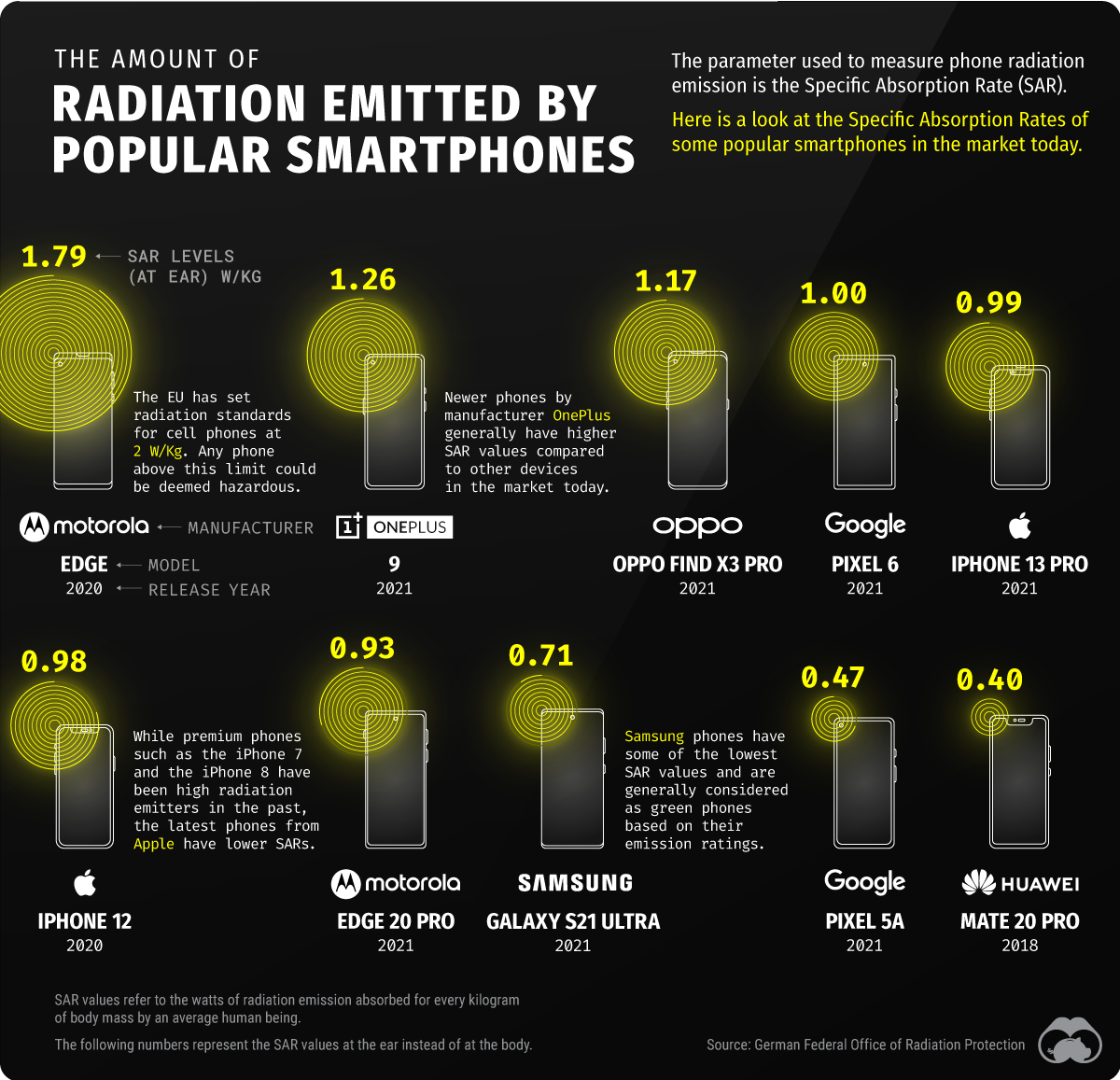
Radiation Emissions of Popular Smartphones
Smartphones have become an integral part of our everyday lives. From work and school to daily tasks, these handheld devices have brought everything into the palm of our hands.
Most people spend 5-6 hours on their phones each day. And, given that our phones emit a tiny amount of radiation, we’re exposing ourselves to radiation for hours each day.
But different phones emit different amounts of radiation.
With the help of data collected by the German Federal Office of Radiation Protection, we visualize the radiation emissions of some popular smartphones in the market today.
Radiation and SAR Values of Smartphones
Smartphones and other mobile devices emit tiny amounts of radiofrequency (RF) radiation. Humans can absorb this radiation when the smartphone is being used or is lying dormant anywhere near their bodies.
The parameter used to measure phone radiation emissions is the Specific Absorption Rate (SAR). It is the unit of measurement that represents the quantity of electromagnetic energy absorbed by the body when using a mobile device.
The Council of the European Union has set radiation standards for cell phones at 2 watts per kilogram, measured over the 10 grams of tissue that is absorbing the most signal.
SAR values are calculated at the ear (speaking on the phone) and at the body (kept in your pocket). For the purposes of this article, we’ve used the former calculations.
Smartphones With the Highest Levels of Radiation Emissions
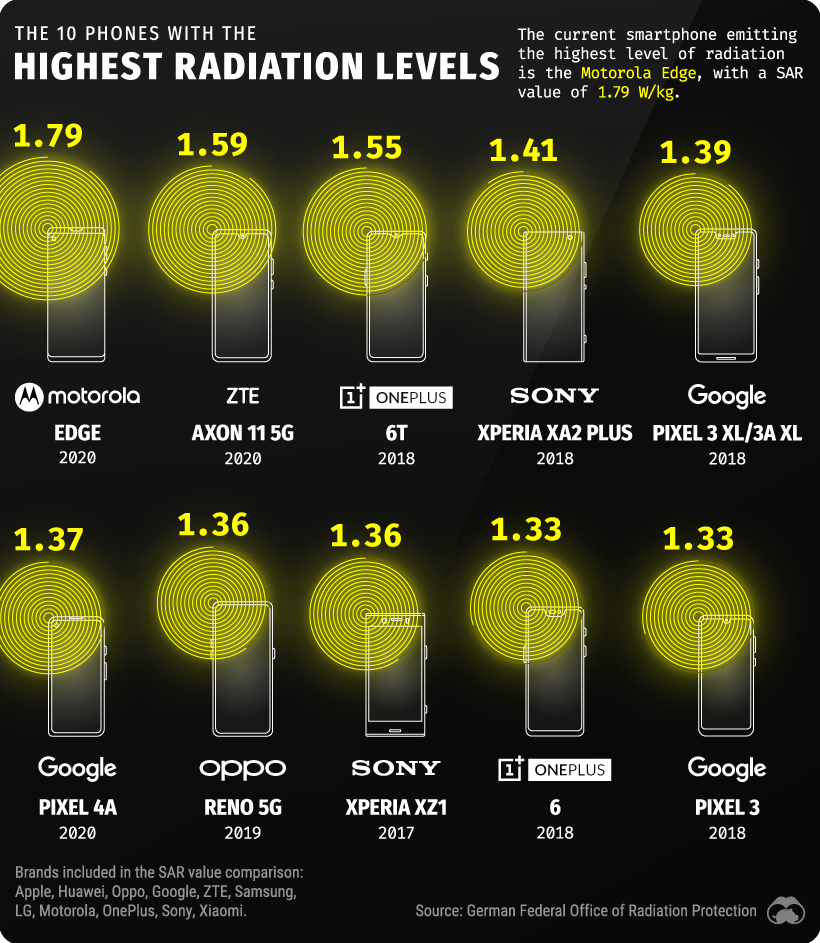
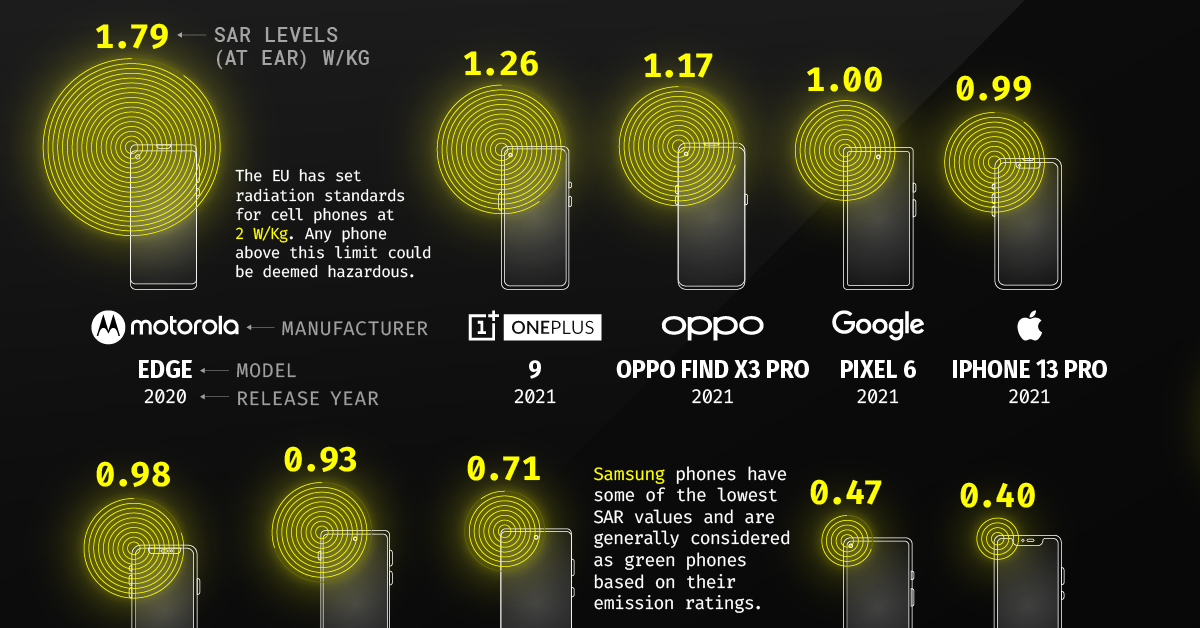
The Motorola Edge has the highest radiation emission with a SAR value of 1.79 watts of radiation per kilogram. That’s significantly higher than most other smartphone models in the market today and close to the limits set by the EU for cellphones.
Coming in second is the Axon 11 5G by ZTE with 1.59, followed by the OnePlus 6T at a close third with 1.55 W/kg. The Sony Experia AX2 Plus with 1.41 and the Google Pixel 3 XL and 3A XL at 1.39 round out the top five.
Here is a look at the 10 smartphones that emit the highest level of radiation:
Now that we have detailed the worst offenders let’s look at the smartphones with the lowest levels of radiation emissions.
Smartphones With the Lowest Levels of Radiation Emissions
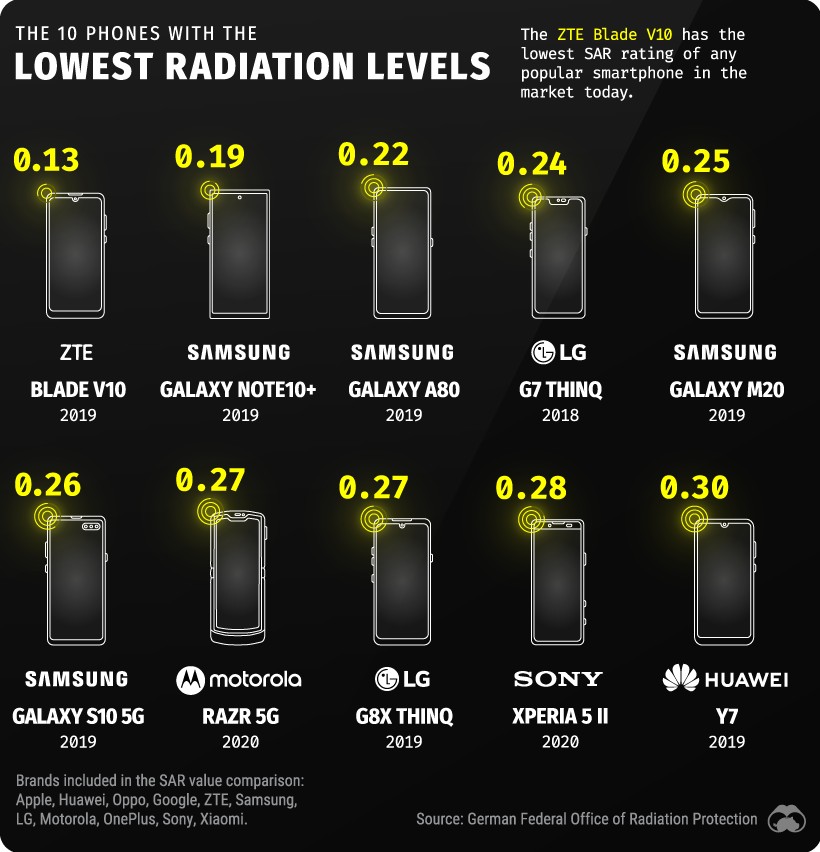
The smartphone with the lowest SAR value is the ZTE Blade V10, with 0.13 watts of radiation per kilogram.
Mobile devices by Samsung carry some of the least radiation risks. The company has four phones considered to be the best in the category. The Galaxy Note 10+ is the best model in their line-up, emitting a meager 0.19 watts per kilogram.
Here is a look at the 10 smartphones that emit the lowest levels of radiation:
There is currently no significant research proving the harmful effects of phone radiation.
Despite this, people who are in contact with their devices for extended periods can at least quantify their radiation exposure and make choices about which brands serve their needs.
Technology
Ranked: The 15 Countries With the Most Supercomputers
From the U.S. and China to Singapore, dive in to which countries have the most supercomputers.

Published
5 days ago
on
March 4, 2026

Ranked: The Countries With the Most Supercomputers
See visuals like this from many other data creators on our Voronoi app. Download it for free on iOS or Android and discover incredible data-driven charts from a variety of trusted sources.
Key Takeaways
- The U.S. has 171 supercomputers, four times more than the next country, Japan, which has 43.
- China is tied for third alongside Germany, both with 40 supercomputers.
Supercomputers are used for everything from weather forecasting and high-powered simulations to artificial intelligence and defense.
The number of supercomputers a country has gives an indication of their technological and economic positioning, and how they prioritize frontier research.
This graphic ranks the countries with the most supercomputers, and the data comes from TOP500’s November 2025 list.
Which Countries Have the Most Supercomputers?
The U.S., the birthplace of supercomputers, dominates the list at 171. The figure is four times higher the number of supercomputers Japan has, which comes in second place at 43.
The data table below shows the number of supercomputers per country as of November 2025:
| Country | Supercomputers |
|---|---|
| 🇺🇸 United States | 171 |
| 🇯🇵 Japan | 43 |
| 🇩🇪 Germany | 40 |
| 🇨🇳 China | 40 |
| 🇫🇷 France | 23 |
| 🇨🇦 Canada | 19 |
| 🇮🇹 Italy | 18 |
| 🇰🇷 South Korea | 15 |
| 🇹🇼 Taiwan | 10 |
| 🇧🇷 Brazil | 10 |
| 🇳🇴 Norway | 9 |
| 🇬🇧 United Kingdom | 9 |
| 🇸🇪 Sweden | 8 |
| 🇵🇱 Poland | 8 |
| 🇳🇱 Netherlands | 7 |
| 🇸🇦 Saudi Arabia | 7 |
| 🇮🇳 India | 6 |
| 🇸🇬 Singapore | 5 |
| 🇦🇪 United Arab Emirates | 5 |
| 🇷🇺 Russia | 5 |
| 🇦🇺 Australia | 4 |
| 🇫🇮 Finland | 3 |
| 🇨🇭 Switzerland | 3 |
| 🇮🇱 Israel | 3 |
| 🇨🇿 Czechia | 3 |
| 🇪🇸 Spain | 3 |
| 🇸🇮 Slovenia | 2 |
| 🇮🇪 Ireland | 2 |
| 🇦🇹 Austria | 2 |
| 🇰🇿 Kazakhstan | 2 |
| 🇹🇭 Thailand | 2 |
| 🇹🇷 Turkey | 2 |
| 🇮🇸 Iceland | 1 |
| 🇱🇺 Luxembourg | 1 |
| 🇸🇰 Slovakia | 1 |
| 🇩🇰 Denmark | 1 |
| 🇧🇬 Bulgaria | 1 |
| 🇭🇺 Hungary | 1 |
| 🇵🇹 Portugal | 1 |
| 🇧🇪 Belgium | 1 |
| 🇲🇦 Morocco | 1 |
| 🇦🇷 Argentina | 1 |
| 🇻🇳 Vietnam | 1 |
China and Germany trail closely, tied in third and fourth place at 40 supercomputers.
The ranking is significantly top-heavy, as the top three countries have more supercomputers than all the other 43 countries combined. In total, 26 countries have five or fewer supercomputers each, while 11 have just one supercomputer.
It is not necessarily smaller countries that have fewer supercomputers. Singapore, for example, has the same number as Russia and India at five. The Singaporean government recently launched a supercomputing hub as it looks to become Southeast Asia’s AI leader.
Increasing AI-Driven Supercomputer Demand
Demand for supercomputers is increasing alongside AI, which requires massive computational power to be trained and run, which far surpass what regular computers are capable of.
There are different types of supercomputers but generally they can crunch vast and complex datasets at speed, far surpassing humanity’s capabilities. By outputting useful information, supercomputers are used to make decisions across health, climate, and material science, which is why they are tipped to hold the key to some of society’s greatest challenges.
Nordic countries actually share access to their supercomputers in efforts to “enable excellence” and contribute towards the UN’s sustainable Development Goals.
The Finland-based LUMI supercomputer, the ninth most powerful in the world, was set up specifically with this in mind; it is hosted by a consortium of 10 countries, including the Nordics and their neighbor Estonia, to share resources and increase researcher access to some of the world’s most powerful computers.
The EU-funded RAISE center was set to develop novel AI technologies that can run effectively on supercomputers, while the U.S. is ramping up partnerships with AI companies to stack its national labs with powerful compute clusters.
Learn More on the Voronoi App 
To learn more about supercomputers, check out this graphic on Voronoi which breaks down the largest computing clusters.
Misc
Ranked: The 20 Most Visited Websites in the World in 2026
Google and YouTube dominate web traffic in 2026, as ChatGPT surges into the top five.

Published
2 weeks ago
on
February 26, 2026

The 20 Most Visited Websites in the World in 2026
See visuals like this from many other data creators on our Voronoi app. Download it for free on iOS or Android and discover incredible data-driven charts from a variety of trusted sources.
Key Takeaways
- Google remains the most visited website in the world in 2026, with nearly 95 billion monthly visits.
- YouTube ranks second, reinforcing Alphabet’s dominance over global internet traffic.
- ChatGPT has climbed into the global top five, ahead of Reddit, Wikipedia, and X.
In 2026, global web traffic is dominated by a small group of platforms that shape how billions of people search, watch, connect, and shop online. Google and YouTube continue to command an outsized share of the internet’s attention, sitting far ahead of every other competitor.
At the same time, the composition of the top rankings is evolving. ChatGPT has emerged as one of the most visited websites in the world, underscoring how quickly AI tools have moved from novelty to everyday utility.
Based on the latest available traffic data from Semrush as of January 2026, this ranking shows which companies dominate the digital landscape.
Search and Video Still Rule the Web
Search engines and video platforms remain the backbone of internet activity. Google alone draws more traffic than the next five websites combined. Meanwhile, YouTube continues to cement its position as the world’s primary video hub.
| Rank | Website | Visits | Country of Origin |
|---|---|---|---|
| 1 | google.com | 94.8B | 🇺🇸 United States |
| 2 | youtube.com | 49.7B | 🇺🇸 United States |
| 3 | facebook.com | 9.5B | 🇺🇸 United States |
| 4 | instagram.com | 6.1B | 🇺🇸 United States |
| 5 | chatgpt.com | 5.5B | 🇺🇸 United States |
| 6 | reddit.com | 5.1B | 🇺🇸 United States |
| 7 | wikipedia.org | 4.3B | 🇺🇸 United States |
| 8 | pornhub.com | 3.8B | 🇨🇦 Canada |
| 9 | x.com | 3.8B | 🇺🇸 United States |
| 10 | whatsapp.com | 2.7B | 🇺🇸 United States |
| 11 | xvideos.com | 2.5B | 🇫🇷 France |
| 12 | amazon.com | 2.5B | 🇺🇸 United States |
| 13 | yahoo.com | 2.3B | 🇺🇸 United States |
| 14 | tiktok.com | 2.2B | 🇨🇳 China |
| 15 | bing.com | 1.9B | 🇺🇸 United States |
| 16 | yahoo.co.jp | 1.8B | 🇯🇵 Japan |
| 17 | duckduckgo.com | 1.8B | 🇺🇸 United States |
| 18 | temu.com | 1.6B | 🇨🇳 China |
| 19 | weather.com | 1.6B | 🇺🇸 United States |
| 20 | netflix.com | 1.5B | 🇺🇸 United States |
Other search platforms also appear in the top 20, including Bing (1.9 billion visits) and DuckDuckGo (1.8 billion visits). Even Yahoo maintains a presence through both yahoo.com (2.3 billion) and yahoo.co.jp (1.8 billion), reflecting the enduring value of search and portal-style platforms.
ChatGPT’s Rapid Rise
One of the most notable shifts is the emergence of ChatGPT.com. With 5.5 billion visits in January 2026, it ranks fifth globally—ahead of Reddit (5.1 billion), Wikipedia (4.3 billion), and X (3.8 billion).
ChatGPT first broke into the top 15 in early 2024, just over a year after launch. Its rapid ascent signals how quickly AI tools have become integrated into everyday workflows, from writing and research to coding and brainstorming.
Social, Shopping, and Streaming Giants
Social media remains a dominant force. Facebook (9.5 billion) and Instagram (6.1 billion) both rank in the top five, while X (3.8 billion) and TikTok (2.2 billion) continue to command global audiences.
E-commerce platforms like Amazon (2.5 billion) and Temu (1.6 billion) also rank among the most visited sites, highlighting the scale of online retail. Meanwhile, Netflix (1.5 billion) and Weather.com (1.6 billion) show how entertainment and real-time information consistently draw massive recurring traffic.
Overall, U.S.-based companies dominate the list, accounting for the vast majority of the top 20 websites. However, the list also includes platforms from China, Canada, and France.
Learn More on the Voronoi App
If you enjoyed today’s post, check out How Cyberattackers Gain Access on Voronoi, the new app from Visual Capitalist.