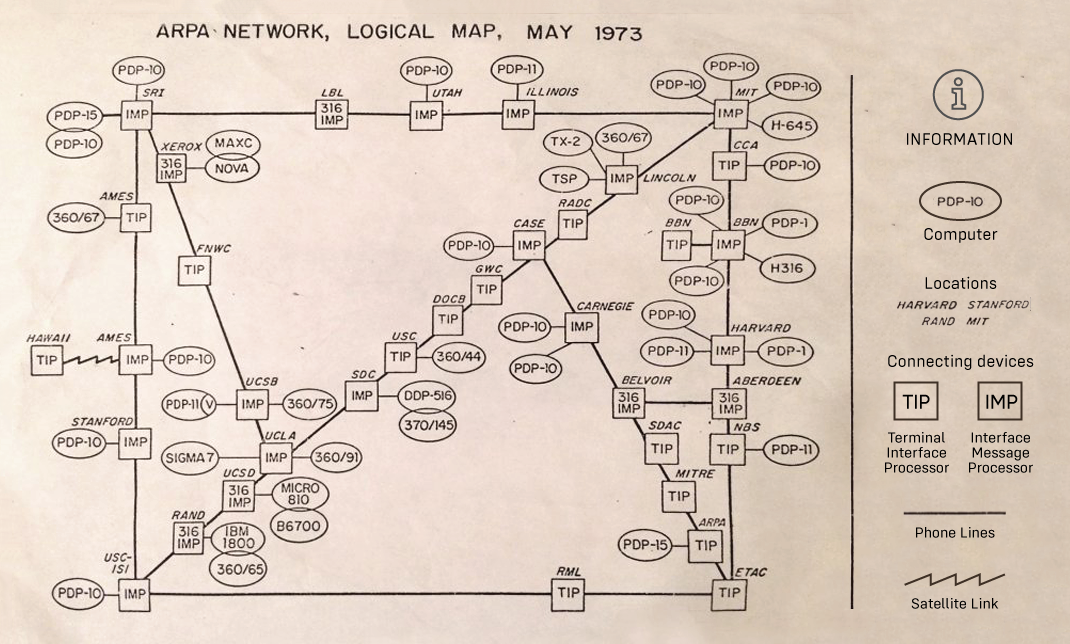
This Map Shows the Extent of the Entire Internet in 1973
Before the modern internet, there was ARPANET.
ARPANET was the first internet-like network, and it was developed to allow multiple computers to share data across vast geographical distances. Interestingly, the researchers that worked on ARPANET are credited with developing many of the communication protocols that the internet still uses today.
Today’s map comes from David Newbury, who shared a keepsake from his father’s time as a computer science business manager at Carnegie Mellon University in the 1970s. We added a legend to help explain the symbols on the map.
A Brief History of ARPANET
ARPANET was funded in the late 1960s by a branch of the U.S. Military called The Advanced Research Projects Agency (ARPA), with the original purpose being to allow researchers at different universities to use their limited computing resources more efficiently.
Before ARPANET, if a researcher at Harvard wanted to access a database at Stanford, they had to travel there and use it in person. ARPANET was used to test out a new communication technology known as packet-switching, which broke up data into smaller “packets” and allowed various computers on the network to access the data.
With ARPANET researchers could:
- Login to another computer miles away
- Transfer and save files across the network
- Send emails from one person to several others
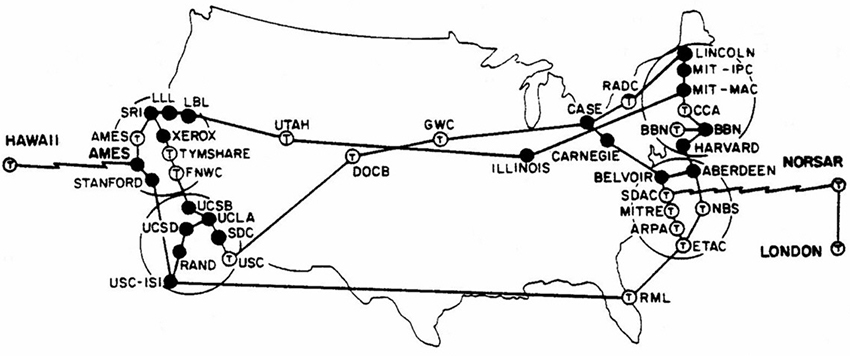
On the map above, you can see the network only had computers in the United States, but later that same year, a satellite link connected the ARPANET to Norway, creating the beginnings of a global network.
A Network of Networks
In 1983, ARPANET adopted the TCP/IP protocol standards which paved the way for a “network of networks”, and the internet was born. Several years later, ARPANET would be decommissioned and the new internet would begin to flourish.
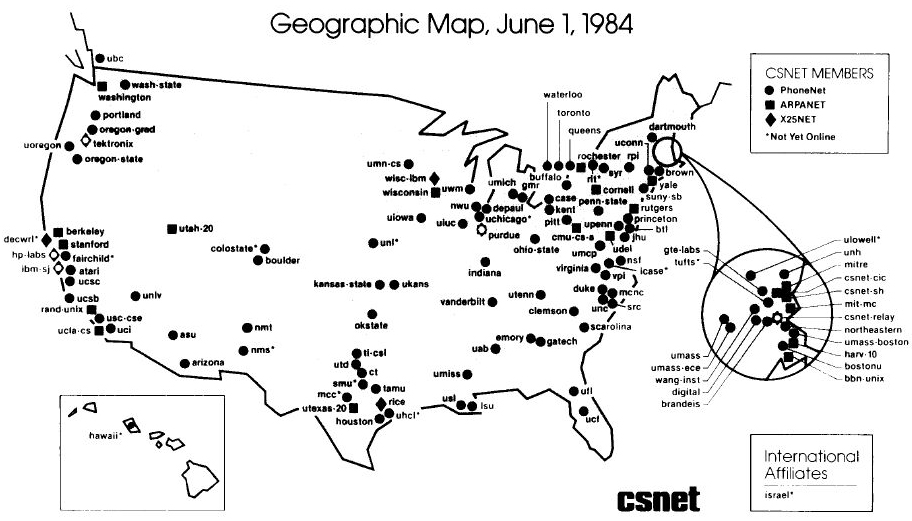
Below you can see what the early internet looked like in 1984:
A Big Jump
These maps take us back to a simpler time when social networks, mobile phones, and unlimited access to the world’s information did not yet exist. Even 12 years after the first message was transmitted on the ARPANET, there were still only 213 computers on the network.
Fast forward a few decades later and the change in scale is mind-boggling – the modern internet has 1.94 billion websites and 4.1 billion internet users globally, resembling a digital universe.
One can only imagine how quaint the ARPANET will look a few more decades from now.
An earlier version of this article said the ARPANET was first connected internationally to the United Kingdom, but in fact, it was with Norway.
Technology
Ranked: The Countries With the Most Data Centers
Dive into this visualization, which shows which countries have the most data centers globally – one place accounts for 43%. 

Published
3 hours ago
on
March 30, 2026

Ranked: The Countries With the Most Data Centers
See visuals like this from many other data creators on our Voronoi app. Download it for free on iOS or Android and discover incredible data-driven charts from a variety of trusted sources.
Key Takeaways
- The U.S. hosts 43% of the world’s data centers, with 4,088 total.
- Germany and the UK are nearly tied for second place, separated by just one facility.
- Europe’s FLAP-D corridor remains a global hub for cloud and AI infrastructure.
The U.S. is home to 43% of the world’s data centers, by far the largest share globally.
As artificial intelligence scales, countries are racing to build the infrastructure needed to support it both now and in the future.
Because AI applications require low latency, data centers are increasingly being built closer to end users—fueling a global expansion in capacity.
This treemap graph visualizes which countries have the most data centers, using data from Data Center Map as of March 2026.
Which Country Has the Most Data Centers?
Most of the world’s data centers are in the U.S., at 4,088, which is more than eight times higher than the next country. AI penetration is greater in developed countries, so it also makes sense that data center locations skew this way.
| Rank | Country | Number of Data Centers |
|---|---|---|
| 1 | 🇺🇸 United States | 4,088 |
| 2 | 🇩🇪 Germany | 507 |
| 3 | 🇬🇧 United Kingdom | 506 |
| 4 | 🇨🇳 China | 369 |
| 5 | 🇫🇷 France | 346 |
| 6 | 🇨🇦 Canada | 286 |
| 7 | 🇮🇳 India | 278 |
| 8 | 🇦🇺 Australia | 270 |
| 9 | 🇯🇵 Japan | 255 |
| 10 | 🇮🇹 Italy | 216 |
| 11 | 🇧🇷 Brazil | 204 |
| 12 | 🇪🇸 Spain | 195 |
| 13 | 🇳🇱 Netherlands | 187 |
| 14 | 🇮🇩 Indonesia | 185 |
| 15 | 🇷🇺 Russia | 181 |
| 16 | 🇮🇪 Ireland | 127 |
| 17 | 🇨🇭 Switzerland | 114 |
| 18 | 🇸🇪 Sweden | 110 |
| 19 | 🇫🇮 Finland | 105 |
| 20 | 🇵🇱 Poland | 99 |
| 21 | 🇳🇴 Norway | 92 |
| 22 | 🇩🇰 Denmark | 82 |
| 23 | 🇹🇷 Türkiye | 76 |
| 24 | 🇲🇽 Mexico | 64 |
| 25 | 🇷🇴 Romania | 63 |
| 26 | 🇦🇹 Austria | 53 |
| 27 | 🇧🇪 Belgium | 48 |
| 28 | 🇵🇹 Portugal | 45 |
| 29 | 🇺🇦 Ukraine | 37 |
| 30 | 🇧🇬 Bulgaria | 31 |
| 31 | 🇨🇿 Czechia | 26 |
| 31 | 🇬🇷 Greece | 26 |
| 33 | 🇱🇻 Latvia | 24 |
| 34 | 🇱🇹 Lithuania | 20 |
| 34 | 🇸🇮 Slovenia | 20 |
| 36 | 🇨🇾 Cyprus | 18 |
| 37 | 🇭🇺 Hungary | 17 |
| 38 | 🇱🇺 Luxembourg | 16 |
| 38 | 🇭🇷 Croatia | 16 |
| 40 | 🇸🇰 Slovakia | 13 |
| 40 | 🇷🇸 Serbia | 13 |
| 42 | 🇪🇪 Estonia | 12 |
| 42 | 🇮🇸 Iceland | 12 |
| 42 | 🇲🇹 Malta | 12 |
| 45 | 🇲🇰 North Macedonia | 7 |
| 46 | 🇲🇩 Moldova | 6 |
| 47 | 🇬🇪 Georgia | 4 |
| 47 | 🇧🇦 Bosnia and Herzegovina | 4 |
| 49 | 🇲🇨 Monaco | 3 |
| 49 | 🇦🇿 Azerbaijan | 3 |
| 51 | 🇧🇾 Belarus | 2 |
Germany, which has the largest population in the European Union, is the second most data center-dense country at 507. The UK is close behind at 506.
Many data centers are clustered around the traditional FLAP-D corridor of Frankfurt, London, Amsterdam, Paris, and Dublin, which are close to metropolitan hubs and financial markets that need fast cloud and, increasingly, AI connections.
It makes sense, then, that France trails closely at 346, though China sits between it and the UK at 369 data centers.
Canada, India, and Australia—large countries with ample land to develop—are next in line, home to 270 data centers or more.
At the bottom of the dataset is Belarus, with two data centers, along with Monaco and Azerbaijan, which both have three.
The Future of Data Centers
As the world aggressively builds out its data center capacity, key questions remain around where infrastructure will go, given the finite nature of land and resources.
Some developers are investing in co-benefits for local communities to aid buy-in. In Ireland, for instance, which had a moratorium on data centers until late last year, an AWS data center feeds its excess heat into a district heating network for social housing and public buildings.
Others are exploring more radical ideas, like putting data centers into orbit.
Learn More on the Voronoi App 
To learn more about AI, check out this graphic, which shows which countries use Claude.ai the most.
Technology
Ranked: The World’s Most Surveilled Cities
Here are the world’s most surveilled cities ranked by CCTV cameras per 1,000 people.

Published
3 days ago
on
March 28, 2026

Ranked: The World’s Most Surveilled Cities
See visuals like this from many other data creators on our Voronoi app. Download it for free on iOS or Android and discover incredible data-driven charts from a variety of trusted sources.
Key Takeaways
- Indian cities dominate the rankings, with Hyderabad (79 cameras per 1,000 people) leading globally.
- Eight of the top 10 cities are Asian. The other two most surveilled cities are in Russia.
- China has 700 million cameras (494 per 1,000 people), though per-city data is unavailable.
Surveillance is becoming a defining feature of modern cities, but the level of monitoring varies significantly from one urban center to the next.
In Los Angeles, the number of cameras exceeds 46,000. Hyderabad, India has around 900,000. This visualization ranks major global cities by the number of CCTV cameras per 1,000 people using data from Comparitech, showing where surveillance is most concentrated.
As governments and municipalities expand surveillance for security and smart city initiatives, these rankings offer a snapshot of where camera density—and public surveillance—is highest today.
Cities With the Most Cameras Per Capita
At the top of the list, Hyderabad, India leads globally with 79 cameras per 1,000 people, followed by Indore (72) and Bangalore (41). Collectively, they hold over 1.7 million cameras.
It’s worth noting that data for specific cities in China is unavailable owing to government secrecy. However, it’s estimated to have 494 cameras per capita, or nearly one camera for every two people.
The table below shows the number of CCTV cameras per capita, highlighting the scale of public surveillance around the world.
| Rank | City | Country | Cameras Per 1,000 People | Number of CCTV Cameras |
|---|---|---|---|---|
| 1 | Hyderabad | 🇮🇳 India | 79 | 900,000 |
| 2 | Indore | 🇮🇳 India | 72 | 251,500 |
| 3 | Bangalore | 🇮🇳 India | 41 | 585,300 |
| 4 | Lahore | 🇵🇰 Pakistan | 28 | 410,300 |
| 5 | Seoul | 🇰🇷 South Korea | 24 | 243,400 |
| 6 | Moscow | 🇷🇺 Russia | 20 | 250,000 |
| 7 | Kabul | 🇦🇫 Afghanistan | 18 | 90,000 |
| 8 | Singapore | 🇸🇬 Singapore | 18 | 113,000 |
| 9 | Saint Petersburg | 🇷🇺 Russia | 18 | 102,000 |
| 10 | Baghdad | 🇮🇶 Iraq | 15 | 120,000 |
| 11 | London | 🇬🇧 United Kingdom | 13 | 131,900 |
| 12 | Los Angeles | 🇺🇸 United States | 12 | 46,800 |
| 13 | Busan | 🇰🇷 South Korea | 12 | 42,800 |
| 14 | Istanbul | 🇹🇷 Turkey | 11 | 179,000 |
| 15 | New York City | 🇺🇸 United States | 10 | 80,300 |
| 16 | Delhi | 🇮🇳 India | 9 | 313,300 |
| 17 | Chennai | 🇮🇳 India | 9 | 106,600 |
| 18 | Ho Chi Minh City | 🇻🇳 Vietnam | 8 | 79,100 |
| 19 | Kuwait City | 🇰🇼 Kuwait | 7 | 24,900 |
| 20 | Bangkok | 🇹🇭 Thailand | 7 | 81,100 |
| 21 | Pune | 🇮🇳 India | 7 | 52,100 |
| 22 | Kochi | 🇮🇳 India | 7 | 24,000 |
| 23 | Lucknow | 🇮🇳 India | 7 | 27,200 |
| 24 | Hong Kong | 🇭🇰 Hong Kong | 6 | 48,000 |
| 25 | Mexico City | 🇲🇽 Mexico | 6 | 136,900 |
| 26 | New Taipei | 🇹🇼 Taiwan | 6 | 27,200 |
| 27 | Ankara | 🇹🇷 Turkey | 6 | 31,400 |
| 28 | Rome | 🇮🇹 Italy | 5 | 22,500 |
| 29 | Sydney | 🇦🇺 Australia | 5 | 26,200 |
Pakistan’s capital, Lahore, ranks fourth globally at 28 cameras per 1,000 people. With 410,300 cameras in total, facial recognition is often linked to national databases in real time.
Moscow, Russia ranks in sixth globally, with 20 cameras per capita. As one of the most pervasive surveillance systems worldwide, Moscow is blanketed in 250,000 cameras, which use facial recognition to identify protestors, journalists, and dissidents.
Across the West, London is the most highly surveilled cities, ranking in 11th overall. Following next in line is Los Angeles, with the number of cameras increasing by roughly 34% since 2022.
The Rise of Surveillance Infrastructure
Beyond Los Angeles, several cities have mirrored this expansion of surveillance systems in public spaces.
Notably, the number of cameras jumped 104% in Hyderabad, 17% in Moscow, and 3.6% in London since 2022. At the same time, these systems are increasingly using machine learning algorithms to identify patterns, automate profiles, and detect “suspicious activity”.
Not only do vast networks of cameras allow government authorities to detect traffic or parking violations, they provide access to people’s movements, raising questions of privacy and data accumulation in an age of AI-powered monitoring.
Learn More on the Voronoi App
To learn more about this topic, check out this graphic on the countries that have banned ChatGPT.