Visualizing All the Global Endangered Languages
This was originally posted on our Voronoi app. Download the app for free on iOS or Android and discover incredible data-driven charts from a variety of trusted sources.
Almost half of the world’s approximately 7,000 signed and spoken languages are currently endangered.
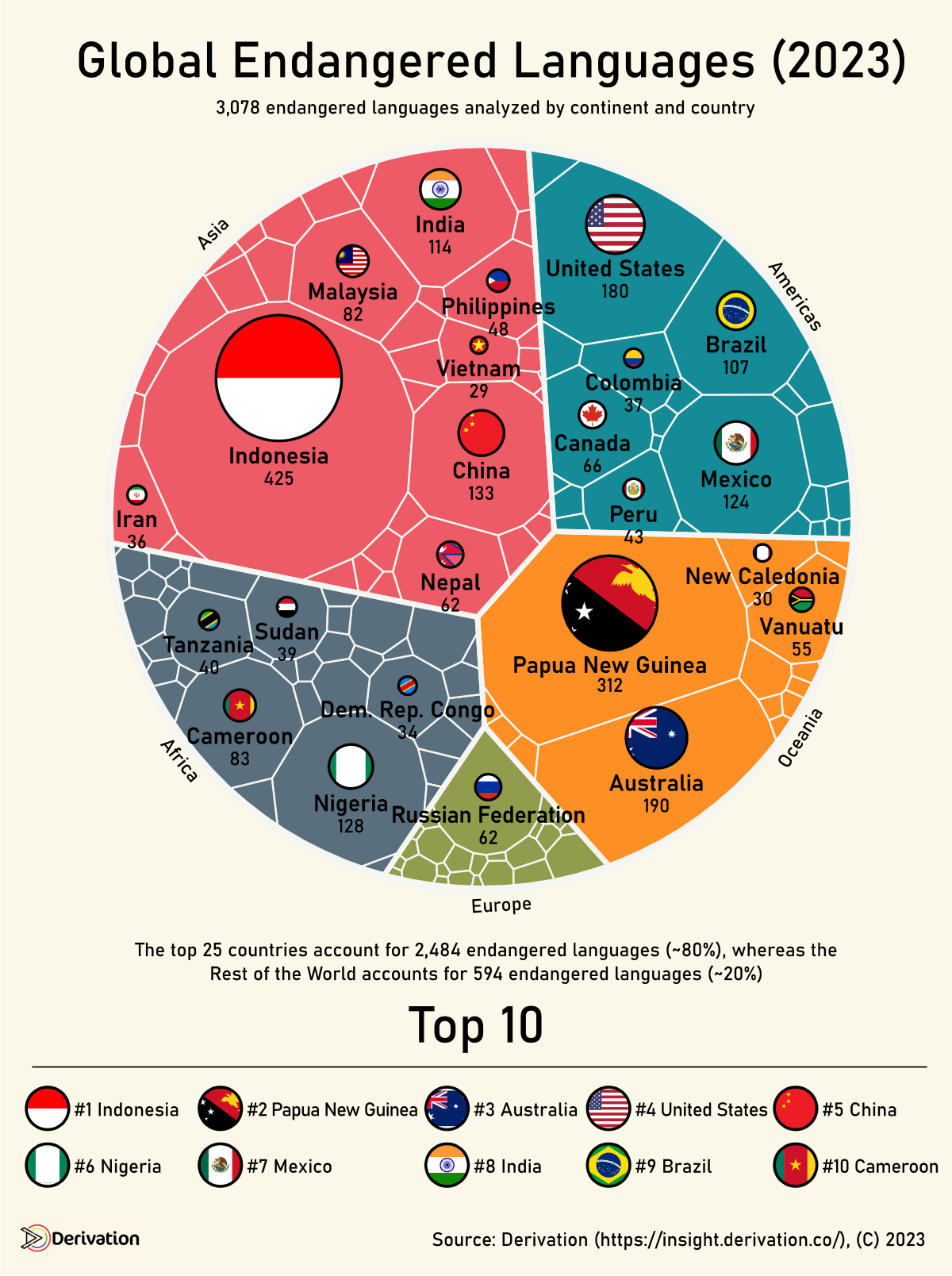
This graphic, from Stephen Jones, CEO of Derivation.co, examines the current global landscape of languages that could become extinct.
Almost 90 million Speak Languages at Risk of Extinction
An extinct language is one that no longer has any first-language or second-language speakers.
In modern times, languages have usually become extinct due to cultural assimilation, leading to language shift, and the gradual abandonment of a native language in favor of a foreign language, primarily those of European countries.
For instance, numerous Native American languages were supplanted by English, French, Portuguese, Spanish, or Dutch due to European colonization of the Americas.
Currently, out of the world’s 7,168 living languages, 3,078 (43%) are classified as Endangered. Over 88 million people speak languages at risk of extinction.
| Locations | Endangered Languages |
|---|---|
| 🇮🇩 Indonesia | 425 |
| 🇵🇬 Papua New Guinea | 312 |
| 🇦🇺 Australia | 190 |
| 🇺🇸 United States | 180 |
| 🇨🇳 China | 133 |
| 🇳🇬 Nigeria | 128 |
| 🇲🇽 Mexico | 124 |
| 🇮🇳 India | 114 |
| 🇧🇷 Brazil | 107 |
| 🇨🇲 Cameroon | 83 |
| 🇲🇾 Malaysia | 82 |
| 🇨🇦 Canada | 66 |
| 🇳🇵 Nepal | 62 |
| 🇷🇺 Russian Federation | 62 |
| 🇻🇺 Vanuatu | 55 |
| 🇵🇭 Philippines | 48 |
| 🇵🇪 Peru | 43 |
| 🇹🇿 Tanzania | 40 |
| 🇸🇩 Sudan | 39 |
| 🇨🇴 Colombia | 37 |
| 🇮🇷 Iran | 36 |
| 🇨🇩 Democratic Republic of the Congo | 34 |
| 🇳🇨 New Caledonia | 30 |
| 🇻🇳 Vietnam | 29 |
| 🇧🇴 Bolivia | 25 |
| 🌐 Rest of the world | 594 |
| Total | 3078 |
Additionally, 100 of them face the genuine threat of extinction within a few decades if no action is taken.
While every language matters to the individuals speaking, writing, and signing them across the planet, 80% of endangered languages (2,484) exist within just 25 countries.
Of those, the top four countries alone – Indonesia (425), Papua New Guinea (312), Australia (190), and the U.S. (180) – account for well over a thousand endangered languages.
Just as during the colonization period, the majority of endangered languages are spoken in Indigenous communities, putting their inherent culture and knowledge at risk of loss.
Languages, however, can be revitalized.
Over the last 50 years, for example, government support to teach native languages in schools has helped increase the number of speakers of the Māori language in New Zealand, and Hawaiian in the American state.
Advancements in AI are also providing tools to preserve languages.

This article was published as a part of Visual Capitalist's Creator Program, which features data-driven visuals from some of our favorite Creators around the world.
Public Opinion
The World’s Happiest Countries, Ranked Each Year (2015–2025)
One country has just reached its ninth year as the world’s happiest population. But new entries are shaking up the leaderboard.

Published
3 days ago
on
March 20, 2026

The World’s Happiest Countries, Ranked Each Year (2015–2025)
See visuals like this from many other data creators on our Voronoi app. Download it for free on iOS or Android and discover incredible data-driven charts from a variety of trusted sources.
Key Takeaways
- Finland has held the top spot since 2017, leading the rankings for nearly a decade.
- Canada, New Zealand, and Australia were in the top 10 in 2015, but not in 2025.
- Costa Rica surged to No. 4 in 2025, one of the biggest recent jumps.
Over the last decade, the world’s happiest countries have remained remarkably consistent at the top, with Nordic nations dominating the rankings year after year. But beneath that stability, there have been notable shifts—including Costa Rica’s recent surge into the top five and the disappearance of countries like Canada and Australia from the top 10.
This chart tracks how the world’s happiest countries have moved up and down the rankings each year since 2015, based on survey data from over 140 countries compiled by Gallup and published in the 2026 World Happiness Report
Finland has now held the top spot for nine consecutive years, while several longtime contenders have slipped or dropped out entirely.
The Dominance of Finland and Northern Europe
Scandinavian and Northern European countries overall have dominated the top of the leaderboard over the last decade, with Denmark, Iceland, Norway, and Sweden consistently scoring alongside Finland among the top five countries worldwide.
The following tables highlight annual rankings in 2015 and 2025 of the world’s happiest countries. Each year’s score is averaged with the previous two years, meaning 2015’s results reflect data from 2013–2015.
| Rank | Country | Score (2015) |
|---|---|---|
| 1 | 🇩🇰 Denmark | 7.526 |
| 2 | 🇨🇭 Switzerland | 7.509 |
| 3 | 🇮🇸 Iceland | 7.501 |
| 4 | 🇳🇴 Norway | 7.498 |
| 5 | 🇫🇮 Finland | 7.413 |
| 6 | 🇨🇦 Canada | 7.404 |
| 7 | 🇳🇱 Netherlands | 7.339 |
| 8 | 🇳🇿 New Zealand | 7.334 |
| 9 | 🇦🇺 Australia | 7.313 |
| 10 | 🇸🇪 Sweden | 7.291 |
And here’s how the top 10 looked in 2025, the most recent year covered:
| Rank | Country | Score (2025) |
|---|---|---|
| 1 | 🇫🇮 Finland | 7.764 |
| 2 | 🇮🇸 Iceland | 7.54 |
| 3 | 🇩🇰 Denmark | 7.539 |
| 4 | 🇨🇷 Costa Rica | 7.439 |
| 5 | 🇸🇪 Sweden | 7.255 |
| 6 | 🇳🇴 Norway | 7.242 |
| 7 | 🇳🇱 Netherlands | 7.223 |
| 8 | 🇮🇱 Israel | 7.187 |
| 9 | 🇱🇺 Luxembourg | 7.063 |
| 10 | 🇨🇭 Switzerland | 7.018 |
The Nordic model’s success in building relatively egalitarian and prosperous societies is often cited as a key reason for these consistently high rankings.
In addition, given the methodology’s subjective nature, social and cultural norms almost certainly factor into the countries’ consistently high scores relative to other regions of Europe and the world.
Beyond Scandinavia and the Nordics
Meanwhile, Western European peers have also been mainstays in the last decade’s annual top 10 rankings.
The Netherlands has placed at least seventh every year of the 2015-2025 period, while Luxembourg has made regular appearances in the top 10 since 2019.
Switzerland has made appearances in every year’s top 10 with the exception of 2024, although its overall ranking has substantially dropped since its second-place peak in 2015. Austria, a regular top 10 scorer up to 2020, has made no post-pandemic appearances.
Non-European Entries From Around the World
Beyond Europe, countries from every continent except Africa and South America have ranked among the 10 happiest countries worldwide between 2015 and 2025.
Australia, Canada, and New Zealand have each made sporadic appearances in the years up to 2024, while Israel has been a regular high-scorer since it first entered the top 10 in 2021.
Two Latin American countries have also made appearances in recent years, with Mexico reaching tenth in 2024 and Costa Rica soaring to a dramatic fourth-place finish in 2025.
Learn More on the Voronoi App 
If you enjoyed today’s post, check out Visualizing Happiness Across the Americas on Voronoi, the new app from Visual Capitalist.
Public Opinion
Ranked: Americans’ Favorite News Sites
Americans today have more news options than ever. But as it turns out, only one is actually liked by a majority of people.
Published
1 week ago
on
March 15, 2026

Ranked: Americans’ Favorite News Sites
See visuals like this from many other data creators on our Voronoi app. Download it for free on iOS or Android and discover incredible data-driven charts from a variety of trusted sources.
Key Takeaways
- BBC News has the highest approval rating among Americans at 51%.
- No other news website reaches 50% positive opinion among respondents.
- Yahoo News (48%) ranks second and is the top U.S.-based brand.
Americans get their news online from a wide mix of sources, including legacy newspapers, cable networks, digital platforms, and sports media brands.
This graphic ranks the 20 news websites with the highest positive opinion among Americans, based on YouGov polling from the fourth quarter of 2025. The results highlight a fragmented media landscape, with many well-known outlets clustered closely together in approval ratings.
London Surprises At The Top
Despite surveying American audiences, the top-ranked news website is BBC News, with 51% of respondents expressing a positive opinion.
The BBC is the United Kingdom’s public broadcaster. Founded in 1922, it has grown into one of the largest global news organizations.
The table below ranks the 20 news sites with the highest approval among Americans.
| Rank | News site | Share of people with a positive opinion about the news website |
|---|---|---|
| 1 | BBC News | 51% |
| 2 | Yahoo! | 48% |
| 3 | ESPN | 43% |
| 4 | NBC | 42% |
| 5 | NBC News | 42% |
| 6 | The New York Times | 41% |
| 7 | Forbes | 39% |
| 8 | CNN | 39% |
| 9 | CBS | 39% |
| 10 | MSN | 39% |
| 11 | NPR | 38% |
| 12 | Fox News | 38% |
| 13 | CNBC | 38% |
| 14 | Reuters | 35% |
| 15 | The Washington Post | 34% |
| 16 | Buzzfeed | 32% |
| 17 | NFL.com | 31% |
| 18 | Politico | 31% |
| 19 | Today.com | 30% |
| 20 | Business Insider | 30% |
BBC stands out as the only news website to surpass the 50% approval mark. No American outlet achieves the same level of broad popularity among respondents.
One possible explanation is distance from U.S. politics. As an international broadcaster, the BBC may avoid some of the domestic partisan divisions faced by American news organizations.
The Strong Domestic Contenders
Following BBC, 48% of Americans express a positive view of Yahoo News, making it the second-ranked site overall and the top U.S.-based brand.
Although Yahoo was founded in 1996, it only began producing original journalism in 2011. Before that, it primarily functioned as a news aggregator, republishing stories from other outlets—an approach that helped it build a large and familiar audience.
Further down the ranking, sports media brand ESPN (43%) outranks the newspaper of record, The New York Times (41%). The result highlights the broad appeal of sports coverage compared with more politically focused news.
The Cable News Kings Online
The Times is not the only major brand that ranks lower than expected in online popularity.
Well-known television networks such as CNN (39%) and Fox News (38%) have large cable audiences but receive more modest approval ratings among Americans online.
Growing political polarization in the U.S., along with ongoing debates over media bias, may help explain why these outlets generate more divided public opinion.
Learn More on the Voronoi App
If you enjoyed today’s post, check out Ranked: The 20 Most Visited Websites in the World in 2026 on Voronoi, the new app from Visual Capitalist.