All of the World’s Money and Markets in One Visualization
In the current economic circumstances, there are some pretty large numbers being thrown around by both governments and the financial media.
The U.S. budget deficit this year, for example, is projected to hit $3.8 trillion, which would be more than double the previous record set during the financial crisis ($1.41 trillion in FY2009). Meanwhile, the Fed has announced “open-ended” asset-buying programs to support the economy, which will add even more to its current $7 trillion balance sheet.
Given the scale of these new numbers—how can we relate them back to the more conventional numbers and figures that we may be more familiar with?
Introducing the $100 Billion Square
In the above data visualization, we even the playing field by using a common denominator to put the world’s money and markets all on the same scale and canvas.
Each black square on the chart is worth $100 billion, and is not a number to be trifled with:
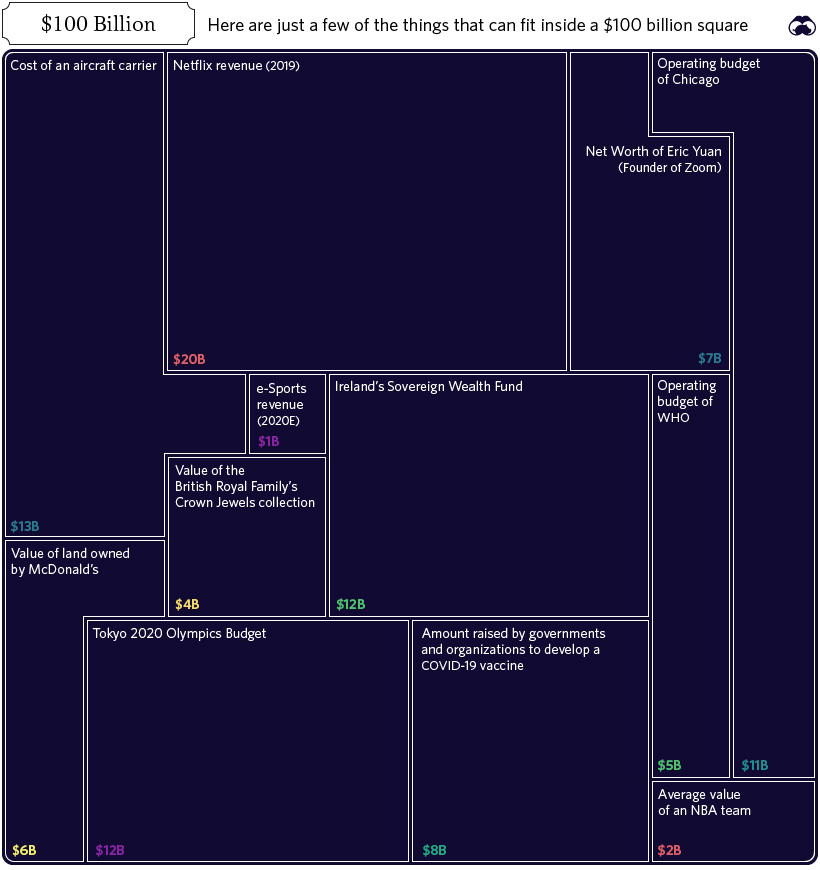
In fact, the entire annual GDP of Cuba could fit in one square ($97 billion), and the Greek economy would be roughly two squares ($203 billion).
Alternatively, if you’re contrasting this unit to numbers found within Corporate America, there are useful comparisons there as well. For example, the annual revenues of Wells Fargo ($103.9 billion) would just exceed one square, while Facebook’s would squeeze in with room to spare ($70.7 billion).
Billions, Trillions, or Quadrillions?
Here’s our full list, which sums up all of the world’s money and markets, from the smallest to the biggest, along with sources used:
| Category | Value ($ Billions, USD) | Source |
|---|---|---|
| Silver | $44 | World Silver Survey 2019 |
| Cryptocurrencies | $244 | CoinMarketCap |
| Global Military Spending | $1,782 | World Bank |
| U.S. Federal Deficit (FY 2020) | $3,800 | U.S. CBO (Projected, as of April 2020) |
| Coins & Bank Notes | $6,662 | BIS |
| Fed's Balance Sheet | $7,037 | U.S. Federal Reserve |
| The World's Billionaires | $8,000 | Forbes |
| Gold | $10,891 | World Gold Council (2020) |
| The Fortune 500 | $22,600 | Fortune 500 (2019 list) |
| Stock Markets | $89,475 | WFE (April 2020) |
| Narrow Money Supply | $35,183 | CIA Factbook |
| Broad Money Supply | $95,698 | CIA Factbook |
| Global Debt | $252,600 | IIF Debt Monitor |
| Global Real Estate | $280,600 | Savills Global Research (2018 est.) |
| Global Wealth | $360,603 | Credit Suisse |
| Derivatives (Market Value) | $11,600 | BIS (Dec 2019) |
| Derivatives (Notional Value) | $558,500 | BIS (Dec 2019) |
| Derivatives (Notional Value - High end) | $1,000,000 | Various sources (Unofficial) |
Derivatives top the list, estimated at $1 quadrillion or more in notional value according to a variety of unofficial sources.
However, it’s worth mentioning that because of their non-tangible nature, the value of financial derivatives are measured in two very different ways. Notional value represents the position or obligation of the contract (i.e. a call to buy 100 shares at the price of $50 per share), while gross market value measures the price of the derivative security itself (i.e. $1.00 per call option, multiplied by 100 shares).
It’s a subtle difference that manifests itself in a big way numerically.
Correction: Graphic updated to reflect the average value of an NBA team.
Stocks
The World’s $158 Trillion Stock Market in One Chart
Explore the world’s $158 trillion stock market, with the U.S. accounting for 44% and China narrowly ranking ahead of the European Union.

Published
14 hours ago
on
August 24, 2026

The World’s $158 Trillion Stock Market in One Chart
Key Takeaways
- U.S.-listed companies account for roughly 44% of global stock market capitalization.
- China and the European Union each have equity markets valued at $15.5 trillion each.
- The U.S. share of global equity market capitalization has risen from roughly one-third in 2012.
In 2025, the global equity market reached a record $157.8 trillion in market capitalization, up more than $25 trillion from 2024.
This visualization highlights the world’s major equity markets based on their 2025 market capitalization. Data has been sourced from the World Federation of Exchanges via SIFMA.
The World’s Biggest Stock Market
With a total market capitalization of $68.9 trillion, the U.S. is by far the world’s largest equity market, accounting for roughly 44% of the global total.
The U.S. is home to the world’s two preeminent stock exchanges, the New York Stock Exchange and the Nasdaq. Shares in the overwhelming majority of the country’s largest public companies are traded on these two exchanges.
The table below lists the world’s major equity markets as of the end of 2025.
| Rank | Country | Market cap in 2025 ($T) | Share (%) |
|---|---|---|---|
| 1 | 🇺🇸 United States | 68.9 | 44% |
| 2 | 🇨🇳 China | 15.5 | 10% |
| 3 | 🇪🇺 European Union | 15.5 | 10% |
| 4 | 🇮🇳 India | 10.6 | 7% |
| 5 | 🇯🇵 Japan | 7.6 | 5% |
| 6 | 🇭🇰 Hong Kong | 6.1 | 4% |
| 7 | 🇬🇧 United Kingdom | 5.6 | 4% |
| 8 | 🇨🇦 Canada | 4.6 | 3% |
| 9 | 🇦🇺 Australia | 2.0 | 1% |
| 10 | 🇸🇬 Singapore | 0.8 | 1% |
| -- | 🌐 Other Developed Markets | 13.6 | 9% |
| -- | 🌐 Other Emerging Markets | 6.9 | 4% |
| -- | 🌎 World Total | 157.8 | 100% |
The U.S. has seen its dominance in global equities strengthen over the past decade. Its share of global equity market capitalization has risen by more than 10 percentage points since 2012, when it accounted for roughly one-third of the total.
Part of this rise has been driven by the strong performance of U.S.-listed tech companies like Apple, Alphabet, and NVIDIA, each of which is part of the so-called Magnificent Seven.
China and the EU Are Nearly Tied
China ranks as the world’s second-largest equity market, narrowly ahead of the European Union. Both round to $15.5 trillion in market capitalization.
Even at that scale, each market is less than one-quarter the size of the $68.9 trillion U.S. market. Notably, many prominent Chinese companies are also listed in Hong Kong, which is itself a $6.1 trillion market.
Equities in both China and the EU have faced pressure as investors weighed geopolitical uncertainty. Nonetheless, EU-listed equities gained nearly 40% in year-over-year value as markets reacted positively to increased German spending and relative policy certainty compared with the United States.
Asia’s Other Stock Market Giants
Beyond China, Asia is home to several other major equity markets, including India ($10.6 trillion), Japan ($7.6 trillion), and Singapore ($824 billion).
Of the three, India had the most difficult 2025. Compared with nearly 19% average growth across global equities, Indian stocks gained just 2.5% on average.
A lack of domestic AI champions was a significant factor. As equities in South Korea, Taiwan, and the U.S. soared, investors redirected capital away from Indian companies.
Learn More on the Voronoi App
To learn more about how the U.S. retail giants compare in annual sales, check out Which Are the Biggest Retailers in the U.S.? on Voronoi.
Business
The World’s 30 Largest Companies by Revenue in 2026
After three decades of growth, Amazon has officially clinched the title of world’s top firm by annual revenue.
Published
5 days ago
on
August 20, 2026

The World’s 30 Largest Companies by Revenue in 2026
Key Takeaways
- Amazon has overtaken Walmart to become the world’s largest company by revenue, with $717 billion in annual revenue.
- The U.S. is home to half of the world’s top 30 companies by revenue, including seven of the top 10.
- State Grid has the highest revenue ($555 billion) of any non-U.S. company.
Amazon has surpassed Walmart to become the world’s largest company by annual revenue, ending Walmart’s more than decade-long run at the top of the global ranking.
This graphic highlights the world’s 30 largest companies by revenue in 2026 using the latest available data from the Fortune Global 500. Annual revenues correspond to the most recent fiscal year ending on or before March 2026.
The Retail Giants of America
Just $3.7 billion separates Amazon and Walmart at the top of the ranking. Amazon generated $716.9 billion in annual revenue, narrowly edging out Walmart at $713.2 billion.
Walmart, the world’s largest private employer, had held the top spot in the global revenue ranking for more than a decade.
The table below ranks the world’s 30 largest companies by revenue as of 2026.
| Rank | Name | Revenues (billions $) |
|---|---|---|
| 1 | 🇺🇸 Amazon | 716.9 |
| 2 | 🇺🇸 Walmart | 713.2 |
| 3 | 🇨🇳 State Grid | 555.4 |
| 4 | 🇺🇸 UnitedHealth Group | 447.6 |
| 5 | 🇸🇦 Saudi Aramco | 445.5 |
| 6 | 🇺🇸 Apple | 416.2 |
| 7 | 🇺🇸 McKesson | 403.4 |
| 8 | 🇺🇸 Alphabet | 402.8 |
| 9 | 🇺🇸 CVS Health | 402.1 |
| 10 | 🇨🇳 China National Petroleum | 401.9 |
| 11 | 🇺🇸 Berkshire Hathaway | 371.4 |
| 12 | 🇨🇳 Sinopec Group | 364 |
| 13 | 🇩🇪 Volkswagen | 363.1 |
| 14 | 🇯🇵 Toyota Motor | 336.3 |
| 15 | 🇺🇸 ExxonMobil Holdings | 332.2 |
| 16 | 🇺🇸 Cencora | 321.3 |
| 17 | 🇨🇳 China State Construction Engineering | 289.9 |
| 18 | 🇺🇸 Microsoft | 281.7 |
| 19 | 🇺🇸 JPMorgan Chase | 280.3 |
| 20 | 🇺🇸 Costco Wholesale | 275.2 |
| 21 | 🇺🇸 Cigna Group | 274.9 |
| 22 | 🇬🇧 Shell | 273.7 |
| 23 | 🇹🇼 Hon Hai Precision Industry | 260.1 |
| 24 | 🇨🇭 Glencore | 247.5 |
| 25 | 🇸🇬 Trafigura Group | 240.3 |
| 26 | 🇰🇷 Samsung Electronics | 234.7 |
| 27 | 🇺🇸 Cardinal Health | 222.6 |
| 28 | 🇺🇸 Nvidia | 215.9 |
| 29 | 🇨🇳 Industrial & Commercial Bank of China | 210.6 |
| 30 | 🇺🇸 Meta Platforms | 201 |
Amazon’s growth increasingly extends beyond online retail. Amazon Web Services (AWS), digital advertising, and other businesses have helped diversify its revenue base and contributed significantly to profits.
That business mix also helps explain why Amazon is significantly more profitable than Walmart despite the two companies now generating nearly identical annual revenue.
The United States of Revenue
The U.S. accounts for 15 of the 30 companies in the ranking, including seven of the top 10. Beyond Amazon and Walmart, the country’s largest companies by revenue span healthcare, technology, energy, and finance.
UnitedHealth Group generates $448 billion in annual revenue, while tech giants Apple and Alphabet bring in $416 billion and $403 billion, respectively. Other major retailers also appear in the ranking, including Costco.
Combined, the strong showing for U.S. companies means North American firms generated 60% of the $10.5 trillion in total revenue represented by the world’s top 30 companies.
State-Owned Revenues in 2026
State Grid Corporation of China, an electricity utility and the world’s largest state-owned enterprise (SOE), generated $555 billion in revenue, more than any other non-U.S. company. However, State Grid is not the only SOE to appear among the world’s top 30.
Fellow Chinese firms China National Petroleum Corporation ($402 billion), Sinopec ($364 billion), and China State Construction Engineering Corporation ($290 billion) were all market leaders in their respective industries.
Outside of China, Saudi Aramco generated $446 billion in revenue, more than any other company in Europe, the Middle East, or Africa.
Learn More on the Voronoi App
To learn more about how the U.S. retail giants compare in annual sales, check out Which Are the Biggest Retailers in the U.S.? on Voronoi.