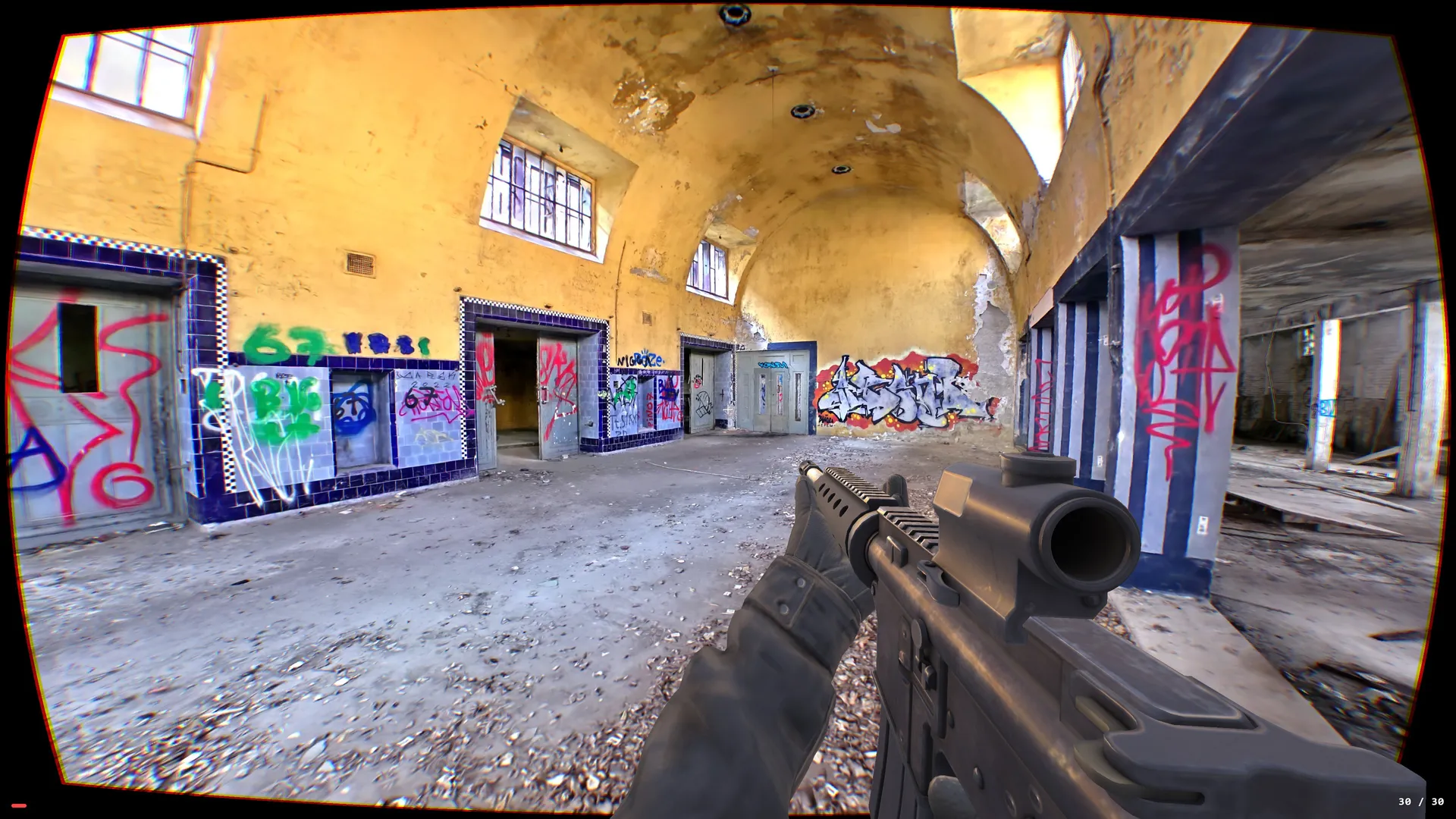
It's true: London-based developer Iakov Sumygin has created a minimalistic playable video game using Gaussian splats for the environment data, and you can load it up and try it right now in your browser. There's not much to do, but we're a tech site, not a dedicated gaming site, and so, as you could imagine, the more interesting part of this story is the technology behind it rather than the extremely basic FPS gameplay.
To understand this post, you're going to have to understand what Gaussian splats are. If you're familiar with the concept of volume pixels, or "voxels," Gaussian splats can be thought of as "voxels of variable size and density." They're not really like voxels; they don't exist in a fixed grid, and they aren't physicalized the same way voxels are. In essence, Gaussian splats are a data type that you can use for representing a 3D world with extremely high visual fidelity, legitimately photo-realistic quality, yet with a modest rendering cost.
Splat scenes, sometimes called "3DGS" scenes, are created quite simply by taking many photos or even videos of a real space and then performing a process called "Structure-from-Motion," which essentially interprets the video data as a 3D scene and creates the sparse point cloud. Then, scene optimization is performed (often using AI) to adjust each Gaussian's position, shape, opacity, and color to match the input images or video.
Gaussian splats are a fairly new technology; while the core idea dates back to Lee Westover's work in the early 1990s, the modern version mostly stems from a paper published by French researchers in 2023 that refined the concept. Since then, the tech has been developed and used quite a bit; last year's Superman movie famously used Gaussian splats for complex visual effects, while musician A$AP Rocky has released music videos with the technique, including one ("HELICOPTER") based on a newer "4D Gaussian Splatting" method that bakes a temporal element into the capture, allowing for moving objects.
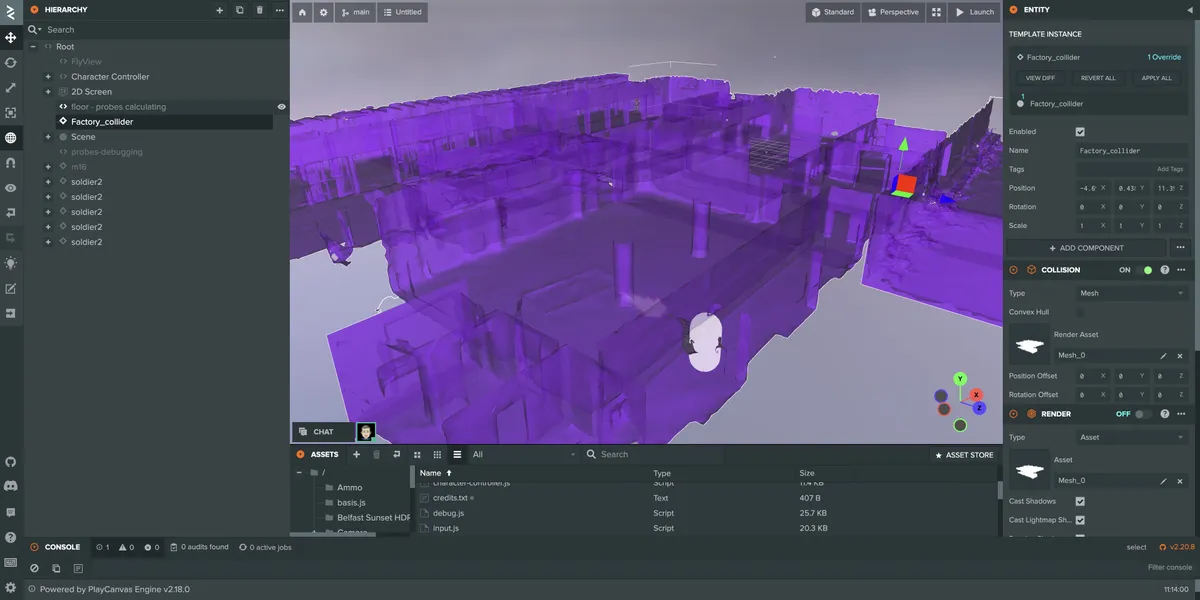
Now, you'll notice I said "visual" fidelity above, and therein lies the rub: Gaussian splats can't really be used for interactive media because they don't capture anything about the world except how it looks. Or can they? That's the real innovation of Sumygin's work: taking a pre-made scan of an abandoned building and running it through specialized tools (which he created) to voxelize the splats and create a collision mesh. Boom: workable 3D geometry for a video game.
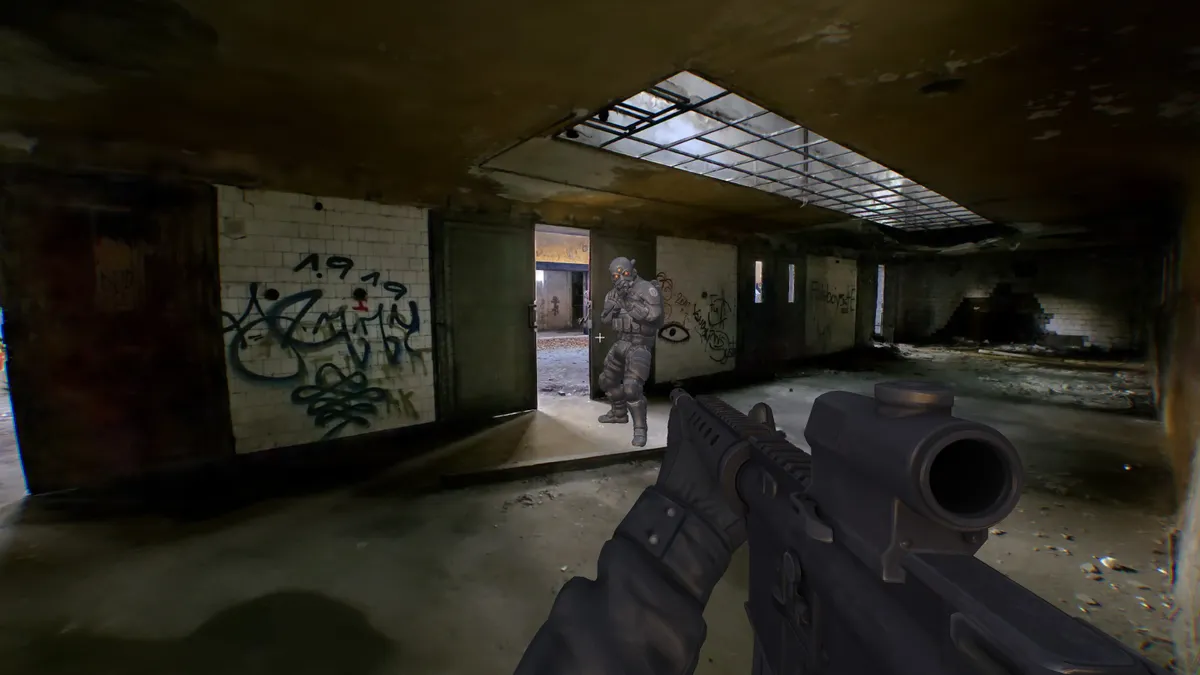
After that, he baked a lighting grid to apply lighting to the object and character models he imported to the project, vibe-coded a basic AI and pathfinding method for the enemy soldiers, and dropped the whole thing on PlayCanvas, which is a browser-based game engine platform owned by Snap, the company that Sumygin works for. (Yes, that's the SnapChat guys.)
Speaking as a gamer, the demo isn't particularly interesting as a video game. There's one clumsy-looking gun, one enemy model with very static animations, many bugs (my gun was eating more ammo per shot every time I reloaded it), and it's very easy to break, such as by falling through the world. I'm also not as taken with the visuals as some people seem to be. While it does indeed look convincingly photorealistic at points, fine detail is basically nil; in parts, it reminds me of Id Software's Rage, which had gorgeous graphics until you looked too closely at things. Frankly, Unreal Engine 5 projects like Unrecord and Bodycam do the same thing better.
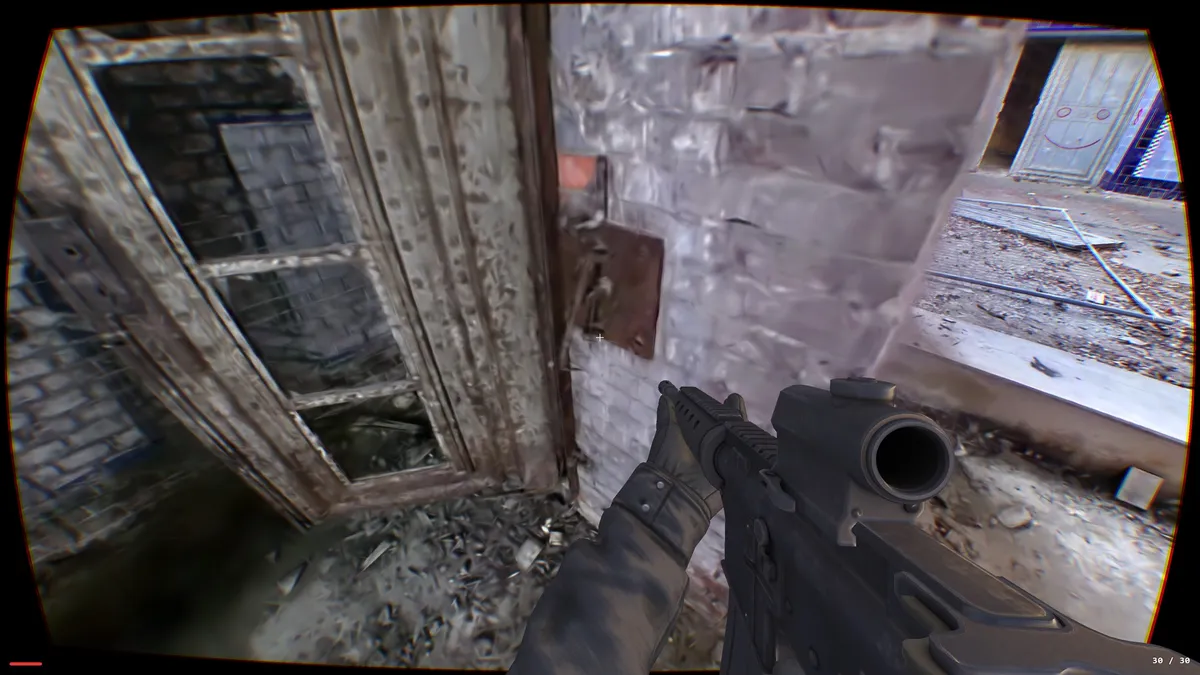
It's really what Sumygin's little game represents that is interesting, because Sumygin's project is completely fascinating from a technical perspective. He doesn't say how long it took him to make, but now that the tooling is done, it should be relatively straightforward and quick for anyone to 3D scan an environment and create a game with impressive visuals based in that environment. It's quite fascinating as a concept. Oh, and the whole project is under 100 megabytes, which is also quite impressive for the level of detail.
If you're a developer interested in the technique, Sumygin's project is completely open-source over on PlayCanvas, including the assets that he used. Frankly, the project is mostly an advertisement for his company's SuperSplat product, but it's an effective one, and it gives a tantalizing glimpse into what could be a very handy tool in the game developers' toolbox.
Follow Tom's Hardware on Google News, or add us as a preferred source, to get our latest news, analysis, & reviews in your feeds.
