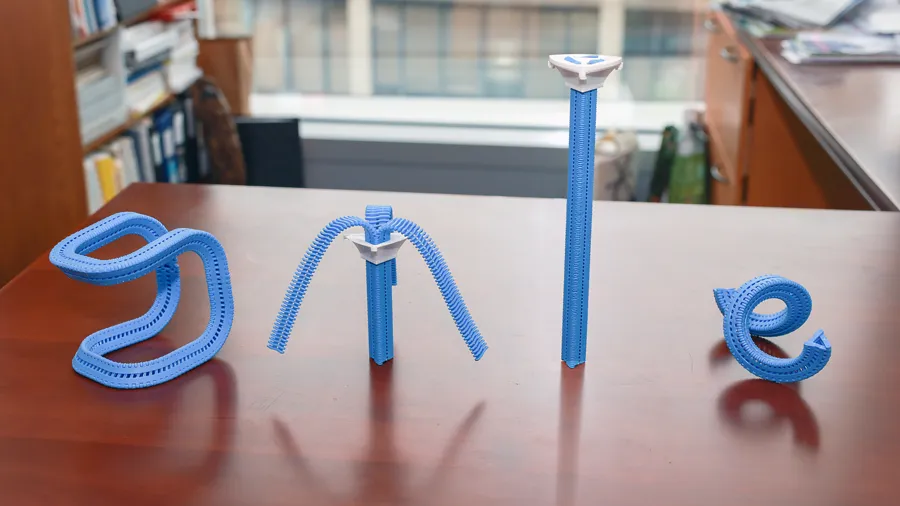
Researchers at MIT's Computer Science and Artificial Intelligence Laboratory have developed a three-sided zipper that transforms 3D-printed floppy structures into rigid, load-bearing forms in seconds. The mechanism, called the “Y-Zipper,” can rapidly assemble beams, arches, robotic limbs, and deployable frameworks — potentially opening the door to adaptive robots, fast-deploying shelters, and reconfigurable medical devices.
Unlike conventional zippers that connect two flat surfaces in 2D, the Y-Zipper joins three flexible arms into a rigid 3D triangular tube. When open or unzipped, the structure behaves like soft plastic strips or floppy tentacles, with each arm flexing and twisting independently. Once zipped shut with a custom slider, however, the arms interlock to form a stiff, beam-like structure capable of supporting loads.