In his first ever official letter addressed to Catholic bishops, Pope Leo XIV compared irresponsible use of AI to the Tower of Babel, and urged everyone to instead “build the city in which God and humanity dwell together.” That analogy must have hit really hard in Japan, where people know that, indeed, the Tower of Babel IS the opposite of a city blessed by God. Because back in the 1990s, the idea to construct such a massive building — right in the middle of Tokyo — was actually floated. And somehow, the proposed structure was even more unholy.
This is the insane story of the proposed 10-kilometer-high (6.2 miles) Tokyo Tower of Babel vertical city. And, yes, that was its actual name, and it’s probably the least crazy detail about the whole thing.
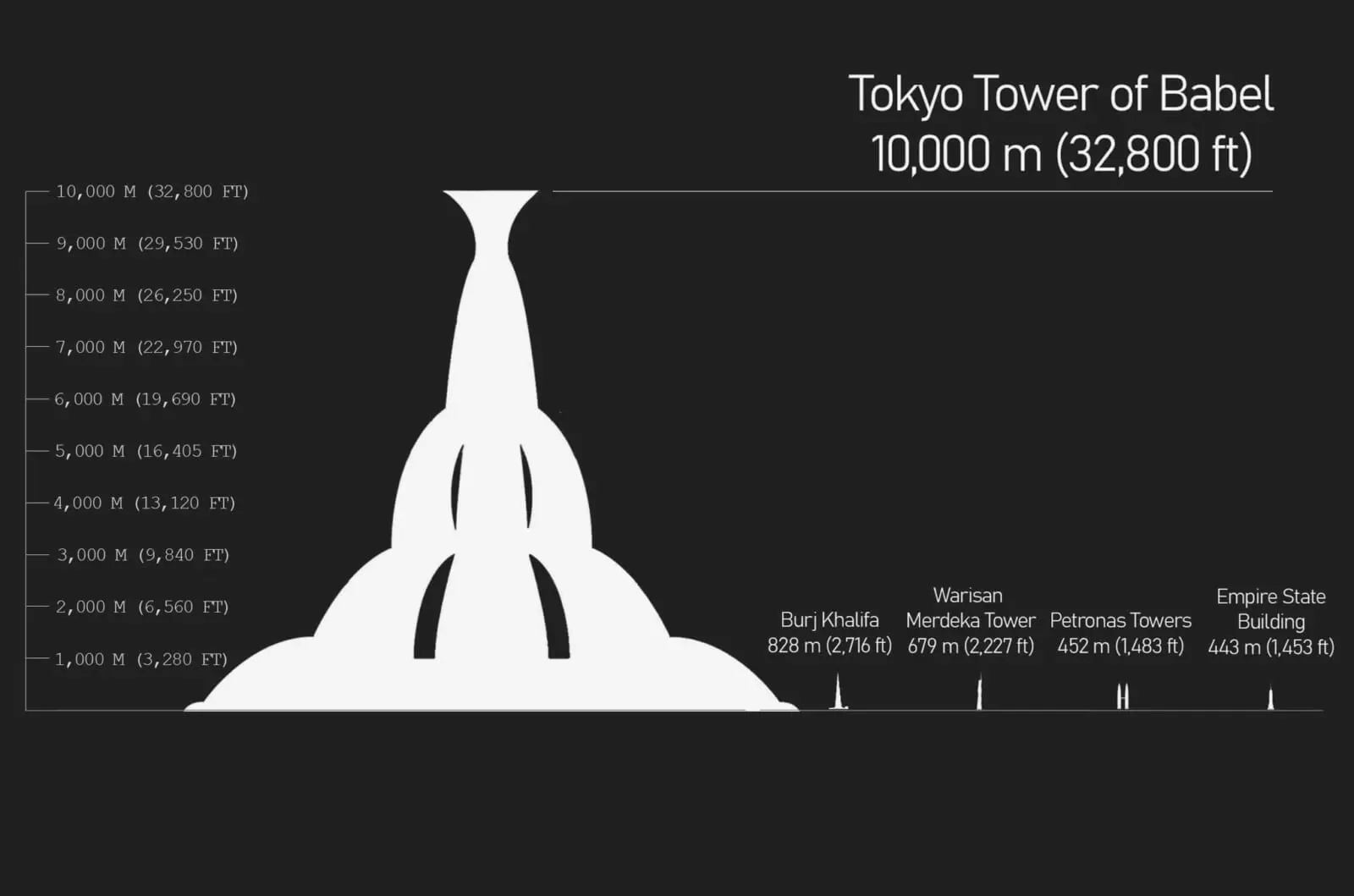
Height of the Babel Tower compared to the world’s tallest landmarks
Architecture With Way Too Many Zeroes in It
When we said that the Tokyo Tower of Babel was meant to be built “in the middle of Tokyo,” that perhaps wasn’t exactly accurate. The tower was actually meant to replace Tokyo, housing 30 million people in one gargantuan structure that would have been 12 times taller than Dubai’s Burj Khalifa, the current tallest structure in the world. Hell, it would have been taller than Mount Everest.
The brainchild of Dr. Toshio Ojima, an architect, environmental engineer and urban scientist at Waseda University, the proposed arcology — the proper name for megastructures meant to curb urban sprawl — would have taken anywhere from 100 to 150 years to build. The estimated cost in 1991, the year Ojima made his proposal? A mere ¥3,000,000,000,000,000 — that’s ¥3 quadrillion.
Adjusted for 2026, it would be approximately ¥3.6 quadrillion, or 23 trillion USD, or about 5% of all the wealth on the planet. Not just physical money, not cash plus deposits, but 1/20th of EVERYTHING: banknotes, coins, cars, real estate, art, etc. A lot of that would go into the 10 billion tons of steel needed to build the monstrous tower. But with an estimated lifespan of 1,000 years, that’s almost a bargain.
On the ground, the Tokyo Tower of Babel would have taken up about 110 million square meters, and Ojima had even come up with the perfect place for it — centered smack-dab in the middle of the JR Yamanote Line loop that connects all of Tokyo’s most popular stations. That massive chunk of the capital, including Akihabara, Shinjuku, Shibuya, Yotsuya, Ebisu and basically everything we now think of as “Tokyo” would have had to be vacated and demolished just to construct the base of the tower. Then the really crazy stuff would begin.
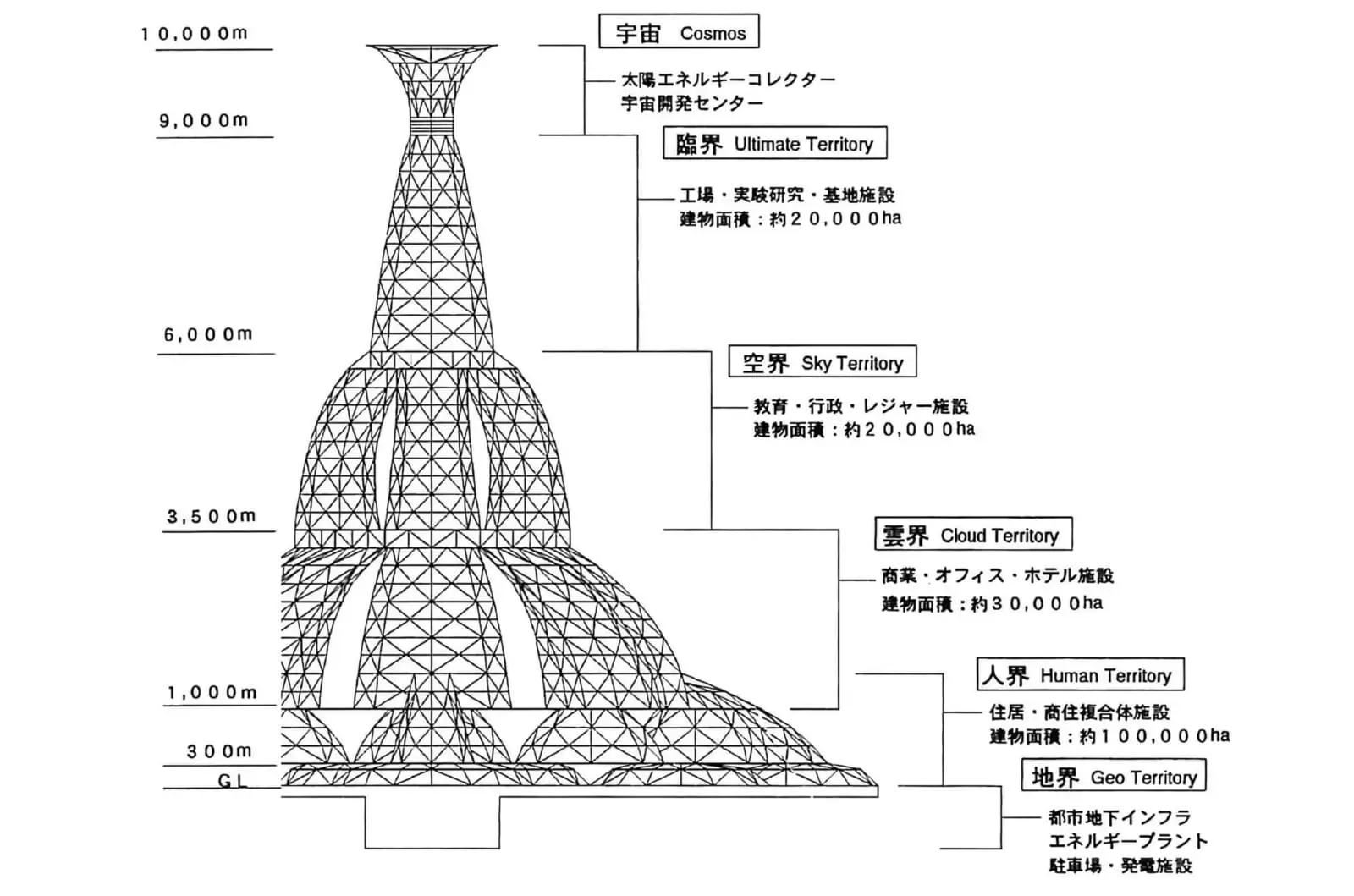
Heights and names of the proposed Babel Tower “territories”
A Dystopian Nightmare Waiting To Happen
If constructed, the Tokyo Tower of Babel would have about 1,969 floors, divided into “territories.” The underground Geo Territory would house power plants, parking, utilities and other crucial infrastructure. The first kilometer of the tower would be the Human Territory, where most of the population would live. It would be a mixed-use commercial zone — because it is Japan after all, where residential areas often have little shops operating out of the ground floors of private houses, home to the country’s best cafes and bakeries.
Between the top end of the Human Territory and the 9-kilometer mark, you’d have the Cloud, Sky and Ultimate territories, occupied by commercial and corporate facilities, government and administrative offices and factories — proving that for all of Ojima’s vision, he has apparently never read a sci-fi story where the rich and powerful lived physically in the clouds above regular people like in Elysium or Battle Angel Alita.
Things would only get more dystopian near the top, in the Cosmos Territory. Dedicated to collecting solar energy and aerospace activities, that part would almost touch the stratosphere. The air pressure would be roughly 1/4th that at sea level while the temperatures would be a brisk minus 50 C to minus 55 C (minus 58 F to minus 67 F), with violent winds and extremely thin oxygen. Ojima noted that Cosmos would require aircraft-grade pressurization and jetliner-level insulation. A fitting comparison, since the top of the building would be in the path of commercial airliners.
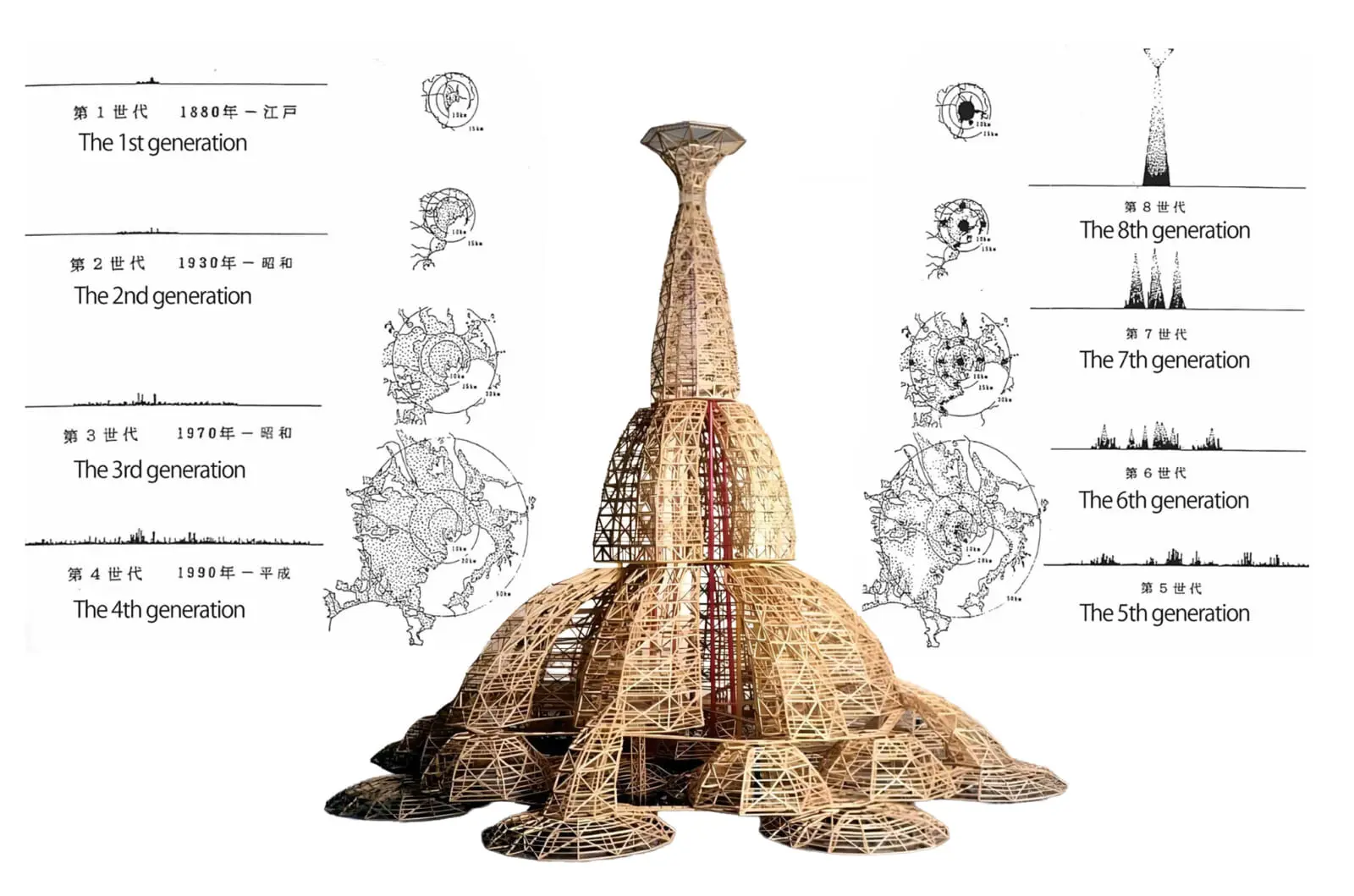
The 8 proposed stages of construction over the Tokyo area (illustrated) with architectural model (Waseda University Archives)
A Beautiful Dream
The idea for the Tokyo Tower of Babel was presented at the 1992 Rio Earth Summit in Brazil, although Ojima had first conceived it during the 1980s. This helps us understand his intentions better. When he first came up with the idea, Japan’s economy was still booming, buildings were getting bigger, science was progressing at the speed of light and the Japanese population was rising.
The important thing to remember about Ojima is that he isn’t some theoretical cyberpunk illustrator (the actual look of the Tokyo Tower of Babel was the creation of artist-slash-designer Masaki Yabuno). In the 80s, he was a logarithmic thinker. According to his calculations, by 2020, the population of Tokyo would outgrow the confines of the city, and he was looking for a solution to the upcoming problem. His vision did involve a lot of hope and expectation about the advancements of material science and engineering, but he assumed that roughly 40 years was enough time for science fiction to become just regular science. He was an optimist. A lot of people in the bubble era were.
In 2025, in an NHK segment, an 88-year-old Ojima reflected on the Tokyo Tower of Babel and concluded that, when it came down to it, he simply dreamed too big. The tower would be impossible now. It will probably be impossible for decades or centuries to come. But the bigger problem is that even if, by some miracle, we could build it, Japan no longer really has a need for it, what with the whole country currently struggling with the opposite of a rapidly growing population.
As for Ojima, he’s had a successful career, winning many awards and commendations, including The Architectural Institute of Japan Award and The Order of the Sacred Treasure. Plus, if someone shows his plans for the Tokyo Tower of Babel to Studio Ghibli, he might end up responsible for the greatest anime movie ever made, which would be a legacy equivalent to a 10-kilometer-high building, only real.