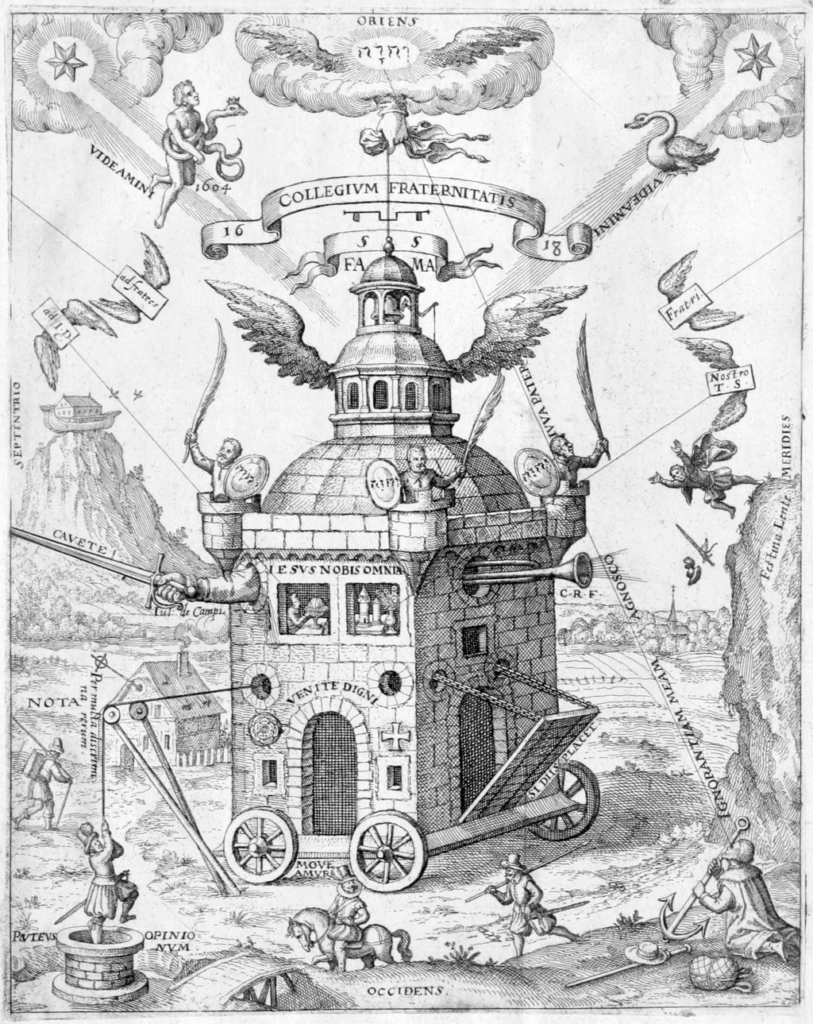
Theophilus Schweighardt, The Temple of the Rose Cross, 1618, via Wikimedia Commons. Public domain.

Over a period of several years in the early seventeenth century, there appeared in Western Europe three manifestos laying out the history of the theretofore unheard-of Rosicrucian order, whose secret directorate was said to employ powerful magical-scientific techniques in service to sociopolitical reform. This naturally led to quite a bit of public speculation, which gradually abated in the absence of further pronouncements; within a few generations the only parties ascribing any significance to the incident tended to be dubious characters claiming to be Rosicrucians themselves, rarely with much to show for it. Thus, as a result of its gradual association with cranks, the Rosicrucian story developed a kind of inoculation against serious scrutiny.
It wasn’t until the sixties that the British historian Dame Frances A. Yates breached the actual nature and extent of the thought movement that informed both the manifestos and its audience. In her book The Rosicrucian Enlightenment, she demonstrates that the texts were written as anti-Hapsburg, proreformist propaganda drawing on doctrines associated with the sixteenth-century philosopher Francis Bacon, and that this was understood by commentators on both sides; that the surreal “alchemical wedding” described therein references the 1613 marriage of England’s Elizabeth Stuart and Frederick V of the Palatinate, widely heralded as the linchpin of a proto-Protestant alliance capable of establishing such reform by force; that the broader proposals were indeed taken seriously by scholars, not as scripture but rather as a set of visionary policy proposals dressed in metaphor, akin to Bacon’s The New Atlantis; and that enthusiasts such as Elias Ashmole would directly implement those proposals by founding the Royal Society, establishing the primacy of science. Rather than being a footnote to premodern folly, the Rosicrucian affair turns out to sit at the narrative center of the modern world.
There’s a lesson here that bears attention today, at the apparent twilight of the same modern world, when the fundamental problem we face involves the degree to which the truth must now compete with such a vast multiplicity of falsehoods that discovering truth itself becomes unviable. Consider that so much of consequence to our own heritage should have been so misunderstood for as long as the Rosicrucian manifestos; it seems that crucial facts can be effectively concealed from serious attention simply by being visibly subject to the unserious sort. Such facts are gradually imbued with a sort of de facto defense mechanism against scrutiny, whereby the mere act of taking an interest in them serves to discredit professional researchers and journalists.
***
Casaubon, the protagonist-narrator of Umberto Eco’s 1988 novel Foucault’s Pendulum, is mindful of this dynamic as he explains his academic focus to a new acquaintance, an editor called Belbo:
“I’m finishing a thesis on the Templars.”
“What an awful subject,” [Belbo] said. “I thought that was for lunatics.”
“No. I’m studying the real stuff. The documents of the trial. What do you know about the Templars, anyway?”
“I work for a publishing company. We deal with both lunatics and nonlunatics. After a while an editor can pick out the lunatics right away. If somebody brings up the Templars, he’s almost always a lunatic.”
Casaubon proves himself scholarly and sane, so Belbo hires him at Garamond Press to evaluate incoming manuscripts dealing with the Templars. Each turns out to rely on the same tradition, wherein the chivalric order’s sudden liquidation by the king of France in the fourteenth century was perpetrated on the grounds that it had stumbled upon some esoteric secret that its chief officers refused to share. The arguments presented for this interpretation comprise a smorgasbord of commonplace logical fallacies; being neither scholarly nor original, the resulting manuscripts are of no use to a credible publishing house.
Fortunately, Signor Garamond quietly presides over a less credible publishing house, which caters exclusively to “self-financed authors” conned into underwriting their own work by way of the mundane conspiracy of flattery and gaslighting. With such things as revisionist history and Hermeticism having come into noticeable vogue across Western Europe, bookstores once specializing in Marxist materialism teemed with volumes on psychic healing—and much else besides, for the seeker of hidden truths turns out to be lucratively catholic in appetite. “Sure, the Templars, too, and cabala, and the lottery, and tea leaves,” intones Garamond. “They’re omnivorous. Omnivorous.”
Eco paints in loving detail the ecosystem of counterestablishment narrative as it existed in the second half of the twentieth century—the wealthy enthusiasts, desperate seekers, failed revolutionaries, con men, police informants, and endless combinations thereof. In contrast, our publishing-industry protagonists are too worldly to believe in anything at all. Embarrassed at having nonetheless once bought into the particular enthusiasm of the revolutionary left, they’re also sporadically ridden with guilt over having not done more in its service. Incoming manuscripts become grist for a cathartic literary game wherein Belbo and company affect to explain history as mere byproduct of a thousand-year factional struggle to reproduce the Templar secret. Parody gives way to pride of creation and thereafter to paranoia, which itself turns out to be wholly justified when a powerful network of Hermetic eccentrics decide that our nihilist curators have in fact discovered a secret worth killing over. Seeming absurdity is no guard against human reality.
Eco the novelist was unusually preoccupied with the dynamics surrounding conspiracies; Eco the medievalist scholar and semiotician was unusually qualified to explore these issues. In The Prague Cemetery (2010), he takes up the themes and imagery of Alexandre Dumas’s novel Joseph Balsamo, which itself famously begins with an induction into a militant anticlerical branch of Freemasons in the picturesque setting of a Prague cemetery. Expanding on themes present in Pendulum, Cemetery explores the role played by the Russian czarist intelligence apparatus in fomenting modern anti-Semitism by publishing the fraudulent pamphlet The Protocols of the Elders of Zion. In his capacity as a philologist who named our friend Casaubon after the founder of that discipline, Eco is also well equipped to debunk this early example of state-sponsored disinformation by tracking its origins; though commonly mischaracterized as outright “forgery,” it is in fact an adaptation of a nineteenth-century French political parody directed at Napoléon III.
Eco’s most commercially successful venture into humanity’s rich tapestry of myth and error remains the 1980 bestseller The Name of the Rose, which is set against the fruitful backdrop of scheme-crowded fifteenth-century papal politics. This time our protagonist is a protoscientific visionary in the tradition of Bacon: William of Baskerville, a Franciscan friar of questionable orthodoxy whose mission to broker an end to the multifaceted religio-politico conflict facing Europe is complicated by a series of murders with symbolic overtones. William is not merely an homage to Sherlock Holmes and the triumph of empiricism; like the criminal profiler who inhabits both the fact and fiction of our own day, he is deeply conversant with the vast phantasmagoria of myth and reality that informs the thought-world of the age. Thus he is equipped to counter what turns out to be a reactionary conspiracy against progress and civilization for much the same reasons that our contemporary commentator class is not: he is guided by empiricism and scholarship rather than unexamined consensus, and he is entirely unburdened by the arbitrary and deeply unempirical pseudoconcept of the “conspiracy theory.”
***
One searches the record in vain for any public appearance of the term conspiracy theory prior to the sixties. Even as mere shorthand denoting a sociopolitical premise already proven false via some coherent investigatory process, neither the phrase nor the concept had found any use among intellectuals of the prior generation, perhaps on the grounds that no such process existed. More precise language was available, such that we find George Orwell characterizing the official narrative from the Soviet show trials to be “incredible as a genuine conspiracy.” It’s a phrase that carries with it an explicit reminder that genuine conspiracies may be found elsewhere (and here, since Stalin’s crackdown was at root a conspiracy to consolidate power). Contrast this with the neologism conspiracy theory, which by usage has come to convey a decidedly more implicit message to the opposite effect.
To fully appreciate the lessons of Numero Zero, the last novel Eco published before his death, we must first pin down what exactly our contemporary political and cultural commentators mean when they deploy this term that earlier generations seem to have managed without. In theory this should be easy enough, given that dozens of articles have appeared over the past quarter century in such culturally representative outlets as The Atlantic and The New Republic, and indeed the bulk of the middlebrow press, declaring that conspiracy theories are on the rise and purporting to explain why. The difficulty we face is that none of these articles goes so far as to define the term, but this may prove a useful indication that no definition is considered necessary. Like justice or pornography, we’ll know it when we see it; failing that, we’ll know it when it’s pointed out to us by the same outlets that championed the case for the Iraq War based on claims that presumably don’t qualify as conspiracy theories. This is very reassuring.
In the absence of definitions, we must rely on examples. Writing for The Atlantic, the editor Adrienne LaFrance provides several in her 2015 article “Going Online in the Age of Conspiracy Theories”:
When you start looking for conspiracy theories online, they seem to be everywhere. Dave Matthews, Nostradamus, Donald Trump, and the typeface Wingdings all predicted 9/11, according to various websites. Elsewhere, you’ll find reports that America is on the brink of a second civil war, and that Elvis and Michael Jackson are still alive.
Seeing as how the latter two are every bit as dead as competent magazine prose, conspiracy theories would appear to be very silly things indeed. Those “reports that America is on the brink of a second civil war” seem not to have panned out either, which is why we may safely disregard The Atlantic’s own December 2019 special issue on “How to Stop a Civil War,” along with the former secretary of labor Robert Reich’s 2022 Guardian op-ed, “The Second American Civil War is Already Happening.” It might also be useful to ask why such a prospect ought to have been short-listed as a prime example of a conspiracy theory to begin with, rather than merely a prediction that struck the establishment as outlandish irrelevancy in 2015 and fait accompli just a few years later.
Here we have another clue, as a remarkable number of examples cited by The Atlantic and sources of the same ilk seem untethered to any discernible definition of conspiracy whatsoever, which certainly bodes ill for the utility of a concept purporting to delineate the legitimacy of such things. The article opens by recounting the circulation of a photo after 9/11, which appeared to show a tourist on the observation deck of the World Trade Center with an airliner headed right toward him. The Atlantic notes that “the photo was doctored, a digital joke made by the man pictured,” but fails to explain how this relates to the subject of conspiracies, theories, or anything at all.
If the concept of conspiracy has already been lost to the forces of vagueness, perhaps theory can still be salvaged. Theories gain credibility largely as a function of their usefulness in making predictions. Each dismissal of a given conspiracy theory, meanwhile, contains within it the implicit prediction that the debunked notion will not later be proclaimed as fact by the same outlet. That The Atlantic has already failed this test on the U.S. civil war question is understandable; every other major outlet in the English-speaking world fares just as poorly when subjected to basic scrutiny.
In 2012, the New York Times dismissed as conspiracy theorists those who claimed that the recent hack of the Texas-based intelligence contracting firm Stratfor had been overseen by the FBI, perhaps through one of several undercover bureau assets it had just publicly admitted to having run the whole operation. In 2024, the New York Times described the very same incident as having been “organized by an F.B.I. informant.” A 2017 New Republic treatise on “conspiracy thinking” denounced author Sarah Kendzior for her paranoia regarding Trump: “For Kendzior, virtually every action taken by the Trump administration is evidence that we’re in the throes of an authoritarian takeover.” Silly Sarah should have waited a year and then sold the piece to The New Republic.
Our present-day establishment’s insistence that disinformation is a problem emanating chiefly from outside the channels of officialdom would have proved unintelligible to any competent observer of Orwell’s time, when the U.S. Department of War produced a film so thoroughly pro-Soviet that Stalin had it played in Moscow theaters while elsewhere U.S. troops were tasked with destroying translations of Animal Farm bound for Ukraine. By 1948, a citizen of either the U.S. or the USSR who continued to voice the same propaganda upon which their respective governments had insisted for years prior was now at risk of persecution. It’s certainly possible that the relevant dynamics have changed so thoroughly as to make these sorts of considerations moot and justify the current press predilection for accepting official narratives. But to argue such a premise requires awareness of what our intelligence services have gradually admitted regarding their respective past conduct and capabilities, as well as what’s been revealed by leaks, document thefts, and oversight bodies like the Church Commission and the House Select Committee on Assassinations.
Numero Zero takes us back to the thematically fertile world of Italian arts and letters and avarice, set this time in the early nineties. The protagonist, Colonna, is an aging journalist relieved to have found work at a tabloid. An informant regales him with outlandish claims regarding the hidden history of postwar Italy, alleging a campaign of false-flag attacks, contract killings, and rigged elections overseen by the CIA and carried out by a Freemason lodge made up of Italian Fascist holdovers. In what will strike most contemporary English-language media professionals as a surreal twist, Colonna investigates these allegations, which turn out to be substantiated. Colonna is unsure of how to proceed until he learns that the conspiracy in question is already public, the subject of occasional television documentaries. It is called Operation Gladio, and like a variety of other conspiracies against the foundations of democracy, it could safely be made public after the fact without fear of consequences for any involved; thus assured of the same immunity, the next generation of conspirators study the relevant past and improve on their craft, encouraged by the knowledge that the press will do neither.
In 2010, in an article for Rolling Stone, the journalist Michael Hastings deemed the war in Afghanistan unwinnable and reported comments from General Stanley McChrystal that made clear his lack of interest in civilian command. The day after the article’s publication, McChrystal resigned. In 2011, Hastings returned to Afghanistan. This time, he revealed an illegal army campaign that utilized advanced psychological operations techniques to persuade visiting U.S. senators to continue supporting the war. His story was picked up by outlets such as the BBC, which expanded on it in an article that uses the term “psy-ops” throughout.
In 2023, the BBC senior reporter Shayan Sardarizadeh included psyops in a short list of “phrases previously only uttered by fringe conspiracy theorists,” but which had “become sadly mainstream during [Israel’s war in Gaza].”
Hastings himself died in 2013 in a single-vehicle accident in LA a few days after informing his editors at Buzzfeed that the FBI was interviewing his acquaintances—something the bureau denied until documents to the contrary began appearing months later. He’d also expressed concern to a neighbor that his car had been tampered with. A decade later, as the BBC suggested to the world that its own prior journalism was “fringe,” Joseph Flynn—brother of General Michael Flynn, who once plotted to kidnap a Turkish opposition leader from Pennsylvania, and whom some researchers believe to be behind QAnon—finally remarked publicly on the incident in two tweets that he later deleted: “Michael H had some problems with his car that night . . . . Too bad . . . so sad,” and “Spontaneous combustion? Tragic. . Doncha think #HorsepasteJimmy . . . he had a bad day. Poor guy he was so young.”
For a generation presiding over decline, it is appropriate to look to the past for insight and to look to the future with modesty and care. Hastings is not my only friend and colleague to have died under circumstances deemed suspicious even by a press that grows ever less curious about such issues. In 2022, a Vice article about the death of Val Broeksmit, an FBI asset and a witness in Adam Schiff’s investigation into Trump’s dealings with Deutsche Bank, was titled, “Val Broeksmit, Deutsche Bank, and the Birth of a New Conspiracy Theory.” When the FBI raided Mar-a-Lago a few months later in search of classified documents taken by Trump from the White House, a photo emerged of a box marked as evidence. Inside was a full-page New York Times article about Val Broeksmit, in which he’s dismissed as a conspiracy theorist.
Wherever we’re headed, the public won’t know until we get there, and perhaps not even then. The bulk of the press has failed not merely to alert the public to the threats of fascism; it increasingly punishes those who might succeed in doing so. It’s fortunate for Eco that he published his famous essay “Ur-Fascism” in Italy in 1995 rather than the United States in 2017.
Barrett Brown is an investigative journalist, media critic, and anarchist activist. In 2015, he won the National Magazine Award for commentary for his monthly literary column The Barrett Brown Review of Arts and Letters in Prison. He is the author of the memoir My Glorious Defeats.