EU-India deal 'accelerated with gusto' over past six months amid Trump's tariff threats - snap analysis
Hannah Ellis-Petersen
South Asia correspondent
in New Delhi
India, the world’s largest country with a population of 1.4 billion, is also one of the world’s fastest-growing economies and is on track to become its fourth-largest economy this year, according to the International Monetary Fund.
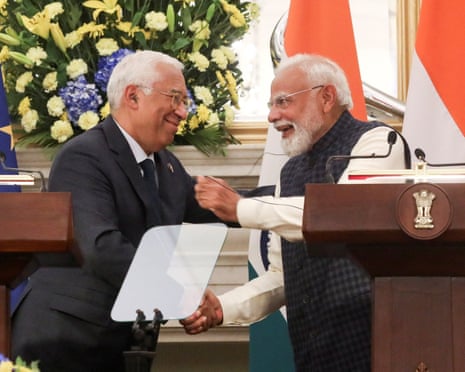
Indian prime minister Narendra Modi and European Council president Antonio Costa shake hands during a joint press statement at the Hyderabad House in New Delhi, India. Photograph: Altaf Hussain/Reuters
The deal is one of the most comprehensive that India has ever signed and Narendra Modi emphasised that it represented about a third of global trade, calling it the “biggest free trade deal in history”.
“This agreement has brought massive opportunities for 1.4 billion Indians and millions of people in European countries,” he said. “It has become a wonderful example of synergy between two of the world’s major economies.”
Trade talks between the two countries began as far back as 2007 but were abandoned owing to disputes over access to cars, agriculture and dairy.
However, they were resumed again in 2022 and accelerated with gusto over the past six months in the face of heavy punitive tariffs by Donald Trump’s administration in the US and joint concerns over China’s monopoly over global manufacturing and the country’s restrictions on key exports.
According to officials, the formal signing of the deal will take place later this year and it could come into play by early next year.
India and the EU have finalised a landmark free trade agreement, which the European Commission president, Ursula von der Leyen, hailed as the “mother of all deals” (9:36, 9:43, 9:52).
The deal is expected to open up India’s vast and traditionally tightly guarded market to the 27 nations in the bloc, with a focus on manufacturing and the services sector (12:40).
Talks about the agreement accelerated with gusto over the past six months (10:13) in the face of heavy punitive tariffs by Trump’s administration in the US and joint concerns over China’s monopoly over global manufacturing (10:44).
In other news,
Europe has marked the International Holocaust Remembrance Day (16:59).
The prime ministers of Denmark and Greenland said they would visit Berlin and Paris today and tomorrow to shore up support over US president Donald Trump’s recent push to take over the Arctic island (11:09, 15:41, 16:30).
A unit of US immigration and customs enforcement agents (ICE) will have a security role in the upcoming Winter Olympic Games in Italy, sparking uproar and petitions against the deployment (11:56, 15:13).
And that’s all from me, Jakub Krupa, for today.
If you have any tips, comments or suggestions, email me at jakub.krupa@theguardian.com.
I am also on Bluesky at @jakubkrupa.bsky.social and on X at @jakubkrupa.
Europe marks International Holocaust Remembrance Day
Holocaust survivors, politicians and regular people commemorated International Holocaust Remembrance Day gathering at events held across Europe to reflect on Nazi Germany’s killing of millions of people, AP reported.
A man leaves a pebble at the Victims’ Wall of the Holocaust Memorial Centre during a memorial service in Budapest, Hungary. Photograph: Tamas Purger/EPA
International Holocaust Remembrance Day is observed across the world on 27 January, the anniversary of the liberation of Auschwitz-Birkenau, the most notorious of the Nazi German death camps. The UN general assembly adopted a resolution in 2005 establishing the day as an annual commemoration.
At the memorial site of Auschwitz, located in an area of southern Poland which was under German occupation during the second world war, former prisoners laid flowers and wreaths at a wall where German forces executed thousands of prisoners.
Nazi German forces killed some 1.1 million people at Auschwitz, most of them Jews, but also Poles, Roma and others.
President of the Polish Association of Former Political Prisoners of Nazi Prisons and Concentration Camps, former Auschwitz prisoner Stanisław Zalewski, during a wreath-laying ceremony with former camp prisoners at the Death Wall on the grounds of the former Auschwitz camp in Oświęcim, Poland. Photograph: Jarek Praszkiewicz/EPA
People attend a flower-laying ceremony at the Kindertransport Monument in Gdańsk, Poland. Photograph: Adam Warżawa/EPA
Candles burned and white roses were placed at the Memorial to the Murdered Jews of Europe, a field of 2,700 gray concrete slabs near the Brandenburg Gate in the heart of Berlin, which honors the 6 million victims and stands as a powerful symbol of Germany’s remorse.
Visitors enter the Hall of Names at the Yad Vashem Holocaust Memorial Museum during International Holocaust Remembrance Day in Jerusalem, Israel. Photograph: Abir Sultan/EPA
Other events took also place across Europe.
British prime minister Keir Starmer (R) greets holocaust survivor Mala Tribich (L) as she arrives to address the weekly Government cabinet meeting at Downing Street in London, Britain. Photograph: Neil Hall/EPA
Hungarian Hassidic Jewish religious leader and head of the Hungarian Chabad-Lubavitch movement Rabbi Baruch Oberlander, President of the Federation of Jewish Communities in Hungary (Mazsihisz) Andor Grosz, Israel’s ambassador to Hungary Maya Kadosh, and Hungarian Minister heading the prime minister’s office Gergely Gulyas attend a memorial service at the Victims’ Wall of the Holocaust Memorial Centre in Budapest, Hungary. Photograph: Tamas Purger/EPA
White roses placed on a concrete slab of the Holocaust memorial to mark the International Holocaust Memorial Day in Berlin, Germany. Photograph: Markus Schreiber/AP
There are an estimated 196,600 Jewish Holocaust survivors still alive globally, down from 220,000 a year earlier, according to information published last week by the New York-based Conference on Jewish Material Claims Against Germany. Their median age is 87, and nearly all – some 97% – are “child survivors” who were born 1928 and later, the group said.
Macron to 'reaffirm solidarity and support' for Denmark, Greenland in meeting with PMs on Wednesday
Meanwhile, the Élysée Palace has said that France’s Emmanuel Macron will “reaffirm European solidarity and France’s support for Denmark, Greenland, their sovereignty and their territorial integrity” during his meeting with the two prime ministers tomorrow, AFP reported.
The three leaders will discuss “security issues in the Arctic and the economic and social development of Greenland, which France and the European Union are ready to support”, Macron’s office said.
I bet we will also get some pictures from their visit tomorrow, fo-shur.
How Trump’s push for Greenland spooked far-right allies - analysis
Jon Henley
Europe correspondent
Donald Trump’s attempted Greenland grab has driven a wedge between the US president and some of his ideological allies in Europe, as previously unstinting enthusiasm and admiration collides with one of the far right’s key tenets: national sovereignty.
US president Donald Trump speaks at an event last year. Photograph: Kevin Lamarque/Reuters
The US president last week stepped away from his drive to seize Greenland, pledging he would not take it by force or impose tariffs on nations opposing him. Faced with a fierce backlash, he also appeared to walk back his swipe at non-US Nato troops.
But for radical-right populists – who lead or support governments in a third of the EU’s member states, are vying for power in others, and who saw in Trump a powerful ally for their nation-first, anti-immigration, EU-critical cause – he is increasingly a liability.
Polling published on Tuesday by the Paris-based European affairs debate platform Le Grand Continent suggested that between 18% and 25% of far-right voters in France, Germany, Italy and Spain consider Trump as an “enemy of Europe”.
Asked to define his foreign policy, between 29% and 40% of supporters of the National Rally (RN), Alternative für Deutschland (AfD), Brothers of Italy (FdI) and Vox parties chose “recolonisation and the predation of global resources”.
Perhaps most remarkably, between 30% and 49% of voters for far-right parties in the four countries said that if tensions with the US over Greenland were to increase further, they would support the deployment of European troops to the territory.
Trump’s expansionism, and his willingness to use economic clout to achieve it, puts Europe’s far right in a tough position. Leaders in France, Germany and Italy have all criticised his plans, some sounding very like the mainstream politicians they despise.
Danish, Greenlandic prime ministers in Berlin for talks on Greenland, Arctic security
As mentioned earlier, Danish and Greenlandic prime ministers are on the tour of European capitals as they shore up the support for the territory amid Donald Trump’s interest.
Here they are in Berlin this afternoon and will be in Paris tomorrow.
Greenlandic and Danish prime ministers meet with German chancellor Friedrich Merz. Photograph: German Federal Government/JESCO DENZEL HANDOUT/EPA
And speaking of Trump’s imperial plans, there’s perhaps something to be said there about the effect it’s having even on some of his European allies…
Over to Jon Henley for more.
Uproar in Italy over ICE security role at Winter Olympics
Angela Giuffrida
in Rome
A unit of US immigration and customs enforcement agents (ICE) will have a security role in the upcoming Winter Olympic Games in Italy, sparking uproar and petitions against the deployment (11:56).
Milan's mayor Giuseppe Sala said US ICE agents would not be welcome in the city during the upcoming Olympic Games. Photograph: Gregorio Borgia/AP
Sources at the US embassy in Rome confirmed a statement from ICE, the agency embroiled in a brutal immigration crackdown in the US, saying that federal agents would support diplomatic security details during the Milan-Cortina games but would not run any enforcement operations.
The daily newspaper La Repubblica claimedItaly’s far-right government, which has nurtured friendly relations with Donald Trump’s administration, had briefly looked into blocking the participation of ICE agents in the delegation, but that would have required a departure from how US officials are usually protected during similar high-profile visits abroad.
Milan’s mayor, Giuseppe Sala, told RTL radio that the agents would not be welcome in the city “because they don’t guarantee they’re aligned with our democratic security management methods”.
“This is a militia that kills,” he said. “It’s clear that they are not welcome in Milan, there’s no doubt about it. Can’t we just say no to Trump for once?
We can take care of their security ourselves. We don’t need ICE.
Alessandro Zan, a member of the European parliament for the centre-left Democratic party, said the presence of ICE agents would be unacceptable.
State oil and gas firm says Russian strike target facility in western Ukraine
Amidst what Nato secretary general Mark Rutte has described as the “harshest winter” that Ukraine has faced in over a decade, Ukrainian state oil and gas firm Naftogaz said on Tuesday that a Russian strike on one of its facilities in the western region forced specialists to halt operations.
Naftogaz CEO Sergii Korteskyi wrote on Facebook that this was the 15th targeted shelling of Naftogaz infrastructure this month.
War correspondent and executive director of war crimes unit the Reckoning Project, Janine di Giovanni, has suggested that Russian president Vladimir Putin is intentionally “weaponising the savage eastern European winter”.
Spain to grant legal status to thousands of immigrants living and working in country without authorisation
In a surprise move, Spain’s government announced Tuesday that it will grant legal status to potentially hundreds of thousands of immigrants living and working in the country without authorisation, the Associated Press reports.
Spain’s minister of migration, Elma Saiz, said her government will amend existing immigration laws by expedited decree to grant immigrants who arrived in Spain before Dec. 31, 2025 legal residency of up to one year as well as permission to work.
According to the estimates from different organisations, the move could benefit between 500,000 and 800,000 people. Many are Latin American or African immigrants working in the agricultural, tourism or service sectors.
“Today is a historic day,” Saiz said at a news conference.
Iran summons Italian ambassador over EU terrorist register efforts
Iranian state media is reporting that Iran’s foreign ministry has summoned Italy’s ambassador over Rome’s efforts to place the Revolutionary Guards on the European Union’s terrorist register, according to Reuters.
Iran’s foreign ministry called upon the Italian foreign minister to “correct his ill-considered approaches toward Iran” and warned of the “destructive consequences” of any labelling against the Revolutionary Guards.
Finland hails 'historic' EU agreement with India
Finnish president Alexander Stubb is the latest European leader to welcome the new EU-India trade deal confirmed this morning.
He said it was a “historic” agreement, and will “further intensify our economic and political ties with India.”
“In these times, it is important for both the EU and Finland to strengthen partnerships all over the globe,” he added.
His comments come as Finland’s prime minister Petteri Orpo is in Beijing for separate talks with China, with Reuters noting that US president Donald Trump’s volatile foreign policy decisions and confrontational approach toward allies push European countries to diversify their foreign relations.
'Europeans can and must take charge of their security,' French foreign minister says in pushback to Rutte's comments
France has pushed back on Nato secretary general Mark Rutte’s suggestion that Europe is not in a position to defend itself without the US.
Speaking in the European parliament on Monday, Rutte said told EU lawmakers that if they thought the EU or Europe as whole could defend itself without the US, they should “keep on dreaming” (Europe Live, Monday).
In a rare public rebuke, French foreign minister Jean-Noël Barrot disagreed with him on X, stressing “Europeans can and must take charge of their own security.”
“Even the United States agrees. It is the European pillar of Nato,” he said.
The European Commission also slightly distanced itself from Rutte’s comments this afternoon, pointing to the EU’s commitment to “become increasingly resilient … and independent on various fronts,” including energy, critical raw materials, and security.
“We’re really pulling together a number of measures with one aim, which is … that we can all really, on various fronts, ensure such gradual independence,” commission chief spokesperson Paula Pinho said.
European Commission ready to defend its Russian energy imports phase out policy despite Slovak, Hungarian legal threat
The European Commission has just responded to the Slovak and Hungarian threat of legal action against its policy to phase out Russian gas imports (12:14).
Energy spokesperson Anna-Kaisa Itkonen told journalists at the daily midday briefing that the bloc’s objective “is never to end up in a situation where any of our member states legally challenge our legislation,” but to work with the member states instead.
But the countries can challenge the policy if they want to, and “we will be there to defend our position.”
“We really stand by the legislation, and there is solid legal work behind [it], so we are also very confident that we are in a position to defend the legislation that has been widely endorsed by the member states,” chief spokesperson Paula Pinho added.
Zelenskyy eyes 2027 for Ukraine's accession to European Union
Ukrainian president Volodymyr Zelenskyy has said he wanted to target 2027 for Ukraine’s accession to the European Union.
In a brief update after his phone call with Austrian chancellor Christian Stocker, Zelenskyy said that “Ukraine’s accession to the European Union is one of the key security guarantees not only for us, but also for all of Europe.”
“After all, Europe’s collective strength is possible, in particular, thanks to Ukraine’s security, technological, and economic contributions. That is why we are speaking about a concrete date – 2027 – and we count on partners’ support for our position,” he said.
Zelenskyy also said he spoke with Stocker about Ukraine’s struggle amid continuing Russian attacks on critical infrastructure.
In an earlier post, Zelenskyy said that almost 1,000 buildings in Kyiv were still left without heating this morning.