Red Cross 'outraged' as latest Israeli strikes kill at least 254 people in Lebanon
The Red Cross said it was “outraged by the devastating death and destruction” in densely populated areas across Lebanon as Israel launched a massive wave of attacks on Wednesday.
Heavy explosive weapons struck bustling neighbourhoods, including in Beirut, without effective advance warnings, the International Committee of the Red Cross said.
“Many who had begun thinking of the moment when they might return to their homes have been rushing to streets and hospitals, searching for missing loved ones or seeking a safety that feels increasingly out of reach,” said Agnes Dhur, the ICRC’s head of delegation in Lebanon.
Lebanon’s Civil Defence said at least 254 people were killed and 1,165 others were wounded in the attacks on Wednesday.
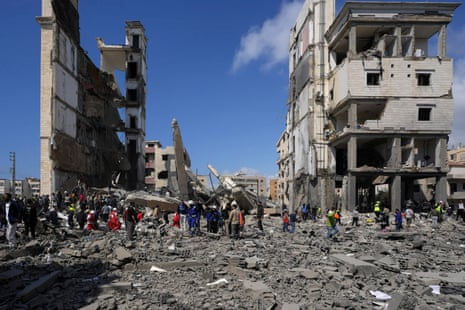
Here are some of the images from those Israeli strikes.
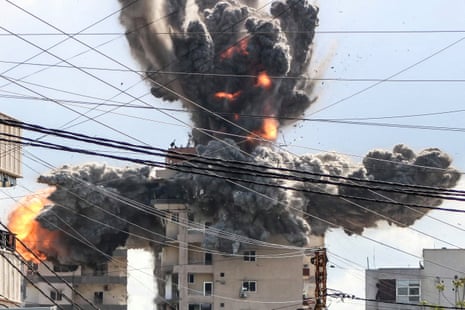
A fireball rises from a building hit by an Israeli airstrike in the area of Abbasiyeh, on the outskirts of the southern Lebanese city of Tyre. Photograph: AFP/Getty Images
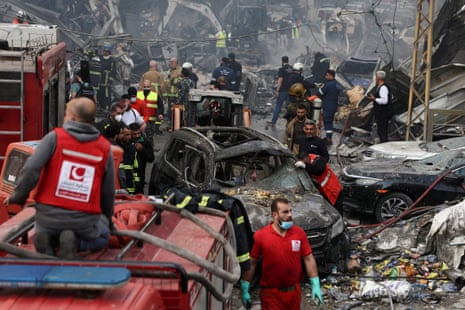
Emergency responders work at the site of an Israeli strike in al-Mazraa in Beirut. Photograph: Yara Nardi/Reuters
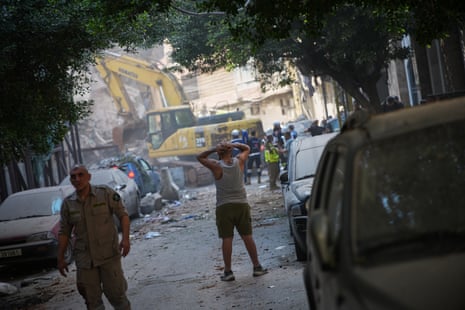
A man reacts as he watches an excavator remove debris at the site of an Israeli airstrike in Beirut. Photograph: Emilio Morenatti/AP
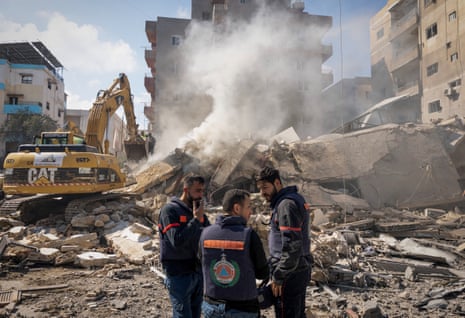
Rescue workers stand next to the rubble at the site of an Israeli strike in Tyre. Photograph: Adnan Abidi/Reuters
People gather as rescuers work at the site of an Israeli strike in Sidon. Photograph: Reuters
This blog has now closed, but we are continuing our coverage of the ongoing situation in the Middle East – and more information on the US-Iran eleventh-hour ceasefire – here. Thanks for following along.
Independent analysts say they have seen no change in traffic through the strait of Hormuz. That’s despite claims from the White House on Wednesday there had been an uptick in the number of ships transiting the strategic waterway since a US-announced ceasefire with Iran.
Windward, a maritime intelligence firm that tracks international shipping, said only 11 vessels transited the strait on Wednesday – about the same number from prior days.
Windward said all ships transiting the strait must still coordinate safe passage with Iranian authorities, who are requiring shippers to pay hefty tolls of up to $1 a barrel for outbound oil, paid in cryptocurrency. For context, the largest supertankers carry up to 3 million barrels of crude.
Windward said radio broadcasts from Iran to tankers in the Gulf on Wednesday warned that those transiting without approval would be attacked.
1.1 million Lebanese displaced since war started, says UN
The United Nations says 1.1 million Lebanese have been displaced since early March.
And that number, representing nearly one-fifth of Lebanon’s population, is expected to rise following the wave of over 100 Israeli airstrikes on the country on Wednesday, the UN humanitarian chief in Lebanon said.
Imran Riza told UN correspondents in a video briefing that Israeli orders for Lebanese to leave their homes now affect 15.5% of the country’s territory.
He also pointed to rising attacks on healthcare facilities during the Israeli-Hezbollah conflict, with over 106 incidents reported resulting in 57 deaths and 158 injuries.
During those heavy Israeli strikes on Wednesday, Israel also struck the last remaining bridge linking southern Lebanon to the rest of the country, a senior Lebanese security source said, as per Reuters.
The bridge ran over the Litani River, which runs about 30km (20 miles) north of the border with Israel. An Israeli military spokesperson said the area south of the Litani was “disconnected from Lebanon”.
Israel has said it intends to occupy the area as a “buffer zone”. It has struck hospitals and power stations there, and thousands of Lebanese civilians still living there say they have been struggling with a shortage of food and medicine.
William Christou, in Beirut, reported earlier in the war about Israel’s desire for a buffer zone in that area.
In case you missed it earlier, here’s some excellent analysis from our senior international correspondent, Peter Beaumont, who writes that Benjamin Netanyahu looks to be the biggest loser in this war.
Lebanon’s Hezbollah says it has fired rockets at northern Israel in its first attack against Israel since the US reached a two-week ceasefire agreement with Iran.
Hezbollah said in a statement that its attack came in response to what it described as Israeli ceasefire violations, after Israel launched its biggest attack on Lebanon in this war on Wednesday, killing at least 254 people, according to Lebanese officials.
Israel has not commented on the reports of Hezbollah rockets. It has just ticked past 4am on Thursday in Israel.
To recap, when the ceasefire deal was announced late on Tuesday, Pakistan’s prime minister, whose country served as a mediator, said in a social media post that it applied to “everywhere including Lebanon and elsewhere”.
But Israel announced on Wednesday it did not consider Lebanon covered by the Iran-US truce. And the Trump administration on Wednesday also stated that Lebanon was not part of the ceasefire deal, with the White House press secretary Karoline Leavitt claiming “that has been relayed to all parties”.
US vice-president JD Vance also told reporters in Budapest that the US never promised to include Lebanon in the ceasefire.
Iran have insisted Lebanon is part of the ceasefire deal. France and Australia have both urged the same.
The Israel prime minister, Benjamin Netanyahu, delivers a press conference on the first day of the ceasefire. Photograph: Alexi Rosenfeld/Getty Images
Hezbollah fires rockets at Israel in response to 'ceasefire violations' – report
Reuters has reported Hezbollah says it fired rockets at northern Israel in response to “ceasefire violations”. We’ll update this news as we find out more.
As we reported earlier, Iran has announced alternative routes for ships travelling through the strait of Hormuz, citing the risk of sea mines in the main zone of the vital waterway.
Tehran has agreed to temporarily reopen the strait as part of a two-week truce, but Israel’s ongoing strikes on Lebanon are threatening that agreement.
“All ships intending to transit the Strait of Hormuz are hereby notified that in order to comply with the principles of maritime safety and to be protected from possible collisions with sea mines ... they should take alternative routes for traffic in the Strait of Hormuz,” Iran’s Revolutionary Guards said in a statement quoted by local media.
The statement shared instructions for an alternative entry and exit route through the strait.
Back to that Trump-Rutte meeting, Reuters is reporting some remarks from a Nato spokesperson.
The spokesperson said Rutte and Trump had a “frank” discussion on a range of issues related to shared security concerns. Rutte underscored the importance of allies continuing to step up to deliver a stronger, fairer alliance, they added.
Red Cross 'outraged' as latest Israeli strikes kill at least 254 people in Lebanon
The Red Cross said it was “outraged by the devastating death and destruction” in densely populated areas across Lebanon as Israel launched a massive wave of attacks on Wednesday.
Heavy explosive weapons struck bustling neighbourhoods, including in Beirut, without effective advance warnings, the International Committee of the Red Cross said.
“Many who had begun thinking of the moment when they might return to their homes have been rushing to streets and hospitals, searching for missing loved ones or seeking a safety that feels increasingly out of reach,” said Agnes Dhur, the ICRC’s head of delegation in Lebanon.
Lebanon’s Civil Defence said at least 254 people were killed and 1,165 others were wounded in the attacks on Wednesday.
Here are some of the images from those Israeli strikes.
A fireball rises from a building hit by an Israeli airstrike in the area of Abbasiyeh, on the outskirts of the southern Lebanese city of Tyre. Photograph: AFP/Getty Images
Emergency responders work at the site of an Israeli strike in al-Mazraa in Beirut. Photograph: Yara Nardi/Reuters
A man reacts as he watches an excavator remove debris at the site of an Israeli airstrike in Beirut. Photograph: Emilio Morenatti/AP
Rescue workers stand next to the rubble at the site of an Israeli strike in Tyre. Photograph: Adnan Abidi/Reuters
People gather as rescuers work at the site of an Israeli strike in Sidon. Photograph: Reuters
'Remember Greenland,' says Trump as he vents frustration with Nato
Further to that Trump-Rutte meeting and the US-Nato relationship, Trump has posted this on Truth Social just minutes ago:
NATO WASN’T THERE WHEN WE NEEDED THEM, AND THEY WON’T BE THERE IF WE NEED THEM AGAIN. REMEMBER GREENLAND, THAT BIG, POORLY RUN, PIECE OF ICE!!! President DJT.”
Trump meets Nato leader amid musings US could pull out of alliance
Mark Rutte, the Nato secretary-general, met behind closed doors with Donald Trump on Wednesday for discussions that were expected to focus on reopening the strait of Hormuz and soothing Trump’s anger with Nato over the Iran war.
It wasn’t immediately clear how things went in the private meeting, ahead of which Trump had suggested the US may consider leaving the trans-Atlantic alliance after Nato member countries ignored his call to help.
However, during an interview with CNN after the meeting, Rutte was asked if he believed Nato countries were tested and failed.
“Some of them yes, but a large majority of European countries, and that’s what we discussed today, have done what they promised before in a case like this,” he said.
“I was also able to point to the fact that the large majority of European nations has been helpful with basing, with logistics, with overflights, with making sure that they lift up to the commitments.”
Mark Rutte meets with the US secretary of state, Marco Rubio, while in Washington DC on Wednesday. Photograph: Anna Rose Layden/Reuters
Rutte said he had a “frank and open” discussion with Trump, where the US president expressed disappointment with America’s allies.
The White House did not immediately offer an update on the conversation.
But earlier Wednesday, the White House press secretary, Karoline Leavitt, acknowledged that Trump had discussed leaving Nato. “I think it’s something the president will be discussing in a couple of hours with secretary-general Rutte,” she said.
Reuters is reporting that Iran’s Revolutionary Guards navy have posted a map showing alternative shipping routes in the strait of Hormuz to help transiting ships avoid naval mines, citing the semi-official Iranian news agency ISNA.
We’ll have more on this as it develops.
Australia has called for the ceasefire to apply to Lebanon and for both Hezbollah and Israel to observe the ceasefire. In a radio interview on Thursday morning, Australia’s foreign minister, Penny Wong, said:
If fighting continues in Lebanon, it risks the whole ceasefire across the region. So we called for that last night. We’ve been joined overnight by the G7 and other countries saying the same thing, and we continue to assert that.
The online betting market Polymarket is back in the news, after a group of new accounts on the platform made highly specific, well-timed bets on whether the US and Iran would reach a ceasefire on 7 April.
The bets resulted in hundreds of thousands of dollars in profits for those users.
Analysis of blockchain data shows at least 50 wallets placed substantial “Yes” bets before Trump announced a two-week ceasefire on social media.
Polymarket labeled the ceasefire betting event as “disputed” due to ongoing tensions, which means some payouts are on hold. This pattern of strategic bets has raised questions about insider trading.
For more on Polymarket and the Middle East conflict, here’s this piece from Jillian Ambrose, our energy correspondent.
Greek prime minister Kyriakos Mitsotakis says it would be ‘completely unacceptable’ for ships to have to pay a fee to cross the strait of Hormuz.
Amid ceasefire talks, Tehran has proposed fees or tolls on vessels to safely pass through the strait. Donald Trump on Wednesday suggested the US and Iran could collect tolls in a joint venture, while the White House said the priority was reopening the strait without limitations.
Mitsotakis said the strait always had freedom of navigation and that needs to continue.
“I don’t think that the international community would be ready to accept Iran setting up a toll booth for every ship that crosses the strait,” Mitsotakis told CNN on Wednesday.
That seems to me to be completely unacceptable.
He said a separate international agreement regarding the strait may be necessary.
“But this agreement cannot, I repeat, cannot include a sort of a fee that ships will have to pay every time they cross the strait. This was not the case before the war started and it cannot be the case after the war finishes,” he said.
“We would be setting a very, very dangerous precedent, if that were to happen, for the freedom of navigation.”
Kyriakos Mitsotakis speaks at a press conference during the EU summit. Photograph: Nicolas Tucat/AFP/Getty Images
Ceasefire must include Lebanon to be 'credible and lasting', says Macron
Emmanuel Macron has said he has told the presidents of the US and Iran that their ceasefire deal should include Lebanon.
I spoke today with Iranian President Masoud Pezeshkian, as well as with US President Donald Trump.
I told both of them that their decision to accept a ceasefire was the best possible one.
I expressed my hope that the ceasefire will be fully respected by each of the belligerents, across all areas of confrontation, including in Lebanon. This is a necessary condition for the ceasefire to be credible and lasting.
He said that this would “open the way to comprehensive negotiations” that lead to a long-term peace deal.
Macron pledged that “France will play its full part, in close coordination with its partners in the Middle East”, and said he had also discussed his position today with the leaders of Qatar, the UAE, Lebanon and Iraq.