The face-lift is better than ever, and everybody wants one. Deep inside the uncanny world of the surgically ageless.
By
,
features writer at New York Magazine
She is the author of ‘Little Bosses Everywhere: How the Pyramid Scheme Shaped America.’
CARTIER Ring, at cartier.com. Photo: Ben Hassett for The Cut
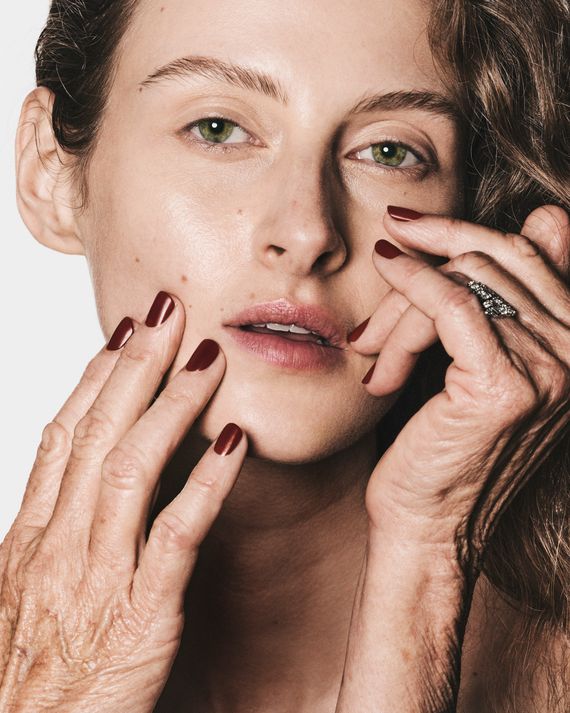
CARTIER Ring, at cartier.com. Photo: Ben Hassett for The Cut
CARTIER Ring, at cartier.com. Photo: Ben Hassett for The Cut
This article was featured in One Great Story, New York’s reading recommendation newsletter. Sign up here to get it nightly.
It started with the lines around her eyes. “Last year, my husband said to me, ‘You’re blind,’” Chloe Hall, 44, tells me over niçoise salads on Madison Avenue one afternoon in July. “At Warby Parker, I put reading glasses on and suddenly saw my eyes. I had never seen how many little wrinkles I had. It was like, Houston, we have a problem.” Then it was her neck. “My daughter would come up and play with the loose skin,” she says, jiggling what I estimate to be a few centimeters of extra flesh under her chin. “Everything was just kind of falling.”
Hall is an Upper East Sider with three kids under 14, an apartment on Fifth Avenue, and a house in Newport. Her husband works in tech. She looks a little like a dirty-blonde Julianne Moore with a pretty, angular face and a straight nose. After the glasses incident, she called her friend Sabina, an amateur beauty expert. “I asked her, ‘Should I get a peel? A laser?’” Hall assumed there must be something the women in her world had been doing lately to look so good. On her jogs in Central Park, at school drop-off, at cocktail parties — more of them were looking better than ever, not just slimmed down but fresh, almost resurfaced, yet natural, as if just back from the most expensive spa known to man. And she couldn’t tell any of their ages; they instead seemed to belong to some glamorous tribe of the nebulously de-aged, appearing somewhere between 35 and 50.

Hall was not prepared for Sabina’s prescription. “You’re really overthinking this,” Sabina told her. “What about a face-lift?”
Hall had always assumed she would get plastic surgery — “Like, since I was 16.” She just thought that it would come when she was older, as a last resort, when the wind-tunnel look was at least preferable to aging. But at Sabina’s direction, Hall started following a few surgeons posting their before and after face-lift pictures on -Instagram. She was surprised to see that the afters didn’t have those classic tight, pulled Palm Beach cheeks or the Joker mouth. Instead, patients of all ages, many of them in their 40s, appeared dewy and youthful, like the women at drop-off. Everyone must be getting face-lifts, Hall suddenly realized. Good face-lifts. Potentially new face-lifts. And she wanted one.
“Everyone is talking about it,” Alexis Page, a beauty consultant based in New York, tells me. “These face-lifts look glowing. They look bouncy. They look vibrant. Even straight guys are asking me about face-lifts. Everyone wants to know what’s happening.” In the past, celebrity transformations have mostly prompted ogling or pity: “What did she do to her face?” Now the question is being asked in awe. Beauty writers have declared it the procedure’s “undetectable era.” Lindsay Lohan recently stepped out looking slimmed and buffed in a way she hasn’t for years. (She denied the lift and attributed the change to a “carrot, ginger, lemon, apple, and olive-oil juice.”) Brad Pitt, Anne Hathaway, and Christina Aguilera have similarly been spotted looking vaguely tighter but not pulled or filled. In May, Kris Jenner was seen in Paris at 69 looking almost disturbingly rejuvenated, maybe even younger than her daughter Kim. Her face looked so convincingly restored that reporters, TikTokers, and Instagram Story–ing surgeons began frantically attempting to figure out exactly what specific procedure she’d had done and by whom. As Ozempic speculation had a few years earlier, face-lift mania gripped the nation. These online sleuths decided Jenner must have had a “deep plane,” a newer face-lift method that has recently experienced a surge of popularity. But they may be wrong. About a week later, Jenner’s representative confirmed she’d gotten a face-lift from a doctor in New York, one who is known to perform an older kind of procedure called a SMAS.
Pinning down precisely what is going on with face-lifts is like watching a very good magician and trying to catch the trick. “It even freaks me out,” one longtime publicist in the plastic-surgery industry says. “I was looking at all these photos of women before and after, and I thought, If I didn’t see the before, would I be able to tell that they’d had anything done? And I don’t think I would.” Especially because there isn’t one simple answer — a single method, hack, or trend. In actuality, it’s everything coming together at once, a moment of face-lift singularity.
The New Celebrity Face: Lindsay Lohan, Kris Jenner, Brad Pitt, and Christina Aguilera, celebrities who’ve had, or have been suspected of having, face-lifts. Photo: Getty Images.
The New Celebrity Face: Lindsay Lohan, Kris Jenner, Brad Pitt, and Christina Aguilera, celebrities who’ve had, or have been suspected of having, face-... The New Celebrity Face: Lindsay Lohan, Kris Jenner, Brad Pitt, and Christina Aguilera, celebrities who’ve had, or have been suspected of having, face-lifts. Photo: Getty Images.
Hall eventually booked a consultation with a surgeon she found on Instagram: a 39-year-old named Dr. Sean Alemi with a temporary office just off Fifth Avenue near the Met. I join her for her pre-op appointment, the final time she will meet with Alemi before her scheduled face-and-neck procedure, which is in about a week. Alemi has Disney-prince looks (strong square jaw, thick black hair, and biceps poking out of his Figs scrubs) and a cerebral, self-assured bedside manner. He gets up at 4:30 every morning, and his desk is adorned with a sign that says HARD THINGS ARE HARD. He practices the deep-plane face-lift, which Hall has chosen based on her Instagram research.
Though there is a multitude of cutesy brand names that plastic surgeons have given to their own techniques (“the Ponytail Lift,” “the Vertical Restore,” the “Micro-Mini Lift”), there are really only two types of modern face-lifts: the SMAS lift and the deep plane. The SMAS lift dates back to the mid-’70s, when a Swedish plastic surgeon figured out how to dissect the face below the superficial surface of the skin. Instead of just yanking on the top layer like a bedsheet, he cut into a thicker layer of fat, muscle, and fascia under it, a region later called the superficial musculoaponeurotic system, or SMAS.
The deep plane was invented almost 20 years later by a Texas-based plastic surgeon named Sam Hamra. The SMAS lift, Hamra found, helped with jowls at the chin and sagging necks, less so with correcting sunken under-eye patches and hollow cheeks. With his new method, Hamra cut into the face under the SMAS layer, actually freeing it from the ligaments that connect it to the deeper face muscles below. He could lift up a patient’s entire cheek and redrape it back up on her cheekbone where it once sat, plush and rosy, before gravity pushed it down. Though it was written up at the time as a breakthrough, the deep-plane technique didn’t become a popular practice among most plastic surgeons. Because it required working close to the muscles and facial nerves, some considered it riskier than the SMAS lift. But it took off among another set of doctors: otolaryngologists, or ear-nose-and-throat surgeons, like Alemi. ENTs spend their entire residencies operating on the head and neck and are thus comfortable performing face-lifts, nose jobs, and blepharoplasties, or eyelid surgeries. And those ENTs who pivot to plastic surgery are called “facial plastic surgeons,” as opposed to general plastics, who operate on the whole body: lipo, mommy makeovers, and, now, “daddy do-overs.”
For years, SMAS face-lifts were the dominant procedure among America’s elite plastic surgeons, most of whom clustered on Park Avenue or in Beverly Hills. But facial plastics steadily trained, became more prominent, and grew their numbers. And in the past five years, the deep plane has finally started getting its due — especially on social media. The most exclusive general plastic surgeons have long tended to get business by word of mouth. But the in-demand facial plastics, younger and more online than their SMAS counterparts, were eager to advertise their results. The deep plane broke containment when Marc Jacobs documented his in 2021 (performed by Dr. Andrew Jacono, the facial plastic with whom Alemi trained as a fellow). Sia got one in Beverly Hills in 2023.
According to Alemi, the deep-plane method is solely responsible for the current wave of undetectable face-lifts. Surgeons who practice the deep plane are able to fully release the SMAS layer from the muscles so that the face is lifted and moved several layers deep, he says. By keeping the layers of the skin and SMAS in one piece, the deep plane also preserves blood flow to the skin. “The muscle underneath is carrying all of the tension. The skin is just along for the ride as a passenger,” Alemi explains. Plus, he says, in the years since Hamra first invented the procedure, facial plastics have pushed it to new heights, or, rather, depths, especially in the neck. Surgeons are now willing and able to shave or remove the ends of the submandibular glands, which produce saliva, in order to make the neck appear more sculpted. On top of that, they’ll typically suggest a cocktail of other enhancements during a procedure, like mid-surgery laser-resurfacing treatments that sandblast the skin, giving patients a newborn top layer, or a “bleph” or a brow-lift to make the eyes appear brighter and more awake.
Not only does the deep plane deliver the most natural face-lift, deep-planers like to argue, but they feel the method is perfectly timed to current aesthetic trends, specifically deflation. The previous decade in beauty was all about plumping: volumizing the face with collagen, hyaluronic acid, or filler. Now, it’s become clear that the dream of noninvasive procedures standing in for surgery was just that — a dream. “Filler doesn’t really lift the face,” Alemi says. “It’s not mechanically possible to inject a tablespoon of jelly into the cheek and expect that it’s gonna eliminate the jowl.” Plus filler and other additives can actually age a patient by sagging, slumping, or — grimly — migrating over time. More patients are coming into surgeons’ offices with their injectables recently dissolved, leaving extra or loose skin behind that must be snipped away. At the same time, as more and more people take Ozempic, other patients are losing weight and suddenly finding themselves with hollowed-out features. This, plastic surgeons say, is a problem only surgery can truly correct. Both of these types of patients tend to be younger, Alemi says. Which has led to a surge of eager customers getting face-lifts earlier: In recent years, more than a third of face-lift recipients were in the 35-to-55 age range.
After a brief discussion of the risks (scar formation, poor wound-healing, nerve weakness), Hall is convinced and ready to go. The following week, with her kids at sleepaway camp, she will return for her deep-plane face-lift at $45,000 plus $15,000 for a deep-plane neck-lift, $6,500 for a CO2-laser treatment, and $10,000 for operating-room costs and anesthesia. Before she leaves, Hall stars in a video for Alemi’s Instagram account, standing in front of the black backdrop he uses to take his before and after photos: “I live in a part of the world where everybody looks 35 forever,” she tells the camera. “And so that’s why I wanna get a face-lift.”
32 days after.
Photo: Courtesy of the subject
The old guard of face-lifting is bristling at the idea that face-lifts used to be bad and now, suddenly, they aren’t. “The word was always natural,” Gerald Imber, 84, tells me in a New York accent. We are sitting 20 blocks or so from Alemi’s office in a corridor of the Upper East Side where the world’s foremost plastics practice. “No one ever came into my office and sat down and said they wanted to look like someone else. There were always good results before. People just weren’t talking about them.” Imber, as a matter of principle, does not share his before and after results online; they can be seen only in person by a patient during a consultation: “I think it’s unethical. I show people pictures of what I think are average results. People on their websites, on Instagram, they put the most dramatic transformations — you know, ugly duckling into a swan. It’s misleading.”
Using the regular old SMAS procedure, Imber has been lifting faces for 50 years, including some very famous ones (Dolly Parton, allegedly). So when I bring up the rise of the deep plane and whether it might be the source of undetectable results, he is more than dismissive. “You can’t rely on what you hear from young people who have just jumped on the bandwagon,” he says, reminding me he has done around 3,000 face-lifts. (Alemi has done around 775.) “All of us have done the deep-plane face-lift many times, and most of us have abandoned it for 98 out of every 100 patients.” He claims that it is still too risky a procedure: “Ask them, ‘Which is more dangerous? Who has a higher incidence of nerve damage?’” he says.
To Imber, the idea that the deep plane is responsible for the best new face-lifts is largely a marketing ploy — by ENTs who wanted to do something “more glamorous than operating on nasal polyps”: “It’s a wonderful PR program for a lot of guys who want to build practices.” Before the 2010s, Imber says, ENTs who performed plastic surgery “didn’t count. But they advertised and they proselytized and they went out and said, ‘Oh, we are not plastic surgeons. We’re facial plastic surgeons.’ They had the best marketing campaign imaginable. And then they gave themselves certification — where it came from God knows.” Imber is referring to the fact that general and facial plastics have their own competing societies and boards. General plastics are members of the American Society of Plastic Surgeons and its associated American Board of Plastic Surgery. To become board certified, these surgeons have to complete six years of surgical training, at least half of that in plastics specifically. Feeling maligned, facial plastics, in 1964, started the American Academy of Facial Plastic and Reconstructive Surgery. Once an ENT has finished their five-year residency, they can become a board-certified facial plastic after being in practice for a comparatively brief two years. “It’s men and boys,” Imber tells me. “They are suddenly making deep-plane face-lifts a hot item again when it stopped being hot 20 years ago.”
After meeting Imber, I stop in at Sherrell Aston’s office a dozen blocks downtown. Aston, at 83, is one of Imber’s contemporaries (they’ve known each other since they were both young surgeons) and is rumored to be Anna Wintour’s surgeon. He and his wife, Muffie, are society-circuit fixtures with a $35 million mansion on Long Island’s Gold Coast, one of several said by listing agents to have inspired F. Scott Fitzgerald’s The Great Gatsby. His practice is primarily face-lifts and noses (and, he’ll later tell me, “a little bit of body because my ladies want it done”).
When I get to his office, Aston immediately ushers me into his exam room, which is decorated with pictures of himself with people like King Charles and Jimmy Carter. Aston is primed to talk to me about deep-plane face-lifts before I’ve even brought them up. His argument is not that deep planes don’t work as well as SMAS — it’s that the two procedures are closer than one might think and suitable for different types of patients. He shows me an image of one of his SMAS dissections up close: “You can see we are in the deep plane there. You can’t get any deeper than that. That was 1978,” he insists. Aston also maintains his SMAS face-lift occurs in the same region as a deep-plane dissection. He simply moves the skin and SMAS separately rather than as one piece. “I know what they like to say,” he cautions, referring to the deep-planers, “but we’re all in the same plane.”
One can start to imagine groups of general plastics and facial plastics squaring off across the tulip-filled medians of Park Avenue like the Sharks and the Jets. “I respect these guys,” Sam Rizk, 57, another facial plastic surgeon, says later that day over a set of macarons and fruit cups brought in by his office manager. As an ENT resident at Memorial Sloan Kettering, he used to go watch the OG plastics lift faces: “But I was more convinced by the deep plane.” Rizk’s starting price is $125,000; last year, he did a deep-plane face-lift for Jennifer Fessler, a Real Housewife of New Jersey. Many of the OGs didn’t want to do the deep plane when it was invented, Rizk says, because they found it too difficult. And now it’s too late: “They’re not gonna jump onboard with the deep plane because they haven’t done it for 40 years. They’re not gonna change their ways.”
Deep-Plane Mania: Results from Dr. Sean Alemi, Dr. Babak Azizzadeh, and Dr. Elizabeth Chance. Photo: Courtesy of Dr. Sean Alemi; Courtesy of Dr. Babak Azizzadeh; Courtesy of Dr. Elizabeth Chance
If the tension between plastic surgeons and their ENT colleagues has been simmering for decades, Kris Jenner’s face, cruising on the Seine, made it boil over. When photos of Jenner looking 20 years younger during Lauren Sánchez’s bachelorette festivities went viral earlier this year, “a ton of patients sent it to me,” says Dr. Elizabeth Chance, a sought-after facial plastic based in Charlottesville, Virginia. I reach Chance on the phone a few days after doctor-hopping on the Upper East Side. “It looked so much like the phenomenal deep-plane work of one of my good buddies. I texted him a picture of it, and I was like, ‘Slow clap, man. This is just insane. So good.’”
The friend was Dr. Ben Talei, the Beverly Hills facial plastic surgeon who did Sia’s deep plane — but the work wasn’t his. As Jenner’s representative would later confirm to “Page Six” in May, her doctor was, in fact, Steven Levine, a plastic surgeon in New York in his 40s known as a protégé of Daniel Baker, a SMAS surgeon and one of Imber and Aston’s contemporaries. Suddenly, doctors were litigating Levine’s results privately in their group chats, publicly in news articles, and on their own Instagram and TikTok accounts. SMAS surgeons were delighted that one of their own was in the headlines. (“He was my resident,” Aston told me.) Deep-planers were pulling apart the results, which they felt couldn’t possibly be that good if it was a plain old SMAS. Chance, once Jenner’s work was revealed to be Levine’s, took to her Stories to urge her followers to compare Jenner’s highly edited photos she posted to paparazzi pictures. “I think Steve Levine did a beautiful job, but it’s not nearly what they’ve curated this image of,” Chance tells me. “Would the deep plane have elevated her midface more? Probably. Did he do a good job? I think so. Her neck looks great.”
Rather than a referendum on the best technique, Jenner’s face is more like a Rorschach test. Surgeons can use it to convincingly make whatever argument they want about what they practice, which they are doing constantly since the bedrock of plastic surgery is marketing. The deep-plane side says the old guard is just mad to be losing market share. (“I get how it would be really annoying to have every patient walk in and say, ‘Why don’t you know how to do a deep-plane face-lift?’” Chance says.) The SMAS guys say the deep plane is just a fad: “People come up with a new name and think, Oh my God, that’s new,” Garth Fisher, the L.A. plastic surgeon who did an earlier face-lift for Jenner in 2011, filmed for Keeping Up With the Kardashians, tells me. “You should be asking, ‘What works? What’s time-tested?’”
That Jenner has already had multiple face-lifts seems to provide the most important data point. “Becoming a varsity athlete is hard,” Mike Nayak, a deep-plane surgeon in St. Louis with a large Instagram following, says. “Becoming a college athlete is harder. Becoming an Olympic athlete is astronomically harder.” Elite face-lift surgeons, having put in Malcolm Gladwell–level hours of practice, have ultimately become Olympians, regardless of which technique they are using. Much of what turns a good face-lift into a great one is located not in the overall technique but in something more ineffable, deep in the weeds of surgery. “It’s down to being able to pivot when you open up a face,” Nayak says. “It’s not always what you expect it to be.” Fifty years into modern face-lifting, surgeons better understand how to read tissue and how much to lift and move it. They can feel exactly which direction to pull, vertically and horizontally (this is called a face-lift’s vector), down to fractions of a degree so that the skin is moved to precisely where it used to sit. They know better where and how to sew it back down and what kind of suture to use. They are able to tunnel farther into the face from smaller openings. They are more meticulous at placing and sewing up incisions so that they become invisible. Their precision overall means they can smuggle dramatic changes into a patient’s face without disturbing the features that make it theirs — bone structure, eyes, smile — and the result is as close to “authentic” as a surgically altered face could be.
Rather than seeing the impact of some new innovation or genius surgeon, we are simply approaching the face-lift’s peak performance. “The name of the technique doesn’t matter,” Talei says. “Everything has improved overall, and even the terrible surgeons are getting better results now. And the best surgeons are getting great results.”
In order to watch the new-old face-lift in action, Alemi invites me to observe a surgery. He wants me to see a more extensive procedure than the one Hall is getting, so I attend the deep-plane face-and-neck-lift of another patient: 65-year-old Anne Kavanagh. Kavanagh spent 20 years in investment banking on Wall Street, then started her own consulting firm in 2000, and lives in a white-and-chrome penthouse in Soho. Unlike Hall, Kavanagh is a bit of a tomboy and never thought she would get a face-lift. Her cherubic, pleasantly lined face reflects hours in the sun on her boat in Sag Harbor. But a few years ago, a close friend got a deep plane, and the results “looked so natural,” Kavanagh says. “I just want to look like I used to.” As Kavanagh’s friend puts it, “Anne has the best of everything. And now she wants the best face.”
Kavanagh’s surgery is at least $22,500 more than Hall’s because she is also getting her eyes done. Kavanagh has also opted to pay for ten $400 hyperbaric-oxygen-therapy sessions at a nearby clinic, which involve being loaded into a highly pressurized clear tube in which the level of oxygen in the air is increased up to 100 percent. The therapy supposedly increases stem-cell production and other healing processes in the body. In the past few years, its use has expanded within the longevity crowd and among celebrities and athletes. Justin Bieber has two personal chambers — one for his home and one for his studio.
Alemi has been going for four hours by the time I get to the OR. The room is controlled chaos: Kavanagh is flat on the operating table, covered in a surgical drape from the chest down, mouth kept open by an oxygen tube, her platinum-blonde hair shining under the fluorescent light. Alemi, in a light-blue gown and surgical mask, sits next to her head on a swivel chair, a nurse and an anesthesiologist nearby. Printouts of Kavanagh’s before pictures hang above the table. She isn’t totally knocked out under anesthesia but is instead in “twilight,” induced by what Alemi describes as a “whisper of fentanyl” plus propofol.
Alemi is just finishing up the right side of Kavanagh’s face-lift and has already completed the main part of the neck-lift. Two small red knots of tissue glisten on one of the tables nearby — “Anne’s glands,” Alemi says. Elsewhere on the table are piles of discarded bits of gray skin, which a nurse identifies as “extra,” and a few needles filled with a yellow gloop: fat from Kavanagh’s abdomen. Alemi used some of it above her left eye, like a chef dolloping a garnish on a dinner plate.
Now he marks up the left side of Kavanagh’s face with a purple pen. After a minute or so, he begins, making an incision with his scalpel along the front of her earlobe, down around and under her hairline. It bleeds bright red, but the nurse quickly suctions the blood away. Gently he cuts through the skin as he lifts Kavanagh’s face, pulling it up as he goes, revealing a shiny, wet, yellow layer underneath. Every so often, he takes a small silver tool and cauterizes the tissue to prevent more bleeding. It smells like burning skin. “This is gnarly fat right here,” Alemi says, pointing to the yellow gloopy layer, though Kavanagh’s tissue is “pristine” because she hasn’t had any heat-based treatments or filler. “If you take a chicken breast and you heat it in a microwave,” he muses while cutting, “it feels different. If you do that to the face, the same thing happens: It becomes tough and gristly.”
Alemi narrates how he has now cut through the layer of the subcutaneous fat and exposed the SMAS layer underneath, though they both look the same to me. “She’s got a tremendous amount of jowling,” he notices. It’s time to enter the deep plane. “At this point, I’ve basically done a SMAS lift,” Alemi explains. By now, the left side of Kavanagh’s face and the side of her neck are tented open like the hood of a car with Alemi tinkering underneath. “See how I can put my finger all the way from here” — he slides his gloved finger into the side of Kavanagh’s face, under the yellow SMAS, and over and around her mouth — “to here,” moving it down and around her chin to under her jaw and down her neck. “But I’m only partway up the face. We need to release all of this” — he stops at her cheek — “to mobilize the midface. That’s what makes it a deep plane.” He takes a blunt tool and begins to spread the malar fat pad, or the fat of the cheeks, from the ligament and muscles below, pointing out a shiny “Saran Wrap” layer that protects the nerves. At this point, he is able to slide his finger under Kavanagh’s cheek all the way to her nose. Nearly his whole hand can fit inside her face. Once all the necessary ligaments have been cut, the features on top move freely and in one piece, like a Halloween mask.
“And we’re gonna now decide how to reposition all that in order to make Anne look 35,” Alemi says, satisfied. He brings Kavanagh’s cheek up about an inch and, once happy with the position, stitches it down on the muscle at a few different anchor points to keep it in place. He further sculpts along the jawline using a pair of scissors to gently shear away at the tissue, like he’s trimming a hedge. This is the part that requires the surgeon’s intuition and judgment to determine how to manipulate, rotate, and move the tissues to make the patient look younger but not too different. Alemi repositions Kavanagh’s face, then sits back, positions her, then sits back, at one point humming Simon & Garfunkel’s “The Sound of Silence.”
When all the excess skin is cut off, he sews the openings up using a series of tiny threads, some as fine as a strand of hair. The ears need to be set back exactly right on her new face, as does her hairline. “If the ears or the hairline get distorted,” Alemi says while stitching, “or the ear gets pulled down, that patient’s gonna look like they’ve had a face-lift no matter how good it looks.”
After the surgery, Alemi inserts two drains — one in each side of Kavanagh’s neck — to help collect fluid buildup during the first 24 hours or so of recovery. Then it’s time for the laser. For about 20 minutes, Alemi directs the device as it shoots a series of red lasers onto the top layer of Kavanagh’s skin. Though she is still under sedation, her body unconsciously starts to jerk and jolt. The anesthesiologist holds down one of her arms as she squirms.
42 days after.
Photo: Courtesy of the subject
Two days after her surgery, I visit Kavanagh at her loft. Wearing a white zip-up sweatshirt and blue pajama pants, she is seated in front of a carton of Siggi’s yogurt at the end of a glass dining table. She greets me in a croaky voice emitted from her deeply purple, swollen, and bruised face. Her ears are enormous. She looks as if she has been cooked, which she essentially has, by the CO2 laser. There’s a reptilian quality to the surface of her skin, where she is gradually shedding a gray film of torched cells. But her jawline is utterly snatched. Her profile is unreal, I tell her. “It is unreal,” she agrees, tilting her head to indicate she is attempting to nod.
After one night in Alemi’s recovery room, the private nurse coordinated by his office took her home and called for an IV drip so she could stay hydrated. Kavanagh immediately extended the private-nurse service for another four days into the weekend, which would cost an additional $2,100 a night. Conversely, she canceled the rest of her hyperbaric-chamber appointments. During her first treatment, she was unable to pop her ears, which patients have to do as they pump up the oxygen. The pressure building in the chamber was excruciating, and when Kavanagh knocked on its wall, she says no one heard her at first. “It was like a bomb was going off in my head,” she says.
I don’t see Hall until two weeks later, back in Alemi’s office for her one-week checkup. Her recovery is proceeding much faster, as is almost always the case in younger patients. Aside from some remaining bruising and swelling — what Hall calls her “Jay Leno chin” — she does not look as though she had major surgery seven days ago. Alemi lines Hall up again against the backdrop he uses to take photos and uploads them onto his computer so we can see the difference. “See how square and bottom-heavy your face was?” Alemi says. Now, he explains, her face is narrow, almost heart-shaped. And her cheeks have been moved up. Even just a few millimeters undoes years of gravitational pull. Hall is thrilled. “I’m on a pink cloud,” she says. “It just was, like, this abstract idea in my future. And now it’s real. This is gonna be so subtle and fabulous for school drop-off.”
In the end, Hall’s surgery cost $76,500. Kavanagh’s was around $100,000. Give it another year, and these prices might look like steep discounts. Alemi’s overhead is about to go up — after recently moving his practice into Manhattan from Long Island, he is renovating a new multimillion-dollar maisonette he bought on Park Avenue. Plus, he recently added two Real Housewives (cities redacted) to his “patient pipeline.” Will he increase his prices? “I don’t have an answer to that right now.”
With more famous people following Jenner’s lead and revealing their doctors, demand is soaring. Only last year, Alexis Page, the beauty consultant, ran into a friend smoking outside a party — “I hadn’t seen her in a while, and I said she looked great, and she pointed to her face and said, ‘Dr. Levine, 200 grand,’” Page says. Last month, another doctor told me that a patient had recently been quoted over $300,000 by Levine. It is, more than one person with knowledge says, impossible at this point to get into Levine’s office without a direct referral from a known patient or doctor. Melinda Farina, who runs Beauty Brokers Inc., a service that matches patients with plastic surgeons, tells me she has a long-standing relationship with “Steve,” who is in her network of doctors, and that her clients can “skip the line” if need be. But Farina’s consultation costs at least $450 with no guarantee of seeing a specific doctor. If you need a last-minute consultation, perhaps for a revision emergency, she charges $2,500.
At least Levine sees patients in person. Robin Levine Shobin recently wrote on Substack about her experience with Dr. Amir Karam, an Instagram-famous facial plastic in San Diego. After submitting photos to the office, she was told she’d need to pay $1,000 for a Zoom consultation. Then a deep-plane face-lift, upper bleph, and fat transfer would cost $156,000. She would meet the doctor in person once she paid a refundable 20 percent deposit of $31,200 to hold a surgery date and was told this was because his office got “9,000 inquiries per month.”
At the same time, elite face-lifts are starting to trickle down. The facial plastics are eager to share their deep-plane techniques now that the public is clamoring for their services via a robust cottage industry of conferences, master classes, and cadaver courses. (Wherein surgeons train on dead bodies: “Fresh specimens provided daily!” one such course claims.) Talei is hosting a deep-plane course in February in Fort Lauderdale. Nayak hosts his own master class in Turkey. As high-quality training mushrooms, it will soon be possible to get an undetectable face-lift in many more places — and for cheaper. Even if there is a drop-off between the most expensive surgeries and the next rung down, “in the next five years,” Talei says, “there’s gonna be a lot more accessibility.”
In the meantime, online forums are filled with women — and men — figuring out how to be ready for the mass-market face-lift. Tips for funding include refinancing a mortgage or opening up a CareCredit card, which offers 24 months at 0 percent interest (then it goes up to over 30 percent). Younger women discuss putting money away in high-yield savings accounts to start building up their funds. “Finance it,” a woman recently commented in a Facebook face-lift support group. “It’s life changing and worth a payment, do it, do it.”
Face-lifts, especially good ones, spread like a contagion. Kavanagh is thrilled with her results, though still slightly swollen when I see her in early August, and already has friends who are now thinking about scheduling their own surgeries. Sandy Leong, Kavanagh’s tennis partner, has been considering getting facial surgery since June, when she attended the Bezos-Sánchez wedding. Her husband is a former colleague of Bezos’s, and she saw Jenner’s hotly debated work in person. “She looks effing amazing,” Leong says in a video call from Amagansett. “I was watching her walk back and forth, and I was like” — she drops her jaw exaggeratedly. She’s not sure she needs it yet, but she wants to put her name on Levine’s list, though Kavanagh thinks she can persuade her to see Alemi instead once her results settle.
Even though she hasn’t gotten a face-lift herself, Leong says that her sense of what people are supposed to look like is getting “warped” with everyone around her beginning to appear so persuasively refreshed. Recently, she went out with some of her husband’s friends who are in the decidedly all-natural, noninterventionist camp: “Somebody goes, ‘It’s so nice that you get along so well with your in-laws.’ And I’m like, ‘No, those are my husband’s peers.’ The person said that because they haven’t done anything. So now I’m thinking, Well, they should do something.”
It’s true that there is something destabilizing about being among meticulously altered faces for a sustained period of time. They appear almost two-dimensional — like you should be looking at them on a screen. The handiwork is so subtle that the more you look, the less you can tell what has been moved, cut, and erased and the less tethered you become to the origin point: what a face modified by time and gravity should look like. Instead, the new faces appear as if they were always that way, belonging to an airbrushed species of another planet. “When you look at someone else with an elite face-lift,” one surgeon says to me, “all you should be thinking is, How did you age better than me? The goal is you want to look genetically dominant to other people.”
Ten days after her surgery, Hall surprised a set of her girlfriends at Casa Cipriani with her new face. “They were looking at me like they couldn’t really tell,” she says to me recently over coffee. “Finally, they were like, ‘Did you have something done?’” She considers the reveal a huge success. “They said I look so natural, just like myself. They all want one.” Next to me in a pair of sunglasses, Hall looks slightly puffy still but has the same sharpened jawline and taut neck as Kavanagh. “It’s like an unboxing. Every day it gets better,” she says. As we sip our coffees, we discuss Emma Stone’s face, which has recently appeared smoother, tighter, and brighter on the Eddington red carpet. (“She looks great!” wrote someone on a Reddit thread speculating what work she’d had done. “But kind of like an AI tweaked version.”) Just days before, Ricki Lake showed off photos of her deep plane on Instagram, crediting her doctor in Beverly Hills. At the table next to us is another group of women, some of whom are in that de-aged zone, others who still have a revealing droop, a jowl, a line. I have an urge to card them all like a bouncer, just to see how far off my guesses are. One classic tell remains a person’s wrinkled hands. But “not for long,” one doctor assures me. “We’re doing amazing things with hands.”
Correction: A previous version of this story incorrectly stated that Kris Jenner’s representative confirmed that she had received a SMAS.
- Sarah Paulson’s Victory Lap
- The Temptations of Andrew Garfield
- Are There Too Many Celebrity Brand Ambassadors?