By
,
a columnist for The Cut covering modern family life.
She is the author of the newsletter series "Brooding." She has written about domestic life and digital culture for the New York Times, The Nation, The Guardian, and Jezebel, among many other publications. She got a PhD in Sociology from Concordia University in 2022.

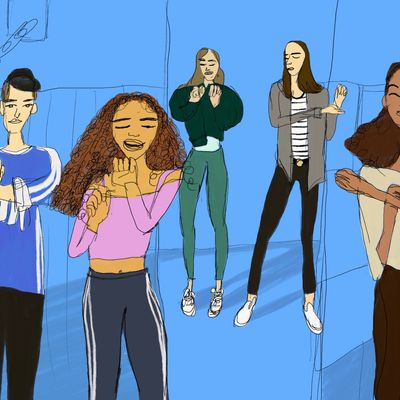
Illustration: Hannah Buckman
New York subscribers got exclusive early access to this story in our Brooding newsletter. Sign up here to get it in your inbox.
A few weeks ago, my older son performed as part of his high school’s annual dance show. The show is mostly choreographed by students, and although some of the dancers are trained and talented, many participants (like my 15-year-old) had never really danced before rehearsals started. They had been practicing after school for months.
The school auditorium was packed and vibrating at that very specific high-school frequency that is just shy of pandemonium. The lights went down, the show began, and right away I was impressed; tightly choreographed to medleys of pop music, the dancers moved in precise, energetic unison. The months of rehearsals came together in flawless transitions. It was exhilarating to see teens working so hard.
But as the show went on into a second hour, I began to feel vaguely disconcerted, as though I were being Clockwork Oranged into scrolling live-action TikTok. Every minute or so, the music would change and a new dance would begin, with new kids and new outfits, but in the same format: front-facing, in unison, like a young corps of determined backup dancers auditioning for a spot on Tate McRae’s tour. I didn’t mind the music, and I wasn’t expecting anything different than what I saw — a night of hip-hop-inspired dance, like a marathon of the 2000s-era music videos I watched on MTV after school. It’s not like I was expecting Martha Graham.
It wasn’t even the dance moves themselves that began to seep into my soul and annihilate my spirit; it was the uncanny projection of what the dancers seemed to be imagining. The machinic front-facingness of their eyes. The way they seemed detached from their peers onstage, focused instead on an imagined camera capturing and broadcasting their performance.
Critiquing art made by young people is a valid taboo, and I know I’m already on thin ice here. If it helps, please be reassured that I offered nothing but my most sincere praise to my son and his friends. I was impressed by their hard work and the bravery it takes to get onstage and dance for strangers. I am a proud parent, plain and simple. But I’m also a thinking parent, whether I want to be or not.
What I didn’t mention, but what I felt just the same, was that I was watching young people not so much dance as work to fulfill and replicate an algorithm’s demands. A lot of the art that children are exposed to is made for and by machines, and imitation is the first stage of art-making, so some resemblance is only natural. Maybe this is simply the way creativity works — nothing to see here. Maybe I’m being oversensitive or just annoying. But before I brush my own reactions aside, I wanted to figure out where they were coming from and whether it’s just me.
I don’t know anything about dance, so I asked my friend Hilary Bergen, a dance scholar and the author of the forthcoming book Dance Anima from Oxford University Press, for some context.
“A group moving in unison has its own energy that can exist separate from the individual dancers. In the case of drill dance, or step-dance routines that you’ll often see performed by Black college sorority and fraternity groups, they’re producing something with their bodies in space, and we can feel it, as the audience,” Bergen explained. “On TikTok, it’s a dancer alone in their living room, dancing for engagement. Or maybe it’s a pair or trio, but even in cases where the dancer is not solitary, that relation between their synchronized bodies is triangulated with the camera and the monetized desire for likes. So when you assemble a group of people all dancing in that TikTok way, even offline, there can be that air of loneliness that seems to take rather than give.”
Dancing for a camera, not to mention dancing in unison like a machine, long precedes TikTok; Bergen reminded me that Busby Berkeley was famous for his elaborate cinematic dances captured by an overhead camera in which dancers could appear literally like tiny cogs in a big mechanism. But TikTok dances do feel different — like the thing “soliciting the dance,” as she put it, is not an audience or a pair of human eyes but an algorithm.
So what exactly is an algorithm soliciting? Mostly something that’s legible to someone scrolling. Something obvious, something “big” that allows an already distracted viewer to easily identify both a person’s objective (“nail the moves to a viral dance”) and whether or not the objective has been met within a second or two, max. The way that TV and film scripts have had their narrative arcs revealed in all caps so that someone can follow the plot while looking at a second device? TikTok has done the same thing to dance, even while bringing it into the homes of millions of people who, a few years ago, never would have danced before.
Now that I understood what caused me discomfort, I needed to figure out whether this discomfort was something I can live with. Janet Manley, a writer whose newsletter I love, has written a lot about illustrated children’s books and is also a painter. When I called her up to ask what she thought about the algorithmic slopification of kids’ art, she reminded me that kids have been imitating dubious “art” forever and that AI slop is maybe not so different from, say, the “cool S” carved into thousands of desks across the world or the Rip Curl logo that she herself spent a good amount of elementary-school hours perfecting. Kids learn to draw by imitating Dog Man and anime characters. They give sparkly, cute kawaii eyes to the people they draw. There’s nothing wrong with that kind of imitation, she suggested, so why should TikTok dances be any different?
With any art form, Manley said, “you learn the medium or form, and then you can subvert it or push it creatively into a new space. Watching Alysa Liu put roller-dancing into action at the Olympics to Donna Summer, I felt so good about that generation of kids! Was it engineered a little bit in terms of how the eye sees TikTok? Maybe! But she took an old art form and made it feel like a revelation. Most kids are going to be mid at art, especially in the years where comparison and peer-group acceptance is peak, but I expect that the smart and inventive ones will take the crappy ingredients and make something new and cool from them. Also, art is a forever problem that you never solve until you die, I think!”
What a comforting thought, that art is a forever problem. Manley reminded me that despite the proliferation of art-as-optimization (coloring books for emotional regulation, sip-and-paints for social connection, ceramics class to improve your attention span away from your phone), artists, as both children and adults, will always make art for its own sake. Maybe teens are learning to dance on TikTok or learning to draw with AI-generated YouTube tutorials, but if they love those practices, they will instinctively seek out new, harder ways to work through them.
Encouraging our kids’ creativity even when they look to slop art for inspiration is probably a better idea than making them feel self-conscious by exposing their juvenilia to our most rigorous techno-dystopian criticism. One way to begin teaching children to identify the difference between an algorithm’s expectations and the seeing eyes of a human audience is to ask them, “Who did you make this for?” when they show you their art. Reflecting on the idea of an audience is not as obvious to children now as it was 20 years ago, since now there are both nonhuman and human audiences. Asking them to think about what motivates them to make art and who or what they are trying to please or impress encourages a form of critical thinking that they can build on as they get older.
And even on TikTok, dance forces us into a state of vulnerability that no other art form really reaches, because, as Bergen put it to me, the art is the body — there’s no difference between the artist and the art. “Dancing in front of an audience, no matter the size, is very brave,” said Bergen. I’m relieved to have learned a hopeful way of looking at live performances of TikTok dances. Because my son loved the dance show, and with any luck I’ll be attending another two-hour performance in about a year’s time.
- Should We Teach Our Children Not to Fear Being Seen?
- Is There a Best Way to Pay Attention to Your Kids?
- Should You Worry About What Your Kid’s Friends Think of You?