Yesterday, the results came in for one of the most significant elections in our lifetimes, one which may mark the end of an era. I want to offer an analysis of what happened, not from a standard partisan or political perspective, but with the goal of explaining how this election is going to change corporate behavior, and, more importantly, how you might be able get involved.
Why is it so important to be involved in governing? To understand that, let’s examine what happened yesterday, its consequences in corporate America, and how governing intersects with politics.

How significant are the results?
It’s hard to overstate what happened. The actual victory for Democrats, or loss for Republicans depending on how you see it, was so crushing it was on the scale of 1974, the electoral reaction to Watergate. It’s so big that the concept of “red” and “blue” states, which comes out of the 2000 election, might be over. The Democrats not only won the U.S. Senate, taking seats in places like Kansas, Iowa, and perhaps even Alaska and Mississippi, they flipped every statewide seat and both legislative chambers in Texas. They literally do not have enough staffers for the seats they now occupy.
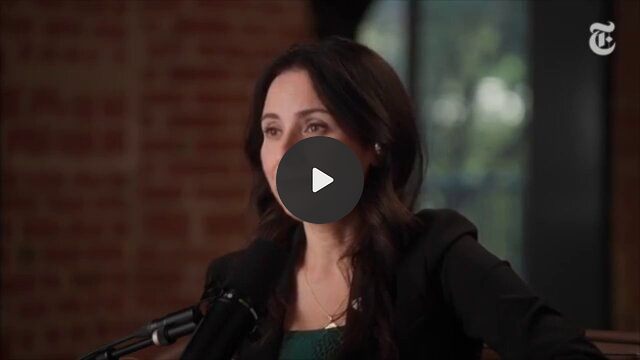
It’s like 1974 in another way too. Unlike earlier wave elections, like 1982, 2006, and 2018, this one seems ideological. That is, the new crop of Democrats have fundamentally different beliefs about the world than the incumbents. As Texas Governor-elect Gina Hinojosa argued, the core question is no longer progressive cultural politics, it’s economic power. To pick another race, you could look at the Texas Attorney General candidate, Nathan Johnson, who won his election on an explicit consumer protection and antimonopoly platform.

David Sirota@davidsirota
This contentious interchange between the NY Times and @GinaHinojosaTX was truly amazing. Hinojosa offered one of the best explanations of populism I've ever seen. Her comments were a total rejection of Corporate Dems' neoliberal formula. Her Texas victory is a game changer.
8:10 AM · Nov 4, 2026 · 177K Views
92 Replies · 697 Reposts · 4.26K Likes
In that sense, it’s more akin to the Watergate Babies on the left who ditched Wright Patman, or the Gingrich revolution on the right who got rid of the moderate Republicans in 1994.
This vote was clearly driven by anger at Donald Trump. The Iran War is deeply unpopular, and 73% of all voters link the conflict to persistently high gas and fuel prices. Heading into the final month of the midterm elections, some 75% of Americans were concerned about the rising cost of food and groceries. While Trump has tried to wrangle the economy with tariffs, voters overwhelmingly link tariffs to higher prices.
But there are other issues as well. Favorability toward the United States’ ongoing support for Israel has also plummeted among Democrats and Independents, and is declining among Republicans. On Election Day, Trump announced the government would be ending its $4 billion per year in military support for Israel by the end of 2026.
In essence, corporate power and the national security posture of the U.S. were both on the ballot. That is unusual and speaks to a broader mandate than just an angry anti-Trump vote.
How can I help?
If you are interested in governing in this new environment, please submit your resume to the resume bank that my organization, the American Economic Liberties Project, set up. There are going to be thousands of open slots for policymaking, communications, legal and investigative positions, across the country, and we are trying to find people who care about monopoly power to staff the newly elected political leaders and help them enact their agenda. So if you’re interested, please upload your details here.
How is Wall Street responding?
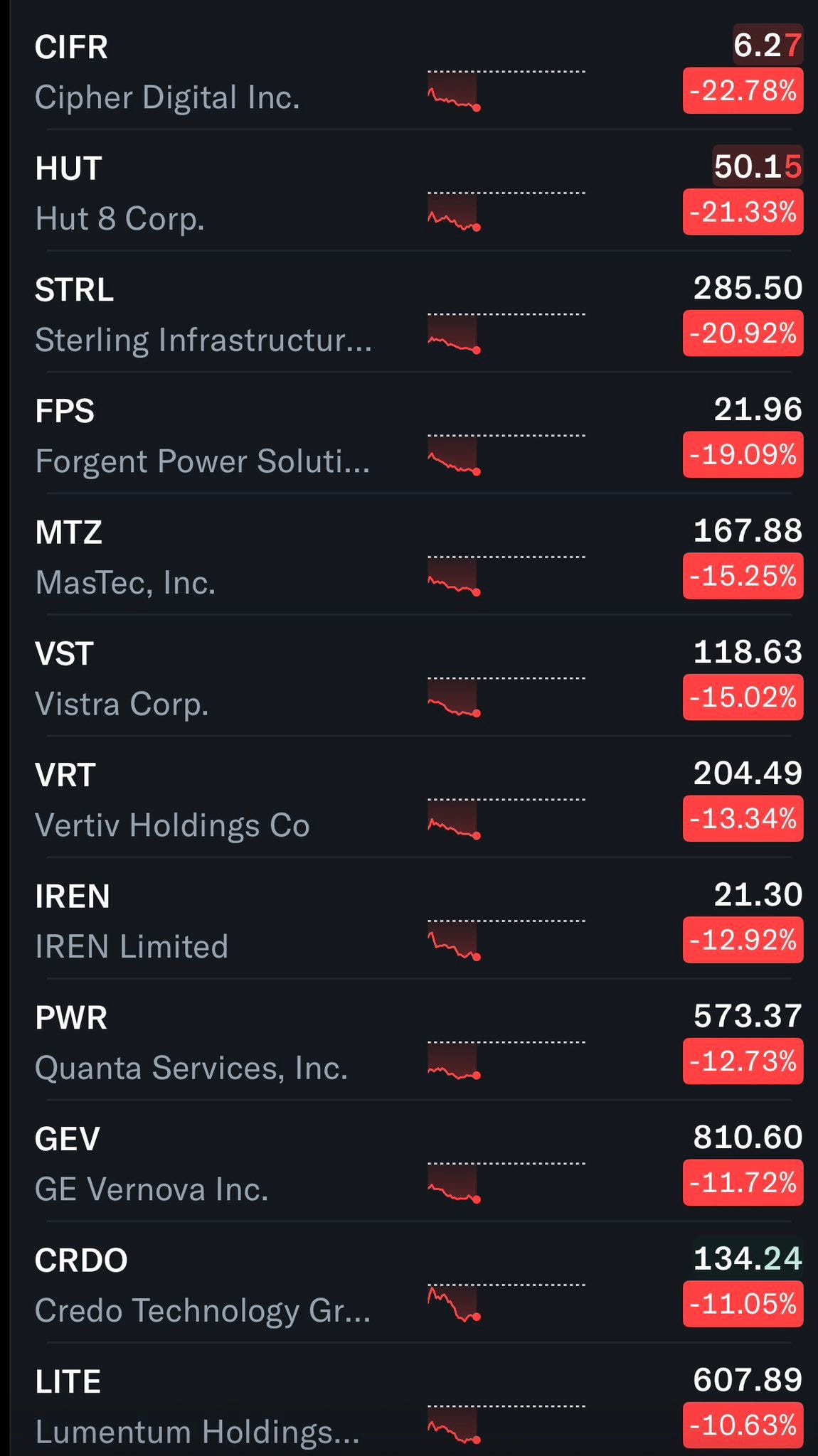
Already, we’re seeing the stock market manifest changes in capital flows. The stock market is surprisingly up; oil prices have crashed as traders expect Trump to wind down the conflict, and much of the market is up on the notion that “gridlock” will mean higher corporate profits and lower tariffs. Companies that offer Medicaid services increased in value, companies that offer privatized Medicare are lower, the data center build-out world is taking a hit as financing and permitting costs are set to increase, but those who already have data centers, namely the big tech hyperscalers, have done quite well.
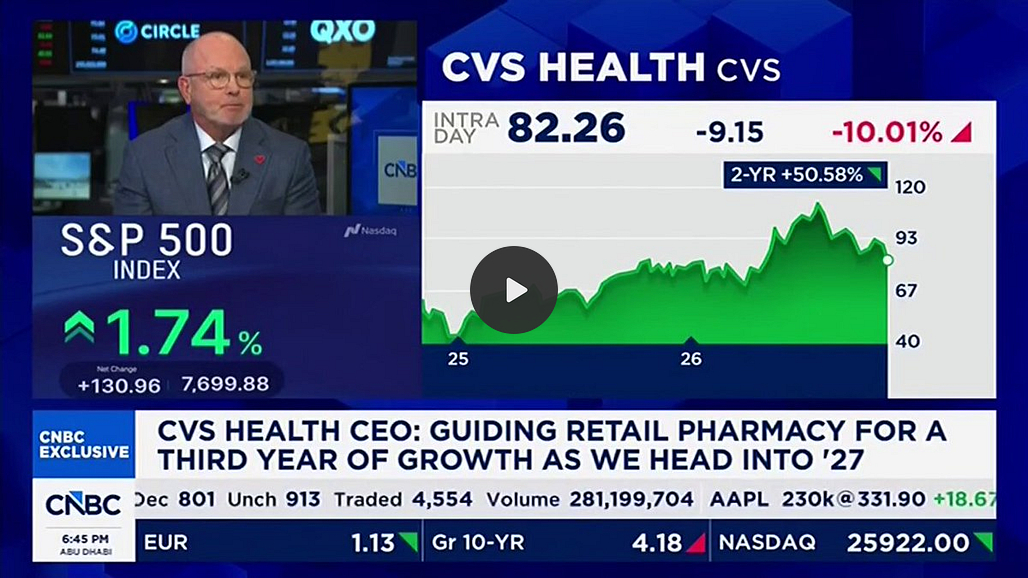
The new political environment has already had one significant consequence in the corporate world: the biggest break-up of the century so far. The $400 billion corporation CVS, which owns insurer giant Aetna and PBM Caremark, just announced it is preemptively splitting itself apart, in part due to the campaign to break up big medicine that BIG and all of you helped launch.
Here’s how it happened. Since 2016, pharmacy benefit managers have gotten more and more unpopular, especially since they are owned by insurers and pharmacy giants who use them to dispense medication in ways that prioritize profits over care. BIG covered CVS over the years, starting in 2020 with our piece “How CVS Became a Health Care Tyrant.”
Over the past few years, several states, including Arkansas and Tennessee, passed laws mandating the split up of pharmacies and PBMs. On a Federal level, Senators Josh Hawley and Elizabeth Warren introduced a similar package of laws, and newly elected Senators Abdul El-Sayed of Michigan and Annie Andrews of South Carolina - both doctors - were on board. The writing was on the wall, and now CVS is trying to get ahead of the politics by announcing it will be selling off most of its pharmacy operations. CEO David Joyner explained this morning that the anticipated regulatory scrutiny is one reason why:

American Economic Liberties Project@econliberties
The CEO of CVS says @SenWarren and @HawleyMO's Break Up Big Medicine bill is one of the reasons the company is breaking up! 👏
3:30 PM · Nov 4, 2026 · 4.81K Views
18 Reposts · 73 Likes
The actual split isn’t enough. The conglomerate is trying to keep their specialty pharmacy that sells the profitable drugs, while splitting off the less profitable physical pharmacies. But it’s a big deal that they are taking apart their empire. Big medicine is in real trouble.

Is this election an endorsement of a Democratic agenda?
Well, not really, or it’s at least yet to be seen. Since 2000, 11 of 13 elections have been “change” elections, meaning there’s a change in party control over the Presidency or at least one of the chambers of Congress. Voters are angry, and no one in power is doing much to assuage that anger, so frustrations are wielded against whatever party is in power. Democrats will soon have power, but they do not necessarily have the enduring trust of the public.
As I’ve mentioned in recent columns, that cynicism created a wedge in the discourse among Democrats, with Senator Schatz and Representative Casar squaring off recently over the extent to which Democrats should wield their power. Their sweeping success in the midterms certainly militates in favor of a mandate for bold action.
Now that Dems have won that power — taking back both the Senate and the House, and many state offices — Republicans are due for their own intra-party reckoning. If there is one certain outcome of the midterms, it’s that MAGA is dead.
Was this election an endorsement of the fight against oligarchy?
I think, yes. This was among the most expensive election cycles in American history, with $12 billion spent. Just 50 individuals were responsible for over $2.8 billion of that spending. In a country of about 343 million citizens, 0.00001458% — about 15 millionths of a percent — were responsible for over 23% of all election spending. And yet, the side with more money did not win.
One of the most notable political figures this cycle is the richest man in the world, Elon Musk, who cleared every previous record by spending $445.5 million in a single election cycle. In 2020, Musk moved his residence from California to Texas amid a clash with state officials. Over the next five years, he moved Tesla, SpaceX, and X/Twitter with him. He also became highly political, endorsing Trump, running DOGE, and then spent $190 million to elect Texas Republicans in the 2026 midterms.
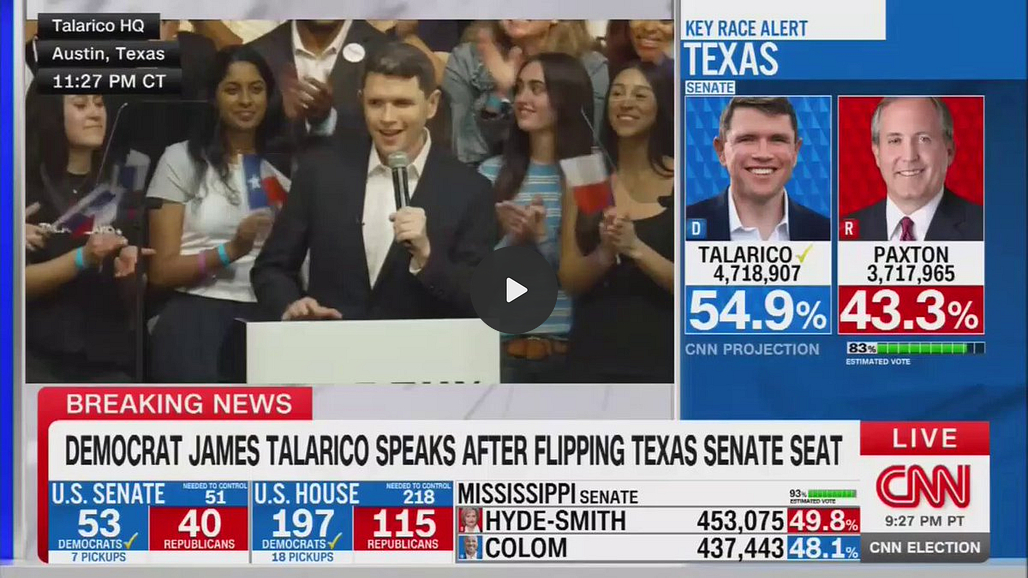
Yet, Texas is the bluest it’s been in 40 years. By the end of the election cycle, Democratic Senate candidate James Talarico was running against Texas AG Ken Paxton on paper, but had focused his rhetorical ire on the richest man in the world.

Team Talarico@TeamTalaricoHQ
.@jamestalarico: In this race, we went up against our own Goliaths. The richest man in the world, the most powerful man in the world, and the entire Washington D.C. establishment. David wasn't as big or as strong as Goliath. He didn't have as many weapons. But he had hope. He …
5:44 AM · Nov 4, 2026 · 29.4K Views
45 Replies · 268 Reposts · 1.72K Likes
Anyone can point to any number of reasons why Democrats in redder areas prevailed the way they did in these midterms. But to listen to, say, the Texas Democrats themselves, it was not about alienating voters with partisan posturing on culture issues, but with the rhetoric of economic populism, and a unifying “love thy neighbor” reorientation of politics in the state. It was a plea for moral clarity against power.
Did Anti-Monopoly Messaging Factor into the Election?
Yes. Heading into the elections, I put together a spreadsheet with every candidate I could find that explicitly ran on an anti-monopoly platform and came up with 71 legitimate Federal and some state candidates. The lion’s share were Democrat candidates, but there were a couple Republicans, too. And that was while I was trying to be conservative in my assessments. I’m not alone, it was fairly common for electoral analysts to notice the populist tone of the campaigns. One advocacy group found that Democrats spent $29 million on 154 ads that mentioned “Big Tech.”
As a campaign messaging example, Ohio Senate candidate Sherrod Brown won his race narrowly, pitching to voters, “I do not work for data centers. I do not work for Wall Street. I work for you.”
Elsewhere, I was tracking 41 local ballot measures across the country, in California, Florida, Illinois, Kansas, Maine, North Dakota, Ohio and Wisconsin, regarding whether to allow new construction of data centers. As of this writing, it would appear that every single one failed. When data centers are put before voters, the outcomes aren’t even close, with most opposition ending up in the 75-83 percent range.
And these losses weren’t due to a bunch of wealthy NIMBYs voting to preserve property values. In fact, the most damning rebuke came from Downe Township, New Jersey, an unincorporated community of about 1,400 residents in the state’s poorest county, which voted down a data center measure with 87% of the vote.
Did Anti-Monopolists win elected office?
Yes. I’m not going to go over every candidate I tracked, but here are a few that you probably didn’t see:
Josh Turek won his race for Senate in Iowa, flipping a red seat blue, while campaigning against vertical integration of healthcare, food price gouging, and private equity ownership of homes and farmland.
Ron Sand will lead from the Governor’s desk in Iowa, two years after leading the effort as State Auditor to block the Koch Industries’ acquisition of a fertilizer plant in Lee County.
Sam Forstag will be the first Democrat to win a Montana House seat in 30 years. He campaigned against meatpacker consolidation and private equity ownership of mobile home parks.
Roy Cooper won his “Make Stuff Cost Less” campaign for Senate in North Carolina pledging to block anti-competitive grocery and food processing mergers and to ban surveillance pricing and price fixing.
Antitrust attorney and former Colorado AG Phil Weiser handily won his bid to become the governor of the state.
Melat Kiros won her Congressional seat in Colorado and campaigned specifically on the Warren-Hawley Break Up Big Medicine bill.
In Georgia, Tanya Miller won her seat for Attorney General and pledged to “use the full antitrust authority of the office” to address food supply chain issues and ensure greater competition and lower prices.
In Arizona, Clara Pratte and Jonathon Hill won their statewide election to the state’s Corporation Commission, essentially the state’s public utilities commission. Both campaigned on making data centers pay their own share of utility utilization, and both criticized excessive utility profits.
In Texas, Clayton Tucker declared victory in his bid for statewide Agriculture Commissioner. His campaign included “busting monopolies that dominate the agriculture industry, such as Tyson Foods and John Deere.”
Aisha Wahab should win a full term Congressional seat in California, and has a record in the state legislature of supporting antitrust reform, and going after surveillance pricing and algorithmic price fixing.
Will Lawrence won a Congressional seat in Michigan, campaigning against Wall Street landlords and AI data centers.
There are many more, but the point overall is that anti-monopoly showed up in a way that it really hasn’t in a long time. And a lot is owed to Bernie Sanders and his Fight Oligarchy tour, which for the past two years has platformed candidates across the country, building the connective tissue between populist rhetoric, actual governance, and mass politics. My back-of-napkin calculation shows Sanders’ endorsed candidates, well over 50, won over 90% of their races, and about a dozen of them flipped their seats.
How did big money interests do?
In 1982, Democrats had a wave year in response to the Ronald Reagan recession, but the candidates they recruited were Wall Street-friendly types. As a result, the party turned increasingly towards a finance-first posture.
The 2026 midterms could have seen a similar dynamic. It might have been a situation where AI companies dominated politics with an endless bankroll, the same way the crypto billionaires like Ripple co-founder Chris Larsen emerged just a few years ago, using hundreds of millions of dollars to defeat populists and organizing the Republican Congress of the last few years. But that didn’t happen, as voters picked the candidates who had less money in an unusually large number of races.
Instead, as the populist dynamic became more apparent, the pro-AI SuperPAC Leading the Future, which counted VC billionaire Ron Conway among its major donors, and perennial political consultant-turned-crypto lobbyist Chris Lehane among its muscle, fell apart under the weight of AI’s undeniable want for popularity.
That’s not to say that corporate interests have no pull. Far from it. In California, the attempt to tax billionaire wealth failed among bitter fights among unions and over $317 million in opposition spending by the state’s billionaire class, and Xavier Becerra will become the new Governor with the backing of a lot of corporate support.
More broadly, there’s a reason the stock market is up, and that Wall Street Democrats are on CNBC talking up the virtues of incoming Speaker Hakeem Jeffries. Among investors, the consensus is that the high profit share economy will continue.
Was there a clear victory among the different factions within the Democratic Party?
Well, not really. While there were plenty of anti-monopoly candidates, there were also many candidates like Wisconsin Governor-elect David Crowley, a favorite of Silicon Valley. While many House incumbent Democrats lost in primaries, not a single incumbent Democrat Senator, with perhaps one exception, faced a competitive primary challenge. As a result, despite the large majorities, there is significant disagreement among Democrats over a host of questions, such as banking rules, AI, tariffs, and corporate power in general.
It’s worth noting the limited reach of another intellectual trend. Last year, the book Abundance came out, launched from the citadel of liberalism, the New York Times and the Atlantic. The Ezra Klein-Derek Thompson book, heralded as a “once-in-a-generation, paradigm-shifting call to renew a politics of plenty,” came out in March 2025 and sparked a deafening and frequently bitter discourse over the future of the Democratic Party and governance more broadly.
The Abundance proponents argued for supply side increases to address cost challenges. They broadly emphasized technocratic approaches to delivering prosperity through the streamlining of permit issuance and stripping of bureaucratic red tape. But little of their agenda showed up in campaigns. And in California, the heart of their movement, Prop 45, the statewide ballot measure to speed up environmental review of “essential projects,” is lagging 54-45. It’s not that Abundance “failed,” but it is an elite persuasion vehicle, and has not broadened into electoral politics.
Is there a Mandate? Governing Matters.
The mandate of this election, if those who are about to wield power will heed it, is to negotiate a change in course. Some 250 years ago, that negotiation produced our Constitution. Since, it has produced laws like the Sherman Act, the Clayton Act, and the Federal Trade Commission Act. Indeed, some of the most transformational laws in U.S. history — laws like the Glass-Steagall Act, the Securities Exchange Act, the National Labor Relations Act, the Social Security Act, and the Fair Labor Standards Act — were passed during a brief span of years following the Great Depression, as part of the New Deal. The next Congress, and the Congress after it, should aspire to similar transformative work.
But these laws, as well as the associated executive authority used to enforce them, came from legislatures who had in-depth knowledge of how our economy worked and the confidence to govern. Without offering criticism, I’ll note that many of the people who just took office are neophytes to their positions, and it would be unsurprising if they were skittish about offending the powerful without having done it before. Many won’t have the knowledge or experience to do so capably or competently. Others will.
America excels at producing leaders, good and bad, from the random clay of its citizenry. Ten years ago, Zohran Mamdani was a random housing counselor and hip hop artist. Fifteen years ago, Donald Trump was a real estate developer and reality TV star. But underneath these characters is a large group of lawyers, business people, analysts, policymakers, workers, and citizens, who offer the advice and help to build the kind of society they value. That’s governing. It’s a team sport.
And with that, I’ll make the pitch, once again, for you to submit your resume here. Or find other ways to get involved. It took hundreds of thousands of people decades to make the mess we’re in, and it’s going to take an equal amount of time and effort to get us out of it. Governing is hard, it’s not particularly well-paid, but it’s incredibly fun and meaningful. So if you want to try, you should. Now is the moment.
Thanks for reading! My name is Lee Hepner, I’m a guest-writer for BIG while Matt is out on paternity leave. Your tips make this newsletter what it is, so please send tips on weird monopolies, stories I’ve missed, or other thoughts. And if you liked this issue of BIG, you can sign up here for more issues, a newsletter on how to restore fair commerce, innovation, and democracy. Consider becoming a paying subscriber to support this work, or if you are a paying subscriber, giving a gift subscription to a friend, colleague, or family member.
cheers,
Lee Hepner