Today’s news of the week has a lot of good and bad stuff in it, as usual. This week’s round-up is a bit unusual, in that I’m going to start by offering some historical perspective on the relationship between fascism and monopoly power.
But first, some house-keeping. I try to only send out a few emails a week to keep your inbox clean, but there’s a lot of great stuff that BIG is putting out you can access. I’ve been enjoying Big Tech on Trial, which is giving daily recaps of the Meta antitrust case. This trial will shape how we communicate with one another and involves a multi-trillion dollar global political kingmaker, yet Big Tech on Trial is one of the only media outlets actually covering the daily goings-on. Read about the testimony of Mark Zuckerberg, Sheryl Sandberg, and TikTok COO V Pappas. Also, Dave Dayen and I have been doing a weekly podcast called Organized Money. Last week, we talked with Facebook co-founder Chris Hughes. Give it a listen.
Ok, let’s talk fascism and big business.
“What the extreme socialist favors, because of his creed, the extreme capitalist favors, because of his greed.” — Antitrust Division chief Robert Jackson, 1938
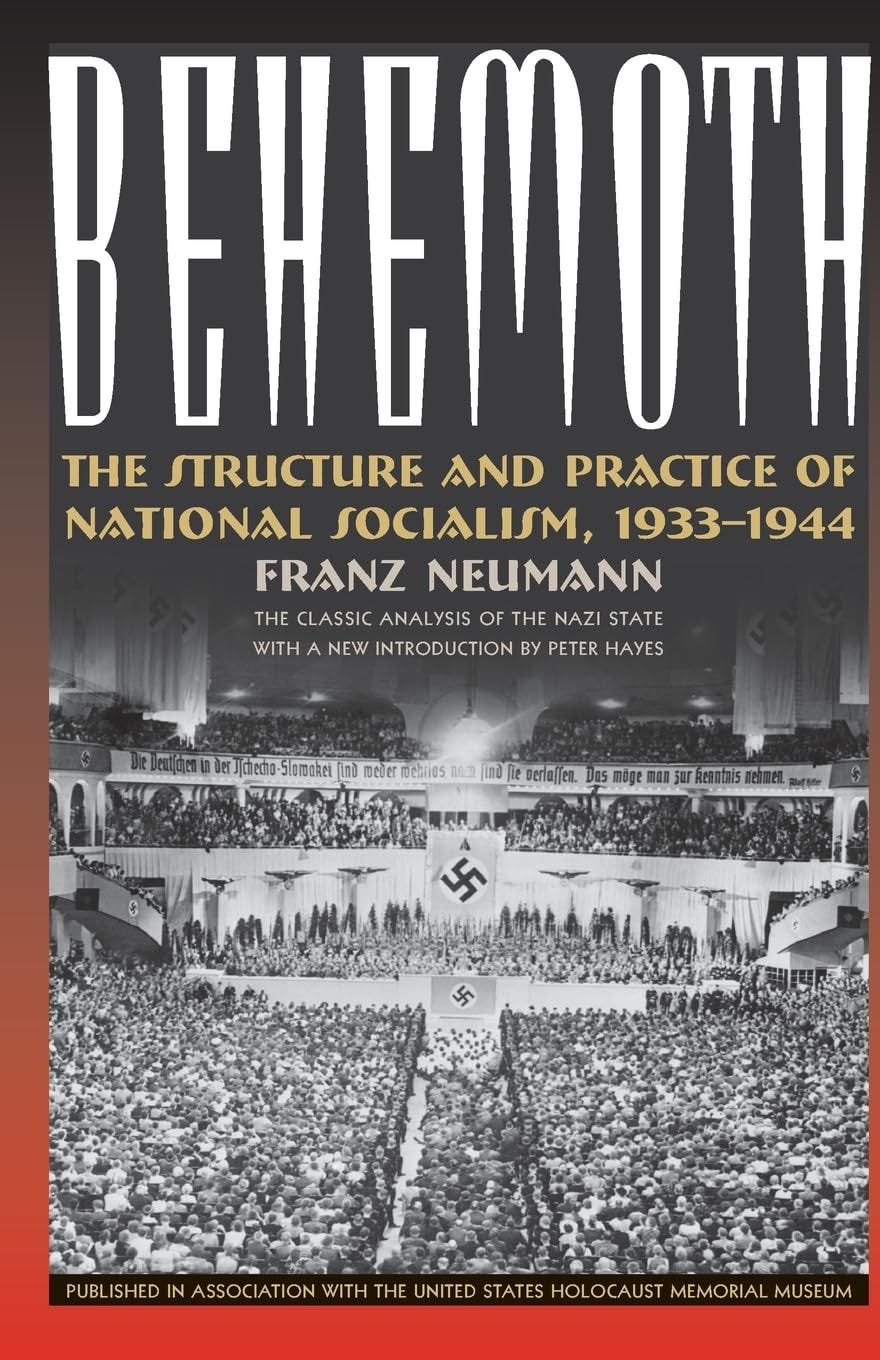
In his 1944 book Behemoth The Structure And Practice Of National Socialism, labor lawyer turned political scientist Franz Neumann analyzed the structure of the Nazi state. In many ways, Behemoth helped frame how Americans understood Nazism for generations, including beginning the unmasking of the centrality of racism and anti-semitism to the state. Neumann was a German Jew and a member of the Social Democratic Party, narrowly escaping arrest by fleeing to England after Hitler came to power. His later career was in America; during the war he worked for the forerunner of the CIA, the OSS, and assisted Supreme Court Justice turned prosecutor Robert Jackson at the Nuremberg trials.
I came upon Neumann’s book in the mid-2010s, when I was researching the post-financial crisis moment in America. It was pretty obvious to me back then that America was headed for some hard times, and my first attempt to sketch out the unstable political waters in which we were swimming was a 2012 article called The Housing Crash and the End of American Citizenship. Eventually I began looking at political debates surrounding the 1929 stock market crash, as the nation slid from prosperity into a deep anxiety inducing depression.
What I found surprised me, though it probably shouldn’t have. In the 1920s and 1930s, American policymakers were thinking very hard about fascism. They weren’t, however, seeing it as a totem of evil, but as a rival system that, along with Communism, presented a genuine moral challenge to democracy. They also distinguished between fascism and Nazism. It’s been airbrushed out of history, but many American businessmen and intellectuals in the 1920s felt warmly towards Benito Mussolini, who they felt had built a coherent Italian state. Herbert Croly, for instance, wrote in the pages of The New Republic that “the Fascist route has its significant and even promising aspects,” substituting “movement for stagnation, purposive behavior for drifting and visions of a great future for collective pettiness and discouragement.”
The 1920s was a very different decade than that of the 1930s; in the 1920s, disdain for democracy was taken for granted among a large swathe of the intelligentsia, as American businessmen raged against the new Soviet Union. But after the market crash, the stakes changed. Hitler was mostly loathed, not just because he was much more obviously brutal and malevolent, but also because, unlike Mussolini, he refused to pay war debts. But also, New Dealers saw in the murderous leadership of the German state one possible fate of a failed democracy, something that could happen here if they didn’t deliver.
And delivering meant something specific, it was to liberate the public from corporate oligarchy. This stuff is all over the archives, speeches, and commentary of the time.
“Monopoly constitutes the death of capitalism and the genesis of authoritarian government,” said the Federal Trade Commission in 1939. In 1940, populist Democrat Rep. Wright Patman went on NBC radio and attacked domestic chain stores like A&P for driving small stores out of business. “We, the American people, want no part of monopolistic dictatorship in either our American government or in our American business,” he said. “Think of Hitler. Think of Stalin. Think of Mussolini. Let’s keep Hitler’s methods of government and business in Europe.” It’s unusual now to allege that Walmart or Amazon are bulwarks of fascism, but back then, seeing bigness as a political alternative to democracy was routine.
Anti-fascism arguments animated antitrust enforcement. Thurman Arnold, the legendary enforcer who built modern antitrust, was in office from 1938-1943, and during that time he brought more cases than had been brought from the original passage of the Sherman Act to him assuming office. Arnold pinned fascism on Germany’s tolerance of cartels. In 1939, he gave a speech arguing that the German “cartel system never gave the results of stabilization which were predicted, but it did so far organize Germany that it had to have a general. Germany became organized to such an extent that a Fuehrer was inevitable, and if it had not been Hitler, it would have been someone else.”
Business elites used the specter of fascism as well. During a debate over allowing the government to inject private capital into industry, in what was known as the Reconstruction Finance Corporation, the head of the Investment Bankers Association declared that "government financing for private capital was 'a short cut to national socialism.’” Arthur Krock of The New York Times called it "totalitarian." This debate was a big deal; the RFC ultimately financed a third of all war plants using this authority, and bailed out banks, railroads, electric utilities, and municipalities nationwide. All sides argued that fascism was the fate of the nation, should we make the wrong political choice.
During the war, dismantling cartels became an object of victory. Franklin Delano Roosevelt wrote to Secretary of State Cordell Hull in 1944, arguing that "Defeat of the Nazi armies will have to be followed by the eradication of these cartel weapons of economic warfare. I hope you will keep your eyes on this whole subject of international cartels.” The FTC sent hundreds of people to Germany and Japan to de-concentrate those economies.
Neumann’s book, therefore, was received warmly. For Neumann, a key driver of the rise of the Nazi movement was monopolization, because he saw it as a system of economic control that was totally compatible with, and indeed encouraged, the rise of an authoritarian government. He noted that the Weimar Republic oversaw a massive merger wave; chemical giant IG Farben was a result of the combination of six firms in 1925. The Social Democrats, he argued, failed because they “did not see that the central problem was the imperialism of German monopoly capital, becoming ever more urgent with the continued growth of the process of monopolization. The more monopoly grew, the more incompatible it became with the political democracy.”
In the U.S., however, our antitrust laws saved our democracy. “In Germany,” Neuman wrote, “there was never anything like the popular antimonopoly movement of the United States under Theodore Roosevelt and Woodrow Wilson.” The Sherman Act, in other words, wasn’t perfect, but it did stop the rise of fascism. This kind of influence is obvious in decisions at the the time, which had deep moral rhetoric. In 1945, Judge Learned Hand ruled that Alcoa was a monopoly, noting that “among the purposes of Congress in 1890 was a desire to put an end to great aggregations of capital because of the helplessness of the individual before them.”
For years after the war, fear of fascism and communism, both of which were centralized systems, fostered support for aggressive antitrust enforcement. As West Virginia Senator Harley M. Kilgore noted in 1949 during debates over a key update to anti-merger law, “Germany under the Nazi set-up built up a great series of industrial monopolies in steel, rubber, coal and other materials. The monopolies soon got control of Germany, brought Hitler to power and forced virtually the whole world into war.” Preserving a competitive system, not just rivalry but also small business, was done explicitly as a measure to block centralized political power.
One of the great intellectual triumphs of both the Chicago School and the New Left historical frameworks of the 1960s and 1970s was to airbrush this history out of the American mind. After the 1970s, making the case that antitrust had some sort of import aside from technocratic improvements in efficiency were grounds for mockery, and no one would imagine bringing them into a courtroom or policy debate.
The anti-fascist roots of modern antitrust were not completely forgotten. Wyatt Wells in 2003 wrote an important book, Antitrust and the Formation of the Postwar World. But it took the modern anti-monopoly movement to revive the arguments. In 2016, I put out an article in the Atlantic, How the Democrats Killed Their Populist Soul, a forerunner to my 2019 book Goliath. At the time, as Trump was on the verge of winning his first term, there was a boomlet of fake fascism “experts,” so I went through how Americans at the time of the rise of the Nazis understood the problem, and why Democrats forgot about those hard-won lessons. Eventually this caught on. As part of the anti-monopoly revival, Google and Paul Weiss lawyer Daniel Crane and Columbia scholar Tim Wu, made the point too. It’s all over the archives, and impossible to miss.
All of this context brings me to what’s happening right now. What we’ve seen over the past fifteen years, and what Trump has accelerated in his first 100 days, is a lesson - centralized economic power begets centralized political power - in action. It’s not a left-wing or right-wing lesson. Starting in 2018, the right began to fear big tech platforms. A few years later, their fears were validated, as they saw how Google, Facebook, Twitter, and Amazon de-platformed Trump and had the power to censor their views. Many conservatives began to rethink some of their prior libertarian assumptions, and that’s a reason that the antitrust cases against big tech are continuing under Trump.
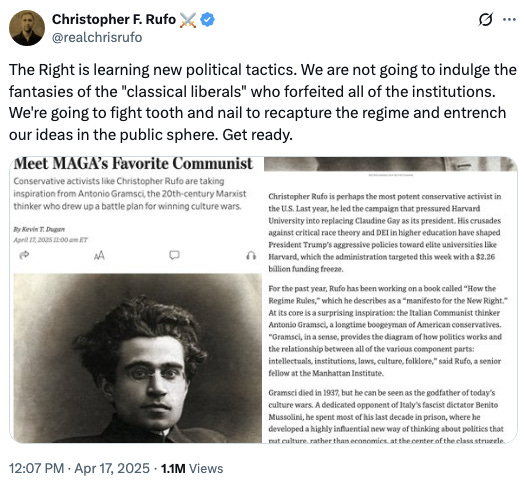
That said, parts of Trump’s coalition seem to have drawn the lesson that centralized power isn’t so much a dangerous threat to liberty so much as a useful tool for changing a social order they don’t like. Here’s prominent right-wing activist Christopher Rufo, making that point.
And today, Trump is offering a master class to Democrats on the perils of centralization. He is using executive orders to threaten giant law firms, universities, and large corporations. And he’s able to do it because we have a very top heavy economy. Take the humiliation of big law firms like Paul Weiss, which caters to big tech and private equity, often in requesting things from government. Trump basically said the clients of these law firms will face repercussions, and pretty much all of them rely on the Federal government for contracts. And at this point, there just aren’t that many big clients, the number of public companies has halved since the 1990s. As Jonathan Kanter explained on our podcast, a nation with lots of regional elite law firms catering to medium-sized corporations headquartered all over the country just doesn’t exist anymore. We’re too centralized. And that makes it much easier for a willing President to subdue whoever he chooses.
Now, I’m not saying we’re headed for fascism; we still have millions of small businesses, and a lot of people have some private property, and that’s a bulwark against authoritarianism. As revolutionary era Congressman William Findley put it, “Wealth in many hands is many checks.” I also don’t think Trump is a fascist, since he is liquidating significant amounts of state capacity. Purely on an instrumental level, fascist leaders like bigger states, not smaller ones, because they need a lot of institutional capacity to control everything. Put differently, it’s just harder to use the IRS to go after enemies if you are firing half the workforce.
Most importantly, I am just not seeing a straight line trend of consolidation, which is one thing Neumann made clear happened in the Nazi state. Last week, Google, one of the largest companies in the world, lost its third antitrust trial. Meta is on trial as well, and may face a break-up. The very Republican state of Arkansas just passed a law splitting apart giant health care conglomerates, at the behest of independent pharmacists. The largest liquor distributor in the nation, Southern Glazer’s, just lost an important decision on whether it is allowed to discriminate against small independent stores. Competition, where it is allowed, is flourishing.
That said, I do think it’s worth remembering that you cannot separate economics and politics. There is no world in which Google flourishes as a monopoly and America flourishes as a political democracy. We must choose. Since the 1970s, we have chosen poorly, and Americans have become more tolerant of authoritarianism in politics, as it just doesn’t seem that different than what they see in commerce. I mean, when I note how petty it is to fire government employees and not even let them collect their desk belongings, one response I hear is a smug variant of “well that’s how it happens in the private sector.” What’s upsetting about this comment isn’t the callousness of it, it is that it’s correct. When we allow authoritarian behavior in commerce, we are inviting it into politics. When we consolidate economic power, we invite our enemies to use it against us. And I don’t care who you support in politics, that should scare you.
And now, the news of the week. Lots happened, including the beginning of the end of big box tyranny as the FTC won an important motion blocking the main unfair tactic used by big chain stores. Plus, UnitedHealth Group loses $100 billion in market capitalization, Trump made some gruesome changes to Federal procurement rules, the private equity business is in more trouble, and some very disturbing news about a possible Facebook settlement.
Oh, and here’s a fun quote from a 2018 Mark Zuckerberg email on whether to split apart Facebook that was just revealed at trial: “While most companies resist break ups, the corporate history is that most companies actually perform better after they've been split up.”
Read on.