In three weeks, Americans are about to vote for change in a midterm election. It will be the seventh straight election that they have done so, even though nothing seems to make any difference. A few weeks after casting their votes, they will experience the high costs and frustrations of travel, as they head on Thanksgiving and then Christmas holiday. Travel isn’t why people are angry, but the cause of the anger, a rigged system reaching into our pockets constantly and persistently, is very much on display when you get on the road.
As travel writer Christopher Elliott notes, it isn’t just one cost upsetting customers; it’s a whole set of overlapping fees and nickel-and-diming in the experience, the canceled flights, higher gas prices, and bank-busting hotel prices. Lodging is particularly bad, he argues, showing a “surge in average U.S. hotel rates, from $103 a night in 2020 to $162 a night in 2025, an increase of almost 58%.”
Most discussions about travel costs by the media frame the cause as high demand, oil prices, or too much consumer spending. Americans just want to see each other, and alas, that’s costly. But I’m going to explain why they are wrong, and what we’re dealing with is an obvious conspiracy. It’s called Expedia, and it is responsible for 80% of every dollar spent booking hotels on the internet. And for a frame of reference, on its last investor call, the company noted that price per hotel booking increased by 5% over the last year, which is twice the rate of inflation.
Now, Expedia is not the only conspiracy at work here. There are others, such as hotel consolidation, junk fees, and hidden pricing algorithms. But what Expedia is doing is worth highlighting, because it plays a sort of ringmaster role in setting prices in the hotel space, not just for people who use Expedia, but even for those who don’t. The story is explained in a new lawsuit alleging a price fixing conspiracy engineered by the firm.
Here’s how it works.
Expedia has power because of its huge share of online bookings. If you are a hotel, you must list on the site, or you can’t get customers. The lawsuit alleges that Expedia Group, which also owns Hotels.com, Travelocity, and Orbitz, leverages its status as a critical channel for booking to charge hotels commissions anywhere from 15% to 30%. Indeed, the company’s executives bragged to investors in August about this pricing power, chalking up increased profit margins to “our supplier-funded promotions,” which are the kickbacks that hotels offer the middleman.
But there’s an important second layer to the problem. Those commissions get baked into hotel prices not just on Expedia but on direct bookings with hotels and other online travel agencies, like Booking.com, which also owns Priceline, Kayak, and Agoda. It even gets baked into higher prices for most hotels on their own websites.
According to the lawsuit, hotels listed on Expedia are subject to what’s called a most-favored-nation clause. An MFN is a contract that says they have to give Expedia their best price, and they can’t offer a lower price anywhere else. That’s why when you go to a hotel website, it’s rarely lower than Expedia, even though it’s buying direct. Now, this dynamic wouldn’t be a problem if Expedia didn’t charge high fees. But it does. So if a hotel raises their prices on Expedia to recover Expedia’s 15-30% commission on each booking, they can’t also charge a lower price on their own website or on other booking channels that don’t charge that 15-30% commission. The commission is baked into every distribution channel.
There’s an enforcement mechanism for hotels who disobey. According to the suit, Expedia suppresses hotels in Expedia’s search results when hotels offer lower prices on their own websites or in other channels. If a hotel performs poorly on “rate competitiveness” – which is not at all about price competition but rather about ensuring that Expedia’s listings reflect the lowest price in the market – its listings are demoted in search results.

To state the obvious, being listed higher in search results is critical for increasing hotel bookings. Expedia itself advises properties that appear in the top 10 of search results receive 62% of clicks.
Expedia also has an “automatic rate match” tool that alerts hotels when they offer lower rates outside of Expedia and automatically lowers rates on Expedia to match the “best available rate.” The automatic rate matching tool further suppresses competition with non-Expedia booking sites, and is a self-executing mechanism that hotels are coerced into using.
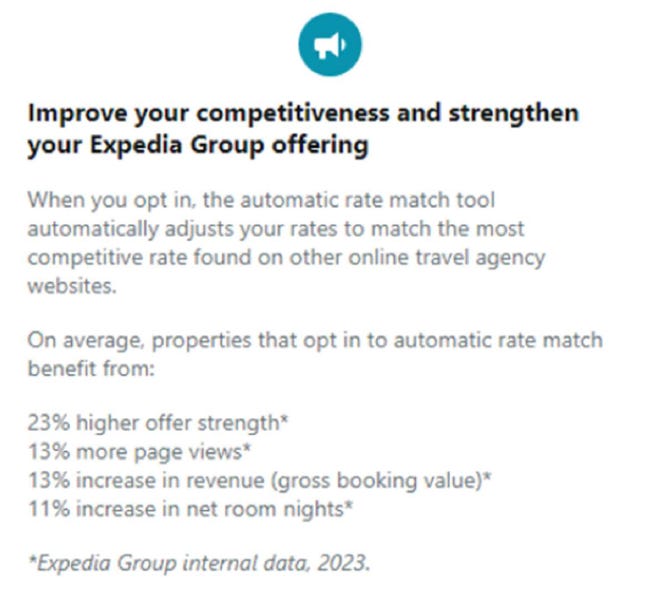
Finally, Expedia offers a VIP Access program that gives hotels access to Expedia-operated marketing campaigns and results in 42% higher bookings than non-VIP listings. In order to be eligible for the VIP Access program, hotels are required to price rooms 10-25% higher on non-Expedia channels indefinitely. So the VIP Access program isn’t just about rate parity with other booking channels. It kills nascent competition, and it serves as a de facto rate inflation scheme for all listings outside of Expedia.
There’s a silver lining here, though not for you and me. The high prices we pay for travel are mirrored in the high profits to Expedia, whose stock is up by 65% since the war in Iran started last April. Their CEO, Ariane Gorin, just can’t help but brag to investors about the higher margins from higher prices. That’s almost certainly not flowing back to the hotels themselves, as Gorin pointed out the company’s margin increase is coming from the hotels who pay for advertising to access Expedia customers.
In August, Matt wrote about how Expedia cheats both customers and hotels, and its contract is so strict that the hotel owner wasn’t even allowed to show the fee he had to pay the online booking middleman:
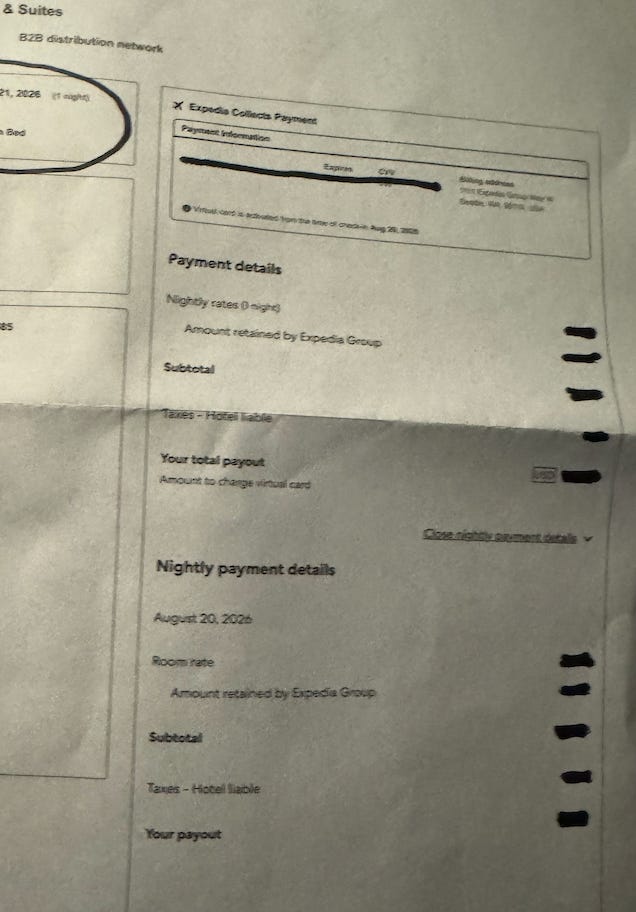
The new lawsuit just adds some texture. Now, I posted about this scheme on social media a couple of days ago, and a lot of people have responded that this is why they don’t use Expedia, or are incredulous that anyone still does (they quantifiably do.) Others have encouraged an Expedia boycott. But these responses miss the central point of the alleged Expedia scheme: You are paying higher hotel prices whether you book on Expedia or not. Expedia’s restraints inflate hotel prices on the hotel’s own booking channel and on all other online travel agencies. You can’t simply avoid higher prices on Expedia by booking elsewhere, because Expedia’s commissions and most-favored-nation provisions permeate every other booking channel, too.
The allegations against Expedia have also elicited frustration that the entire economy seems to be rigged. Not only is this observation correct, but many markets are rigged in exactly the same way that Expedia allegedly rigs hotel prices.
The clearest analog are the allegations against Amazon, now pending in major lawsuits by the Federal Trade Commission and the State of California, which allege Amazon is hiking prices across the retail economy through a coercive price parity scheme that looks strikingly similar to Expedia’s. Amazon too, punishes third party sellers on its platform by eliminating the coveted “Buy Box” from product listings when those sellers offer lower prices on non-Amazon channels. Removing the Buy Box can decimate a seller’s whole business, much like how Expedia has become a critical booking channel for hotels. So, while Amazon holds itself out as the place to find lowest price details, those prices are only low relative to the higher prices coerced by Amazon.
Other parallels can be observed in online food delivery platforms like Uber Eats and DoorDash, which, along with Postmates (acquired by Uber Eats in 2020) and Caviar (acquired by DoorDash in 2019), faced restaurant industry blowback and regulatory scrutiny in 2019 even before shelter-in-place orders decimated in-restaurant dining and made online food delivery services all-but essential. A big part of that controversy was about food delivery platforms charging 30% commissions to restaurants listed on their platforms (often without their consent), while restricting restaurants from offering cheaper menu prices for dining in. (A feather in my cap, several years ago now I wrote the first municipal law capping predatory restaurant commissions and liberating restaurants from margin-destroying price parity clauses.) Similar to the allegations against Expedia, that 30% commission risked being priced into menu items even for non-delivery dining, or else restaurants, with their notoriously thin margins, had to figure out how else to eat the added costs.
There’s also an important consolidation story here. As mentioned above, Expedia Group also owns Hotels.com, Travelocity, and Orbitz, all of which were acquired by Expedia in 2015. Booking Holdings, formerly Priceline Group, has an eye-popping string of multi-billion dollar acquisitions stretching back two decades, and now owns Priceline, Booking.com, Kayak, and Agoda. Booking Holdings expanded beyond hotels when it acquired OpenTable in 2014 for $2.6 billion, which isn’t exactly relevant to hotel bookings, but is nevertheless a shocking data point in the empire-by-acquisition story.
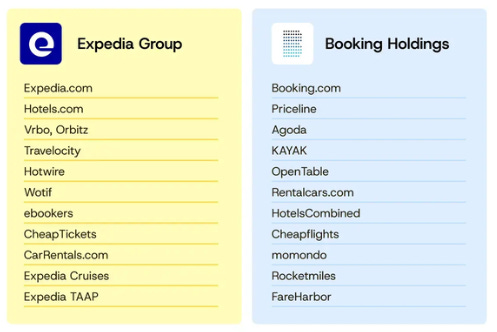
So, to the extent you’d expect more competition on all of these online travel agencies, even without Expedia’s alleged pricing restraints you’re actually seeing very little. That’s bad for hotels seeking better commission structures and, ultimately, for travelers who end up absorbing higher hotel prices.
If all of this is true, the “lowest price,” whether on Amazon or Expedia, is a mask for economy-wide market-rigging schemes that actually bake monopoly commissions and other fees into the prices of goods and services, while preventing the very price competition that would lower prices further. If Expedia is the lowest price platform, it’s only because they prohibit hotels from offering their prices at lower rates anywhere else.
To turn a phrase, one might call it “artificial inflation,” and Expedia’s alleged conduct is only one piece of the puzzle.
The infrastructure of our economy is rigged, and even though the allegations against Expedia implicate potential 30% price hikes across the board, it would be too convenient to lay all of the frustration at Expedia’s feet. More accurate would be to situate the allegations against Expedia in a decades-long multi-layered scheme to maximize profits, cut competition, and push the boundaries of consumer willingness to pay.
The longest-running gambit is the trend toward consolidation across the hotel industry. Hotel markets are geographically localized, which makes sense inasmuch as the level of industry concentration in a place like New York City has little to say about the number of competitors in Detroit. Markets have also become more segmented in the past half century, with different classes of hotels catering to, say, business travelers with limited needs, as opposed to more full-service hotel suites. With those significant caveats aside, the consolidation of brands under just a few hotel groups is startling.
Marriott’s $13.6 billion acquisition of Starwood Hotels in 2016 made it the largest hotel company in the world, with 30 brands (since expanded to 39 brands) spanning luxury offerings to more affordable “select” options. In February 2016, the FTC and DOJ cleared the acquisition, which was the largest hotel merger in decades, consolidating 1.1 million hotel rooms across 110 countries, without so much as a second request regarding potential anti-competitive effects:
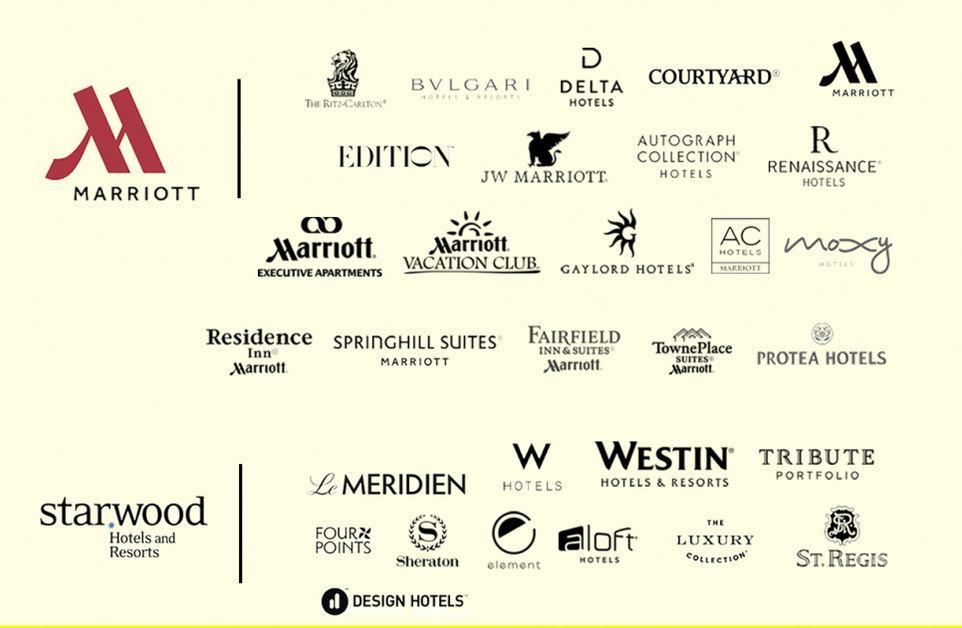
Today, just three brands — Hilton, Marriott, and Choice International - represent 56% of the top 10 hotel brands in the country, by number of locations, and the array of brands under each hotel group lends to a false impression of competition. Competition between hotel groups, or inter-brand competition, is softened by two other features of the hotel industry: First, loyalty programs that encourage brand loyalty at the hotel group level and reduce the likelihood that participants will interact with different hotel groups as actual competitors for their patronage. And second, non-exclusive franchisor-franchisee relationships, which can lead to a single franchisee controlling pricing and other competitive decisions across different hotel brands in the same area.
Ultimately, decades of concentration and the spawning of new hotel brands — often with the purpose of cutting off independent entrants — betrays what the naked eye might otherwise perceive as robust competition.
Another layer of enshittification is an alleged algorithmic price fixing scheme that spans every major hotel group in the country. In recent years, multiple lawsuits have exposed the scourge of algorithmic market rigging among hotels. Among the largest is a lawsuit against virtually every major hotel chain and a company called SAS Institute, a business analytics firm that offers AI-based pricing “solutions,” including the G3 Revenue Management System. The extensive complaint sheds light on how decision making algorithms are automating price decisions that “drive incremental revenue,” aka price increases. An interesting wrinkle in all of this is that hotel chains are also chasing upstream financial investment, including by private equity firms, so participation in a data-sharing and price optimization scheme becomes yet another variable for survival.
Other cases, like Gibson v. Cendyn and Cornish-Adebiyi v. Caesars, have gone after more localized algorithmic price fixing schemes in high-propensity tourist markets, like the Las Vegas Strip and Atlantic City. I wrote about Cendyn’s algorithmic pricing tool, hilariously called “Rainmaker,” for BIG a few years ago in a piece called “The Banality of Price Fixing.” Both the Gibson and Cornish-Adebiyi cases allege that participating hotels used the same algorithmic pricing services to automatically accept recommended prices 90% of the time, meaning individual hotels had basically delegated their core pricing decisions to the same third party. But only the case against Caesars has been allowed to proceed, while the 9th Circuit dismissed the Gibson case without allowing plaintiffs to uncover the details of how the Rainmaker algorithm functioned.
The collapse of the Gibson case is not necessarily attributable to it being a weaker case on the merits, but because 20 years ago, the Supreme Court, in a case called Twombly, granted corporations another shield, in the form of a new mandate for judges to kick cases out of court based on limited available facts. Even the “Dean of the Antitrust Bar” Herb Hovenkamp, who is notoriously antagonistic to Neo-Brandesians, and whose treatise — it should be noted — is quoted throughout the Twombly opinion, is scrambling to make sense of the consequent proliferation of “cartel management services.”
I’ll ask you to excuse this brief legal rant with the following takeaway: Price fixing has always been patently illegal, at least in principle, but today, price fixing conspiracies are concealed in code, which makes them harder to detect and harder to prevent. The age of illegal business dealings in smoky back rooms has been replaced by the proliferation of far more efficient and widespread algorithmic cartels. And while Congress could easily fix this and kill a lot of illegal cartels in their cradle, doing so would make a lot of private equity firms mad.
On top of the consolidation and optimized price fixing is a final layer of enshittification, which is the retail deception that too many people in America are intimately familiar with. This is where you find pricing scams like “junk fees,” which conceal the all-in price of hotel rooms with miscellaneous, unavoidable charges added at checkout. This is the “resort fee,” or the “booking fee,” or any other number of inexplicable charges tacked onto the advertised price of a hotel room.
There’s been good progress at the policy level to address junk fees, including a rule banning junk fees under Lina Khan’s FTC, but compliance is another issue. For example, I was recently headed to DC on a work trip and quickly snagged a room at one of my favorite hotels when I saw a pretty good deal on third-party booking site Agoda. But when it came time to check in, the hotel hit me with a $40 per night resort fee — more than 15% of the reservation price. Now, my modus operandi here is never to be rude to a customer service representative, they aren’t punching bags for bad decisions made in boardrooms, but I did ask about it. And, lo and behold, in the small print of the Agoda reservation was a disclosure that I’d be charged a resort fee at the property itself.
It’s a classic case of deception, inducing consumers to purchase at what appears to be a good deal, only to tack on unavoidable, hidden fees that erase the deal entirely. In my case, the property absolved itself of responsibility.
It brings me no joy to write another story about how everything is bad and this is why we can’t have good things. So let’s be clear: The case against Expedia is good news. The pending cases against the major hotel chains for forming nationwide and local cartels to fix hotel rates is also good news. The fact that a wave of lawmakers is taking it upon themselves to pass new laws reinforcing consumer protection laws against junk fees, and making it easier to bring price fixing cases in the first instance is GOOD news.
If antitrust laws can be successfully enforced — a prospect made more difficult by a string of Supreme Court decisions dating back a couple of decades, principally Twombly and Leegin — maybe we can have good things. That looks like forcing prices to be set competitively, liberated from the restraints of central coordinating platforms or coercive third-party pricing services. That means a return to the “heads in beds” strategy of setting hotel prices, where the imperative is to maximize bookings, even if that means offering a lower-than-”optimal” price that only seeks to maximize revenue. Unrigging the market will also lend to a greater likelihood of independent market entry, because rigged markets constrain the beneficial risk-taking necessary to align financial investment with innovative business propositions. And so on.
And it’s all possible if we demand a populist reorientation of our politics that is laser-focused on holding the powerful accountable. An antitrust and consumer protection movement with actual teeth:

Seth Harp@sethharpesq
Worth remember that price inflation in the USA is driven above all by the complete lack of federal, state, & local enforcement of laws against anticompetitive, monopolistic business practices -- stratagems to which capitalists will constantly resort if not regulated by the state.

Lee Hepner @LeeHepner
Why are hotels so expensive? A new lawsuit alleges that travel website Expedia is rigging the entire market, exploiting its leverage over 80% of all online bookings to inflate hotel prices in every booking channel by 15-30%. It's an economy-wide price fixing scheme, not unlike
1:34 AM · Oct 13, 2026 · 49.7K Views
14 Replies · 766 Reposts · 3.89K Likes
As Americans head to the polls in a few weeks, and then head to family dinners to argue with each other about their chosen candidates, it’s worth keeping the Expedia story in mind. The reason is that Americans of all political persuasions are united against this kind of corrupt and extractive behavior. The only question is how to get the people we elect to do something about it.
The lawsuit discussed above is Andrews v. Expedia Group, Inc., Case No. 2:26-cv-03743 (W.D. Wash.). The full docket can be found here.
Thanks for reading! My name is Lee Hepner, I’m a guest-writer for BIG while Matt is out on paternity leave. Your tips make this newsletter what it is, so please send tips on weird monopolies, stories I’ve missed, or other thoughts. And if you liked this issue of BIG, you can sign up here for more issues, a newsletter on how to restore fair commerce, innovation, and democracy. Consider becoming a paying subscriber to support this work, or if you are a paying subscriber, giving a gift subscription to a friend, colleague, or family member.
cheers,
Lee Hepner