(There are two important updates at the bottom of this piece. The first is I got a key date wrong. The second and more important update is Apple caved and let Fortnite back in the App Store.)
Late last month, Judge Yvonne Gonzalez Rogers issued a stinging order against Apple as part of the longstanding antitrust battle between Epic Games and the phone giant.
The case was started in 2020 when Epic Games changed its popular Fortnite game app on the iPhone to allow “players to bypass Apple’s payment system for in-game purchases, and use a proprietary Epic payment option instead.” Apple in turn kicked Fortnite out of the app store, citing the breach of its app store rules. Epic Games then sued Apple for monopolization, with a slick marketing video ready to go decrying the tyranny of the phone giant.
Over the course of the next five years, the two firms fought in court, in a case that went all the way to the Supreme Court. Apple prevailed on every count except a California state law on unfair competition. Last year, Gonzalez Rogers finalized her court order, telling Apple to make it easier for app developers to give their customers alternative payment mechanisms.
Apple complied in a manner that can only be described as bad faith, which led to another series of hearings and last month’s judicial rebuke. In it, Judge Gonzalez Rogers mandated that the firm freely open up its app store to app developers who want to link out to their own payment system, and made a criminal referral of Apple Vice-President of Finance, Alex Roman, accusing him of having “outright lied under oath.”
She also ordered Apple to comply immediately, which opens up the app ecosystem for new products. A host of developers updated their apps, and Apple quickly approved them. It also appealed the decision to the Ninth Circuit, and asked for the higher court to issue a ‘stay,’ or halt, to the order, while it hears the appeal.
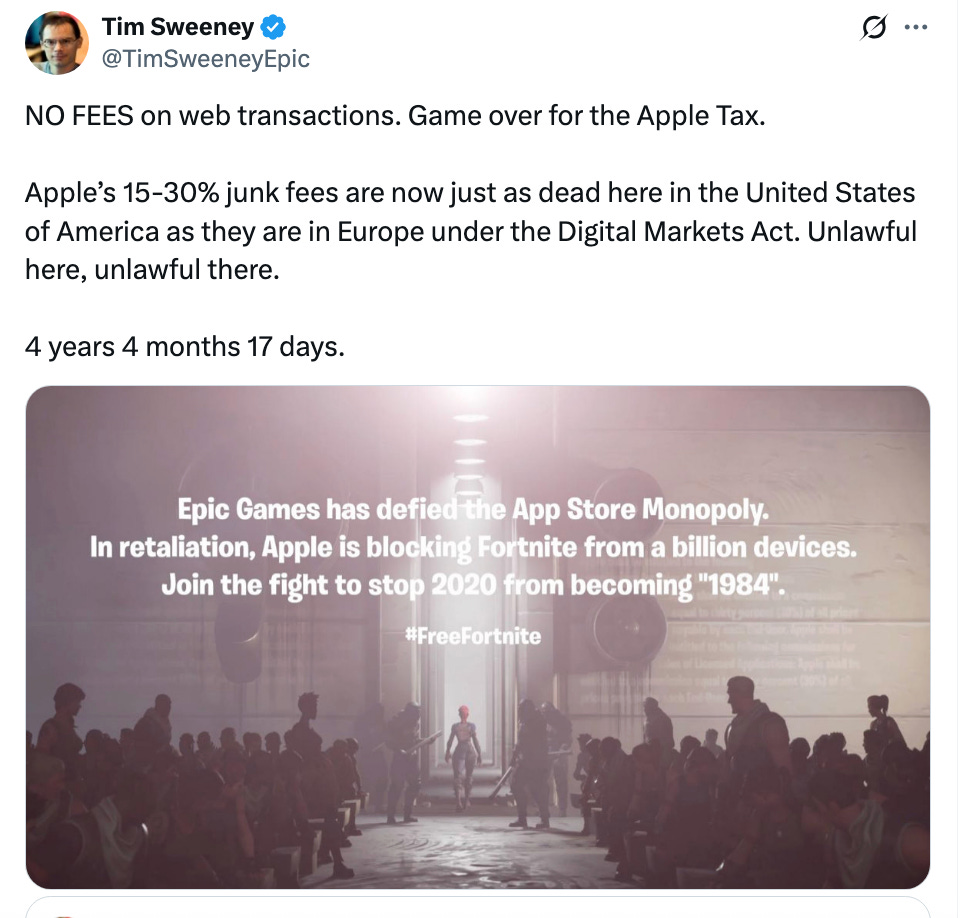
As with many other developers, Epic Games submitted a new version of Fortnite to Apple. But unlike the quick approval granted to most, Epic Games waited for five days, and then was told that it simply could not get the app onto the app store until the end of litigation. In other words, Apple said it simply would not adhere to a court order. Epic Games in turn filed yet another complaint to the judge.
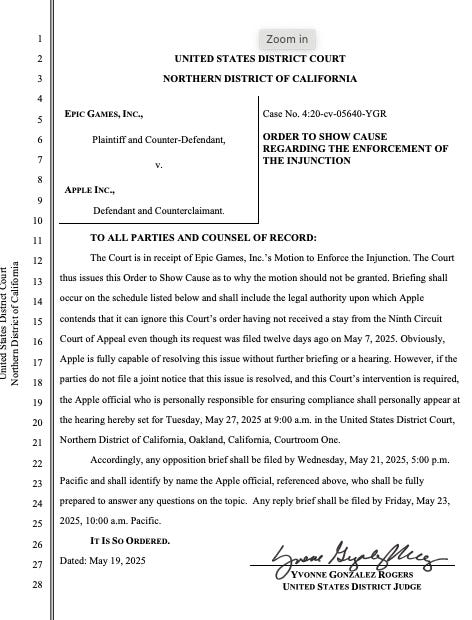
At this point, it’s fair to say Judge Gonzalez Rogers has lost patience. Yesterday, she issued an order demanding Apple explain at a briefing next Tuesday “the legal authority upon which Apple contends that it can ignore this Court’s order.” Furthermore, she mandated that “the Apple official who is personally responsible for ensuring compliance shall personally appear at the hearing.” In other words, an Apple executive should prepare for sanctions if Fortnite doesn’t get into the app store, and soon.
It’s worth speculating on the attitude of Apple’s CEO Tim Cook as he refused to comply. There’s more here than just financial calculation in flouting a judicial order, as disobeying a direct court order is unusually aggressive. I believe that what is happening is that Cook feels mistreated, and is acting accordingly. Here’s a text message chain that came out in the trial from communications chief Marni Goldberg, illustrating the view that Cook likely holds. Often, true believer employees reflect the views of their boss, so that could be happening here. In this text message, Goldberg is discussing how the judge is acting during the case.
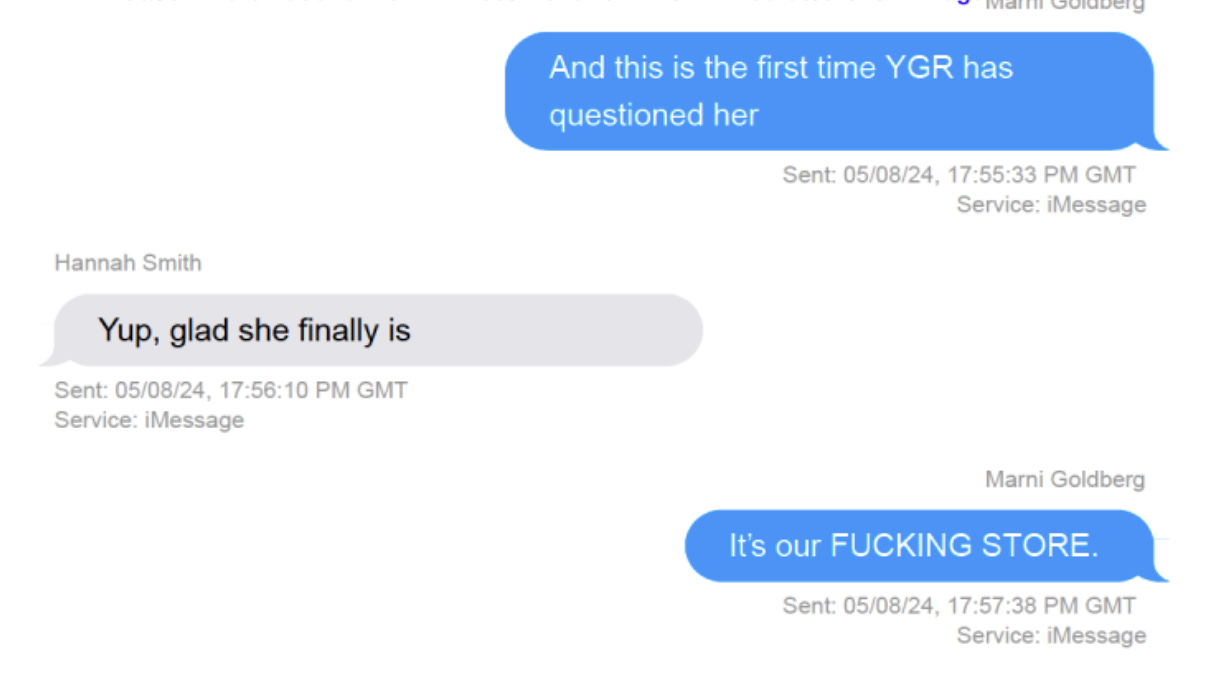
Goldberg texted, “It’s our FUCKING STORE.” And that’s what Apple executives think. We made it, we run it, we own it. How dare anyone tell us what we can do with our property? Cook is almost certainly livid at being ordered to do something he believes is unfair. He also thinks nothing bad will happen to his company or his colleagues if he simply refuses to obey a court order, and believes that the appeals court will rule in his favor and grant an emergency stay.
Usually, Cook would have a good chance at that, the Ninth Circuit often does set aside orders until the appeal is done. That is what happened earlier in the case, and it’s happening now in the parallel Epic Games vs Google antitrust case, while that one is on appeal.
But routine bad faith behavior towards judges does have its consequences, even for one of the most powerful companies in the world. On the very day Gonzalez Rogers told Apple it would have to let Fortnite into the store or ritually sacrifice an executive, the appeals court on which Apple had placed its hopes and dreams backed up the district court. Specifically, the Ninth Circuit said it won’t rule on Apple’s emergency request to stay the order until August, at the earliest, when it is fully briefed on the appeal. That’s the appeals court equivalent of a “sick burn,” as a colleague put it. [THIS DATE IS WRONG. SEE THE UPDATE AT THE BOTTOM OF THE PIECE.]
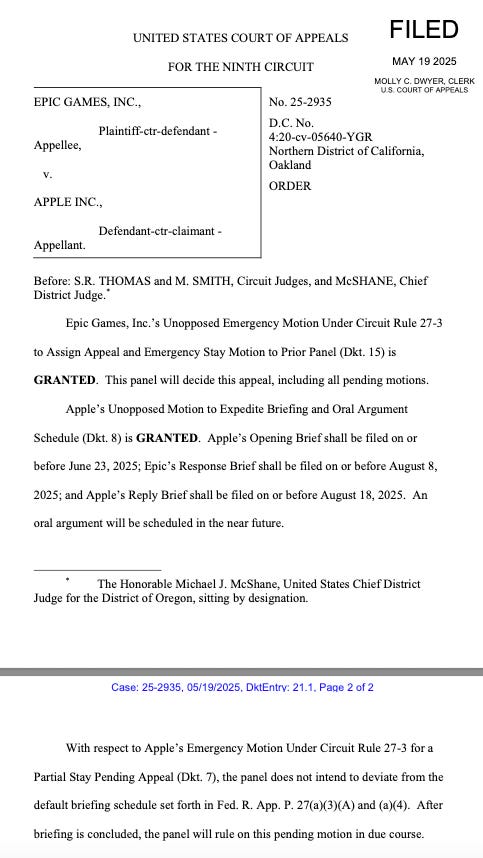
The Ninth Circuit is going to wrestle with the serious questions of law - most notably the takings clause - but it will allow the order from Gonzalez Rogers to go into effect at least temporarily, which will have the effect of punishing Apple for its bad behavior. It could also show to the court that there are serious costs of curtailing the order, if app developers explain in amicus briefs what a more open app store does in terms of improving functionality to the iPhone and the app ecosystem.
The cherry on top is later in the day, another lawsuit against Apple, from developers harmed by the company’s refusal to adhere to the court order, was then assigned to… Judge Gonzalez Rogers.
The irony here is that Gonzalez Rogers has really bent over backwards for Apple, ruling against Epic Games on every Federal antitrust charge, and leaving open a host of ways for Apple to mitigate harm from the one state trade law she ruled Apple violated. I watched the whole process carefully, it took endless amounts of annoying bad faith nonsense from Apple to change this judge’s approach. Finally, she came to realize that Tim Cook and Apple was not running a large corporation that got a bit too aggressive, but a lawless bad faith legal operation willing to lie in court.
When I first started working on monopoly questions a decade ago, I was told that the hardest thing to do would be to get judges to change their minds about antitrust law, since judges mostly come from the corporate bar, and largely believe that big business is generally innovative and honest. And that is sometimes true. But it turns out that big tech is fairly good at getting judges to hate them. Judges will tolerate a lot of nonsense, but they do get mad when powerful corporate executives won’t even pretend to care about the rule of law.
UPDATE: An hour after I published this piece, Apple let Fortnite back in the App Store. So no need for another smackdown from the judge. Yay!
Also, I misread the appeals court deadline. The briefing schedule for the emergency halt to the order is faster than I realized. Epic Games had its brief due yesterday, and Apple’s response is due on Tuesday, May 27th. Apple asked for relief by May 28th, but appeals court said indifferently that "the panel will rule on this pending motion in due course.”
Thanks for reading!
And please send me tips on weird monopolies, stories I’ve missed, or comments by clicking on the title of this newsletter. And if you liked this issue of BIG, you can sign up here for more issues, a newsletter on how to restore fair commerce, innovation and democracy. And consider becoming a paying subscriber to support this work, or if you are a paying subscriber, giving a gift subscription to a friend, colleague, or family member.
cheers,
Matt Stoller
P.S. I got this note from a reader that I thought was useful in terms of showing how dominant corporations actually make it harder to run a small business.
I realize this is small potatoes compared to much of what you research but I wanted to bring your attention to something that has been infuriating me for several years...
I am a longtime small wholesale bakery owner. I have been in business here since 2009 and prior to that I ran a small business (bakery/ farm CSA).
We have always utilized Intuit Quickbooks for our accounting. We have always used an outside payroll service and do no retail sales.
Intuit has been trying to force businesses to use QB online. But without payroll, retail and the need for online billing, the software is completely unnecessary for a simple wholesale business. Additionally, the swap over from desktop to online is not a simple import. Nor is the cost of QB online particularly affordable. But all that said, my business requires clerical continuity to avoid a major headache. I have just been informed that I will be billed $999 / annually to continue using QB for Mac. The list below indicates the price increases throughout the last five years as they forced an annual subscription payment (rather than a several year upgrade).
2019: $233.15
2023: $581.94
2024: $687.94
2025: $999
Thank you for your writing and advocacy.
Intuit, which makes Quickbooks, also produces Turbotax. And it just used lobbying muscle to get the GOP to kill the Federal government’s new service, Direct File, that helps taxpayers to file at no cost. Last year, incidentally, Intuit also got busted for deceiving customers over whether its tax filing product is free.
I write a lot about economic termites, which is another way of saying how real work gets taxed by private lords, driving up costs in all sorts of hidden ways. At least in terms of tax filing, Intuit seems like it belongs in that category.