Why are US AI models consistently topping benchmark scores while Chinese ones are about 4-6 months behind? One factor may be that Chinese AI companies have raised far less funding than their US counterparts. To understand this gap, we compiled funding data on four leading Chinese AI companies (DeepSeek, MiniMax, Moonshot, and Z.ai) and compared them to three leading US AI companies (Anthropic, OpenAI, and xAI1).2
It turns out that, as of July 2026, the three US startups had raised an average of $116 billion in equity funding, compared to an average of only $4.9 billion for the four Chinese companies—a 24x gap!3
We think this gap is best explained by a mix of three factors. First, compute limitations from US export controls have kept Chinese companies from reaching the capability frontier thus far and likely make investors less excited about their future growth. Second, Chinese AI companies are serving a more challenging home market that’s less ready to adopt enterprise AI. And third, even with a great business case, it’s hard to raise a lot of money in China, both because of a smaller venture capital (VC) ecosystem and because previous state intervention in tech companies makes it risky for investors to bet on rapid growth. Let’s look into each of these.
US AI companies have access to far more compute than Chinese ones. Due to export controls, US companies were estimated to own at least 16 million H100-equivalents (H100e) in early 2026, an order of magnitude more than the 1.8 million H100e owned by Chinese companies. (And that gap would be larger if the US were properly enforcing its export controls.) As a consequence, Chinese AI models typically use more than 10x less training compute than their US counterparts (see plot below).4 Chinese AI startups have also repeatedly reported being constrained by limited compute, both when training and when deploying their models. According to one report, in 2025, DeepSeek even had to delay its R2 release due to repeated failures during a training run on inferior domestic chips.
Restricted compute access means Chinese AI companies can’t scale up their training runs as fast as their US competitors and may struggle to deploy their models to many users. Since more funding can’t buy more compute, companies have little to gain from raising additional capital, and investors may be reluctant to invest. In short, restricted compute access forces companies to stay small.
However, there’s one caveat to this explanation. Despite being banned from importing AI chips, Chinese AI companies can still legally rent compute outside China through the cloud, and recent evidence suggests they are indeed using this pathway.
That said, the scale of this foreign cloud access is unclear. As mentioned above, Chinese AI companies have repeatedly cited compute access as a challenge, and at least one company, Z.ai, has been added to the US Entity List, significantly limiting its ability to do business with US companies.5
Overall, we think compute access restrictions are a significant reason why Chinese companies have raised less money, but likely not the only one.
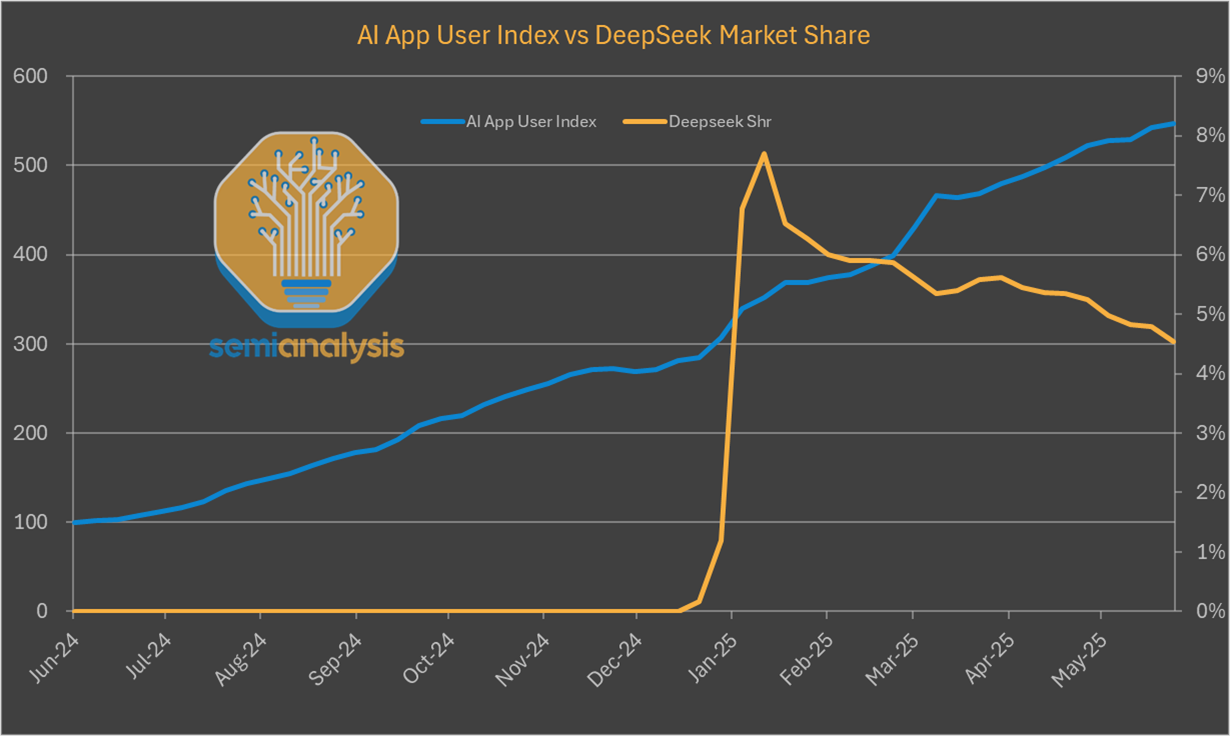
Most of the global AI market has seemingly been captured by superior US AI models. OpenAI released ChatGPT in 2022 and reached 100 million users within two months, and Anthropic has been wildly successful in the global enterprise AI market. Meanwhile, apart from DeepSeek’s short-lived surge in early 2025, none of the four Chinese AI companies has won significant international market share, plausibly because of limited compute access.
Lucky for Chinese AI companies, none of Anthropic, OpenAI, or Google deploys its AI models in China. But despite the seemingly uncaptured market in the world’s second-largest economy, Chinese AI companies have yet to achieve revenue anywhere near that of the leading US AI companies.6 At the end of 2025, Chinese AI startups’ combined annualized revenue was less than 3% of OpenAI’s.7 Revenues have grown significantly across the board since then: Z.ai may have reached an annualized revenue of $1 billion in July 2026, while Anthropic may now be at $60 billion. We couldn’t find enough data for a mid-2026 comparison, but it’s clear the gap remains stark.
If Chinese AI companies wanted to catch up to the funding raised by US AI companies, they’d have to demonstrate a clear case for rapid revenue growth. However, two roadblocks stand in the way:
First, consumers in China don’t like to pay for AI products. Chatbots in particular seem hard to monetize. We don’t have comprehensive data on paying AI users in China, but in May 2026, Tencent President Martin Lau said, “The penetration rate of paid users is currently only in the single digits, making it difficult to replicate the large-scale subscription-based development path seen overseas.” As another example, ByteDance’s Doubao allegedly lost 6.1 million monthly active users in May 2026 after introducing its paid model. Given the abundance of free and open-weight models in China and the small differences in capabilities between these and the best proprietary models available in China, consumers may just not be ready to pay. It likely also doesn’t help that many Chinese users access American AI models through a network of fake accounts.
All this said, the lack of consumer revenue shouldn’t be that surprising. OpenAI and Anthropic both make most of their revenue from enterprise customers rather than consumers.
Second, labor is cheap in China, making it easier to implement custom AI solutions and less attractive to automate jobs. In 2022, the median software engineer pay in San Francisco was $234,000. In Shanghai, the median was only $86,000.8 Chinese firms may thus find it easier to hire software engineers to adapt an open-source model for their use case.9 Lower labor costs also reduce the benefit of replacing workers with AI. A US firm spending $230,000 on a software engineer has a stronger incentive to spend heavily on software that saves engineering time.10
Another reason why Chinese AI startups have raised less than US ones could be that it’s just hard to raise money in China, no matter how strong your business case. This is both because the Chinese investment ecosystem is much smaller than the US one and because previous state intervention has set an uncomfortable precedent for investors.
China’s VC market is 6x smaller, and AI companies have a particularly hard time attracting investment. In 2025, US VC funding reached $322 billion, compared to just $54 billion in China.11 Given US outbound investment restrictions, Chinese AI companies have limited access to the US funding pool.
Not only is there less VC funding in China, but Chinese VCs also seem less excited to invest in AI companies (see plot above). According to PitchBook data, 28% of all VC investment in US companies went to AI model companies in 2025; in China, this figure was just 5%.12 Chinese VCs instead pour most of their funds into semiconductor and electronic equipment companies. Unlike US VCs, many Chinese VC funds are state-backed and thus incentivized to follow the government’s industrial priorities, which likely include closing the compute gaps created by export controls.
Beyond their large domestic VC market, US frontier labs have tapped overseas sovereign wealth: Abu Dhabi’s MGX has backed OpenAI, Anthropic, and xAI, and has closed a $49 billion AI fund in July 2026, while Qatar’s QIA and Singapore’s Temasek have joined recent US rounds. Meanwhile, Chinese labs are cut off from part of this pool: under the trade agreements between the US and the United Arab Emirates, state-linked Emirati firms have to avoid Chinese AI companies flagged by Washington. However, some foreign investment stays open to Chinese AI companies—Saudi Aramco’s Prosperity7 joined Z.ai’s $400 million round in 2024, and Singapore’s Temasek raised its China exposure by $8 billion in fiscal year 2026.
Besides more limited access to large-scale funding, Chinese AI companies also face significant regulatory uncertainty. According to The Information, some DeepSeek employees faced travel restrictions in 2025 after the release of R1, suggesting that commercial success can bring tighter state scrutiny. As mentioned earlier, later that year, the Chinese government may also have pushed DeepSeek to train its new models on Huawei rather than NVIDIA GPUs—a move that reportedly caused repeated training-run failures. More recently, Chinese authorities reportedly barred Manus co-founders from leaving the country amid scrutiny of the company’s acquisition by Meta. And rumor has it China might soon restrict foreign access to open-weight models, which could significantly harm some companies’ license-based business models.
China’s broader technology sector provides an earlier precedent. In 2020, Ant Group, a successful Chinese fintech startup, was about to complete its IPO when the Chinese Communist Party suddenly blocked it, shortly after Jack Ma criticized China’s financial regulators in a speech. Both Ant and Alibaba, a separate publicly traded company that owns 33% of Ant, subsequently faced years of regulatory pressure. For example, Alibaba was fined $2.8 billion for antitrust violations and subjected to a three-year regulatory “rectification”, while Ant was forced to restructure as a financial holding company and was later fined $984 million.
By setting such precedents, the Chinese government shows that state intervention can stall companies’ activities, acquisitions, and IPOs, and that investors will have to accept less-profitable exit options, reducing expected returns. As a result, investors (both domestic and foreign) will think twice before committing large sums even to a fast-growing startup.
That said, the risk of state intervention in AI companies is not unique to China. In March 2026, the US government designated Anthropic a supply chain risk following a dispute over military uses of Claude. And in June, it forced Anthropic to withdraw its Fable model for several weeks due to perceived cybersecurity risks. Yet these actions do not appear to be substantially reducing Anthropic’s access to capital. For example, Anthropic raised $65 billion in May and is reportedly pursuing an IPO. Overall, state intervention has been much more frequent and disruptive in China than in the US.
To summarize, we think Chinese AI companies both have a weaker business case than their US counterparts and face a more challenging investment ecosystem. These dynamics largely explain why they have raised much less money.
Despite this funding gap, Chinese AI startups remain the only non-US actors competing near the capability frontier. However, it looks increasingly likely that Chinese AI capabilities rely heavily on distillation of superior US AI models rather than on fully homegrown innovation. If that’s true, Chinese models may be stuck a few months behind the frontier and thus mostly unable to take market share from leading US AI companies.
What if the Chinese government started heavily subsidizing its AI companies? With sufficiently large subsidies—say, tens of billions of dollars per year—it could indeed enable them to afford the compute to train models at the frontier. However, given the cost of training the largest models is more than doubling every year, subsidies may only be a temporary strategy and can’t easily substitute for the hundreds of billions in revenue that US AI companies are projected to reach. And of course, money is just part of the equation: these companies would also have to secure large-scale compute, which the US government could easily curtail if it got serious about cracking down on smuggling and cloud access.
What does all this mean for the future of Chinese AI companies? Are they doomed? Not necessarily. The Chinese market is likely large enough to sustain a robust AI ecosystem. For example, Z.ai seems to be generating significant revenue, primarily by deploying its models to Chinese companies and government organizations. But with uncertain compute access, less globally competitive products, and no investment ecosystem to fund rapid growth, we don’t expect Chinese AI companies to raise anywhere near as much funding as their US counterparts in the coming years.