Let me give you the number first.
Anthropic ARR: $30B+
OpenAI ARR: $25B
The company that was supposed to be the safety-focused underdog just lapped the most famous AI company in the world. On revenue. On efficiency. On enterprise adoption.
And it did it spending a fraction of what OpenAI spends to train its models.
If you want to understand how Claude got here, everything Anthropic shipped in 2026 and how to use it is the place to start. Major releases roughly every two weeks since January. All documented.
Here is Anthropic’s ARR vs its competitors:
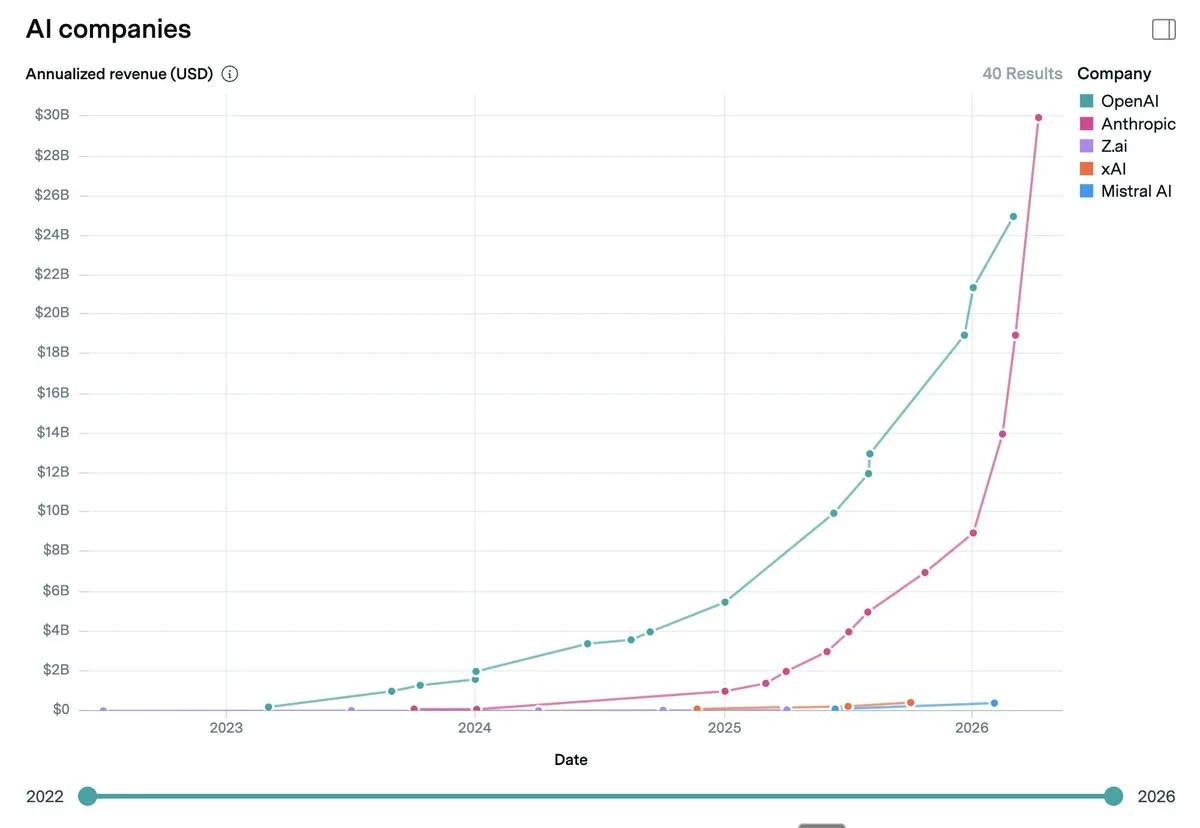
30x in 15 months. The jump from $9B to $30B happened in four months.
Anthropic’s revenue run rate is higher than the trailing 12-month revenues of all but 129 S&P 500 companies.
A company essentially pre-revenue in early 2024 now out-earns most of the Fortune 500.
When Anthropic announced its Series G in February, over 500 business customers were each spending over $1 million annually. Today that number exceeds 1,000, doubling in less than two months.
1,000 companies spending $1M+ each. That doubled in under two months.
Anthropic’s revenue is more enterprise-based, contrasting with OpenAI’s largely free user base and focus on converting free users into paying customers.
Enterprise revenue is stickier. It expands. It renews.
The products driving this growth are not hard to find:
Claude Cowork changed how serious teams operate
Claude Code became people’s chief of staff for thousands of operators
Claude connecting to Microsoft 365 made Copilot look expensive and limited
These are workflow replacements. That is why companies are spending $1M+ per year. Claude replaced line items in their budget.
Revenue is the headline. Training costs are what matters for the long game.
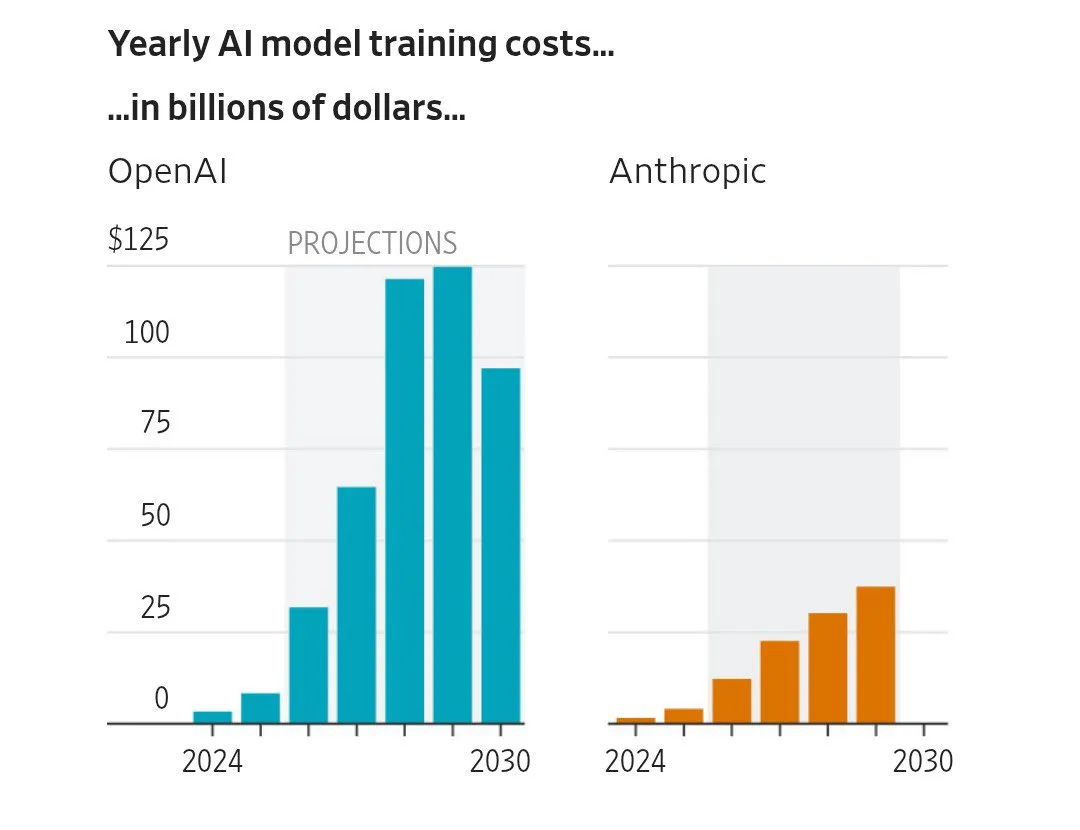
OpenAI expects to spend $121 billion on compute in a single year. Anthropic’s training costs collapse as a share of sales faster than any comparable technology business in history.
The projections going forward:
▫️ OpenAI: heading toward $125B in yearly training costs by 2030 ▫️ Anthropic: projected at around $30B for the same period
OpenAI is spending 4x more to train models that generate less revenue. That is a structural gap, not a temporary one.
OpenAI projects $14 billion in losses for 2026. Anthropic projects positive free cash flow by 2027, while OpenAI has pushed its breakeven target to 2030.
Anthropic reaches profitability three years before OpenAI. While generating more revenue.
Part of why Claude keeps getting better on less compute is the architecture decisions Anthropic has made. The leaked Claude Code source code revealed 44 hidden features and 20 unshipped ones. A roadmap they never meant to publish.
The same day the $30B number dropped, Anthropic signed a new agreement with Google and Broadcom for multiple gigawatts of next-generation TPU capacity expected to come online starting in 2027.
Anthropic is investing its revenue advantage into the next generation of infrastructure.
And the distribution advantage is real:
Claude is the only frontier AI model available on all three of the world’s largest cloud platforms: AWS Bedrock, Google Cloud Vertex AI, and Microsoft Azure Foundry.
OpenAI is on Azure. Gemini is on Google. Claude is on all three. That compounds into revenue every quarter.
The revenue number makes more sense when you look at what Claude actually does in a professional context.
The teams winning with Claude are the ones who stopped using it like a search engine. They learned how to build with it properly. They understand prompt engineering at a level that produces different outputs. They know the one prompt structure that changes output quality across every model.
Some specific use cases that drove enterprise adoption:
Claude Cowork SEO workflows replace a $10K/month agency — I spent a week stress-testing every workflow
Claude in Excel audits financial models in minutes — founders, VCs, and operators use this daily
Claude for investing replaces a research team for most workflows
10 Claude Cowork workflows with copy-paste prompts — the most-read issue in this newsletter
Every way to make slides with Claude in 2026 — 5 methods, downloadable files, prompts that work
Each of these replaced something companies were paying for. That is what $1M+ ARR per customer looks like from the inside.
OpenAI has a larger consumer user base with 900 million+ weekly active ChatGPT users. But Anthropic’s enterprise mix is stronger: 80% of revenue from business customers versus OpenAI’s more consumer-heavy composition. Enterprise revenue carries higher retention rates, better expansion economics, and lower churn.
A year ago, the consensus was that OpenAI had an insurmountable lead. The brand. The user base. The head start.
The $30B number says the consensus was wrong.
Anthropic built a better enterprise product. Deployed it across every major cloud. Signed 1,000 companies to $1M+ contracts. And did it spending a fraction of what the competition spent.
The revenue leader has changed. The cost structure is moving in opposite directions.
The enterprise contracts being signed today are going to Claude.
Getting started:
Claude Cowork:
Claude Code:
Specific use cases:
Prompting:
The $30B number is a milestone on a curve that is still accelerating.
Where does this end in 2026?