Digital subscribers can listen to this article.
Subscribe today for unlimited access to Texas Monthly. Already a subscriber? .
Forrest Welborn never wanted to own a saloon. Some nights he’d rather be doing anything other than carrying bags of beer-soaked garbage to the dumpster, setting up mics for wannabe country singers, or mopping chickenshit off a barroom floor.
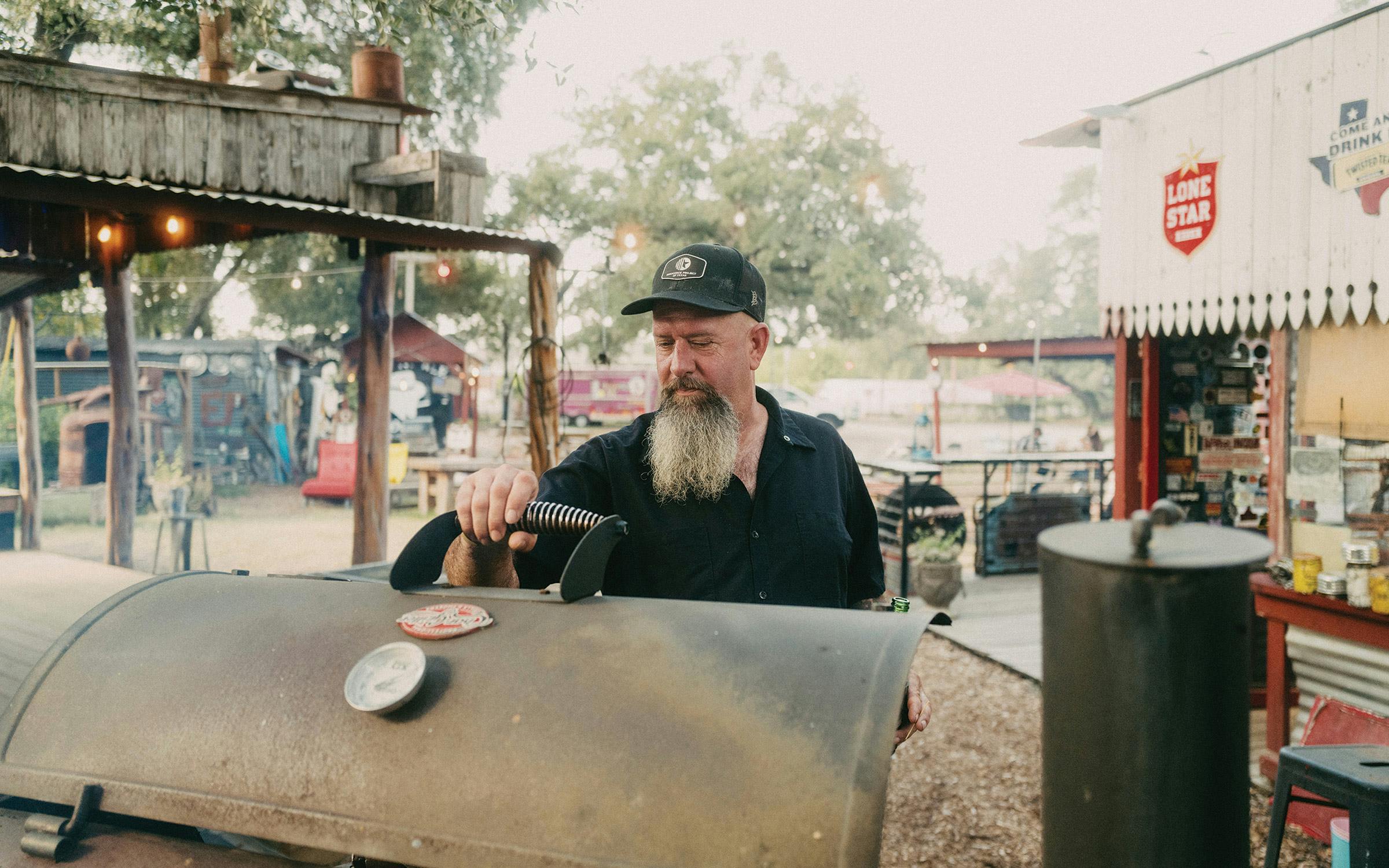
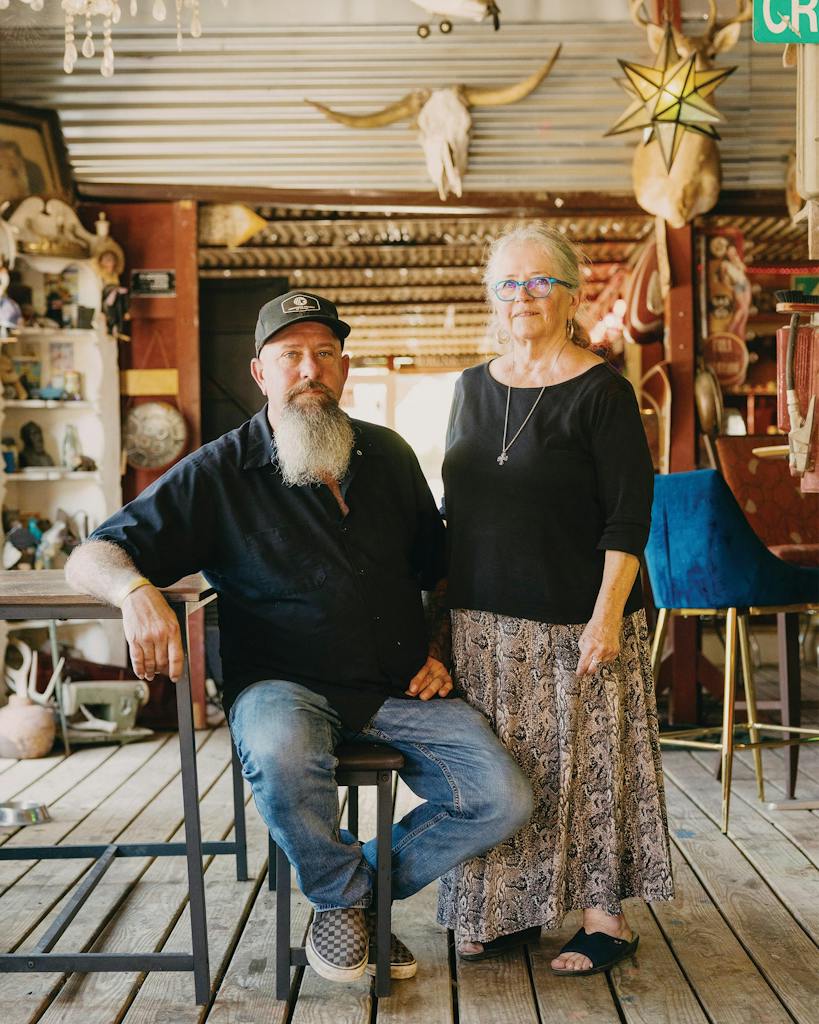
But that’s what he finds himself doing these days. Forrest owns the Manchaca Springs Saloon, just south of Austin. He’s there almost every day, arriving in the morning, leaving in the wee hours. The bar looks like a clubhouse built by anarchists, hammered together out of wood, sheet metal, and clear plastic. The walls are covered with old beer signs and license plates.
The saloon has minimal indoor plumbing, so some mornings, Forrest will have a tank of water towed in to service the handwashing stations and porta-potties. He’ll feed his five chickens, which live in a coop and a tree in the yard. They wander the property all day long, past the rusted pieces of yard art, onto the stage, and out to the vintage RV and the trailers that sit on the far side of the dirt parking lot—the Noble Draw Mobile Cigar Lounge, the Bachelors Barbershop, the Texas Twisted Pig barbecue truck. I asked Forrest if the birds have names. “Chicken,” he said, chuckling. “Red Chicken, Blue Chicken.” Forrest doesn’t joke a lot, but when he does, he’s pretty low-key about it.
The truth is, he doesn’t talk a lot either. Forrest speaks in a clipped, rural drawl. He has a hard face and wary blue eyes, though the first thing you notice about him is the long gray goatee that extends half a foot down from his chin. His head is mostly hairless, and his arms are covered in faded blue tattoos: an Iron Cross, a Harley-Davidson motorcycle, a spiderweb.
Wearing a daily uniform of jeans, dark blue “Manchaca Springs Saloon” T-shirt, and black ball cap, he spends a lot of time behind the actual bar, standing in front of a wall crammed with photos and art. Among the photos is one of Forrest and his sister, India, taken not long before she died of brain cancer last year.
The regulars are patient with Forrest, even when the saloon is jammed. They know that he gets stressed from the daily pressures of running a bar, that he sometimes paces the floor nervously. They know that he’s struggling with demons they can’t begin to comprehend. So when he retreats to a corner of the parking lot to smoke a cigarette, they don’t pester him.
I’ve been pestering Forrest since 1999, after he and three other young men were arrested for allegedly taking part in one of the most notorious mass murders in Texas history—the 1991 slaughter of four teenage girls at an Austin yogurt shop. He wouldn’t talk to me then, even once the charges against him were dropped nine months after they were brought. I wasn’t surprised. Forrest’s life was ruined by the accusations. Most people in Austin believed he was guilty. The police harassed him. The public hated him. Men pulled guns on him, and girlfriends dumped him when they found out about his past. He lost his business. He couldn’t find a job. He stopped trusting almost everyone. He became an outcast in his own city. He withdrew. He drank too much. This went on for decades.
Then, last year, the police announced that they had finally found the actual murderer—a serial killer and rapist who had attacked other women and girls in other cities. Finally, it seemed, Forrest could shed his cloak of disgrace. He even agreed to talk to me, though he wasn’t enthusiastic. “I just want it all to be over and done,” he told me in early February. “The sooner the better.”
There was a hearing coming up that was intended to be a public reckoning and an official apology from the Travis County district attorney. But Forrest was having none of it. “Their apology is not accepted,” he said, his eyes alive with anger. “Their apology doesn’t mean anything to me.” Forrest rarely reveals much of what’s going on inside, but when his emotions push past his hard front, he tears up and turns away. Sometimes he just leaves the room.
It’s hard to blame him. For 34 years, Forrest felt as if the whole world had betrayed him. And while he hated the cops and assistant DAs who persecuted him, the people he despised the most were his three fellow suspects, friends of his who had falsely accused him of participating in the murders. He particularly loathed the man who had once been his best friend, Maurice Pierce. “I still hate him,” Forrest said. “Even though he’s not around anymore, I still hate him. I hate all of them. I know hate’s a strong word, but I really hate those guys.”
In February, Forrest was officially declared innocent, and a few months later he was granted millions of dollars in compensation from the City of Austin. In August, he turned fifty, and his mom and the patrons of the Manchaca Springs Saloon threw him a big party. Sixty friends—many of whom he didn’t even know two years ago—toasted him, hugged him, and gave him raucous high fives. You would think Forrest would, finally, be happy.
Forrest was always a quiet kid. He was born in Austin in 1976 to Jimmy Welborn, a machinist, and Sharon Shipman, who worked for the IRS. They were both from Lubbock, though they didn’t meet until they’d each moved to Austin. Jimmy, who played guitar, had been a big fan of the vibrant Lubbock music scene that included Jimmie Dale Gilmore and Butch Hancock, and he used to take road trips to Austin to watch his friend Jesse Taylor play lead guitar with Joe Ely. Jimmy moved to town in 1970, and Sharon and her son, Eric, from an early relationship, arrived a few years later. “My cousin Mary and I moved because this is where all the long-haired guys playing music were living,” she told me. Sharon and Jimmy met in 1973 and married in 1974. Soon after, India was born, then sixteen months later came Forrest.
The couple split when Forrest was in the first grade, and all three kids lived with Sharon. Starting in seventh grade, Forrest moved back in with his dad, a block away from McCallum High School. Even then, he kept to himself and spent much of his time drawing and working on model planes. Sharon said he struggled with dyslexia and didn’t always like school.
Like his parents, Forrest loved music—Stevie Ray Vaughan and Iron Maiden were two favorites—and he played stand-up bass in orchestras throughout his school years, one of the few opportunities he had to connect with his peers. His parents bought him an electric bass and an amp, and he played in a bluesy garage band called the Half-Eaten Jelly Donuts, though they never made it out of the garage. “We were just making noise,” he said, “pissing off the neighbors.”
Forrest also loved to tinker with cars and motorcycles. At school he met a fellow auto enthusiast named Maurice Pierce, who was a year older. “We messed with cars all the time,” said Forrest. “His dad always bought some new piece of junk, and we’d work on it and then go riding around and thought we were cool.”
They were something of an odd couple. Maurice was stocky and social, Forrest tall and shy. Maurice occasionally got in trouble for fighting—or stealing fire extinguishers. He even had a girlfriend, Kimberli. In 1991, Maurice got hold of a .22 pistol, and the boys would go to a nearby trail and shoot at cans and rocks. “He always kind of wanted to be a tough guy,” said Forrest. “I don’t even really know how we hit it off. But we were best friends. It seemed like we were always together.”
They spent a lot of their time walking around the nearby Northcross Mall, which had an arcade, an ice-skating rink, and a food court. They were there the night of December 6, 1991, and learned two days later that four girls had been murdered that same night, a few blocks away, at an I Can’t Believe It’s Yogurt! shop. Two of them, Jennifer Harbison and Eliza Thomas, were working, while the others, Jennifer’s sister, Sarah, and Sarah’s best friend, Amy Ayers, were just hanging out. The details of the crime were gruesome: The girls had been sexually assaulted, shot in the head, and set on fire. And because their bodies weren’t discovered until after the firefighters had turned off their hoses, much of the evidence was washed away by the time the police showed up. A .380 shell casing was found in a drain, and .22 slugs were taken from the bodies.
The six detectives of the Austin Police Department homicide unit were overwhelmed with tips and theories. Then, eight days after the murders, an off-duty cop working security at Northcross Mall saw Maurice, who was with Forrest, walking around with a pistol in his pants. The guard stopped him, confiscated the pistol, and called APD. Maurice’s .22 was the same caliber that had been used to kill the girls—and had three shells in it. Maurice had another sixteen in his pocket.
Both boys were taken to a juvenile detention center, and at around midnight, Maurice was transferred to the police station. A couple of hours later, his questioning began, directed by Senior Sergeant Hector Polanco, a fifteen-year veteran with a reputation for getting confessions. Polanco was known to walk into an interrogation room and announce that his nickname was “El Diablo”; he would threaten the death penalty and grab a man’s arm and show just where the needle would go.
Maurice was terrified. He later told his girlfriend, Kim, that Polanco had claimed that his pistol was the murder weapon—and showed him graphic photos of the dead girls. “They were throwing them in his face, saying, ‘This is how the girls look now,’ ” Kim told me. (Polanco later denied doing either of these things.) In a statement Maurice wrote later that afternoon, after several hours of questioning by Polanco, he admitted to having the gun the night of the murders but insisted he didn’t have anything to do with the crime. Instead, he claimed that Forrest had borrowed the gun, had been acting oddly (“I think he was on some kind of drugs. . . . He was jumping around and acting crazy”), and had boasted that he and a friend had shot the girls in the back of the store and started a fire with their bodies. Maurice said Forrest told him, “I enjoyed watching them burn.”
After the interrogation, the officers took Maurice—who had been up all night, unaccompanied by a lawyer—to his apartment building, where he claimed to have thrown spent shell casings from the .22 onto the roof after Forrest gave him the gun back. (The cops found two such casings there.) Later that day, the cops put a wire on him and gave him orders: Entrap Forrest, who had already been released without being questioned. Maurice drove to Forrest’s house and waited. When his friend finally arrived a couple of hours later, the two cruised around as they always did. But the conversation went in directions that unnerved Forrest; Maurice kept trying to get him to admit his guilt, asking things like, “Don’t you remember when you said that you killed those girls?” Forrest acknowledged he had said something along those lines, but insisted that he had been joking. “I’m telling you the truth,” Forrest kept saying. “How could I have killed them? I was with you that night, wasn’t I?” Forrest told me that they drove around for an hour, but Maurice was asking so many weird questions that he finally told him to just drop him off. “I want out of here,” Forrest told his friend. “I don’t know what the hell you’re talking about.”
As soon as Forrest got out of the car, the police picked him up and took him to the station. His bad night got worse. The cops told Forrest that Maurice had been wearing a wire and had implicated him in the killings. “I felt like my best friend just f—ed me over and lied to me and lied to them,” he told me. When he finally got home that night, he didn’t know which was worse—being accused of murder or being betrayed by his closest friend.
Meanwhile, Maurice passed a polygraph test, and the consensus of the officers—including Polanco—was that neither young man had anything to do with the murders. As Detective John Jones wrote in a report, “Conclusion: Pierce was fabricating his involvement via some unknown mental deficiency.” When Maurice finally got home that weekend, he was exhausted. His lips were swollen because he had spent so much time biting them, Kim later remembered.
The boys may have been innocent of murder, but they were guilty of bad judgment—and terrible timing. Both of them told the cops that the night after the murders, they had walked through the parking lot of a nearby car dealership and seen the keys in a Nissan Pathfinder. They hopped in and picked up two other teens they had recently met—Robert Springsteen and Michael Scott, both seventeen—and took a joyride to San Antonio. According to Kim, the four had also hung out on the night of December 6. In the cops’ eyes, it all looked suspicious. So on December 15, they spoke to Robert and Michael about the murders. But the police concluded that they weren’t involved either.
A couple of days after the interrogations, Forrest was walking home when Maurice pulled up beside him in his car. “Hey, what’s going on?” Maurice said. “Come on, get in.” Forrest was still furious. “I don’t want to have anything to do with you,” he said and kept walking. He never spoke with Maurice again.
The betrayal profoundly changed Forrest. He withdrew from everyone. “I didn’t want to have any friends,” he told me. If his best friend could abandon him, why have any friends at all? “I was kind of lost. Everybody had questions, and I just didn’t want to be around anybody.” He cut his hair short so people wouldn’t recognize him.
But the police wouldn’t let up. He’d be walking to school, and a passing police car would slow down. “Get in,” he’d hear, “let’s go for a ride.” The officers would take him to the station and question him. Forrest wanted to help, but he had nothing to offer. “They would get a little mad, start slamming their hands on the tables. Then the nice cop would come in, like, ‘Oh, we need your help. We think you may know something, and so you can help us if you could just remember anything.’ ”
Forrest stopped going to class, and in the spring of 1993, he dropped out. “I went straight to a junkyard where I knew nobody was going to be, and I just started working.” He bought an old Camaro and spent hours tinkering with it. He got a job at an auto shop, then a car wash, then a gas station. He was drinking a lot and was convicted of a DWI in 1994. “I was in pretty bad shape, so I was self-medicating, I guess is what you call it. Alcohol. A lot of alcohol.”
In 1995, Forrest’s girlfriend got pregnant, but by the time their son, Jaymes, was born, the couple had split up. Forrest continued clashing with the law. “I couldn’t get my life together,” he said. “I was driving around with no insurance and no registration, just out there being silly.” He moved to Lockhart, where Sharon was now living, but his life continued to unravel. He was arrested in 1996 for five outstanding offenses and, he says, spent twenty days in jail for driving with a suspended license.
In 1997 he moved to Lubbock to work at his uncle’s automotive shop. One day an Austin police detective named Paul Johnson, who was the new face of the yogurt shop investigation (by then in its sixth year), stopped by. Johnson and another officer had been poring through the thousands of tips, looking for any they felt hadn’t been properly closed. The story of the four boys and the .22 pistol had caught their eye.
Once again, Forrest, who was now twenty, insisted on his innocence. He passed a polygraph test and swore to Johnson that he didn’t have the pistol that night. Forrest remembers that Johnson was skeptical about his assertions. “He pretty much said, ‘We know that you know something, and we’ll be getting back to you.’ ”
Forrest moved back to Lockhart a few months later, where he lived in an RV park and worked at a muffler shop. He grew his hair long again. In April 1999 he opened his own shop, Lockhart Automotive. Forrest had a solid reputation as a mechanic and got a lot of business. “Everything was going good,” he told me. “I had great customers. I had different used-car lots bringing me work.”
Johnson had also interviewed Maurice, who was living in Lewisville, northwest of Dallas. By this time, Maurice had dropped out of high school and married Kim; they had a young daughter named Marisa. He was working at a warehouse and supporting his family, but he was also having trouble with the law—arrests for public intoxication, burglary of a vehicle, possession of marijuana. Maurice insisted that he wasn’t involved in the murders. “I was very nervous,” he told Johnson about his 1991 interrogation. “I was trying to say things to help me get out of the police interview, and they were twisting my story up.”
Johnson wasn’t convinced. In the summer of 1999, he was put in charge of another yogurt shop task force. According to Beverly Lowry’s 2016 book, Who Killed These Girls?, at its first meeting, in August, he gave a PowerPoint presentation titled “The Investigative Plan to Pursue Maurice Pierce.” The next month two detectives contacted Mike Scott, who lived in Buda, just outside Austin, with his wife and stepdaughter. Police asked Mike, who had dropped out of high school and was working on his GED, to come to the APD station, and on September 9 he was taken to an interrogation room.
At first, Mike, unaccompanied by a lawyer, denied having anything to do with the murders. But detectives Ron Lara, John Hardesty, and Robert Merrill pushed him hard. Police are allowed to lie in interrogations, and they told Mike that Maurice and Rob had blamed him for the murders. A video camera recorded the detectives sitting next to Mike at a small table, leaning in close and getting more and more aggressive. “You know you were in there,” one said emphatically. “Did you shoot any of those girls?”
“No, sir,” replied Mike.
“Then tell us what f—ing happened!” the detective roared. “What did those two boys do to those girls? Do you want to live with this for the rest of your f—ing life?”
“No, I don’t.”
“Then get it out right now! They’re f—ing you over. F— them. They’re the ones that shot the girls. Do it!”
Mike started giving details, though they were jumbled. First, he said the victims had clothes on when they were killed, then he said they were partially clothed, then, finally, fully nude. Their hands had been bound with an extension cord. Then napkins. Then clothes. They had been strangled, he said. Or maybe battered. Knifed. Finally, he said they had been shot.
Detectives slyly fed details to Mike. One of them asked, “So one of the girls, you’re saying, was shot twice?” Mike hadn’t said that before, but he did now.
Forrest hadn’t even been part of the conversation until Mike was asked how many boys were in the car with him, and he answered, “Three.” “Who else was in the car?” asked Hardesty.
Mike responded with a question. “Me, Robert, Maurice, and Forrest?”
“Forrest was in the car, wasn’t he?” replied the detective.
“Forrest was in the car,” affirmed Mike.
“Yeah,” reaffirmed the cop, “Forrest was in the car.”
Finally, after five days of on-and-off questioning, Mike signed a full confession.
Two detectives then went to Charleston, West Virginia, where Rob Springsteen, who was now married, had moved not long after the murders. At first, sitting in the police station without a lawyer, he was adamant that he had nothing to do with the murders. But after about three hours of detectives shouting in his face and accusing him of being a “cold-blooded murderer,” Rob, his head hanging low, his voice barely audible, his body language showing utter dejection, began confessing. “I don’t know whether this is true or not, or whether I’m fooling myself,” Rob said to his interrogators. “I’m so confused.”
Armed with two confessions, detectives went back to Forrest and grilled him again. They were relentless, Forrest says, getting in his face, slamming their hands on the table, telling him they knew he was involved. “We have DNA,” he remembers them saying, “You’re going to be charged with it. Just go ahead and tell us now.” They even tried, again, to entrap him. Forrest had agreed to help the officers by accompanying them to the yogurt shop to try to refresh his memory. They drove him to the alley behind the shop, where Mike walked up behind him and put his hand on his shoulder. “I told them everything,” Mike said, according to police testimony, “you need to tell them the truth.” “I don’t know why the f— you’re telling them this,” a startled Forrest replied.
Finally, after an intense interrogation session in which a detective badgered him incessantly—“You can hear screams right now, blood-curdling, g—damned screams!”—Forrest had had enough. “I’m ready to leave,” he said. The cops had no reason to hold him, and he walked out.
I asked Forrest if he had ever thought of giving in just to end the interrogations. “I was never going to lie about something like that,” he said. He knows about the research showing that innocent people can be coerced into confessing to something they didn’t do. After looking at 375 DNA exonerations that occurred between 1989 and 2020, the Innocence Project found that more than a quarter of the convictions had involved an innocent person confessing to crimes. Many confessors were young, and some had mental health issues. Many were fed misinformation by the police—as Maurice had been. “I was scared to death myself,” Forrest told me. “But that doesn’t mean I’m going to say that I did something that I didn’t do, especially something like that.”
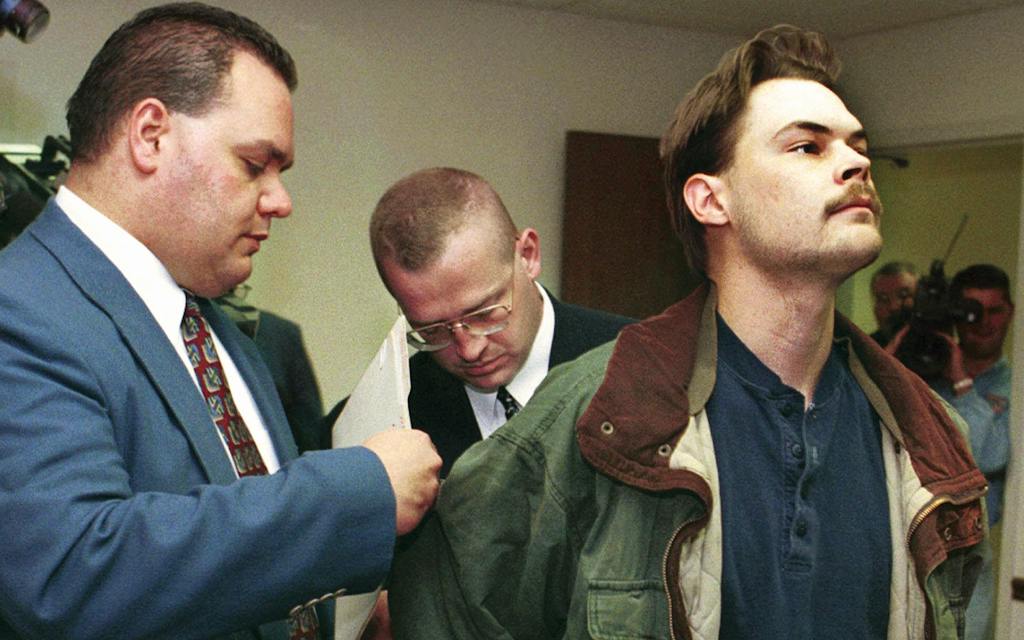
At 9:30 a.m. on October 6, 1999, nearly eight years after the murders, four police cars drove up to Forrest’s shop. He was charged with capital murder. Officers picked up Mike in Austin and Rob in Charleston. In Lewisville, Kim remembers, authorities brought in a SWAT team to capture Maurice. “They hog-tied him in front of the house. I came out in my nightgown; I could hear the dogs barking, and all the guns were pointed at me.”
Four bad boys and four good girls: It was an irresistible narrative. The girls—conscientious students with college on the horizon—were all about rodeos, animals, and country music. The boys were troubled young men, pot smokers, high school dropouts. Nearly everyone in Austin believed that they were responsible for the worst murders in the city’s history—even though none of their DNA or blood was found at the scene, and Johnson had been told months earlier by a ballistics expert that Maurice’s pistol was almost certainly not the murder weapon. Their bonds were set prohibitively high—Maurice’s at $1.5 million and Forrest’s at $1 million, while Mike and Rob were given no bond at all.
On the front page of the Austin American-Statesman, the four looked dazed. Forrest, with a dark beard and hair past his shoulders, stared straight ahead. He was already shutting out the world.
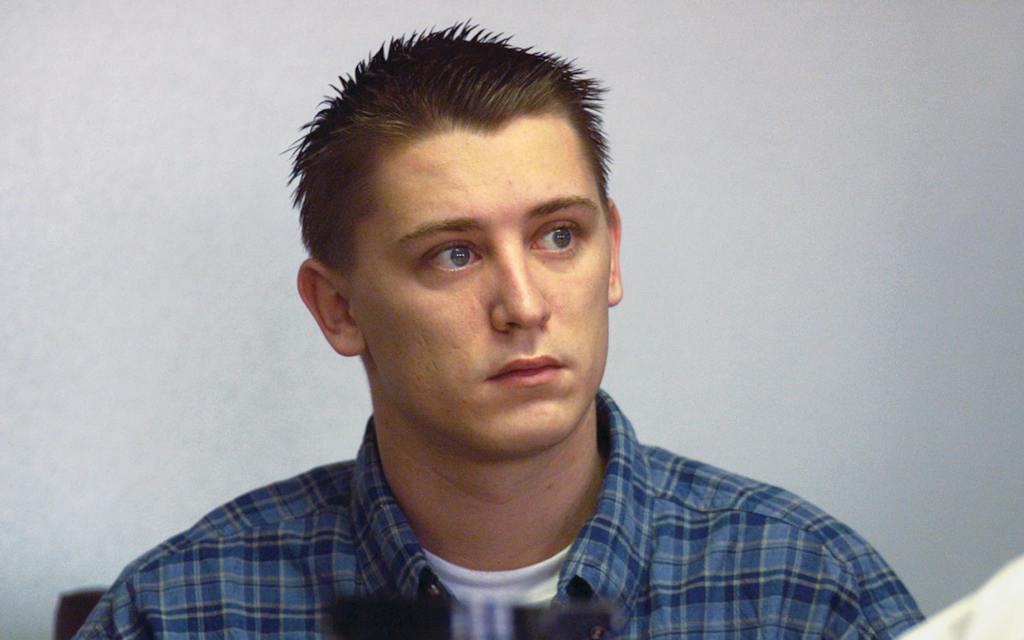
The first time I saw Forrest in person was on November 29, 1999, in a courtroom. Though both he and Maurice were now in their twenties, they had been teens at the time of the murders, so in order for them to be tried as adults, a judge had to determine if there was probable cause to believe they had committed the crimes. Forrest sat next to his lawyer, Robert Icenhauer-Ramirez, who was so confident in his client’s innocence that he had allowed two lawyers from the DA’s office to talk with him for three hours; they got nothing. At the same table, Maurice sat next to his attorney, Guillermo Gonzalez. The two young men were still an odd couple: Forrest had shaved his beard but still had a mustache and long hair; Maurice had a blond crew cut and looked like he was in a fraternity. They didn’t speak at all. Forrest was nearly immobile throughout; Maurice would occasionally lean his head down.
The hearing was the first time the public learned of the scope of the case the cops were building. Mike’s confession was played on a video monitor, and the cops explained that robbery was the motive, that Maurice was the leader, that Forrest stayed in the car while the other three went in, that Maurice started shooting his .22 because there were only a few dollars in the register, that Rob, armed with a .380, raped one of the girls and Mike tried to rape another, that after the girls were shot they were stacked and set on fire.
Almost every word was untrue—and Forrest and Maurice sat and listened to all of it in silence. At the end, the judge reckoned there was probable cause, and they were certified to be tried as adults. Forrest teared up while Maurice put his head on the table. Perhaps because Forrest hadn’t confessed and was accused only of being the driver, the judge lowered his bond to $375,000. She halved Maurice’s to $750,000.
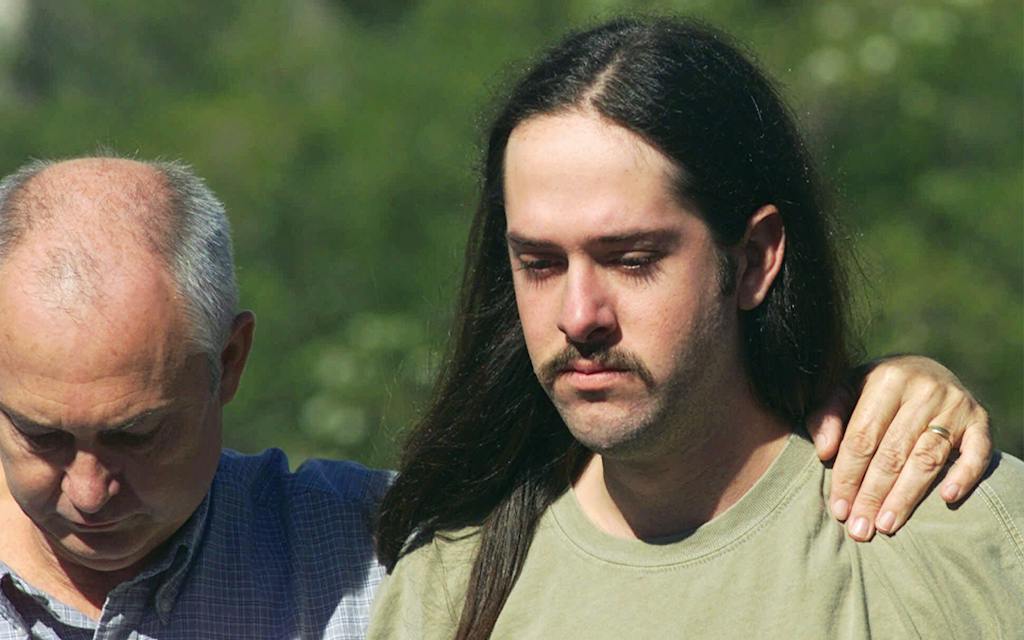
On December 10, after Forrest’s aunt put up most of the $37,500 cash deposit, he walked out of jail with his family, his sister leading him by the arm. Sharon remembers looking up the hill at the gathered photographers and feeling terrified. “They had long cameras, and India and I both thought, ‘Somebody’s going to shoot him.’ We were scared to death.”
Forrest might have been free, for now, but most of the public and the law enforcement community regarded him as a brutal murderer—or, at least, the guy who whisked the murderers away from the crime scene. “We prefer that he be in custody,” said Rosemary Lehmberg of the district attorney’s office. “We think he is charged with a really egregious offense.”
When Forrest returned to his shop in Lockhart, all his tools had been stolen, and he had to close his business. The family was shattered by his arrest. Sharon said the stress led to her divorce from her third husband. India was so affected that she had a nervous breakdown. “She was six weeks away from graduating from nursing school,” said Sharon. “There was all of the talk and the suspicions and whispers, and it just broke her. She was diagnosed with PTSD and depression.”
Forrest declined when I asked to interview him. “He’s having a rough time,” his father, Jimmy, told me. Forrest cut his hair again so people wouldn’t recognize him and moved to tiny Lytton Springs, near Lockhart. He got a job at an automotive shop. His reputation as a mechanic had followed him, and many locals brought him cars to work on. He did construction and went dumpster diving and scrapping—looking for metal and cans to sell at recycling places. He took India with him sometimes. “She enjoyed that kind of stuff,” said Sharon. “They just fed off of each other.” India was Forrest’s only friend. He was still hurting from Maurice’s betrayal, still unable to let anyone get close to him.
When, in 2000, a second grand jury failed to indict Forrest, all four charges against him were dropped. But he didn’t do any celebrating. “I don’t think he felt free of it,” said Sharon. “It was like, ‘We’re dropping the charges—for now.’ ” Forrest continued getting crosswise with the police. Since he was still on probation, he says, his driver’s license had been suspended. He needed to get to work, though, so he drove anyway and says he was repeatedly stopped by police and taken to jail. He felt like he was being followed everywhere he went. “I always thought I was being paranoid, that people were watching me, people were following me. And I was trying to tell other people, and they’re like, ‘Oh, you’re crazy.’ ”
It wasn’t just the cops. Once, Forrest was washing his clothes at a laundromat. “Some guy drove up, pulled a rifle on me, called me a murderer, said he was going to kill me. Then he drove away. Everybody thought that I had something to do with it. Everybody just thought it was lack of evidence.”
The harassment continued after Rob and Mike were put on trial in 2001 and 2002; the only evidence against them were their now recanted confessions, each of which was used against the other man. Both were found guilty: Rob was sent to death row, Mike to prison for life. And Forrest was convinced he was next. “They’d told me there’s no statute of limitations, so they can get me anytime they want. ‘Be prepared because we’re going to come get you.’ ”
Forrest tried to build a normal life. He moved to Lockhart, where he lived on fifteen acres and worked on cars and motorcycles. In 2005, his son,
Jaymes, who was nine, moved in with him when his mother relocated to a different part of the state. Forrest loved being a small-town dad, taking
Jaymes to his junior high football practice. He built a dirt-bike track in the backyard, and the two would ride go-karts. But in 2009, Jaymes went back to live with his mom, and Forrest was alone again. “It broke my heart,” he told me.
Maurice was having a rough time too. Since his family couldn’t pay the $750,000 bond, he stayed behind bars for more than three years. Kim said the authorities constantly pressured him to confess. All the inmates knew who he was. “When he was walking to take a shower,” she said, “they called him Yogurt Man.” His sister Renee visited and said he was beaten up badly at least twice.
Finally, prosecutors acknowledged that they had no physical evidence against Maurice and dropped the charges. He was released on January 28, 2003. “I am innocent,” he proclaimed at a press conference two days later. “My life will never be the same.” A few days later, he left for Carrollton, where Kim and Marisa had moved. “We do not have the evidence to convict him right now,” said district attorney Ronnie Earle. “But life is long.”
Background checks made it difficult for Maurice to get a job, so he worked as a mechanic at a Kawasaki dealership where Kim’s uncle was employed. And he doted on Marisa, teaching her to ride a bike, taking her to the zoo, attending her graduations. Because he had a sweet tooth, he even showed her how to bake. “Everything revolved around Marisa,” said Kim. “She was our only child. He loved his daughter more than anything.”
Kim had long bristled at public officials’ portrayal of Maurice as a hotheaded ringleader; before the arrest, she said, he was quiet and lighthearted. “My father was genuine and steadfast, full of hope even though the world had been extraordinarily cruel to him,” remembered Marisa. Renee agreed. “My brother wanted to live life, take care of his daughter, ride his motorcycles, have fun.”
But jail had changed him. “He was different when he got out,” said Kim. “His eyes looked different to me. They used to be really a pretty bright blue, and then they kind of were grayish. Something died in him in those three and a half years being separated. He had a hard time knowing how to feel.”
Maurice got traffic tickets in his first year of freedom but didn’t pay them, leading to an arrest warrant. In 2007 he got into a fight with another driver and was fined $200 and charged with disorderly conduct. Like Forrest, Maurice thought the police were out to get him. “I feel like I’m being followed,” he would tell Kim. “He was always paranoid,” said Renee, “looking over his shoulder, saying they were watching him.” Kim said he was so worried about the police that he carried his written dismissal with him at all times.
Maurice might have thought things would ease up a little in 2006, when the Texas Court of Criminal Appeals overturned Rob’s capital murder conviction. Though Mike’s confession had been used against Rob, his lawyers hadn’t been allowed to question Mike, which was a violation of the Sixth Amendment. The court overturned Mike’s conviction in 2007 on the same grounds.
Law enforcement authorities announced that they were going to prosecute both men again. But in 2008 a lab, using Y-STR DNA technology that analyzes the male Y chromosome, examined genetic material on a vaginal swab taken from one of the girls back in 1991. Technicians worked up a profile of the donor of the material, but couldn’t identify him. To the shock of the DA’s office and the APD, the profile didn’t match Rob or Mike (or Forrest or Maurice). The two men were set free on the afternoon of June 24, 2009. “It feels wonderful,” said Rob, who had spent four years on death row. “I’d like to thank God and my families and my attorney for this opportunity.”
Meanwhile, Maurice and Kim were having marital problems. In 2008, on the same day they had a fight in a grocery store parking lot, Maurice was driving his Mustang in Plano and was pulled over for speeding. “Mr. Pierce seemed to be nervous,” the officer wrote in a report, noting that Maurice stated that “he had been accused of several offenses in the past that he had not committed.” When the cop found an outstanding warrant on Maurice and asked him to step out of the car, Maurice put it in reverse and drove off, injuring an officer. Police traced him to Austin, where they found him hiding in a closet in Renee’s house. Maurice fought the officers so hard that they tased him. According to a police report, Pierce said “he hates cops and would do anything not to return to jail.” He spent a year behind bars and was released in 2009 as he awaited trial.
Maurice and Kim separated, and he eventually moved to Austin, where he worked as a landscaper for her uncle and lived at Renee’s. Every day he called Marisa, who had gotten married and was pregnant. When he called on the night of December 23, 2010, she told me, he was on his way back to Renee’s, and they were talking about her baby, who was due any day. Then, abruptly, when he was close to Renee’s, he said, “They’re after me.” Marisa asked what he was talking about, and he said he’d rolled through a stop sign and the police were behind him. Marisa told me that she assured him that everything was okay.
The next thing she knew, he had stopped the car, and she could hear him running, still holding the phone, though the call soon disconnected. Maurice was being chased by APD Officer Frank Wilson, who caught up with him in a nearby yard. The two men wrestled, and Maurice pulled a knife from Wilson’s utility belt and slashed him in the throat, cutting his trachea and nicking his carotid artery. Wilson pulled his pistol and shot Maurice in the stomach. Maurice staggered away, dropping at the end of a nearby driveway.
Marisa told me he called her one last time. “I’m sorry,” he told her in a whisper. “I don’t think you’re ever going to see me again. I love you.” She had no idea that he’d been shot and was dying in a driveway. “I love you too,” she said, thinking this was just another incident of police harassment. “We’re going to figure this out. It’s going to be okay.”
Marisa didn’t find out until the next day that those were the last words she would ever say to her father. Two weeks later she gave birth to his granddaughter, Khloe.
Kim says that even after Maurice’s death, the police harassed the family. Officers approached them to see if they had anything new to say now that Maurice was dead. “They tried to get me to change my story. I guess they thought that after he was dead, I was going to magically say, ‘You know what? He really did do it.’ ”
Kim is convinced the cops had finally gotten what they wanted. “I think he was murdered in cold blood by the police,” she said. Renee, who observed that her quiet neighborhood was swarming with cop cars within moments of the stop, agrees. “If it was just a routine stop, why were so many there so quickly?”
Sergeant Ron Lara, who had been involved in the 1999 interrogations and was still working on the case nearly twenty years later, denied that the police had it in for Maurice. “We didn’t keep track of him,” he said in 2011, not long before a grand jury cleared Officer Wilson of any wrongdoing. “Maurice was out there, and we knew that, and we knew he was getting into trouble. But it’s not like we were checking up on him.”
Maurice’s death at the hands of a policeman wasn’t a surprise to Forrest, who was living in Lockhart, building custom motorcycles, and getting stopped constantly. He was terrified he would meet the same end. “I felt like they were just waiting for me to make the wrong move and they’re going to get me too.” Sharon experienced the harassment firsthand when she was driving her son’s car and was pulled over. “I waited until the officer got all the way up to the car door to roll down the tinted window, and he was shocked to see it was me and not Forrest. And he started fumbling, trying to make up some reason for stopping me. He said I had rolled through a stop sign, which was absolutely not true.”
Local law enforcement still believed the four were guilty. In a 2011 news report on KXAN-TV that aired on the twentieth anniversary of the murders—three years after DNA evidence showed an unknown perpetrator had raped the girls—a group of five APD officers were asked to raise their hands if they still believed the four men had been involved in the murders. All five did so.
Forrest continued to self-medicate, and he got his license suspended in Lockhart twice for intoxication. He didn’t have a lot of friends—or girlfriends. When he’d ask a woman on a date, he knew she’d google his name, which would take her straight to a news story about the murders.
In 2012 he moved back to Austin, where it was easier to get lost in the crowd. But the police followed. In 2018, Forrest, along with India and her husband and their son, were all living with Sharon. One morning in July, Forrest was buying his morning taco and energy drink at a local convenience store when a couple of cops called him over to their car. “They wanted me to push on Maurice,” said Forrest, “say that he was guilty.” He walked away. (APD records show that for seven consecutive days in July 2018, agents with the major crimes/gang unit were watching Forrest from six in the morning until ten at night.)
He kept working, and during the pandemic he and a partner started a construction company called Texas Pride Decks, building decks, patios, and sometimes houses. But Forrest got a hernia and had to take time off, and the company eventually foundered.
By then he had begun frequenting a quiet bar near his home, the Manchaca Springs Saloon, a former barbecue stand just outside the city limits that had been slowly converted—wall by wall, roof panel by roof panel—into an actual structure. Forrest liked the place. The regulars were misfits like him—bikers, old hippies, disabled veterans—and the walls were covered with rusted beer and railroad signs, which he had always liked to collect. He felt at home, even though the place was filthy, the roof leaked every time it rained, and there was a huge area along one side that hadn’t been enclosed yet. In early 2025, Forrest learned that the owner was interested in selling, and he took out a loan and bought the place. He’d run his own auto-repair shop and custom motorcycle business. How hard could it be to run a saloon?
First, he set about cleaning it. Though India was nervous about her brother being around alcohol all day long, she helped. Forrest raised a wall along the open area, using materials donated by his regulars. Most of them were thrilled that he was renovating their hangout, even if they weren’t so sure about his past. “The bar is a very tight-knit community,” bartender Mhystie Anderson told me. “He was kind of a black sheep—a lot of people thought he was involved in the murders.”
Forrest was used to people thinking he was a killer, but he forged ahead. He started booking more live music and collecting more pieces of wall art, sometimes trading them with customers for beer. A wheel from a Singer sewing machine. An elk’s head. A “frog crossing” sign that India brought him.
Forrest was also determined to slow down his drinking, especially now that he ran a bar, a place that gave him a chance at building the sort of community that had always eluded him.
In July 2025, India was rushed to the hospital after having seizures at work. Her diagnosis: terminal brain cancer. Forrest was devastated. The disease moved quickly, and on August 5, she told her mom that when she got to heaven, she would find out who killed the girls in the yogurt shop and make sure to let the world know. She died on September 14.
Twelve days later, the APD announced a stunning breakthrough in the case. DNA testing had matched crime scene evidence to a man named Robert Eugene Brashers, who had a history of violence against women and young girls in five other states. “India did what she was supposed to,” Sharon told me. “She was still taking care of her baby brother.”
This break was the result of dedicated work from Detective Daniel Jackson, who took over the APD cold case unit in 2022. He sent the .380 cartridge found in the drain at the yogurt shop to a national comparison database; it had been submitted twice before by others, but the software was better now, and on July 2, 2025, he learned that the shell matched a .380 shell from an unsolved 1998 murder in Lexington, Kentucky. Next he arranged for DPS to resend the mystery Y-STR profile to crime labs around the country so they could manually input it into their databases. APD had tried such a search a few years earlier and hadn’t gotten any results, but more labs had more data now.
This time the Austin Y-STR matched a sample from a case in Greenville, South Carolina, in which a 28-year-old woman had been sexually assaulted, tied up with her pantyhose, killed, and then placed in a bathtub, where the water destroyed evidence. The killer was Brashers. To make sure the match was correct, Jackson sent tissue found under Amy Ayers’s fingernails to compare with Brashers’s DNA profile. It was a match. Brashers was also tied to murders and rapes in Tennessee and Missouri.
Forrest heard the news when one of his regulars approached him on September 26. “I knew you didn’t do it,” the man said. “What are you talking about?” Forrest asked. Soon his phone was lighting up. “People were telling me we should celebrate,” he told me. “And I’m just telling ’em, ‘There’s no celebration. I’m not going to celebrate—there’s still these four girls who lost their lives. And then there’s four guys that lost their lives too. It’s still not over.’ ”
But the news affected him deeply. He knew that many of his regulars had thought he was guilty. Forrest wasn’t going to let himself get too excited about any of it—or admit his true feelings. “I still try to keep everything to myself,” he told me.
Sharon did her best to make the saloon feel like home. Grieving India’s death, she started making pots of soup and occasionally bringing sandwiches to the bar on Tuesday nights. More than ever, she wanted to spend time with her son, who basically lived there. She’d lay out the food on a couple of tables and watch the regulars line up: mechanics, carpenters, lawyers, veterans, thirtysomething Hispanic men in cowboy hats, twentysomething white kids in Crocs.
Forrest hosted meetings for motorcycle clubs and enthusiasts of vintage hot rods; the parking lot would be packed with choppers, lowriders, and men and women wearing various biker colors. He held a garage sale for a women’s shelter, raised money for a local food pantry, and hosted a Christmas toy drive to benefit kids at the Manchaca United Methodist Church. He ran chickenshit bingo games. A wedding venue opened down the road, and the saloon began hosting after-parties. “We’ve got more business here than we’ve ever had before,” said Mhystie, the bartender. “Everybody here knows how amazing he is. Everybody loves him.”
Not everything has tied up perfectly for Forrest. He and Jaymes, now 31, are estranged and haven’t spoken in a year. And he still likes to drink. Sharon says there are plenty of people at the saloon who watch out for him. “He’s had times where his emotions got too much for him, and he drank too much, but they would either take him home or put him in the RV next to the cigar lounge.”
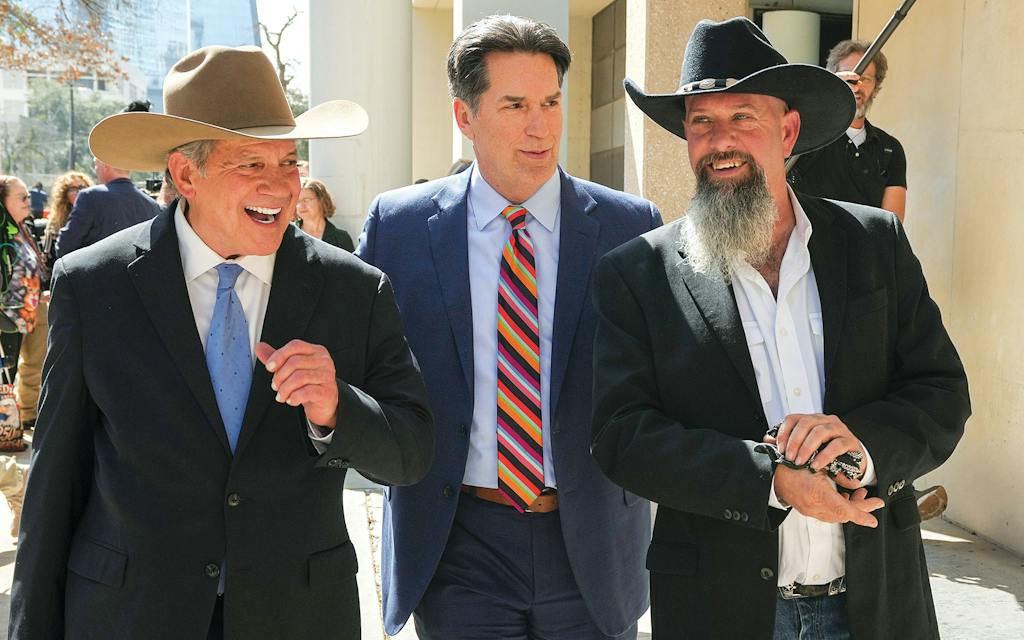
It took Austin officials nearly 26 years to admit they had made a terrible mistake. But when they finally did, they went all in—before, during, and after a February 19 hearing in Judge Dayna Blazey’s courtroom. The hearing was so crowded that extra chairs had to be brought in to make room for everyone, including more than a dozen men and women who had at some point worked on the case over the past 34 years: defense lawyers and their assistants, members of the DA’s office, cops. Forrest was there, dressed in a black cowboy hat, white shirt, no tie. He was nervous. “It was very stressful,” he told me later, “just trying to hold myself together.” Mike Scott wore a suit and tie. Rob Springsteen, who lives in West Virginia, didn’t show up for what his attorney described as “personal reasons.”
“Every day in this courthouse,” began assistant district attorney Trudy Strassburger, “the state asks people to take responsibility for harm they’ve caused to another, and then we do what we can to assist in repairing the harm. Today it’s our turn to accept responsibility.” Forrest had already met Strassburger; four days before the hearing, she and another ADA had come to the saloon. The first thing they did was apologize for her office’s actions over the years—and then they each hugged him. Forrest, who had been so bitter about the actions of law enforcement that he thought he could never accept an apology, began weeping. “It felt good,” he told me.
At the hearing the four men finally had a chance to speak or be spoken for. As giant photos of them in their lost youth sat on easels or were shown on TV monitors, their words focused on the hurt—and the harassment. “I have lived every single day since October the sixth, 1999, being seen as a monster for something I did not do,” said Rob’s lawyer, Amber Farrelly, reading a statement from her client. Mike, tall, balding, and wearing a suit jacket with a gray tie, was soft-spoken and appeared nervous. “I lost my family, lost my youth, lost my early adulthood.”
Maurice’s daughter, Marisa, was the angriest. “Let me be clear,” she said. “This is not one moment of evil. This was the result of a justice system that actively hunted my father, harassed him, twisted facts to fit a narrative, and tried to force a confession to support a story they had already decided to tell.”
Forrest’s lawyer, Steve Goodson, read a statement from his client that focused on the betrayal that still hurt all these years later. “When the murders happened, I was fifteen years old. At that time, I had only one person who I would call a friend. That was Maurice Pierce. . . . The APD detectives made my best friend implicate me in this heinous crime, and I lost the one friend that I had.” Forrest sat immobile at a table up front, as he had the last time I’d watched him in a courtroom, 27 years earlier.
The apologies continued at a press conference that was held after the hearing. “To Amy, Eliza, Sarah, and Jennifer,” Travis County district attorney José Garza said, “we are so sorry that we have failed you for so long.” Then he moved on to the men. “To Mr. Forrest Welborn,” he said, turning to look at Forrest, “on behalf of the office of the Travis County district attorney, I am sorry for what you have been through.” Forrest, staring straight ahead, would not meet his gaze. “You are innocent. And you were wrongfully accused, and I am sorry for that.” At this, Forrest turned his head, and his eyes met Garza’s. “I hope this process and any process that comes after affords you the fresh start that you deserve. Thank you. Thank you for being here.” Forrest nodded. Garza next apologized to Kim, Marisa, Rob, and Mike, who mouthed a thank-you to the DA.
When the conference was finished, Forrest stood next to his mom, dad, and other relatives. He was relieved it was over and ready to get back to the saloon. Then Kim, whom he hadn’t spoken to in 34 years, walked toward him. “I’m sorry that this happened,” she said, putting a hand on his arm. Forrest nodded, nervously running his hand down his goatee. Then Kim reached in to hug him. “Maurice never turned on you,” she said in his ear, as he returned the embrace. “He didn’t want to turn on you, Forrest. You were his friend.” They disengaged, and both were crying. Forrest wiped away tears and looked away—and then reached back to hug Kim again. “He was told the wrong things,” Kim continued, and though Forrest could have quibbled with some of her words, he knew this wasn’t the time to object.
They held on to each other a few moments longer. Afterward, he reached into his jacket pocket and pulled out a handkerchief and wiped his face. “I just want you to know that,” she said. “Thank you,” he replied.
Forrest, it seemed, had finally found some peace. So had Kim. “I really wish that they would have talked to each other,” she told me later. “But the police basically scared the crap out of all of us. They said, ‘Y’all are getting released, and don’t ever talk to each other again.’ And so we didn’t. I wish we would have, because then Maurice and Forrest could have figured it out. They would have been great friends.”
That night the saloon regulars stopped by to congratulate Forrest. A woman who used to live in North Austin near the yogurt shop brought him a card saying she always knew he was innocent. Later, Sharon sat at a nearby table while Forrest chatted with a young woman at the bar. Sharon has been dreaming that he would find a partner, someone he could share his life with. Now, for the first time in a while, he seemed at ease.
The hate, for the moment, was gone. “It meant a lot,” Forrest said about his conversation with Kim. “It made me feel better.” He also found himself accepting the official apology. When Garza turned and looked him in the eyes, something shifted. “I felt that it was sincere. Him turning and looking at me, it meant a lot.” He’d like a more concrete solution for the cops who interrogated the four young men. “I would like for some of those detectives to go do some prison time,” he said. “That’d be nice.”
None of the officers have ever faced disciplinary charges, though Polanco was thrown off the yogurt shop task force over concerns that he had coerced a confession from another suspect. In 1992 he was suspended indefinitely after he rejected a thirty-day disciplinary suspension for perjury in another case. He eventually got his job back and sued the city, receiving a $318,537 settlement. Paul Johnson, whose work led to the prosecutions of the four men, has refused to admit he made a mistake. In fact, in the final episode of the recent HBO documentary miniseries The Yogurt Shop Murders, he insisted that they were likely in league with Brashers. “Just because he was [there],” Johnson said, “I don’t think that shows that our guys or other guys were not.”
The morning after the hearing, Forrest was back at the saloon, getting it ready for another day. In March the nights got warmer and Soup Night ended, though Sharon would bring cobbler on Tuesdays and sometimes Forrest grilled chicken for everyone. He kept making fixes to the saloon, and in April he built a new stage with a friend and bought a new PA system for the bands. One of the constants in his life has been his love of music, and every night he would set up the PA and talk to the musicians, young singer-songwriters with frizzy hair and colorful shorts, middle-aged metalheads, geriatric hippies wearing cowboy hats. Oddballs themselves, seeking a home.
In May, Forrest hired someone to help him with bookings and someone else to help him set up in the mornings, feed the chickens, and order the beer and liquor. He was finally learning to trust others—he even seemed to be relaxing a bit. Still, he would have moments where he had to go off and be by himself. “It just gets so overwhelming sometimes,” he said. “Every day, same thing, same people, it just gets kind of tired.”
That month lawyers for the four men reached an agreement with the City of Austin. In lieu of suing the city and APD, Forrest, Mike, Rob, and Maurice’s family would receive a total of $35 million; Forrest would get a little less than $5 million. Mike, Rob, and Maurice’s family each got roughly $10 million, presumably because the three of them had spent significantly more time behind bars than Forrest had. This seemed like the best possible ending, and that evening Sharon brought a large plate of cookies and a cake to the bar.
But Forrest wasn’t celebrating. He was working, setting up the stage for open mic night, sitting on a drum stool tinkering with mic cables while Lynyrd Skynyrd’s “That Smell” played over the speakers. Sharon and I approached, and he looked up at us, frowning. She gave him a hug. “How are you doing?” she asked. “Fine,” he answered tersely. I shook his hand and told him the same thing that many others had texted and said all afternoon: “Congratulations.” But the whole thing was making him uncomfortable. “I just find it weird,” he said, looking worn out. “I don’t think I should be congratulated. I don’t really know how I feel about it.”
The day before, he had told me that the eight months since Brashers had been identified as the killer had been more stressful than any time in recent memory. “Before, it was in the back of my mind, where I wasn’t thinking about it every day. But now that they found the killer and then all the court stuff, all the lawyers and this and that, it’s really stressful. Someone was talking to me last night, telling me, ‘Oh, how do you feel now that you’re free?’ And I was like, ‘I’m not free. If I was free, we wouldn’t be having this conversation right now.’ It’s not over. I’m not free.”
Forrest was still angry at his fellow defendants. One morning in late June, he and I sat down at the saloon and watched videos of Mike’s and Rob’s interrogations, which he had never seen before. I thought that maybe watching these callow twentysomethings crumble in the face of unconstrained authority might soften his rage.
It didn’t. “I still really have a hard time with somebody saying that they did something they didn’t do,” he told me. “I was in a room just like that. They yelled at me, they pushed me around. ‘You know something! Tell us the truth!’ I know how hard it was in there. But I still cannot feel for them. I’m still really upset and mad at them. If they didn’t confess to something they didn’t do, we wouldn’t be here right now doing this today. If it wasn’t for them, I wouldn’t have had to live my life the way I’ve had to live it—lost relationships, can’t get relationships—because I’ve been a murder suspect for thirty-five years. I had a business when I got arrested. I could have had three or four businesses.”
He was animated, and his eyes were wide, shiny with emotion. He took a sip of his beer. “It’s just very hard for me to understand. I’ve had people try to explain to me before where the police have their skills to break people down; a lot of people have confessed to stuff they didn’t do, but I don’t know. I don’t see it.”
Forrest, the only one who never gave in to the cops, couldn’t let Maurice, Mike, or Rob off the hook. It was going to take more than a tearful reunion, a few official apologies, and a bunch of cash to make his anguish go away.
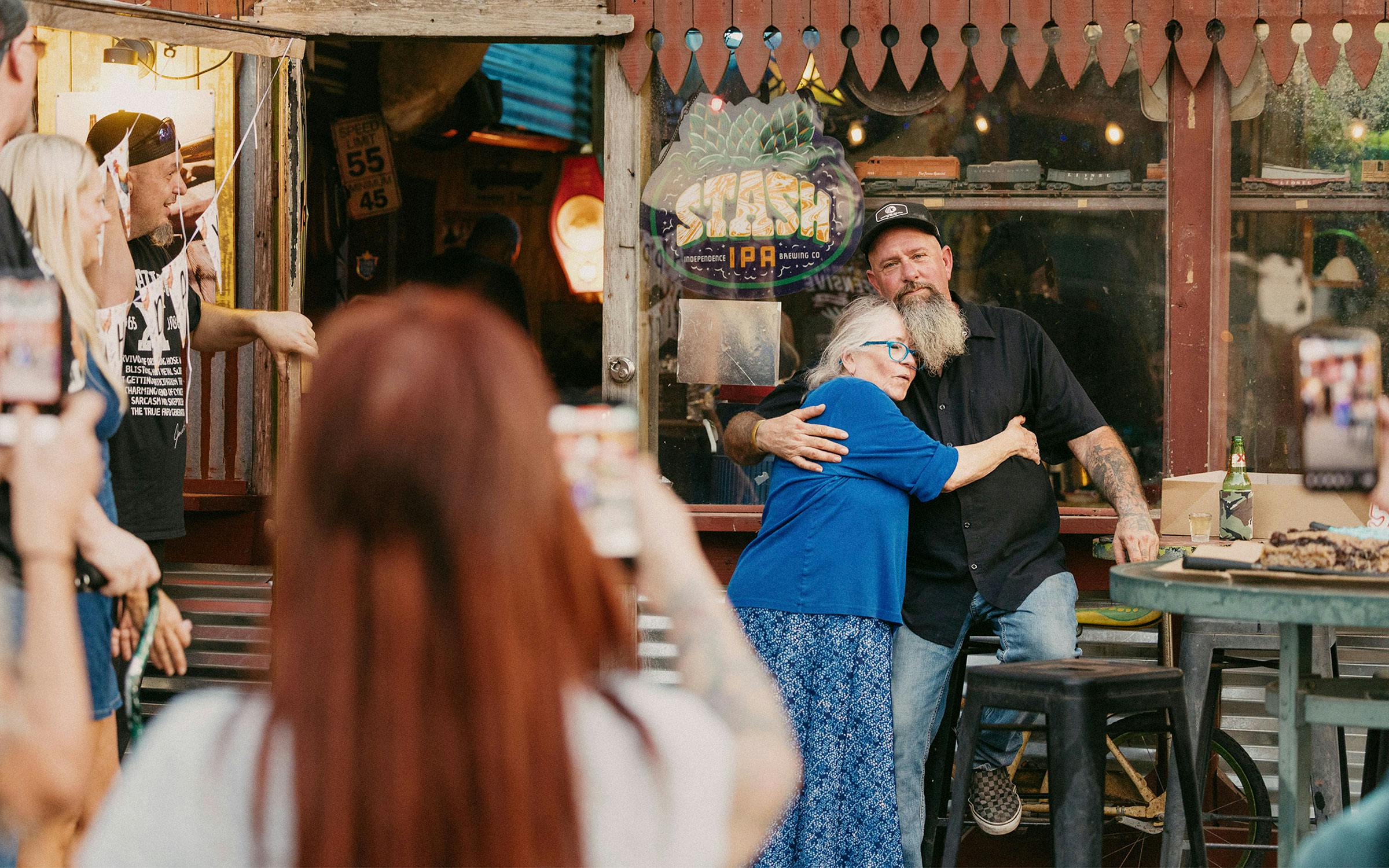
Maybe a party would do the trick. Forrest had told me that for much of his life he thought he’d never make it to fifty. But on August 21 he did, and his mom came to the saloon that evening with a chicken-enchilada casserole and a tamale pie. Friends brought jalapeño poppers, cornbread, banana pudding, and a German chocolate cake. The bar was jammed with patrons who wished Forrest a happy birthday.
It was a Friday night, though, and two bands were scheduled to play, so Forrest had work to do. He set up the PA on the outdoor stage, hauling out speakers, plugging in mic cables, talking to the members of Tamale Hatchet while they tuned up. The group—a tattooed country-rock bar band—had played its first gig on this stage ten months ago.
At 8 p.m., Sharon brought the cake out to the patio, and a crowd of friends gathered to sing “Happy Birthday.” Sharon hugged her son, and when the song was over, Forrest raised his beer in thanks—and actually smiled. “We love you, Forrest!” a woman called out.
Tamale Hatchet began to play, and Forrest stood on the patio listening, walked back to the soundboard to tinker with the bass level, then returned to the patio. The singer thanked Forrest for giving the band its first show, then launched into a song called “Whiskey on a Rainy Day.” Forrest listened intently, his body relaxed, his face calm.
He was fifty now, officially an old man, and he seemed to be enjoying himself, an unfamiliar feeling. He knew he was fortunate to have created this strange little world for himself. The music, the dinners cooked by his mom, the camaraderie with the regulars. But he also knew that at any moment it could all be taken away from him. Maybe this time, he thought, things would be different.
“Correction: This story previously misquoted Maurice Pierce’s daughter Marisa’s characterization of how the justice system treated her father. The quote has been corrected as of October 2, 2026.”
This article originally appeared in the October 2026 issue of Texas Monthly with the headline “The Man Who Can’t Forget.” Subscribe today.
When you buy a book using a link on this page, a portion of your purchase goes to independent bookstores and Texas Monthly receives a commission. Thank you for supporting our journalism.