Tesla Model Y efficiency exceeds early-production Model 3, data shows

13 min read Original article ↗

Doubts may still linger about the potential of battery electric vehicles for mainstream transportation, but EVs are getting progressively better. And if the data from the Tesla Model 3 and Model Y fleet is any indication, it appears that these improvements could result, at least to some degree, in an all-electric crossover being more efficient than the early production versions of an all-electric sedan.

In a recent conversation with Teslarati, David Hodge, the founder and CEO of Embark — a transportation app company that was sold to Apple in 2013 — explained that his work on a little passion project has shown something incredibly interesting about the Model 3 and Model Y’s efficiency. Hodge is currently working on the Nikola app, a service that he hopes will eventually grow to be the CarFax for EVs. So far, users of the app have driven about 7,000,000 miles, and over 2,000 Model 3s are registered in the fleet. 

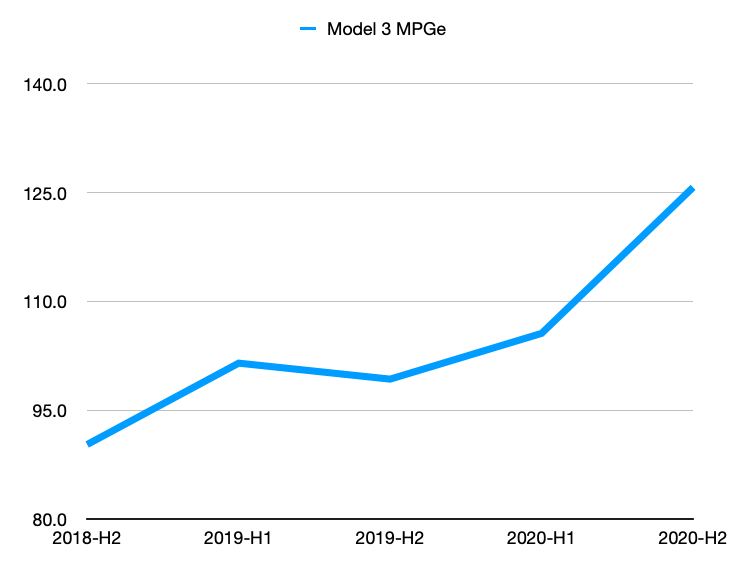
These Model 3s are comprised of vehicles that were produced from the beginning of Elon Musk’s first “alien dreadnought” attempt to cars that rolled off the line this quarter. Based on data that the Nikola app proprietor shared, it is evident that the Model 3 has gotten significantly more efficient over the years. Users of the app with vehicles produced in 2018, for example, showed a real-world average MPGe of 90.3, while cars that were produced in 2019 had a real-world average of 100.4. 

The Tesla Model 3’s real-world efficiency over time, as reflected by users of the Nikola app. (Credit: David Hodge)

These efficiency improvements continued in the first half of 2020, when Nikola app users who owned Model 3s showed a real-world average MPGe of 105.2. Interestingly enough, Tesla appears to have rolled out a major improvement to the Model 3’s efficiency in the second half of the year, as vehicles produced after June 2020 have shown a real-world average MPGe of 125.7. That’s the biggest improvement in the Model 3’s efficiency yet, at least as reflected in data from the Nikola app’s users. 

Inasmuch as the improvements in the Model 3’s MPGe are notable, the efficiency of the Model Y appears to be even more noteworthy. The Model Y is the newest vehicle in Tesla’s lineup today, having started deliveries earlier this year. But even with its early ramp, it is becoming quite evident that Tesla did something special with the all-electric crossover. 

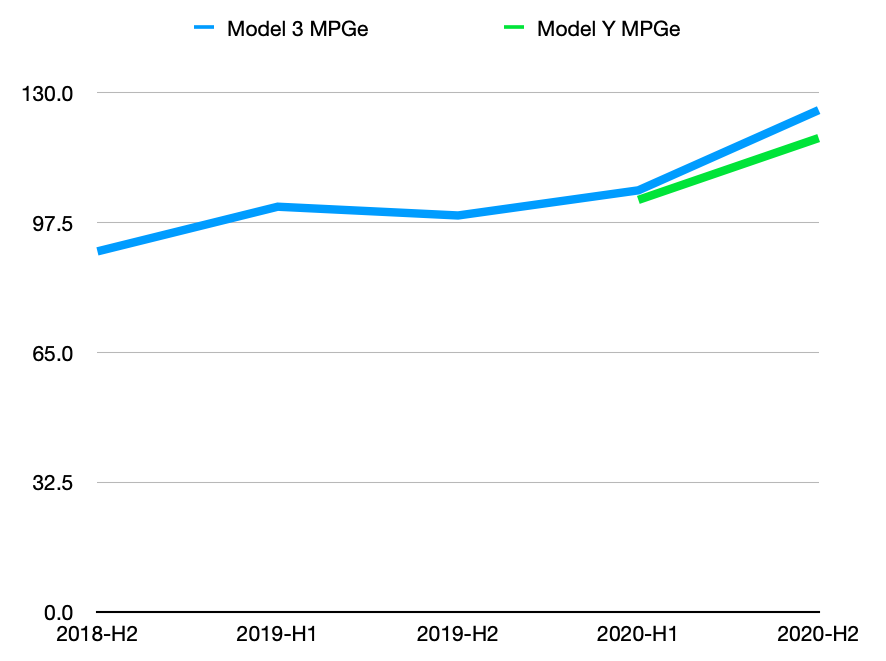
Nikola app users who owned Model Ys that were produced in the first half of 2020 showed a real-world average MPGe of 103.2, which was very close to the MPGe of Model 3s that were manufactured in the same period. And just like the Model 3s, Model Ys that were produced after June 2020 exhibited a significant improvement in efficiency, with the vehicles having a real-world average MPGe of 118.7. That’s higher than the MPGe of Model 3s that were produced just last year

The real-world MPGe of the Tesla Model 3 as compared to the Tesla Model Y, per data from users of the Nikola app. (Credit: David Hodge)

As noted by Hodge, such efficiency figures from the Model Y are extremely impressive, especially considering that it is larger and significantly heftier than the Model 3. This is also a pretty unique situation considering that the company’s flagship sedan, the Model S, has always been significantly more efficient than its SUV counterpart, the Model X.

“This is pretty impressive considering the obvious aerodynamic differences in the Y and the fact that the S has always outperformed the X by about 15. If you just look at cars made since June, the Model Y MPGe climbed to 119 on average, but it looks like some of the tech improvements made it over to the 3, which is seeing 125.6 MPGe average in that period,” Hodge noted. 

Tesla has a habit of rolling out improvements to its vehicles as soon as they are available. The latest Teslas are therefore expected to have the best tech that the company has to offer at the time of their production. With this in mind, and as per the findings of auto teardown expert Sandy Munro, the Model Y is indeed equipped with Tesla’s best, both in tech and in design. And considering that the all-electric crossover is expected to share components with its sedan sibling, it is not very surprising to see the Model 3 experience efficiency gains as soon as the Model Y started ramping up. Such is simply the nature of Tesla. 

Simon is an experienced automotive reporter with a passion for electric cars and clean energy. Fascinated by the world envisioned by Elon Musk, he hopes to make it to Mars (at least as a tourist) someday. For stories or tips--or even to just say a simple hello--send a message to his email, simon@teslarati.com or his handle on X, @ResidentSponge.

News

Tesla Roadster gets an update, but not the one fans were looking for

Tesla has quietly filed a new trademark application for its next-generation Roadster, giving enthusiasts their first official glimpse of fresh branding for the long-teased electric supercar.

Published

13 minutes ago

on

May 6, 2026

Credit: Dan Burkland

Tesla has been slow to show its hand regarding the massive project that is the Roadster, but it is now coming forth with a new update.

However, it is probably not the one fans were looking for.

Tesla has quietly filed a new trademark application for its next-generation Roadster, giving enthusiasts their first official glimpse of fresh branding for the long-teased electric supercar.

The February 3 filing includes an inverted triangular badge with the word “ROADSTER” centered above four vertical lines that, according to the application, represent “speed, propulsion, heat, or wind.”

A sleek, angular wordmark and a minimalist curved-line silhouette hinting at the car’s aerodynamic shape round out the trio of marks.

I found something cool. Tesla has filed a new trademark application for its next-generation Roadster. It could be the new Roadster logo/badge.

The filing says the lines depict speed, propulsion, heat or wind.

(I took the liberty of making the logo red. Trademark filings are… pic.twitter.com/W9JSDwTRL7

— Sawyer Merritt (@SawyerMerritt) May 6, 2026

For a program that began with Elon Musk’s 2017 reveal, this is tangible forward motion. The original Roadster proved EVs could be thrilling; the next generation aims higher, with promises of sub-two-second 0-60 mph acceleration and, in its most extreme configuration, optional SpaceX cold-gas thrusters for rocket-like thrust.

The new trademarks suggest Tesla is now locking down the visual identity that will accompany those headline specs, as well as a small hint that maybe we’re finally getting close. However, the company has not revealed any progress on the vehicle itself or its specs to the public.

It continues to tease with developments like this one.

That said, the update lands with a familiar bittersweet note. Fans have waited nearly a decade since the initial unveiling. Production was once eyed for 2020, then 2021, then later still. In the intervening years, Tesla has delivered the Model Y, Cybertruck, Semi, and major autonomy advances while scaling its energy business.

The Roadster has taken a back seat, and the delays have been genuinely disappointing. Many longtime supporters have grown frustrated watching renderings and hearsay while other marques roll out ever-faster electric sports cars.

Elon Musk talks Tesla Roadster’s future

Yet, the Roadster program itself still sparks genuine excitement. It represents the purest expression of Tesla’s “accelerate the world’s transition to sustainable energy” mission—pushing performance boundaries to prove EVs can outperform anything with an engine.

The new branding, modest as it is, keeps that promise alive. It tells owners and prospective buyers that Tesla hasn’t forgotten the car that started it all.

No one would blame fans for wanting more than a logo right now. But in an industry where many concepts never leave the drawing board, the fact that Tesla continues to invest in and protect the Roadster’s identity is reason for measured optimism.

The wait has tested patience, but when the next-generation Roadster finally arrives, the new badge may well adorn one of the most exciting cars ever built. For those who have followed the journey this far, that payoff still feels worth it.

News

Tesla gets a massive order for the Semi: 370 units and $100M

WattEV, a leading provider of electric freight operations and charging infrastructure in the United States, has announced one of the largest deployments of electric Class 8 trucks in California history: an order for 370 Tesla Semi vehicles.

Published

19 hours ago

on

May 5, 2026

Credit: Tesla

Tesla just got a massive order for the Semi, and it is its largest by a long shot.

WattEV, a leading provider of electric freight operations and charging infrastructure in the United States, has announced one of the largest deployments of electric Class 8 trucks in California history: an order for 370 Tesla Semis.

Valued at approximately $100 million, this marks the state’s biggest single electric truck order to date and signals accelerating momentum for zero-emission long-haul freight.

Credit: Tesla

Deliveries are set to begin with the first 50 Tesla Semis in 2026, with the full fleet operational by the end of 2027. More than 300 of these trucks will support a joint program with the Port of Oakland, helping electrify drayage and regional freight routes. The initiative aligns with California’s ambitious goals to transition to carbon-neutral freight operations.

Salim Youssefzadeh, CEO of WattEV, said at the annual ACT Expo industry event that the Semi was the easiest choice:

“We selected the Tesla Semi based on cost, performance, and availability after issuing a public request for proposals…With the Tesla Semi now entering mass production and drawing strong reviews from fleet operators nationwide, WattEV’s vertically integrated model – combining vehicle deployment, megawatt-class charging infrastructure, and full-service leasing – offers a turn-key path for carriers without any capital risk.”

Critical to the rollout are new Megawatt Charging System (MCS) hubs in Oakland, Fresno, Stockton, and Sacramento. These stations will deliver up to 300 miles of range in roughly 30 minutes—comparable to a traditional diesel fill-up. The Oakland depot, where WattEV recently broke ground, will serve as a cornerstone for northern and central California corridors, connecting ports to inland hubs and beyond.

This deployment builds on WattEV’s existing experience. The company has already logged millions of electric miles in Southern California, including early Tesla Semi deployments at the Ports of Long Beach and Los Angeles. By combining high-efficiency electric trucks with strategically placed fast-charging depots, WattEV aims to prove that battery-electric long-haul trucking can match—or exceed—diesel economics while slashing emissions.

The order arrives as Tesla ramps up Semi production at its Nevada factory, targeting higher volumes in 2026. Fleet operators nationwide have praised the Semi’s real-world performance, including strong torque, low operating costs, and advanced safety features. For California, the project supports air quality improvements around ports and highways while demonstrating scalable infrastructure for heavy-duty electrification.

Industry observers see this as a pivotal step toward broader adoption. With diesel trucks facing rising fuel and regulatory costs, turnkey electric solutions like WattEV’s could accelerate the shift. As the first 50 Semis hit the road in 2026, they will not only move freight but also help build the charging network that paves the way for even larger fleets.

This landmark order underscores Tesla’s growing footprint in commercial trucking and California’s leadership in sustainable transportation. For WattEV and its partners, it’s more than a vehicle purchase—it’s the foundation of a zero-emission freight network connecting Northern and Central California.

News

Tesla begins factoring international designs in Full Self-Driving visualization

Tesla has begun incorporating region-specific vehicle designs into its Full Self-Driving (FSD) visualization system, marking a quiet but meaningful step toward global readiness. In software update 2026.14, released as part of the Spring Update, European Tesla owners are now seeing flat-fronted, cab-over European-style semi-trucks rendered accurately on their center displays.

Published

22 hours ago

on

May 5, 2026

@norbertcala on X via Not a Tesla App

Tesla has begun factoring international designs into its Full Self-Driving (Supervised) visualizations, marking a tremendous step in how the company plans to roll out its driver assistance tech in areas outside North America.

Tesla has begun incorporating region-specific vehicle designs into its Full Self-Driving (FSD) visualization system, marking a quiet but meaningful step toward global readiness. In software update 2026.14, released as part of the Spring Update, European Tesla owners are now seeing flat-fronted, cab-over European-style semi-trucks rendered accurately on their center displays.

The change, first spotted by Not a Tesla App, adds a second 3D model alongside the traditional North American long-nose semi-trucks that have been standard until now. Vehicles can detect and display both styles depending on what’s in front of them, and the feature requires no FSD subscription—every Tesla owner in Europe sees it immediately.

The European semi-truck visualization was actually added to the vehicle software back in October alongside roughly fifteen new visual assets.

Tesla Full Self-Driving gets first-ever European approval

Tesla held it in reserve, activating it only once fleet data confirmed the AI could recognize these trucks with high confidence. This mirrors recent rollouts for horses and golf carts, where Tesla similarly waited for reliable detection before enabling the graphics. The result is a more realistic on-screen representation tailored to local roads, where cab-over designs dominate heavy transport.

The significance of this update extends far beyond a simple graphics tweak, which is really what people need to be paying attention to. These small, incremental steps forward continue to show Tesla’s intent for global expansion.

For the first time, Tesla is explicitly factoring international vehicle designs into its visualization engine, signaling a deliberate push to make FSD feel native in international markets.

In Europe, where cab-over semis are commonplace, seeing an accurate rendering builds immediate driver trust—the critical bridge between the car’s AI perception and the human behind the wheel. Accurate visualizations reinforce that the system truly understands its surroundings, reducing range anxiety and skepticism that have slowed autonomous adoption abroad.

Regulators in the EU have repeatedly emphasized human-AI transparency; by customizing visuals to match local reality, Tesla strengthens its case for broader FSD approvals and smoother regulatory reviews.

This move also highlights Tesla’s data-driven engineering philosophy. Rather than rushing generic models worldwide, the company is leveraging its global fleet to learn regional nuances before flipping the switch.

It accelerates FSD’s international expansion while improving safety—misidentified vehicles could erode confidence or, in edge cases, affect decision-making. For a company aiming to deploy robotaxis and unsupervised FSD globally, tailoring visualizations to European, Asian, or other markets is no longer optional; it’s foundational.

Early European owners report the change feels more intuitive, making the car’s “mind” easier to read in daily traffic.

As Tesla continues enabling the remaining visual assets added last year, the pattern is clear: localization is now baked into the FSD roadmap. What began as a small graphics update in Europe could soon appear in other regions, turning the visualization display into a truly worldwide language of autonomy.

With this step, Tesla isn’t just showing trucks differently—it’s proving it’s serious about making FSD work everywhere, one culturally accurate pixel at a time.