AGING: As of last month, people aged 65 or older accounted for 20.06 percent of the total population and the number of couples who got married fell by 18,685 from 2024
By Kao Chia-ho and Lee Wen-hsin / Staff reporter, with CNA
-


Taiwan has surpassed South Korea as the country least willing to have children, with an annual crude birthrate of 4.62 per 1,000 people, Ministry of the Interior data showed yesterday.
The nation was previously ranked the second-lowest country in terms of total fertility rate, or the average number of children a woman has in her lifetime.
However, South Korea’s fertility rate began to recover from 2023, with total fertility rate rising from 0.72 and estimated to reach 0.82 to 0.85 by last year, and the crude birthrate projected at 6.7 per 1,000 people.
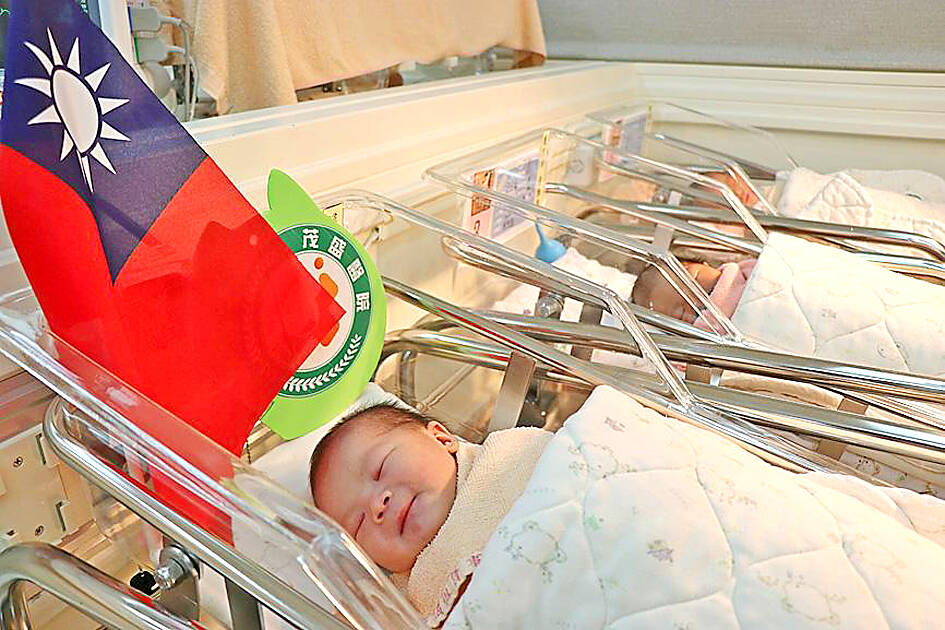
Newborns are pictured at Taichung’s Lee Women’s Hospital in an undated photograph.
Photo: Tsai Shu-yuan, Taipei Times
Japan’s crude birthrate was projected to fall below six, but hold above five per 1,000 people last year.
In contrast, Taiwan’s crude birthrate plummeted from 5.76 per 1,000 people in 2024 to 4.62 last year, and its total fertility rate is likely to fall below 0.8.
Ministry data showed that only 107,812 babies were born in Taiwan last year, or a crude birthrate of 4.62 per 1,000 people.
That was 27,044 babies fewer than 2024, when there were 134,856 newborns and a crude birthrate of 5.76 per 1,000 people, and was a record low since the ministry began compiling statistics.
The number of newborns has declined for 10 consecutive years, from 208,440 in 2016 to 193,844 in 2017; 181,601 in 2018; 177,767 in 2019; 165,249 in 2020; 153,820 in 2021; 138,986 in 2022; 135,571 in 2023; 134,856 in 2024; and 107,812 last year, ministry data showed.
Taiwan has officially become a “super-aged society” under UN criteria, which defines it as one in which people aged 65 or older make up at least 20 percent of the population.
Countries where people aged 65 or older make up 14 percent or more of the population are defined as “aged” societies, while those with 7 percent or more are “aging” societies.
As of the end of last month, Taiwan’s population aged 65 or` older totaled 4,673,155, or 20.06 percent of the total population, the ministry said.
The total population was 23,299,132 as of the end of last month, down 101,088 from the same period in 2024, the second consecutive year of population decline, the data showed.
There were 200,268 deaths last month, 1,839 fewer than in December 2024, with a crude death rate of 8.58 per 1,000 people, it showed.
As of the end of last year, people aged 14 or younger totaled 2,681,890, or 11.51 percent of the population, while people aged 15 to 64 reached 15,944,087, or 68.43 percent, the figures showed.
As for marriages, 104,376 couples tied the knot last year, down 18,685 from 2024, the ministry said, adding that 52,101 couples divorced last year, 1,368 fewer than a year earlier.
Minister of Health and Welfare Shih Chung-liang (石崇良) said that half a year ago, the ministry already expected Taiwan would become a “super-aged society.”
In response to the rapidly aging population, the Ministry of Health and Welfare has plans in four key areas — health promotion, decentralized care, reform of the benefits system and integration of technology — adjusting medical and care systems to meet the challenges associated with a “super-aged society,” he said.
Additional reporting by Chiu Chih-jou