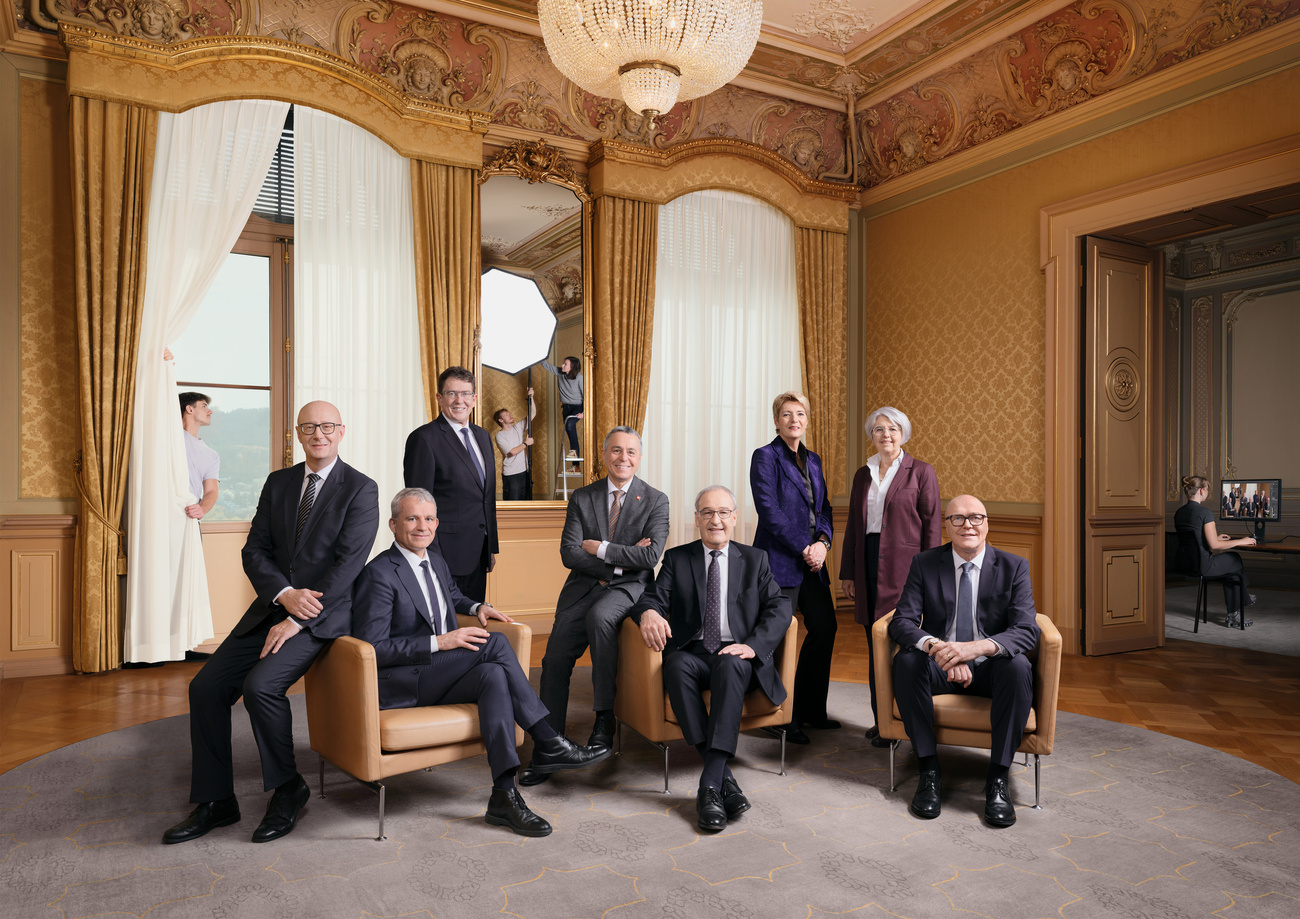
On December 10, the United Federal Assembly elected Economics Minister Guy Parmelin as President of the Swiss Confederation and Foreign Minister Ignazio Cassis as Vice-President for the year 2026.
Keystone / Anthony Anex
On December 10, Switzerland’s parliament elected Economics Minister Guy Parmelin as the country’s president for 2026. This annually rotating office is a Swiss peculiarity, found nowhere else in the world. So how exactly does it work?
Generated with artificial intelligence.
This content was published on
9 minutes
I cover topics related to the Swiss Abroad and Swiss specialities, also producing a daily briefing for the Swiss Abroad community.
I studied communication sciences, then worked as a reporter and video journalist for private radio and television. I have worked for SWI swissinfo.ch in various roles since 2002.
Deutsch
Warum die Schweiz kein Staatsoberhaupt hat
Original
Français
Pourquoi la Suisse n’a pas vraiment de chef d’État
Italiano
Perché la Svizzera non ha un Capo di Stato
Português
Suíça mantém tradição de rodízio presidencial sem reeleição
العربية
لماذا تفتقر سويسرا إلى «رئيس دولة» بالمعنى التقليدي؟
Русский
Почему в Швейцарии нет главы государства?
Any member of Switzerland’s seven-person executive body who goes to the federal parliament building on the relevant Wednesday in December and is elected president of the Swiss ConfederationExternal link comes out basically unchanged: he or she has no extra powers, no rights to a presidential palace, no police escort.
While the role of president of Switzerland does mean a busier schedule – and generally a celebration in the home canton – the incumbent has no greater say over the country’s affairs. He or she conducts the weekly meetings of the Federal Council, as the government’s executive body is called; represents the federal government at home and abroad; and has the honour of delivering the New Year’s addressExternal link to the nation on television.
Government decisions, however, continue to be made by all seven members of the Federal Council. It is the majority that decides, not the president.
More
More
Swiss Politics
Switzerland’s 21 living ex-presidents: a world record
This content was published on
Twenty-one former Swiss presidents are still alive. What does this record say about the country’s political stability and leadership?
“The president of the Swiss Confederation and the vice-president of the Federal Council are elected individually, one after the other, by the United Federal Assembly from the members of the Federal Council for a term of office of one year,” is how the Swiss parliament’s websiteExternal link describes the annually recurring process.
Once the year is out, the vice-president takes the president’s place. “Re-election for the following year is not permitted,” the website continues.
The unwritten rule is that the members of the Federal Council are elected to the role of president in order of seniority, that is, according to the length of time they have been in office. And if two members joined the executive body on the same day, as often happens, then the one who was elected second assumes the presidency one year after the first.
The president of Switzerland is often referred to in Latin as “primus inter paresExternal link” or first among equals. While acting as president, he or she continues to head the federal department or ministry, for which he or she is responsible.
Thus, in 2026 Parmelin will still run the economics ministry, while Ignazio Cassis, the foreign minister, will serve as vice-president.
The vice-president’s role would become important if Parmelin were unable to discharge his duties. Cassis would then take over all presidential responsibilities. And in 2027, it will be his turn to be president of Switzerland for one year.
Swiss Foreign Minister Ignazio Cassis (right) with the Kuwaiti Secretary of State at the Ministry of Foreign Affairs, Bader Al-Tunaib (left) after the arrival of the Swiss delegation at Kuwait City International Airport on October 24, 2025.
Keystone / Anthony Anex
Rotation not personality cult
The principle of rotation was introduced in 1848 with the first federal constitution of modern Switzerland. The framers of the document were pragmatic thinkers who wanted to avoid any royal trappings or an executive branch dominated by a strong president. They also had in mind the cantons, which wanted to share their hard-won federal right to self-determinationExternal link.
Between 1848 and 1890, according to the Federal Council websiteExternal link, “it was mainly the particularly influential Federal Councillors who were elected president”. Thus, Karl Schenk from Bern and Emil Welti from Aargau each held the office for six years – although never consecutively, of course.
Since the 1890s, the position has rotated continuously, according to the seniority of the seven members of the Federal Council.
No other state has this principle of automatic rotation at the highest level. It brings a great deal of calm and stability to the political system. There are no election campaigns, no re-election strategies, and no attempts to cling to office.
Term of office: One year – with a regular change at the beginning of January.
Election: Annually in December by the United Federal Assembly (the Swiss parliament, comprising the House of Representatives and the Senate), from among the seven members of the Federal Council.
Order: Rotation according to seniority in office; the vice-president automatically assumes the presidency in the following year.
Role: Conducting Federal Council meetings, representing the federal government at home and abroad, performing representative duties.
Special rights: The Swiss president has no additional decision-making powers; all decisions are made by the entire Federal Council. The only prerogative is the casting vote in the event of a tied vote in the Federal Council.
The role of the president of the Swiss Confederation is mainly representative. During state visits, he or she does give speeches, but these must have been approved by the entire Federal Council beforehand. No one can act single-handedly; this is also typically Swiss.
Officially, meanwhile, the term “state visits” is never used at home; instead, they are referred to as “presidential visitsExternal link”. But from the perspective of the host country, the Swiss president is often invited on a “state visit” and received with the full honours dictated by protocol, in order to accord the same diplomatic standing as the representatives of other states.
At home, the president’s term of office begins with a moment of common orientation: every year, the New Year’s address on January 1 describes a kind of state of the nation on television.
In it, the newly elected president emphasises values such as compromise, humility and dialogue, urging citizens to engage in civic life and remain level-headed. This is not an order, rather more a request.
Despite the representative nature of the office, some members of Federal Council have succeeded in leaving their mark on their presidential year with their personal style.
Thus, Rudolf Gnägi (president in 1971 and 1976) made a name for himself as a man of the people, a “farmer from the Bernese Seeland”, who consciously maintained a down-to-earth tone during his years as president.
And Ruth Dreifuss, elected as Switzerland’s first female president in 1999, linked her year in office to a symbolic step toward gender equality.
On December 9, 1998, Ruth Dreifuss celebrated as the newly elected and first female president of the Swiss Confederation together with her supporters on the parliament square in Bern.
Keystone / Stringer
A reflection of political DNA
The Swiss presidency embodies Switzerland’s model of governance, which relies on negotiation, compromise and trust in established procedures rather than charismatic leaders.
The president remains bound by the principle of collegiality and must represent jointly reached decisions to the outside world.
The political affiliation of individual government members hardly plays a role at this point. Instead, the members of the Federal Council are obliged to pull together.
While in other capitals, heads of state come with grand visions, push through their party interests or personal preferences – which often go against their bombastic election promises – or try to cling to power, the Swiss president seeks to represent the diversity of voices that is typical of Switzerland.
From left to right: Federal Chancellor Viktor Rossi and the Swiss Federal Council in its current composition with Beat Jans, Ignazio Cassis, Karin Keller-Sutter, Guy Parmelin, Elisabeth Baume-Schneider, Albert Rösti and Martin Pfister, on the occasion of the Federal Council trip on June 26, 2025 at Lake Walen in Weesen.
Keystone / Gian Ehrenzeller
The prerogatives of the office include increased invitations abroad and a casting vote in case of a tie during votes in the Federal Council, essentially making the president’s vote count double in order to break a deadlock.
The one-year term of office symbolises a country that prefers to discuss issues at length and reach a consensus rather than make hasty decisions. This has helped it to maintain its internationally acclaimed stability over time.
No other country in the world has ever adopted this principle: it is too complicated and not at all glamorous. It is, however, part of Switzerland’s political identity.
The president serves not so much as the head of the Swiss political system but as its mirror: modest, predictable and collegial. And it has been like this for over 175 years – with no institutional crises.
Edited by Marc Leutenegger. Adapted from German by Julia Bassam/ac
More
Have you ever heard anything peculiar about Switzerland that you found interesting?
Is there anything peculiar related to Switzerland that has caught your interest? Share it with us, and we might feature it in an article!