People’s interest in achieving quick financial success drives many aspiring traders to seek shortcuts in building their personal brand and trading capital simultaneously. Some individuals choose to buy Instagram followers to create an impression of trading success and expertise. Others focus solely on follower count growth to monetize their trading education content or signal services.
The decision to buy followers is a smart move to provide social media proof. On the other hand, it is important to take into consideration that many successful traders will tell you that generating authentic followers will create stronger credibility. Combining the followers generated will then build towards a firmer foundation.
Understanding Day Trading Fundamentals
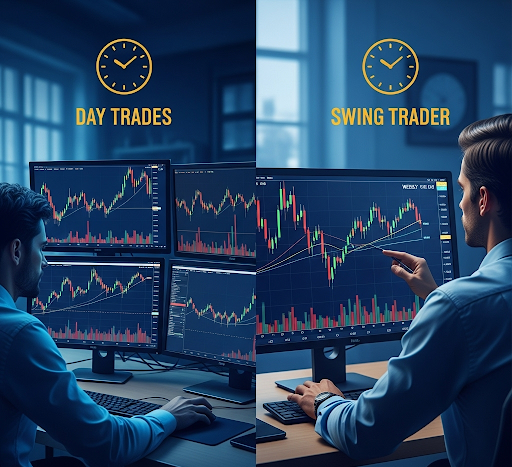
Day trading will require opening and closing positions on the same day. It capitalizes on short-term price movements. Positioning can be made in virtually any financial instrument whether currencies, or stocks. This approach requires constant market monitoring and quick decision-making abilities, as positions typically last minutes to hours rather than days or weeks.
Day trading moves fast, demanding strong emotional discipline, and huge time commitment. Successful day traders develop systematic approaches to market analysis and maintain strict risk management protocols to protect their capital from rapid losses.
Swing Trading Strategy Overview
Unlike day trading, swing trading is focused on trying to capture price movements over a few days to weeks. Traders have more time in reviewing these trends, without being closely involved reviewing these movements. This approach suits individuals with full-time jobs or other commitments that prevent continuous market monitoring throughout trading hours.
Position holding periods in swing trading typically range from two days to several weeks, depending on market conditions and specific trading strategies. This extended timeframe allows for more thorough analysis and reduces the stress associated with minute-by-minute price fluctuations.
Capital Requirements and Risk Management
Day trading often requires larger capital amounts due to pattern day trader rules and the need to make multiple trades profitably after commission costs. Regulatory requirements mandate minimum account balances for frequent day trading activities, creating barriers for traders with limited starting capital.
Swing trading can accommodate smaller account sizes more effectively because fewer trades are required to generate meaningful returns, and commission costs represent a smaller percentage of overall position values.
Technology and Platform Requirements
Day trading will require advanced charting, rapid order execution system, and real-time data feeds. A trading platform that is always often acquired from top-notch systems. The technology costs and learning curve associated with professional-grade trading software represent significant initial investments.
Swing traders can often succeed with simpler platforms and less expensive data subscriptions, though professional tools still provide advantages in market analysis and trade management efficiency.
Skill Development and Learning Curves
Both trading styles require extensive education and practice before achieving consistent profitability. Day trading skills focus on rapid pattern recognition, quick execution, and managing emotions under pressure. Whereas swing trading emphasizes longer-term trend analysis and patience in waiting for optimal entry and exit points.
Market analysis techniques differ between these approaches, with day traders relying heavily on technical indicators and intraday charts, while swing traders incorporate both technical and fundamental analysis over longer timeframes.



 Stock trading carries high stakes. Professional and retail traders face financial risks daily, but legal and insurance challenges can hit just as hard. From regulatory compliance to liability disputes, traders need robust protections to safeguard their careers and investments. Legal expertise becomes a lifeline when navigating these complexities. Fortunately, specialized attorneys can guide traders through murky waters, ensuring they stay compliant and protected.











 In the
  The primary goal of SEO is for your site or page to gain top spots on search engine results pages (SERPs). Attaining this, the search engine has to deem your site or page relevant to the search query. The more it is recognized to be relevant by the search engine, the greater the likelihood for your site or page to rank high, garnering a top spot on the first page of the SERP.
 ncreasing growth in revenues as results of successful ecommerce integrations have sparked interests in researching about publicly traded ecommerce stocks. However, take notice that the leading ecommerce companies have been in the business of selling goods and various innovative products since the early years when ecommerce was first introduced as a new market. Today, they still represent the ecommerce companies with the likeliest potential to offer good returns on investments.
 EBAY – a.k.a. eBay Inc. a US-based marketplace platform whose mission is to connect global sellers and buyers of any goods, including second-hand items. Listed in on the NASDAQ trading platform, eBay shows a trailing of annual revenue placed at around USD10.3 billion, while employing only 10,800 people as staff and crew. EBAY’s market capitalization totals $26,133,424,128, while its stock price has been going steady at $48.63 per share. This online marketplace shows a Price to Earning Ratio or P/E ratio: 2.5235 and a Price/Earnings to Growth (PEG) ratio of 2.4479.
 The current AMZN share is priced at $134.95. Which last week was pegged at a lower price index of $122.28. Also listed in the NASDAQ platform its 12-month revenue trail is about USD$477.7 billion, while employing as many as 1,622,000 workers. Amazon’s has a market capitalization amounting to $1,245,550,084,096, with a P/E ratio of 60.0098 and a PEG ratio of 4.6175.
 Shopify’s latest price is steady at $34.83 while listed in the New York Stock Exchange, whilst showing a trailing of yearly revenue of about USD$4.8 billion. Shopify currently has 10,000 staff in its employ. Its market capitalization amounts $46,571,626,496, while exhibiting a P/E ratio of 284 and a negative PEG ratio of -94.58.