Last updatedUpdated: by · CreatedCreated: · 8 min read recently updated Recent changes today +160 / −82 words 3 weeks ago +4 / −0 words 4 weeks ago +32 / −32 words 3 months ago +9 / −0 words 3 months ago +85 / −179 words 3 months ago +12 / −0 words 3 months ago +201 / −9 words 3 months ago +32 / −15 words 4 months ago +13 / −0 words 4 months ago +1084 / −1057 words 4 months ago published · 1787 words Hacker News
Everyone is using Obsidian for AI, or wants to use it to become more productive. But I think it’s a dead end.
The reasons are clear: Obsidian notes are open on your local disk in an open format, Markdown, and accessible to everyone, including your AI agents. This makes it as great and easy an integration as possible. But should you actually use AI with your notes? And if so, what are the use cases or ways you should interact with it?
First of all, if you use Vibe Code Agents with Obsidian, use the Obsidian CLI. It will be much faster to return your files, search, or act, grepping through the files.
Second, I’m a strong proponent of avoiding adding lots of AI-generated summaries[^1] or other on-the-fly-generated text to my vault. The reason is simple: over time, I don’t know anymore whether the content was written by me or by an AI, and my own, much more valuable thoughts get diminished by “AI Slop”.
- Also, when searching for something, you need to fight through the noise of generated stuff. If you only have your own writing, it’s all valuable, or at least there’s a reason why you noted it down. There was a conviction, idea, or something that moved you.
- Yes, it’s good in certain areas, and mostly on-the-spot summaries seem great, but every time I come back to them, I find them very average. It doesn’t help me, as it didn’t highlight the things I would, and I need to reread anyway.
- What I do sometimes with Obsidian Webclipper, if I create a new note, is summarize it in one sentence or a few. I clearly mark it as AI-generated and even put it in a quote, so it’s clear to me, and to anyone in 5 years, that it wasn’t mine. If I have added my own thoughts and writing, I will just remove the generated paragraphs (not my words).
But, use it for advanced research, like finding related notes. I think this might be the best use case. But don’t use it for tagging or organization, because eventually all your relations and connections won’t count for anything, since they aren’t made by you. The power lies in the deliberately created graph of notes, your very own Second Brain.
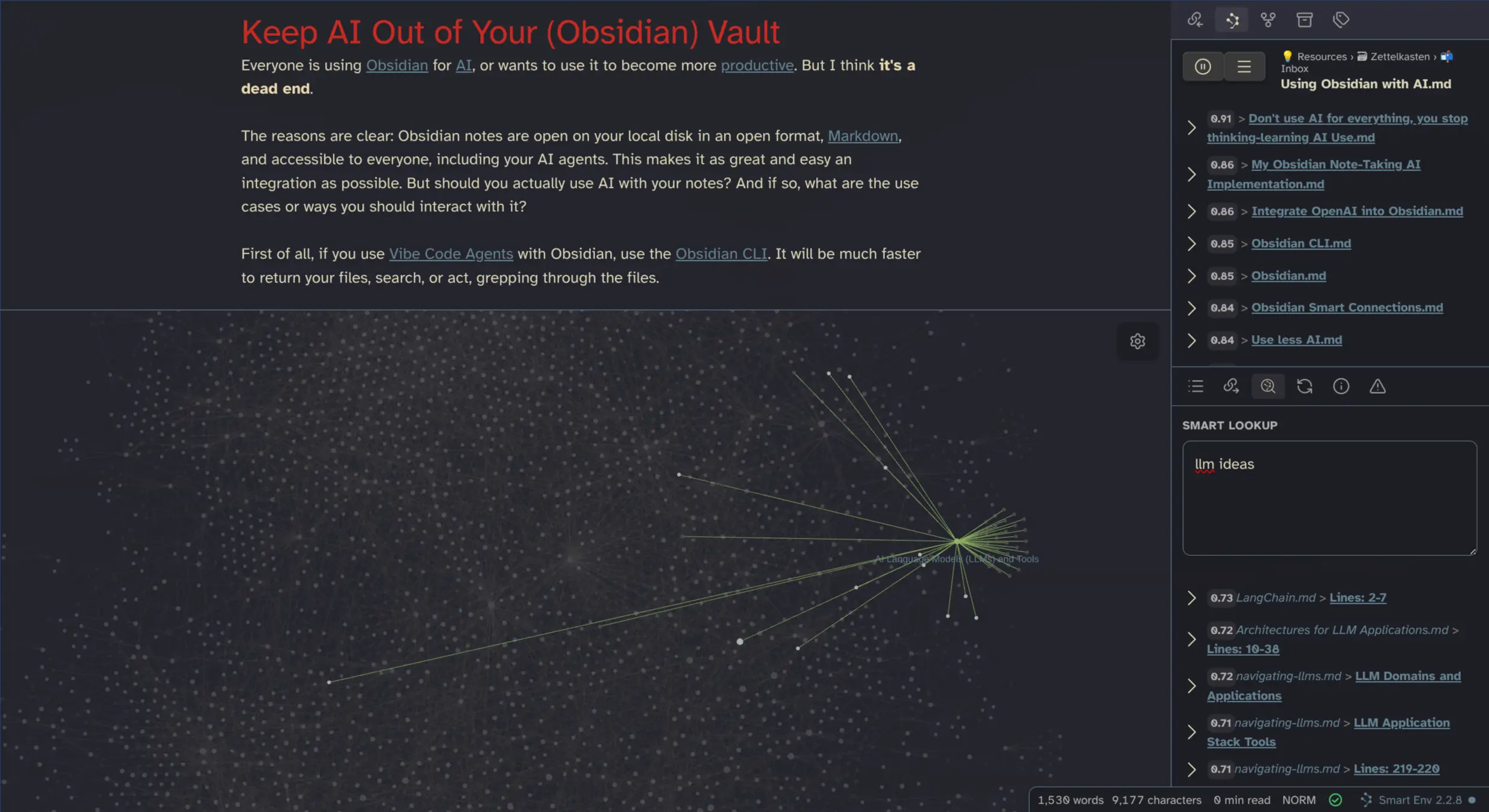
My Obsidian Vault with Smart Lookup and related notes with Smart Connections and local graph | Also check out Vim Motions for Writers to see my writing workflow and how I write
I personally don’t use it like that yet, but I might one day with a powerful local model, since I have lots of sensitive notes I don’t want to upload anywhere. Plus, it takes away the thinking part of My Obsidian Note-Taking Workflow. I don’t want to replace my human thinking yet. But I use a mathematical or local model with Obsidian Smart Connections, or the Graph Analysis plugin.
I’m pretty sure that if you go all in with using AI to generate your notes, you will end up with less clarity and fewer insights. You might start fresh very soon, as you won’t get value from it, and stop maintaining or adding ideas.
[^1] To be clear, I mean long summaries, no harm in a 1-2 sentence intro in a note.
Long AI Summarization is usually just noise
Kepano says, too: “A summary of a PDF is noise. An insight I had from reading the PDF is signal”. Tweet. Read more Other Opinions by Jason Fried, Paul Graham, Ted Gioia, Mitchell Hashimoto, and many more.
# Search is an Organizational Question
I think if you have an urge to do something, do it in a separate vault, or just use a database, e.g. DuckDB, and do all the fun stuff with AI as I did for search and clustering. But don’t mix your precious notes and Zettelkasten for it. Not yet, at least, but probably never.
I have 25'979 files totaling 3.5 GB, all in a single vault, and I find everything in split seconds (using the Omnisearch plugin). Search is pretty much an organizational question; e.g., I use Zettelkasten, and some refer to Memex as its digital version.
But if you need more advanced features, you can just add the Obsidian Smart Connections plugin and get vector and similarity search, etc., out of the box.
# Your Notes Will Be Your Prompts Tomorrow
Remember, your notes will be prompts or libraries for AI tomorrow, but not if you generate them.
# Cultivating Knowledge
Also on the notion of cultivating knowledge for AI systems, I’d say I’m more interested in cultivating for myself, long-term 🙂.
I imagine if humans do not have their own knowledge bases, everyone will have the same (average) notes based on AI models, not 100% of course, but there is no conviction, no decisions made, just all equally similar.
This is another reason we also need human-curated knowledge on a large scale. AI models will retrain on this data, better than on synthetic, fake data, IMO, though we need to find an economic model that also works for the creator of these insights and knowledge.
# Whose Knowledge System is It?
Using Claude Code (or another agent) to generate your system and make connections, like , is not your system. If you want a tool for retrieval, yes, sure, but I have a second brain and a knowledge system where my thinking happens. I make the connections because I had an idea, or something told me to do so.
Great video on this with more of the same thinking I have at Obsidian vs Claude — Why I’m Not Worried About AI Killing Note-Taking Apps. He says elegantly that a second brain is a system; the connections and writing parts are not inefficient; it’s the process of thinking and learning.
Claude is just a tool, like Obsidian, but as File Over App, by the CEO of Obsidian, goes, it’s not about the app anyway, it’s about the files, your thoughts, your insights. So if it’s someone else’s, heck, even generated, it’s not why I use the second brain. Can be useful, too, sure, but not as much as my new ideas, the thinking I get from my knowledge system.
Touch some grass, they say.
# Examples
Some examples that identify this phenomenon quite well, or help us understand and think through it better.
# It’s Hard to Finish an Idea that is not Yours
While I use Claude a lot for my Omarchy plugins and Linux optimization/failure detection, I don’t use it for writing and note-taking, especially for coming up with unique ideas and driving them home by writing them through to the end.
It’s so hard to finish an idea that is not yours and is just suggested by AI.
# Andrej Karpathy’s LLM Knowledge
Andrej Karpathy LLM Knowledge Auto Research, which is another good example of how not to do it (IMO), especially if you like to learn. Sure, it’s fun and helpful, but it will lose its appeal and value over time. It’s like this Reddit quote says it well:
I definitely agree that the ‘Karpathy LLM Wiki’ mediated knowledge base everyone is excited about is not a useful way to actually learn or manage your learned and curated data for the reasons written. If instead you do just want an automated research summary of some knowledge - sure why not, but it’s not particularly interesting and I really don’t get the excitement about it. Reddit
Some great discussion in this thread on this topic.
# Does not Scale, or Will Die Very soon
Automating the links and connections like this won’t sustain for YOUR second brain, for your ideas and notes - you are skipping the thinking, and IMO, the insights. Most of my ideas come from linking and seeing the links I made myself, sometimes years back.
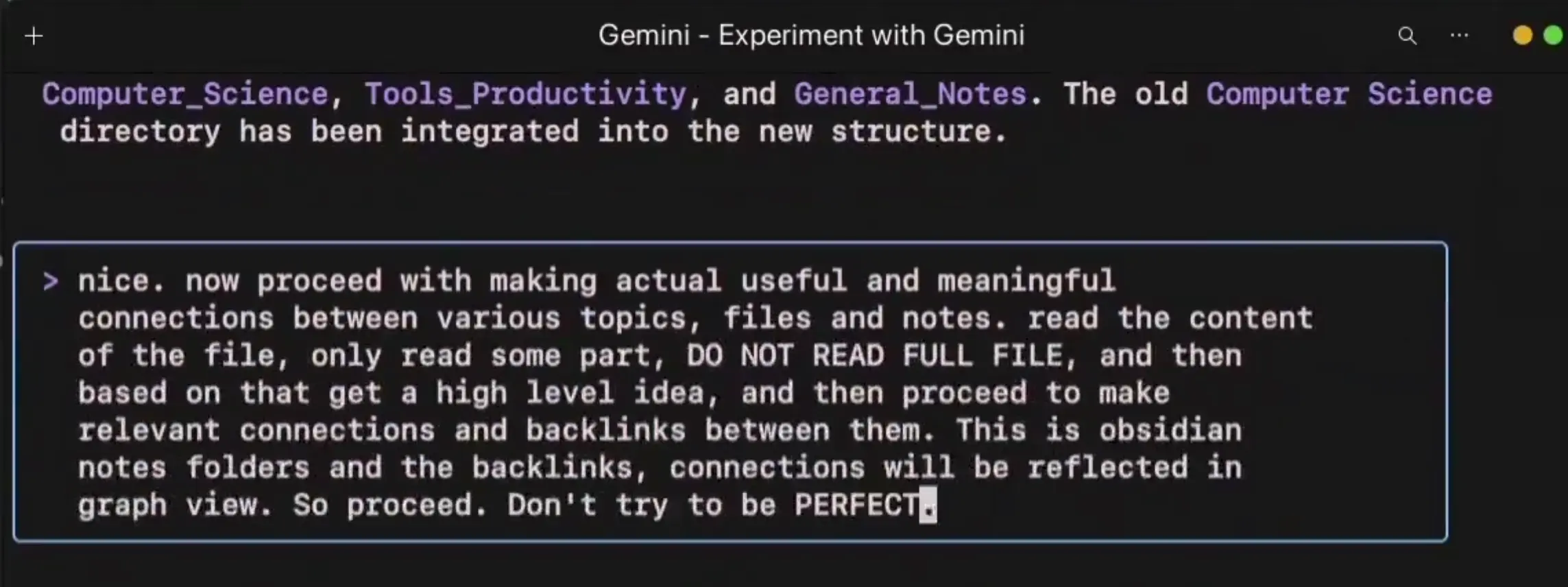
A good example of what not to do for your own vault.
Tweet
For sure interesting to see what comes out, but I wouldn’t recommend it for your “second brain” where you develop your thinking and YOUR ideas.
If you want the above brain, which is not yours, you should use Wikipedia. Wikipedia graphs and wikilinks give you great insights, as the automated AI ones (probably more), but made by human collaborators. But if you want to create your own knowledge base, I’d do it manually. The payoff comes over the year, it compounds.
# PARA Method: Dedicated Folder
The PARA method by Tiago Forte is super convenient - and you could create an AI folder in resources and put all generated notes there and hide that from search or through other mechanisms. This way, you could still have AI-generated insights or notes that you can link, if helpful, to your original notes.
# Voice to Text
AI with Voice to Text can be another approach to use with Obsidian, which makes sense when you are in a car or so.
But because of my talking much more compared to when I write, and to AI or translator service not understanding all my words, it’s much more work for me than just typing it out. Plus, I usually skip the thinking, though sometimes talking it through can add to the process.
# Slowing Down: Have More Impact Long-term?
See Slowing Down.
# Creativity by Its Very Nature is Forward-looking
# Further Reads
- Second Brain Assistant with Obsidian (NoteGPT)
- Building an Obsidian RAG with DuckDB and MotherDuck
- Don’t use AI for everything, you stop thinking-learning AI Use
- How To Think Better in the Age of AI (From the Stoics)
- Use less AI
- Everything Ive published came out of one Obsidian vault
Origin:
Li by mehdio, Obsidian
References: Writing is Thinking!,