A Car Park Like No Other
When you hear a rumour you can do two things, pay it some ear service and then dismiss it, or become intrigued and embrace the need to know more. Is it true – did somebody really gut the inside of a 4000-seat theatre and turn it into a car park? Is the ornate ceiling really still in place? Is there still carpet on the floor in places? The ‘Michigan Building Car Park’ might sound like a mundane kind of name, but it’s the stuff of folklore in Detroit and further a field.
So forgive me for telling a story with no cars in it on Speedhunters – but you’re going to want to see this. Oh, and there’s a cool twist in this tale too…

The car park (because that’s what it is), has been successful in it’s own right, having been used for adverts and films for the last few decades. But it’s the theatre part which fascinates me. The why, how and who were ringing in my head after I remembered it existed on a recent trip to Detroit.

It’s one of those places I’d heard of, and when the chance arose to actually get inside I couldn’t resist seeing if the dramatic pictures in my head levelled up with any kind of reality. Seeing as it’s a privately run garage for the Michigan Building (an office block alongside), we needed to secure proper permission for access. But all formalities aside, as the roller shutter raised up and this was the first thing I saw. I got that buzz in my stomach which makes me act like a kid at Christmas.

The car park is inside this building, and you can see the two towers joined at either side which are the office parts of the structure. The entrance is on the other side and you drive along the wall line inside on the right in this picture. Imagine you were looking up and headed directly for that large bricked up arch window, which also gives you a clue as to the grandeur of this place in its heyday.

The arch on the outside of the building lines up with the one you can see here on the left at the back. The pillars you can just make out on the far left line the inside of the openings you can see on the wall in the picture before this one. But I’m getting ahead of myself here as this photograph was taken from the first floor, and we’re not done with the ground floor yet!

Just behind the white pickup truck (on the end of the row above) is the entrance to elevator. This whole section was the entrance foyer to the theatre, and with a capacity of over 4000 when it opened in 1926 you can imagine this buzzing with life; cigarette smoke hanging in the air and music wafting in from the theatre itself. Nowadays this elevator is long gone – the base of the shaft filled with stinky brown water and the doors are only just holding on to the frames. To access the next floor you drive around this corner, which I presume is a supporting feature of the building that couldn’t be ripped out.

But why virtually destroy what was hailed as one of the most impressive theatres of its kind, only to fill it with a steel-framed, multi-storey car park? It opened in the ’20s when live performances were still popular and the original owner was a guy called John H. Kunsky who sold it sometime after. It then passed through a number of different owners and as the world moved on I guess it’s relevance faded. But like Detroit itself, the building is a survivor.

When the theatre lost favour with the locals and finally closed for business in 1976, it didn’t get pulled down. It must have been a pretty big landmark given the number of people who had passed through its downtown doors over the preceding five decades. But just as it had gone from grand performances to music nights and then finally – by all accounts – a nightclub, it had to survive and that meant becoming a car park.

So hang on, I know what you’re thinking… Why a car park? Well in the mid ’70s the occupants of the main Michigan Building didn’t have enough parking (which is ironic given the large, empty urban spaces surrounding the car park today). So the enterprising landlord, fearing a mass exodus of tenants, decided to rip out the lower guts of the failing theatre and put in the three-storey metal structure that’s here today.
PS. Remember this picture, I’ll refer back to it later.
Going Up

Three storeys were enough to solve the parking problem, but that didn’t change the fact the original building was still nine storeys high… So as you walk up from the second level of parking you’re greeted by the most amazing sight. As most of the original ceiling was revealed to me, I got a proper handle on the scale of the place for the first time.

Looking straight up at the top of the ramp showed how the box of a building had been transformed into the grand theatre – a metal mesh-like frame hung from the roof and the plaster then hung on it.

But it was when I turned around that I got a true sense of the scale. Yes, it looks shitty and decayed, but as far as buildings go this is seriously impressive. How did this once great place descend so far, yet hold on to so much? Because the car park conversion was done as cheaply as possible, I guess it was just quicker to leave the roof in place. Effectively, everything non-structural was cut out and the rest was left.
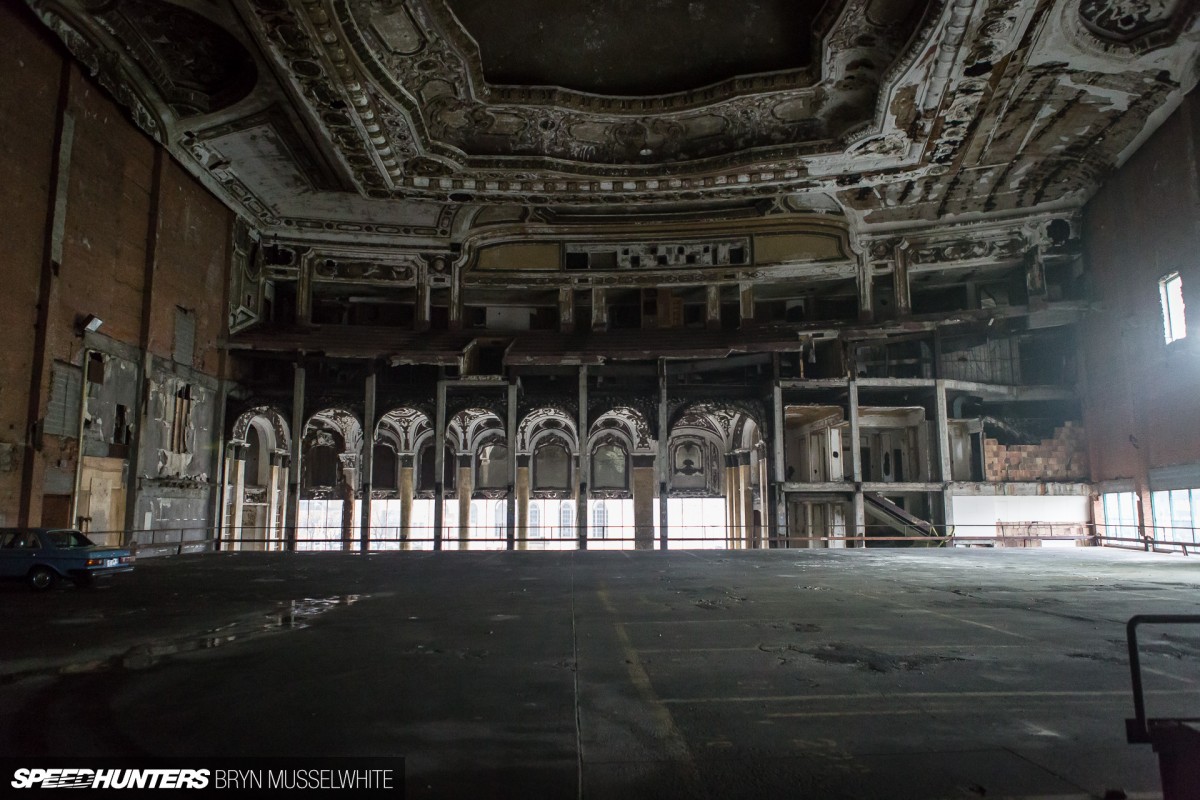
You can see where they sliced through the top tier of seating, with the projection and lighting gallery being right up at the top in the middle. I left the tail end of a Mercedes-Benz 200 in the picture on the left here for the purpose of scale… And to get a car in the story!

Getting closer to what would have been the back end of the theatre you can see just how ruthless the demolition work was. And remember – this was completed nearly 40 years ago.
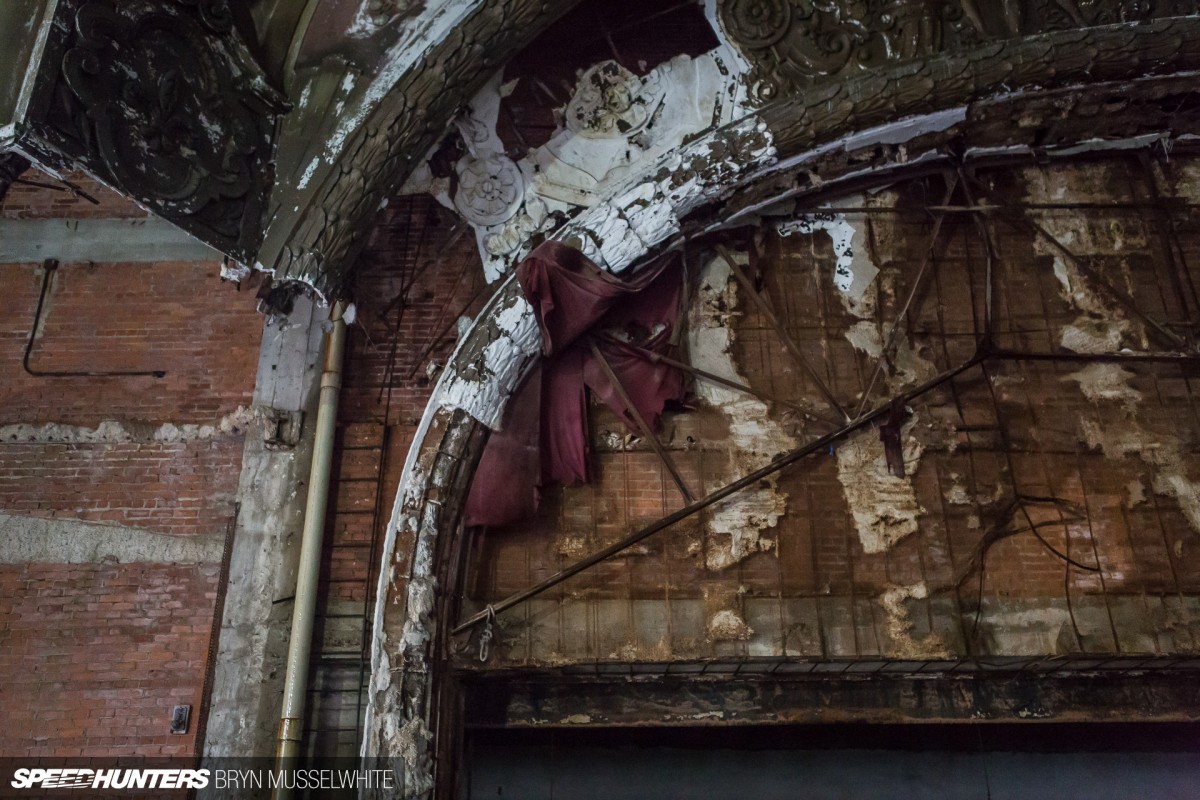
Turning around to look back to where we came up to the top floor and you could see the massive curve of the top of the stage – still with part of the curtain material hanging down.

Not wanting to get this far and go home, I decided to ask if it was possible to head up to where we’d just been looking – right up the back at the top. So after removing some wooden panels on one wall, one of the original grand staircases – carpeted and seemingly ready to welcome guests – was revealed. Using a smartphone’s torch, a few precarious climbs later and this was the view. Take a couple of steps past this point and it’s a five-storey drop down though…

Back to that picture I asked you to remember (one of the outside of the building), and in it you can see a massive arched false window. As I was weaving my way in and out of a maze of empty offices and stairwells, I stumble across this crazy fifty mirror interior to that very window!

Down on the ground level again this is the back stage area – itself absolutely massive. The performances here must have been a major affair. In fact, the whole theatre cost US$5,000,000 to build in the mid ’20s, so can you imagine what that would be now?

I could go on (and I have) about how cool this old car park is. There must be other structures like it out there, but because this is Detroit it feels extra special. What will become of it in the future? Who knows. Right now the whole car park thing is working out pretty well, but the regeneration which will inevitably come is a fair way off yet, so I reckon it’ll be here for a while. And all the time this angelic, yet slightly eerie face, will stare down at you from the ground floor ceiling.

So what about that twist I mentioned at the start? Read this sign…
Yup, you read it right – the Ford Motor Company was essentially founded after what happened on this sight in 1892. So maybe it’s not so strange that the theatre gave way to a car park after all.
Anyway, normal service will now resume… I’ll get back to hunting speed soon enough, but thanks for coming on this little detour with me. Our world has been impacted so much and in so many ways by the motor car, that it’s good once in a while to get blown away with surprise and remind yourself just how important it is to us.
Bryn Musselwhite
bryn@speedhunters.com
Instagram: Speedhunterbryn
Please – under no circumstances – try to gain illegal entry to the Michigan Building Car Park for exploration purposes. This is a private building and I had permission to be there.
Cutting Room Floor


