How Life-Size Cows Made of Butter Became an Iconic Symbol of the Midwest
The Iowa State Fair has featured a bovine butter sculpture for more than 100 years. Now, the tradition is part of the new “State Fairs” exhibition at the Renwick Gallery
:focal(1512x1123:1513x1124)/https://tf-cmsv2-smithsonianmag-media.s3.amazonaws.com/filer_public/a0/f2/a0f275f7-7134-4a24-ab7a-a6ef69e55127/butter_cow_1_-_isf_1.jpg)
When twins Hannah and Grace Pratt moved out of their tiny dorm room at the University of Northern Iowa and into their “adult” apartment, the mini-fridge they no longer needed gave their mother, Sarah, an opportunity: an extra place to store her art.
Sarah Pratt has sculpted the iconic life-size cow made of butter at the Iowa State Fair since 2006. For 15 years before that she trained as an apprentice under longtime butter sculptor Norma Lyon, who died in 2011. In 2017, Sarah’s daughters joined their mother as apprentices, but long before that they’d been softening and fashioning butter in the display cooler, a fish-tank-like setup with glass windows on one side where fairgoers could watch them work. The trio also makes butter sculptures for the fairs in Illinois and Kansas.
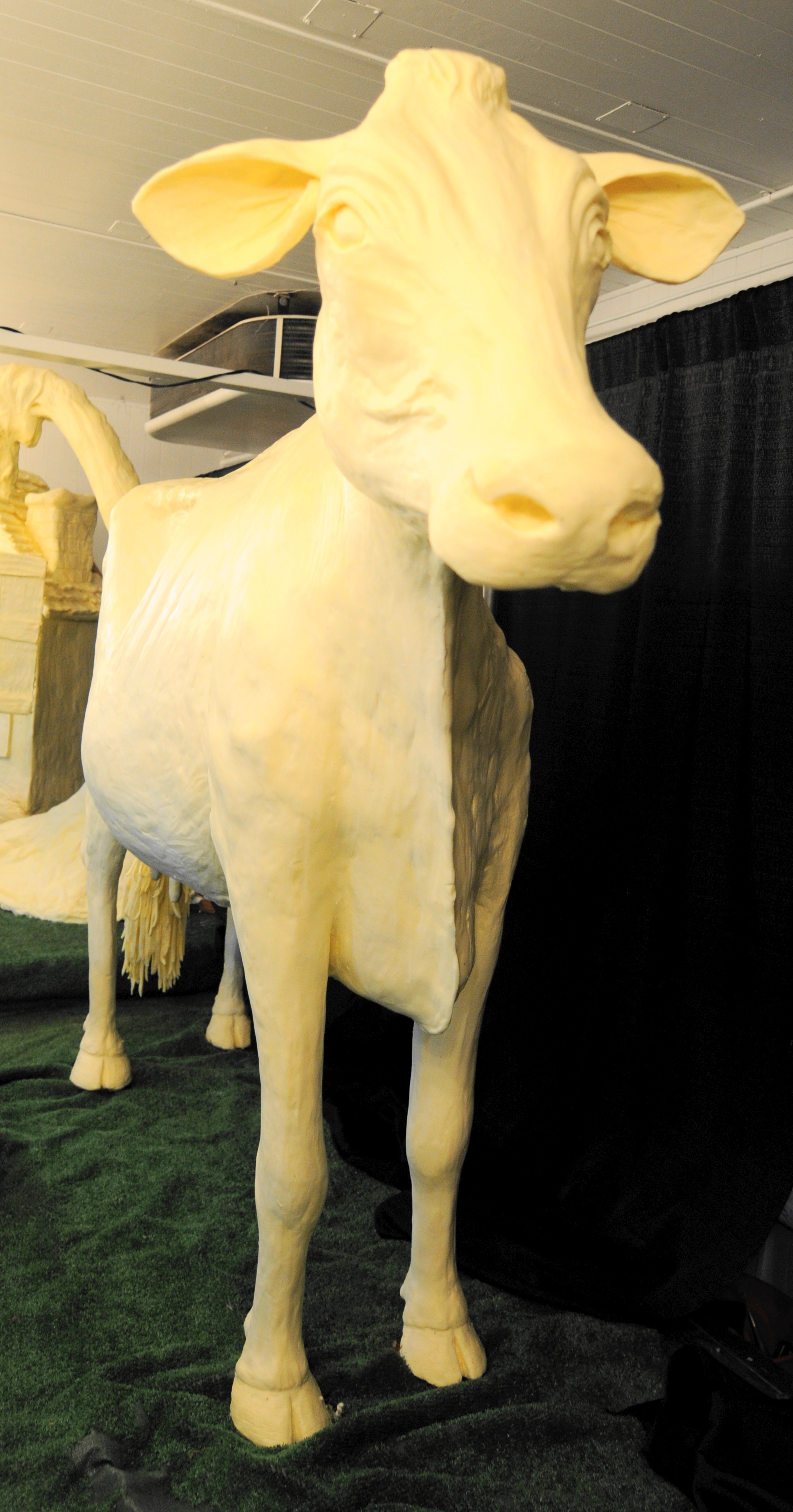
Sarah has taken great pride in continuing Lyon’s legacy. She’s carved the cow so many times that she can almost sculpt from muscle memory. She starts with an armature, the wire frame that holds it in place, and then slowly shapes 600 pounds of Iowa butter into a 5½-foot-high and 8-foot-long cow over the course of a few days.
“In Iowa, the cow is always in the pose that it would be in a dairy show—head up and out and straight,” Sarah says.
The Pratts had a special guest visit the cooler at the 2023 Iowa State Fair: Mary Savig, the Smithsonian American Art Museum’s curator of craft. Savig’s mother was a dairy farmer in Minnesota, a state which also has a well-known butter sculpting display at its annual fair. That August, she stopped in Iowa on an eight-week tour of several fairs around the country during research for an upcoming exhibition showcasing artists’ contributions to state fairs. Savig wanted not only to display unique crafts in the Smithsonian showcase but also to find artists with interesting personal journeys. The three Pratts fit the bill.
/https://tf-cmsv2-smithsonianmag-media.s3.amazonaws.com/filer_public/dc/42/dc424283-b355-4f3e-bcd9-e13b3019699e/pratts_posing_with_butter_cow_in_progress.jpg)
Fun facts: Behind the scenes of making the butter cow
-
The Pratts use their hands as one of their main sculpting tools, while other butter artists prefer to wear rubber or winter gloves. The warmth of their hands helps shape the butter, they say.
-
Because the butter used for the Iowa State Fair's cow sculpture is recycled for many years, the cooler where it's made has a funky smell that most fairgoers would never know about on the other side of the display glass.
Savig loved that the trio had a passion for honoring the history of butter sculpting, and their family involvement had a fun story, so she floated the idea: What if they included a butter cow display in the Smithsonian’s upcoming “State Fairs” exhibition at the Renwick Gallery in Washington, D.C.?
“I was flabbergasted,” Sarah says. “I just thought, if they took one of my [sculpting] tools and put it in a glass case, I was going to buy a plane ticket: I’ve got to come see my tool under a glass case. That would have been a dream come true.”
But Savig was not interested in a tool—she wanted to feature a full butter cow made by the family.
The Pratts and Savig discussed the possibility of transporting the Iowa butter cow after the 2025 fair in August, but they ultimately determined a cow would need to be sculpted from new butter in Washington. To do so, Sarah had to figure out how to push the limits of her craft. All of the state fair displays she’d worked on lasted only a few weeks at most, and the sculpture at the Renwick Gallery would be showcased for an entire year. On top of that, the Pratts would need to work with fresh butter—the butter from the state fair sculptures is often recycled for about a decade because it becomes easier to mold.
Her daughters’ college dorm room mini-fridge came in handy. Sarah needed to play around with new butter and test how it would hold up for that long. Honored to share the history of her craft in a Smithsonian museum, she thought her experiment ought to give a nod to one of the first popular butter sculptors. The three Pratts drew up a design, small enough in scale to fit in the mini-fridge, in early 2024. Then they worked the butter in their hands like potters and carved a test creation that would stand in the fridge for over a year. They fashioned a figurine of Ohio butter sculpting legend Caroline Shawk Brooks.
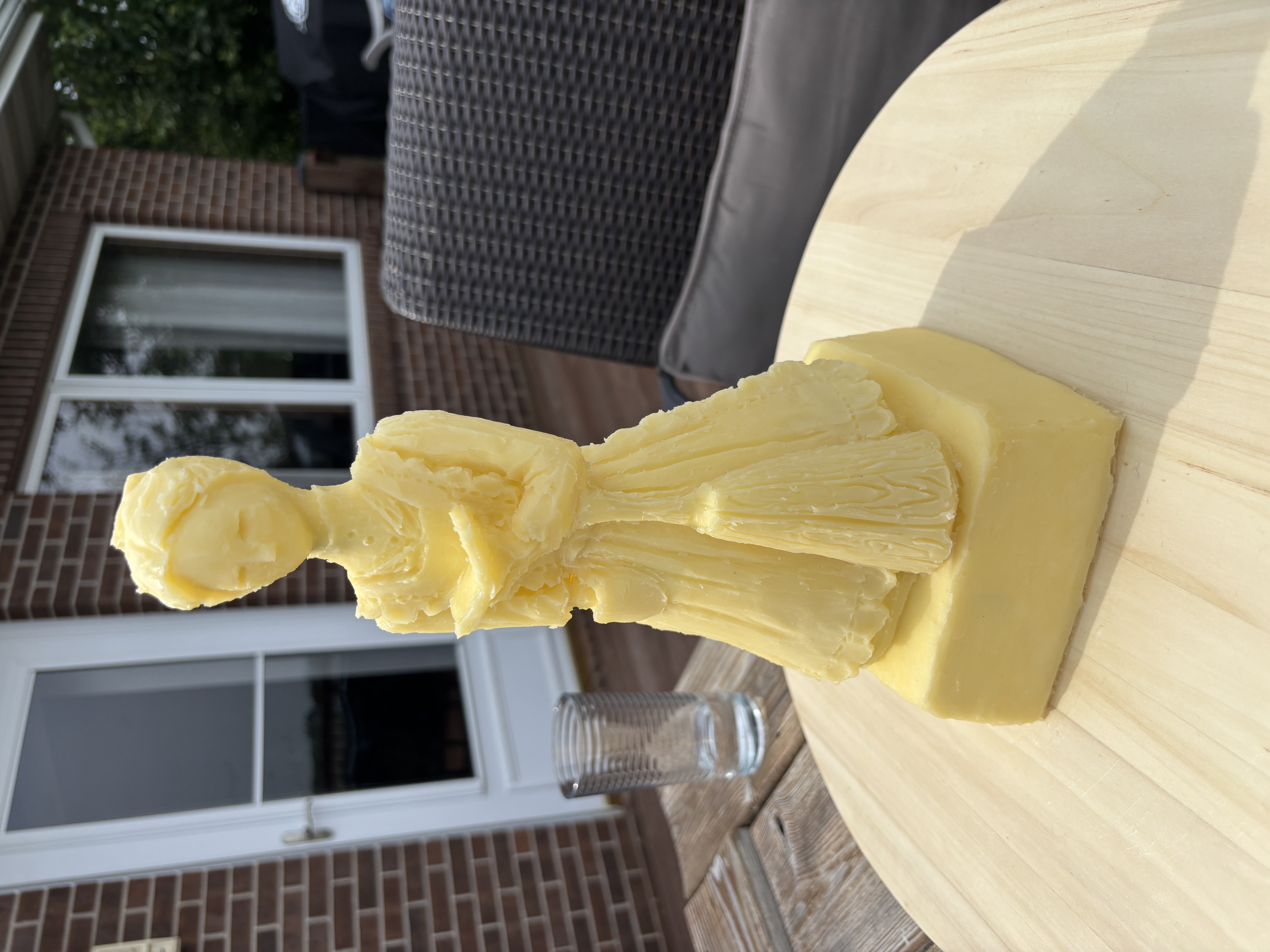
Long before the popularity of state fairs in the United States, butter sculpting added sophistication to banquet spreads in the Renaissance and Baroque periods. Butter molded into various shapes adorned dinner tables across the U.S. in the 1800s. Brooks, the wife of a farmer and an artist at heart, saw something more in butter. When her husband’s cotton crop failed in 1867, she started selling butter sculptures. Six years later, she created a portrait for a church auction, and the bidding war helped rake in enough money to fix the church’s roof. Two thousand people flocked to see her sculpture of a sleeping princess displayed at a Cincinnati gallery for a couple of weeks in 1874.
Brooks toured the country by train, using ice blocks to keep her sculptures intact in the days before mass refrigeration, as Sarah learned in her research. The 19th-century artist garnered international recognition through her displays at the World’s Fairs, even creating a sculpture that had to be shipped overseas for the event in Paris in 1878.
“It was a creative expression of herself, but also using what she had,” Sarah says. “I think that uniquely makes butter sculpting embody that American spirit, or the Midwest spirit.”
Brooks and other artists gained popularity at fairgrounds, creating an atmosphere ahead of its time in the late 19th century. “Women, especially, could have their say at the fair, where they otherwise couldn’t have a say elsewhere and in other art forums,” Savig says.
At Midwest state fairs, butter sculptures helped promote the dairy industry. Various sculptures appeared at the Minnesota State Fair from 1898 through 1927. Then, in 1965, the fair carved out a new Minnesota tradition: sculpting each year’s dairy princess, a young woman crowned as the industry’s goodwill ambassador, into a “bust,” or butter head.
J.K. Daniels sculpted the Iowa State Fair’s first butter cow in 1911. Norma Lyon, affectionately known as “Duffy,” took over the tradition in 1960, becoming the first woman to tackle the responsibility. She held her tenure for 46 years, and due to her fame, Midwesterners called her simply the “Butter-Cow Lady.” She brought pizazz and professionalism to the work, Sarah says of her mentor.
/https://tf-cmsv2-smithsonianmag-media.s3.amazonaws.com/filer_public/45/d4/45d4d8f3-f587-4cd7-9a37-96985c35b9b5/norma_and_sarah_1997_sculpting_elvis.jpg)
“She and her husband were very well known in the dairy industry and were very outspoken about dairy farming,” Sarah says. “She was just a really outgoing, bold, say-yes, figure-it-out kind of person.”
Lyon took any opportunity to spread the word about her art and the dairy industry, appearing on “Today” and “The Tonight Show.” In 1984, she sculpted a small cow out of cheddar cheese—because it was easier to haul around than butter—to show off during an interview with David Letterman.
Lyon also introduced companion sculptures to accompany Iowa’s butter cow. In 1996, she crafted a butter rendering of American Gothic, the famous painting by Grant Wood, another Iowan. Since then, the displays have grown even more intricate. Thousands of fairgoers line up each year for a chance to see the butter sculptures behind the glass case, which has a permanent location in one of the state fair’s buildings. The herd of patrons sometimes wait an hour for their turn.
The Iowa State Fair has also been a common stop for presidential candidates since 1972, when Iowa began hosting the first-in-the-nation caucuses. One candidate even used the butter cow in his campaign: Though Sarah had taken over the sculpting by 2006, Lyon remained recognizable, so then-candidate Barack Obama asked her to endorse him via a radio ad in late 2007 to help attract more rural supporters ahead of the Democratic presidential caucuses in January 2008. “You know, you see a lot of manure in our line of work. It’s a lot like politics,” Lyon said in the ad. “You got to know what’s bull and what’s for real. Barack Obama’s got a real plan for rural America.”
/https://tf-cmsv2-smithsonianmag-media.s3.amazonaws.com/filer_public/bf/95/bf95cfce-7275-49c0-a8bd-2177c0ac55c0/sarah_and_butter_cow_-_isf.jpg)
In upholding the tradition, the Pratts have made the butter cow part of their family’s history. Sarah, Grace and Hannah always bring whimsy and their family dynamic to the art: During the sculpting process, they sing and dance. They also used to argue about which one of them would wear a cherished “Got Milk” sweatshirt from the ’90s into the 40-degree cooler until Sarah found similar ones on Etsy. Now, they have about six of the sweatshirts to go among the three of them.
“Growing up with it, it just seemed like this normal thing,” Hannah says. “Butter sculpting is just what people do in the summer, because I didn’t know any different.” It wasn’t until she was older, and people were flabbergasted when they learned she helped sculpt the butter cow, that she realized how big of a deal it was.
Both Grace and Hannah are using their education at the University of Northern Iowa to further their craft. Grace, a studio art major, has been focused on improving the details, like facial features and the veins on the cow’s udders.
Hannah has put her love for costumes as a theater design major into practice while sketching the outfits of their human figures. She carved a slim strip of butter to tie a ribbon on Caroline Shawk Brooks’ dress for their test sculpture.
As the leader, Sarah has made sure to teach her daughters about Brooks’ legacy and the tradition’s history. The butter cow at the Renwick Gallery will in itself make history: Savig believes it’s the first time a butter sculpture will be exhibited in a Smithsonian museum.
“There were a lot of questions, like: Can we keep a refrigerator on for a year? Will it be too loud? Will the motors work?” Savig says. “All of these questions we had to solve before we could commit to it, and it is wildly complicated, and so much credit is due to our exhibits team, who made the entire exhibition possible.”
The Pratts crafted the sculpture before the exhibition’s opening, but they will be on call if touch-ups are required throughout the year.
“State Fairs: Growing American Craft” will occupy both floors of the Renwick Gallery, the Smithsonian American Art Museum’s branch location for contemporary craft, from August 22, 2025, to September 7, 2026. Among the 240 artworks will be an octagon case in the center of the gallery, displaying the iconic butter cow.