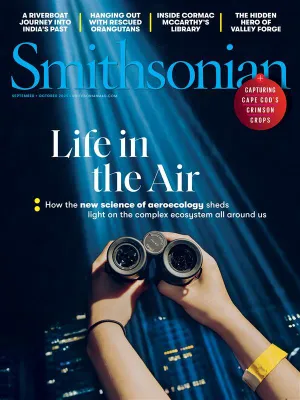
Two Years After Cormac McCarthy’s Death, Rare Access to His Personal Library Reveals the Man Behind the Myth
The famously reclusive novelist amassed a collection of thousands of books ranging in topics from philosophical treatises to advanced mathematics to the naked mole-rat
:focal(1500x1000:1501x1001)/https://tf-cmsv2-smithsonianmag-media.s3.amazonaws.com/filer_public/d2/f6/d2f60703-6ca8-4e64-b80b-f671be00d8ed/1_smithsonian_cormac_shoot_2_-1112.jpg)
Cormac McCarthy, one of the greatest novelists America has ever produced and one of the most private, had been dead for 13 months when I arrived at his final residence outside Santa Fe, New Mexico. It was a stately old adobe house, two stories high with beam-ends jutting out of the exterior walls, set back from a country road in a valley below the mountains. First built in 1892, the house was expanded and modernized in the 1970s and extensively modified by McCarthy himself, who, it turns out, was a self-taught architect as well as a master of literary fiction.
I was invited to the house by two McCarthy scholars who were embroiled in a herculean endeavor. Working unpaid, with help from other volunteer scholars and occasional graduate students, they had taken it upon themselves to physically examine and digitally catalog every single book in McCarthy’s enormous and chaotically disorganized personal library. They were guessing it contained upwards of 20,000 volumes. By comparison, Ernest Hemingway, considered a voracious book collector, left behind a personal library of 9,000.
What makes McCarthy’s library so intriguing is not just its size, nor the fact that very few people know about it. His books, many of which are annotated with margin comments, promise to reveal far more about this elusive literary giant than the few cagey interviews he gave when he was alive. For as long as people have been reading McCarthy, they have speculated about which books and authors informed and inspired his work, a subject he was loath to discuss. They have wondered about his interests and true personality because all he presented to the public was a reclusive, austere, inscrutable facade.
When Bryan Giemza, a scholar of literature and humanities at Texas Tech University, offered me exclusive journalistic access to McCarthy’s library and the cataloging project, what he was really offering was an unprecedented insight into McCarthy’s life and work. As a further enticement, he said that Cormac’s younger brother Dennis McCarthy would be there. “Dennis probably knew him as well as anyone,” Giemza said.
Did You Know? Who was Cormac McCarthy?
- Cormac McCarthy is an award-winning novelist whose works often explored the American West with darkness and complexity. Among McCarthy's many awards are a Guggenheim Fellowship in 1969, a MacArthur Fellowship in 1981, a Pulitzer Prize for Fiction in 2007 for The Road and a National Book award in 1992 for All the Pretty Horses.
/https://tf-cmsv2-smithsonianmag-media.s3.amazonaws.com/filer_public/e7/f1/e7f129cb-7960-40e5-9c45-3c4c6f92c304/4_smithsonian_cormac_shoot_2_-0899.jpg)
I parked behind the house between a silver 1966 Buick Riviera rusting on deflated tires and a weathered red Lincoln Mark VIII. These were among the last survivors of McCarthy’s little-known vehicle collection. Dennis had sold 13 other cars, including two Allard racing cars from the early 1950s, a 1992 Lotus and a Ford GT40 racing car. McCarthy, who labored in obscurity and chronic poverty until he was 60, became a multi-millionaire later in life and freely indulged his desires and obsessions, with classic sports cars high on the list. Most of the money came from Hollywood, which turned three of his novels—All the Pretty Horses, No Country for Old Men and The Road—into star-studded movies.
I knocked on the imposing front door, an Indo-Portuguese antique made of teak and fortified with iron strappings, metal studs, flattened nails and small chains. There was no response, so I tried the handle. The door swung open and revealed a dimly lit hallway reduced to a narrow passage by head-high stacks of cardboard boxes on both sides. All those boxes were packed with books.
The first room off the hallway—the room where McCarthy died at age 89—was now so crammed with book boxes that it was impenetrable. Scholars called it “the Beast Room.” The next room was nearly as full. One open box showed volumes about the architect Frank Lloyd Wright, country houses in Ireland, schizophrenia, African history and British antique rifle barrels.
In the dining room, underneath a beautiful hanging light fixture of wood and colored glass that McCarthy designed and built himself, scholars were sitting at the table, scanning books’ ISBN bar codes through their phones into the library cataloging software on their laptops.
I found Giemza in the living room, wrestling with an internet connectivity problem. “Cormac didn’t have Wi-Fi in the house, so we had to bring our own,” he said. Nor did McCarthy use a computer—ever. He typed out his pages on a cheap, durable Olivetti typewriter and, I learned later, did most of his work propped up on pillows in bed.
The living room, like the house in general, had a sturdy, old-fashioned and decidedly masculine feel, but its clean lines were obscured by a chaotic overlay of clutter—mainly books, but also piles of nameless junk and hundreds of bowls, glasses and kitchenware items still in their packaging. Some of the book boxes and loose books had been moved into the room for the cataloging project, but not the rest of it. One of the first discoveries made by the visiting scholars was that McCarthy was something of a hoarder. His particular fixation on kitchenware, much of it bargain kitchenware, remains mysterious and a mark of his eccentricity.
/https://tf-cmsv2-smithsonianmag-media.s3.amazonaws.com/filer_public/7b/3a/7b3a3968-5768-4b36-aa2b-fb4d11340dad/23_smithsonian_cormac_shoot_1_-19.jpg)
/https://tf-cmsv2-smithsonianmag-media.s3.amazonaws.com/filer_public/40/0c/400ca512-0a87-4329-8fbe-dd1880779ec3/6_smithsonian_cormac_shoot_1_-21.jpg)
The second major discovery, discernible in his work but confirmed beyond doubt in his library, was that McCarthy was a genius-level intellectual polymath with an insatiable curiosity. His interests ranged from quantum physics, which he taught himself by reading 190 books on the notoriously challenging subject, to whale biology, violins, obscure corners of French history in the early Middle Ages, the highest levels of advanced mathematics and almost any other subject you can name.
Giemza marveled at the heavy-duty philosophy books they were finding. “Seventy-five titles by or about Wittgenstein so far,” he said, referring to the Austrian philosopher of mathematics, logic, language and the mind. “And most of them are annotated, meaning Cormac read them closely. A lot of Hegel. That was his light evening reading, apparently.”
In the living room was a pool table piled with books and a leather couch facing two tall windows and three sets of nine-foot-tall wooden bookshelves designed by McCarthy that held approximately 1,000 books. Moving closer, I saw they were nearly all nonfiction hardbacks with no obvious system of organization.
One shelf held volumes about Mesoamerican
history and archaeology, along with Charles Darwin’s collected notebooks, Victor Klemperer’s three-volume diary of the Nazi years, books about organic chemistry and sports cars, and an obscure volume titled The Biology of the Naked Mole-Rat (Monographs in Behavior and Ecology). Another shelf held books about Grand Prix and Formula 1 racing, a great passion of McCarthy’s, and the collected writings of Charles S. Peirce, the American scientist, philosopher and logician, in six fat volumes of dense, difficult prose.
/https://tf-cmsv2-smithsonianmag-media.s3.amazonaws.com/filer_public/02/51/0251ae3b-5286-47dd-9130-d49b2f5d875e/30_smithsonian_cormac_shoot_1_-9.jpg)
Trying to take it all in, I felt both fascinated and overwhelmed. It seemed almost inconceivable that an author who produced 12 novels, two plays and five screenplays had also found the time, energy and brainpower to master architecture, woodworking, stonemasonry and a wide range of intellectual disciplines. Some of his math books were nearly all equations.
Then we found an intricate drawing he’d made for an engine modification to one of his cars, and another showing how to rifle a gun barrel with hand tools. We found dozens of well-thumbed engine repair manuals and auto mechanic’s tools in the outbuildings, and learned that he could disassemble, reassemble and redesign an engine to increase its horsepower. Then I learned he had an eidetic memory and could remember nearly everything he had read or heard, including the lyrics to thousands of songs. McCarthy was starting to seem like a man whose talents and intelligence were without limits, yet he lived in a hoarder’s shambles and couldn’t stop buying nonstick skillets and fruit bowls.
By studying his library more closely, I hoped to gain a better understanding of McCarthy, but it was possible the mystery of his character would only deepen.
Giemza introduced me to his colleague Stacey Peebles, a professor of film and English at Centre College in Danville, Kentucky, and the current president of the Cormac McCarthy Society. It was Peebles who first met with Dennis McCarthy, the author’s brother and literary executor, and suggested that the society take on the monumental task of cataloging the books. The society’s mission is to further the study and appreciation of McCarthy’s work, and Peebles thought there was enough material in the library to keep scholars busy for decades—scrutinizing the annotations, tracing connections between the research books and passages in the novels, interpreting literary and philosophical influences. “If we were a well-funded institution, we’d take all these boxes into an empty building where we had plenty of space to work in, a dedicated team of people and all the time we needed,” she said. But Peebles and her small team all have full-time jobs, so the project has required a trade-off between detail and efficiency. “We can’t be as meticulous as we’d like and scan all the annotations, because we’ve got limited time and a massive amount of books to get through.”
/https://tf-cmsv2-smithsonianmag-media.s3.amazonaws.com/filer_public/c1/86/c186f493-38df-48a6-9c8a-655f94839b6d/27_smithsonian_cormac_shoot_2_-1001216.jpg)
McCarthy often had a pencil when he was reading and would make tiny vertical marks next to sentences that interested him and add comments in the margins in small print handwriting. Sometimes he jotted down thoughts on slips of paper that he left between the pages. Inside The Life of Saint Teresa of Ávila by Herself, first published in 1565, we found him musing philosophically: “There is an intelligence to the universe (of which we are fractal) and that intelligence has a character and that character is benign. Intends well toward all things. How could it not?”
McCarthy is known for the bleak, violent nihilism in many of his novels, so it was a surprise to see him describing the universe as intelligent and well-
intentioned. He was a lapsed Catholic who went back and forth on the question of God’s existence, sometimes changing his mind from one day to the next.
Peebles was collecting her favorite annotated books on the pool table. One was Realism in Mathematics by Penelope Maddy. In the margins, Mc-
Carthy summarizes the author’s points and comments on them, frequently disagreeing. “Gibberish,” he noted at one point. It was an exciting find for the scholars because McCarthy mined this book deeply for his final novel, Stella Maris. Its protagonist, Alicia Western, is a young mathematical genius with schizophrenia.
/https://tf-cmsv2-smithsonianmag-media.s3.amazonaws.com/filer_public/72/b4/72b497be-7623-4675-9240-ac8528489df8/5_smithsonian_cormac_shoot_2_-0998.jpg)
/https://tf-cmsv2-smithsonianmag-media.s3.amazonaws.com/filer_public/ef/e5/efe5a3aa-1a4e-4903-af9e-92d7284cc131/17_smithsonian_cormac_shoot_2_-0966.jpg)
Another of Peebles’ favorite finds is an annotated copy of Shakespeare’s Hamlet. McCarthy, who once said, “the ugly fact is books are made out of books,” borrowed and altered elements from Hamlet for his 1979 novel Suttree. It was his most ornate and poetic book and the closest he ever came to writing autobiographically. The main character is a troubled dropout who has rejected a life of privilege and responsibility in Knoxville, Tennessee, where McCarthy grew up as the black sheep among six children in a well-to-do Catholic family with strong Irish roots.
He was born in 1933 and christened Charles Joseph McCarthy Jr. after his father. In his youth, he was known as Charlie, or sometimes Doc, until he changed his name to Cormac as a young man, partly inspired by the medieval Irish king Cormac mac Airt. The name change was probably also a declaration of independence from his father. Charles McCarthy Sr. was an attorney who became the chief counsel for the Tennessee Valley Authority, and Cormac always characterized him as a domineering, violent man who beat him viciously for trivial offenses. (His brother Dennis disputes this description and says that Cormac was “grossly exaggerating.“)
McCarthy told his own son John, and some of his friends, that the beatings started when he was 3 years old. Readers and critics have often wondered where the darkness and violence in McCarthy’s work comes from, and, if Cormac’s characterization is true, his childhood might account for some of it. He loved his mother, Gladys, but she was psychologically fragile and frequently absent from the family in mental health institutions.
He hated his Catholic school and loved roaming outdoors. Talking about his school days in a (rare) 1992 interview, McCarthy said, “There was no hobby I didn’t have, name anything, no matter how esoteric, I had found it and dabbled in it.” He made money trapping muskrats around Knoxville and selling the pelts, and somehow also established himself as an authority on antique American rifles.
In 1953, McCarthy dropped out of the University of Tennessee, where he was studying engineering and physics, and joined the Air Force. He was stationed in Anchorage, where he became the radio disc jockey for the base, and started reading in earnest in his spare time. After four years, he returned to the University of Tennessee but dropped out again and started writing novels.
The first three, The Orchard Keeper, Outer Dark and Child of God, were gothic tales set in the rural Appalachia he knew from his youth. In lyrical prose with marvelously rendered vernacular speech, they tackled dark subjects—murder, infanticide, incest, necrophilia—while displaying a reverence for nature and folk traditions. The fourth novel was Suttree, McCarthy’s richly comedic evocation of 1950s Knoxville. These novels earned critical praise and prestigious grants and awards, but each sold more poorly than the last.
One of the few details we have about McCarthy’s personal life comes from his second wife, Anne
DeLisle, an English singer and dancer, whom he met on a ship to Ireland in 1965. Their home was a partially converted dairy barn outside Knoxville; they bathed in a lake. “Someone would call up and offer him $2,000 to come speak at a university about his books,” she once said. “And he would tell them that everything he had to say was there on the page. So we would eat beans for another week.”
After leaving her without an explanation in 1974, McCarthy drifted around cheap motels with his typewriter, a pile of books and a light bulb for good reading light. In 1976 McCarthy took up residence in El Paso and turned his attention on the American Southwest and northern Mexico, setting himself the task of learning the culture, history, natural history, geology, folkways and distinctive Spanish idioms of the borderlands.
According to a letter he wrote, McCarthy read over 300 books to research Blood Meridian (1985), an ultraviolent philosophical Western based on the true story of a state-funded scalp-hunting gang in the 1840s and 1850s. Now widely regarded as his greatest masterpiece, it sold a pitiful 1,883 copies when it was first published. McCarthy’s fortunes changed with the publication of All the Pretty Horses in 1992. This elegiac Western, set in 1949 and 1950 in Texas and Mexico, became a best seller, won a National Book Award, and was adapted into a movie starring Matt Damon and Penélope Cruz. McCarthy followed with two more novels about drifting cowboys, then shifted course with No Country for Old Men (2005), a crime thriller that the Coen brothers turned into a quadruple-Oscar-winning movie starring Josh Brolin, Javier Bardem and Tommy Lee Jones. Next came The Road, a post-apocalyptic father-son journey that won the Pulitzer Prize for fiction in 2007 and was made into a film with Viggo Mortensen playing the father.
/https://tf-cmsv2-smithsonianmag-media.s3.amazonaws.com/filer_public/93/f4/93f4c6cd-b174-4ddc-9d3b-c9b6842852de/31b_smithsonian_cormac_josh_brolin_-1000406.jpg)
McCarthy had moved to Santa Fe with his third wife, Jennifer Winkley, and their young son John in 2001. He found the town off-puttingly liberal, moneyed and artsy, and moved there for one reason only: His great friend Murray Gell-Mann, the Nobel Prize-winning physicist, invited him to join the Santa Fe Institute, serving as a sort of in-house literary intellectual. This elite scientific think tank, co-founded by Gell-Mann, brings together some of the world’s most brilliant minds to research complex interconnected systems. McCarthy had long preferred the company of scientists to that of literary people, and he delighted in the high-flying conversations at the institute. He went there nearly every day to work on his writing and kept up with all the institute’s scientific research.
McCarthy was famous for refusing to discuss his work, so there was widespread amazement in literary quarters when he agreed to do a televised interview in 2007 with Oprah Winfrey, who had picked The Road as her book club selection. Viewers saw a courteous, gray-haired Southerner with a high-domed forehead and a flashing smile. When Oprah asked if he was “passionate” about writing, he replied, “Passionate sounds like a pretty fancy word.”
Oprah, knowing it was true, asked if The Road was a love story to his young son John. “In a way, I suppose, that’s kind of embarrassing,” he said. She made slightly better headway on the subject of punctuation. McCarthy didn’t use quotation marks, hated semicolons and kept commas to the barest minimum. “There’s no reason to block the page up with weird little marks,” he said. “If you write properly, you shouldn’t have to punctuate.”
McCarthy could pull it off because he was a virtuoso, renowned for his powers of description and ear for dialogue. The Nobel Prize-winning novelist Saul Bellow extolled McCarthy’s “absolutely overpowering use of language, his life-giving and death-dealing sentences.” McCarthy’s detractors, meanwhile, found his writing overly mannered, his characters overly masculine, and accused him of relishing the violence he wrote about so vividly.
When McCarthy died in June 2023, after battling leukemia, prostate cancer, dehydration and what he once called “the sheer velocity of time,” the accolades were immediate, and fulsome. Stephen King called him the “last great white male American novelist.” Sebastian Junger compared him to Mount Everest. The Guardian headlined its remembrance with a prophecy: “His work will sing down the centuries.”
Dennis McCarthy, the youngest of the six children, made his way through the book-choked hallway into the book-strewn living room. A retired lawyer, editor and conservation biologist, Dennis published his first novel in 2021, a spiritual Western about Billy the Kid. Now 81, he was fit and trim, with blue eyes, a radiant smile and a strong resemblance to Cormac. “He was my best friend for 70 years and a fabulous older brother who always looked out for me,” he said. “We were very, very close.”
/https://tf-cmsv2-smithsonianmag-media.s3.amazonaws.com/filer_public/50/18/50185ebe-477e-4b58-ba13-0396e594e31d/24b_smithsonian_cormac_shoot_1_-15.jpg)
I asked him which authors his brother most admired. “Moby-Dick was Cormac’s favorite book without question, and Faulkner was more of an influence than he liked to admit,” he said. “He loved Hemingway’s short stories, James Joyce, Dostoyevsky and Shakespeare of course.” Readers and scholars had already identified these literary forebears, but it was satisfying to hear them confirmed.
Of the many thousands of books in the house, the basement and the outbuildings, how many had McCarthy actually read? “If you exclude the encyclopedias and reference books, I would guess about 85 percent,” Dennis said. “Cormac kept on ordering books after he was too sick and frail to read, because it was a compulsion, but until that point he would read for hours and hours nearly every day. He never left the house without a book. He never left the house without a gun. Both were equally unthinkable.”
Why was he always armed? “He was a conservative country boy from the South who understood that the world is a dangerous place.” When he was 24, McCarthy accidentally shot himself in the leg while practicing alone on a gun range in Tennessee. Dennis didn’t know any more details, because his brother refused to discuss the incident, but it was likely a quick-draw gone wrong.
When I asked Dennis about his brother’s reputation as a recluse, he said it was totally inaccurate. “He was very sociable and could get along with anybody. Well, almost anybody. He didn’t suffer fools gladly, or people who rushed up to him gushing about his books. But he had a lot of friends, and he loved dining and conversation, and five-hour lunches that sometimes turned into ten-hour lunches.”
Those friends included physicists and quark-discoverers Gell-Mann and George Zweig, the whale biologist Roger Payne, the movie star Josh Brolin, plus a bar owner in Tucson who calls himself God and a silver-tongued con man from Knoxville named John Sheddan, who appears exactly as himself under his own name in McCarthy’s penultimate novel, The Passenger.
Brolin got to know McCarthy during the filming of No Country for Old Men and was at the author’s bedside the night before he died. “It was me, his ex-wife, his son John, and that was it,” Brolin tells me on the phone. “He was telling these wild stories, about drinking wine with André the Giant in Paris, and all this stuff was coming out totally lucid, sharp, funny, inspired. Then he would go into this lost dementia and he’d be grabbing at stuff that wasn’t there. Then he’d go to sleep, and then he’d wake up and tell another story.” Soon after Brolin left, McCarthy drew his final breath.
McCarthy’s son John, the model for the boy character in The Road, was now 26 and sleeping in his father’s old bedroom upstairs. He’s a licensed pilot, a composer and a musician. The first time I met John, he was coming sleepily down the wooden stairs in search of coffee. I had just learned that Dennis had emptied two storage units full of books in El Paso and two more in Santa Fe and moved the boxes into the house for cataloging. “So I’m getting a totally unrealistic picture of what the house was like when you were growing up here,” I said to John.
“Not really,” he said. “This is pretty much how it was. Boxes everywhere. Piles of books everywhere. The hallway stacked up with boxes with a little path through the middle. Whole rooms so full of books you couldn’t go in there. It didn’t bother me at all.”
/https://tf-cmsv2-smithsonianmag-media.s3.amazonaws.com/filer_public/4a/bc/4abc5528-c2e0-4521-b48e-5011d236b3bd/sepoct2025_i01_cormacmccarthy.jpg)
/https://tf-cmsv2-smithsonianmag-media.s3.amazonaws.com/filer_public/18/a5/18a5005a-568c-48a6-8cea-7baa95b5a2c0/8c_smithsonian_cormac_shoot_1_-5.jpg)
It was John who told me that McCarthy worked in bed—a California king with high-thread-count sheets, the Olivetti on a wooden platform with a leather pillow underneath it, and piles of typed pages, magazines, books and catalogs. Writing, McCarthy once said, was not a conscious process for him. He put a blank piece of paper in the Olivetti, the words arrived, and he typed them down. But that was just the first stage of an extensive rewriting and structuring process, and some of his books took 20 years or more to get right.
“Dad didn’t like being interrupted when he was working, or when he was reading,” John said. “‘No, no, no. I’m reading. Go away!’ he would say. But he was a great father, always there for me, and I learned so much from him. We would have these long conversations about science and history and music, and whatever else, and he was the funniest person I’ve ever met, just a natural comedian.”
I asked John what else his father collected apart from books, cars and kitchenware. “I would say clothes were the other big one. He had hundreds of tweed jackets, hundreds of shirts, hundreds of suits that he’d never worn.” John once spent three days dragging stuff out of a room he wanted to use as a bedroom. “When I was done, I said, ‘You ever think you might be a little bit of a hoarder?’ And he looks at me and he goes, ‘Yeah, probably.’ He attributed it to all those years when he had no money.”
Dennis isn’t buying that explanation. “Cormac always lived in chaos, which I found fascinating because he had such a fabulous artistic sense. He could design things beautifully and he dressed impeccably, but his living quarters were always a disaster. He was an incredibly complicated individual.”
The cataloging scholars could only spare four or five days at a time. Then they would go back to their jobs for a few months and try to carve out another long weekend in New Mexico. The stalwarts were Peebles and Rick and Jonathan Elmore, whip-smart twin brothers who looked nothing alike, taught at different colleges and wrote academic papers together about McCarthy’s work.
The cataloging was dusty, repetitive, eye-straining work, but it was conducted with good humor and camaraderie, and you never knew what might come out of the next box. One afternoon, after looking through a batch about Cistercian abbeys, violin makers, metaphysics, meta-ontology, the incest taboo and the material foundations of ancient Mesopotamian civilization, I said, “Was there anything he wasn’t interested in? Sewing perhaps?”
“Nope,” said Jonathan Elmore, an English professor at Louisiana Tech University. “We’ve cataloged books on needlework and quilting.” Rick noted McCarthy’s keen interest in clothes and fashion, which could, I granted, be described as sewing-related. McCarthy was a longtime subscriber to the fashion and style magazine W, and he had annotated many of his books about menswear. In his copy of The Suit: A Machiavellian Approach to Men’s Style, McCarthy penciled his opinion of slip-on dress shoes: “disgusting.” Further down the same page, next to a sentence praising shiny-buckled monk-strap shoes, he wrote, “yet more horror.”
The scholars treated annotations like pieces of treasure and would read them aloud to each other. Inside Reclaiming History: The Assassination of President John F. Kennedy, they found notes on a slip of paper, including a line about the assassin’s bullet: “it was going like a bat out of hell when it left the president’s head and in that crowd it is a pure freak of chance that it didn’t take out a citizen-spectator.”
The historical figures who interested McCarthy the most, judging by the number of books he owned about them, were Albert Einstein (114 books), Winston Churchill (88) and James Joyce (78). Architecture is the dominant subject in the collection, with 855 books. The human being whom McCarthy most admired, Dennis confirms, was Ludwig Wittgenstein. The team cataloged a staggering 142 books by or about the philosopher, with a high proportion annotated.
McCarthy’s fascination with Wittgenstein came as a surprise to the scholars, but it makes sense. As Rick Elmore, a philosophy professor at Appalachian State University with floral tattoos climbing up his neck, puts it, “Wittgenstein was always asking how the systems we use to represent the world relate to the world we want to represent. It’s one of the central questions in McCarthy’s work.”
With the exception of Moby-Dick in multiple, gorgeous leather-bound editions, the scholars found hardly any novels until they started cutting open boxes that Dennis retrieved from a storage locker in El Paso. Out came the entire canon of Western literature, from ancient Greece and Rome to the best novelists, poets and essayists of the 1970s, nearly all in cheap, worn, paperback editions. “These are the books that he read in his 20s and 30s and maybe into his 40s, and he was broke that whole time,” said Dennis. “Once he got money, Cormac bought all his books in hardback if possible, and for the last 40 years of his life he read almost no fiction at all.”
/https://tf-cmsv2-smithsonianmag-media.s3.amazonaws.com/filer_public/19/fa/19fae08d-c25e-43cb-901d-ecbd6a24bd83/13_smithsonian_cormac_shoot_1_-11.jpg)
/https://tf-cmsv2-smithsonianmag-media.s3.amazonaws.com/filer_public/07/e0/07e003c7-a552-46e2-ba68-9ed9c5480102/11_smithsonian_cormac_shoot_2_-0917.jpg)
/https://tf-cmsv2-smithsonianmag-media.s3.amazonaws.com/filer_public/84/e4/84e43550-3500-42e8-8315-4b326a40d31b/12_smithsonian_cormac_shoot_2_-0913.jpg)
Why? The answer stems from McCarthy’s deeply disparaging view of modern society, which he considered lost, divorced from nature, history and tradition and heading toward social collapse and apocalypse. “Cormac considered contemporary fiction a waste of time,” said Dennis, “because contemporary writers no longer have a legitimate culture to feed their souls.”
One afternoon, Dennis was marveling at McCarthy’s storytelling abilities and comedic talents, and I asked him if there was anything, apart from housekeeping, that his brother had been bad at. He thought about it for a moment and said, “Marriage.”
McCarthy was married and divorced three times. “His wives needed more than he gave them,” Dennis said. “The work always came first for Cormac. He loved those women, but he loved himself more. He was a narcissist. And if he hadn’t been a narcissist, he never would have achieved the same heights of artistic greatness.”
The most enduring love of McCarthy’s life was a woman named Augusta Britt. As she revealed last year in interviews with Vanity Fair magazine, they began a sexual relationship when she was 17 and he was 43, and he took her to Mexico to evade the FBI, who were after him for statutory rape and Mann Act violations. Britt has said she didn’t feel sexually exploited and credits McCarthy for saving her life by rescuing her from an abusive situation in Tucson, but some readers and commentators have found McCarthy’s behavior with her beyond the pale. (Britt declined to comment for this piece.)
McCarthy and Britt were together as a couple for about four years. Even after they split up, “He never stopped loving her,” Dennis said. “He continued to see her on a regular basis, and they maintained a close relationship for the rest of his life.”
Piece by piece, the inscrutable mystique that McCarthy built around himself is falling away. Two biographies are on the way to publication, one by a friend of McCarthy’s named Laurence Gonzales, the other by literary biographer Tracy Daugherty, and Britt might collaborate on a book with Vincenzo Barney, who wrote her story in Vanity Fair. We also have McCarthy’s library, which perhaps more than any other source can illuminate the mind of the man who, as Peebles says, “built his life on books.”
On the first day of the final cataloging session, Peebles let out a hooting sound upon finding a dead bat at the bottom of a box. The downstairs of the house had been steadily accumulating dust for more than two years, since McCarthy’s death, and it was still crammed with books. The McCarthy scholars—Cormackians, as they call themselves—repacked the cataloged books, wrote the date and “Cataloged CMS” for Cormac McCarthy Society, and stacked them up wherever space could be found. The annotated books went into separate boxes marked “annotated” or were piled up on the pool table. The dead bat was left in the bottom of a book box.
/https://tf-cmsv2-smithsonianmag-media.s3.amazonaws.com/filer_public/46/16/46167e18-1504-456f-8760-d613d8cef40a/cormacmccarthy081214_242beowulfsheehan.jpg)
When the project began, Peebles had hoped that all the books could be kept together in a single collection in some sort of Cormac McCarthy memorial building, but that wasn’t panning out. Dennis had arranged for the annotated books to join his brother’s papers, which include the notes and drafts for his entire body of work, at the Wittliff Collections archive at Texas State University. The Santa Fe Institute wanted a selection of the most intellectually rigorous academic books for a small library it was planning to build in honor of McCarthy. The rest of the books were going to the University of Tennessee in Knoxville, where he enrolled twice and failed to graduate.
In the digital realm, however, McCarthy’s library will live on as a complete entity, and the public will be able to inspect its cataloged titles free of charge. “Our goal, right from the outset, was to create an open-access database listing all the books in his collection,” Peebles said. “Anyone who wants to know what books McCarthy was reading, and whether he annotated them, will be able to log on and access that information.” The University of South Carolina Press has agreed to partner with Peebles to create a website for this purpose, and to publish a monograph by Peebles about the cataloging project. There’s talk of scanning all the annotations at some point and making them available on the website, but that is still theoretical.
Almost exactly a year after the project began, Peebles opened the very last box. Perhaps the best adjective for its contents is Cormackian. Peebles pulled them out and announced books about Mexican architecture and the French Renaissance court, Kierkegaard’s metaphors and the Texas Rangers, the neurobiology of mental illness, architecture and society in Normandy from 1120 to 1270, and the Gun Digest book of assault weapons.
She was unable to calculate the total number of books because the cataloging software didn’t account for multi-volume works. McCarthy’s 36-volume history of Utah, for example, registered as a single entry. Nor did the software tally multiple editions of the same book, so McCarthy’s 13 copies of Moby-Dick registered as one entry. The total number of entries was 18,520. Taking into account duplicate copies and multi-volume works, Peebles felt confident that McCarthy’s library contained just over 20,000 books, with 2,170 annotated.
Driving away from the house, with the taste of old book dust in my mouth, I marveled at the extraordinary force of McCarthy’s curiosity. I thought about the books on acousto-optics and lay intellectuals in the ninth-century Carolingian Empire. The $2,200 he spent on eight volumes of Horace Walpole’s collected letters. The $10,000 in several uncashed royalty checks that he used as a bookmark in the memoir of William Faulkner’s niece. To peer into someone’s library is to peer into their brain, and here, it seemed, was a mind that wanted to know everything.
Editors’ note: After the print version of this story was published, this version of the piece was updated with further comment from Dennis McCarthy. Also, on September 8, 2025, this article was updated with further details about the University of South Carolina Press’ involvement in this archival project.