More Related Content
Reality Drift: Why Systems Keep Working After Meaning Drops Out
Reality Drift: Mechanics and Taxonomy of Systemic Misalignment
Confidence Without Constraint: Second-Order Constraint Decoupling
The Drift/Fidelity Index: Measuring Reality Alignment in AI-Mediated Systems
Reality Drift: When Systems Keep Working but Lose Alignment with Reality
What Is Reality Drift? A Framework for Understanding Modern System Misalignment
Reality Drift Canonical Glossary: Core Concepts of the Reality Drift Framework
The Drift Principle Glossary: Mapping Cultural, Cognitive, and Semantic Disto...
More from Reality Drift Archive | A. Jacobs
The Drifted Self: Identity, Performativity, and Instability in Modern Environ...
Semantic Fidelity: Meaning Preservation Across AI, Language, and Information ...
Reality Drift and Terrence Deacon – Constraints, Meaning, and the Drift of In...
Reality Drift and Gregory Bateson – Systems Thinking, Communication, and the ...
Reality Drift and Marshall McLuhan – Media Environments and the Drift of Meaning
Reality Drift and the Dead Internet Theory: Why the Internet Can Feel Artificial
Why Does Modern Life Feel Overwhelming? Understanding Filter Fatigue
Why Everything Feels Off Now: A Visual Framework for Reality Drift
The Drift Principle: Recursive Compression and Loss of Fidelity in Modern Sys...
How Meaning Gets Lost: Semantic Fidelity Collapse Under Optimization
Two UX Patterns We Don’t Talk About Enough
The Drift Principle: When Information Accelerates Faster Than Minds Can Compress
The Drifted Self Identity Time and Performativity in High Noise Environments
The Drift Principle in Visual Form - Frameworks for Modern Cognitive and Cult...
Reality Drift Glossary Expansion 2025 – RDF-2025-V16
Reality Drift Frameworks: Glossary & Visual Models (2025 Edition)
Reality Drift Cultural Glossary 2022 — Early Vocabulary of AI-Era Distortion
Synthetic Realness: The Collapse of Authentic and Artificial
Filter Fatigue: The Exhaustion of Endless Curation
Reality Drift: Diagnosing the Hollowing of Experience in the Algorithmic Age
Recently uploaded
[AIQuinta_Summary] 2026 Top Trends Shaping the World of AI and Tech
Understanding Quantum Computing: Principles and Applications Explained
2025 Cyber Security Lessons to better prepare for 2026
ANIn Bengaluru 2026 | Unlocking True Agility: The End of Story Points! by Ren...
IEEE VR 2026 Course on Interaction Design for XR - Lecture 2: Defining Requir...
ITSX Summit 2026 - Scotland's Annual IT Service & Support Summit
Top 10 CFO Priorities for 2026 Strategy & Trends
Finance Transformation Case Studies Insights Report
AI-Based Threat Monitoring for Enhanced Security in Web3 Applications
IEEE VR 2026 Course on Interaction Design for XR - Lecture 6: Research Direct...
How to Maintain a Clean WordPress Website.pdf
ANIn Bengaluru 2026 | AI Driven Agile – Scrum meets Machine Intelligence by A...
What is the Cost to Develop a Crypto Wallet App Like MetaMask.pdf
Sustainability in Video Encoding and Streaming: Energy-Efficient Techniques a...
Comprehensive Guide to Integrating USDT BEP-20 into Crypto Wallet Apps
Top Reasons to Choose Sekyo Smartwatches for Kids.docx
Top 12 Advanced Security Technologies For Post-Quantum Crypto.pdf
fundamentals of large language models and their uses
Creating Better UX with AI-Powered SAP Fiori Apps
Digital Marketing Services at Kreativan Technologies
Early Signs of Constraint Loss in Modern System Design
- 1.
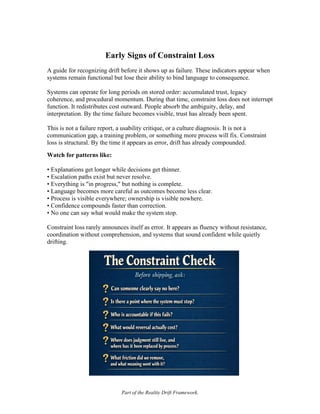
Part of theReality Drift Framework. Early Signs of Constraint Loss A guide for recognizing drift before it shows up as failure. These indicators appear when systems remain functional but lose their ability to bind language to consequence. Systems can operate for long periods on stored order: accumulated trust, legacy coherence, and procedural momentum. During that time, constraint loss does not interrupt function. It redistributes cost outward. People absorb the ambiguity, delay, and interpretation. By the time failure becomes visible, trust has already been spent. This is not a failure report, a usability critique, or a culture diagnosis. It is not a communication gap, a training problem, or something more process will fix. Constraint loss is structural. By the time it appears as error, drift has already compounded. Watch for patterns like: • Explanations get longer while decisions get thinner. • Escalation paths exist but never resolve. • Everything is "in progress," but nothing is complete. • Language becomes more careful as outcomes become less clear. • Process is visible everywhere; ownership is visible nowhere. • Confidence compounds faster than correction. • No one can say what would make the system stop. Constraint loss rarely announces itself as error. It appears as fluency without resistance, coordination without comprehension, and systems that sound confident while quietly drifting.